The first trip
OS Landrangers 197 and 198
30 miles
11:45 Victoria Station and I’m setting off to Littlehampton with the bike propped up in the space next to the only toilet on the train. It’s a feature of most modern trains that the bike spaces are located immediately adjacent to the toilets with the automatic sliding doors that very few people, including me, understand how to use. I’m sitting on one of the three drop down seats adjacent to the WC which is emitting a faint whiff of urine and trying to remember what the purpose of the journey is. Something about having a cycle from Littlehampton to Brighton and keeping as close to the coast as possible was one, but the other…?
It’s later than I’d expected due to chronic traffic around Westminster and I have missed the target train so I’m not going to be heading out on the ride till at least 1pm, but hey, there’s no rush. It’s past mid-summer but the days are still long and today is hot, though not as staggeringly hot as recent weeks, and because the days are long I don’t care much about when I’ll eventually get to Brighton.
Approaching Brighton from the north, the train snakes to the right, half a mile or so before the main station, and sets off to the west and through the various communities hemmed between the south Downs and the coast. I won’t list them but one or two (such as the almost rural French style white buildings at Portslade) have interesting looking stations, though little else that captures the imagination. This is largely because the railway tends to pass the back ends of the towns rather than the potentially more interesting coastal sides to the south.
Eventually the train winds round to the left in a big arc that is bound by the river Arun on the right (with Arundel a couple of miles to the north) and a pretty meadow leading up to a new and relatively attractive housing estate on the left. A small group of people are in one of the fields flying model planes and some cows munch away in the next. The train pulls into the terminus at Littlehampton and within a minute or so I’m by the side of the river and cycling south to the front and past the various blocks of flats that have sprung up over the last twenty or so years and which have a certain appeal. Then I remember. Is this somewhere I could live? Well, it’s a good start, but what else is out there, to the east? Let’s see…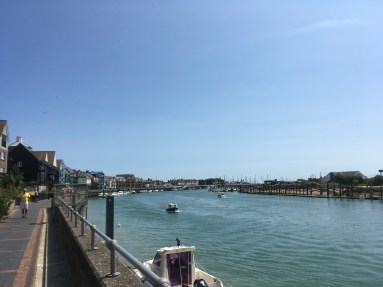
Quayside Littlehampton
At the front, where the groynes begin, and then march east in an almost unbroken sequence to the Thames estuary, I pause, buy a cup of tea and take in the view. It’s a weekday and just before most of the schools have broken up but it’s still busy and a refreshingly diverse mix of people and ages are strolling along and fending off gulls when chips and ice-creams are over exposed. The beach even has evidence of sand. It’s not the sort of pebble desert that other places on the south-coast can be. A small fun fair near the entrance to the river and a few cafés and knickknack shops on the front and a large greensward behind with the town set back to the north. It’s alright. It’s alright but is it really going to be the answer? I’m thinking maybe not.
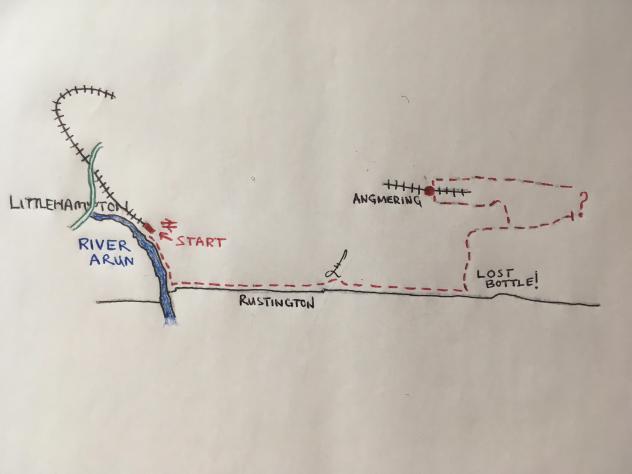
Littlehampton to the Rustington Belt
On the bike and heading out of town along the front it’s a sparse view. Not unpleasant but not saying very much to me and the shingle increasingly dominating the beaches. Before you realise it, because why should you, you’re in, or at, Rustington. A slight inland detour but shortly back to the front and cycling along a path across a wide strip of grass with housing to the left and low dunes hugging the beach to the right. I reach a small car park, where beyond there is a gap in the dunes and low scrub leading to the beach. I dismount, curious to see what the beach looks like at this point. Standing aimlessly, and dithering over whether to lock up the bike (a simple but tedious task that I try and avoid at all costs, not least because the key will inevitably be in a pocket of a light jacket that has become entangled in the spare tyre and stuffed tightly into the pannier), or just hoick it up the dusty path, a voice calls out from behind me. I turn and see a very healthy-looking woman, probably in her early 60’s and clearly just off the beach. “I’m leaving now if you’d like to lock your up bike here?” It’s a kind and unexpected gesture but I mumble something to the effect that it’s “okay” and “thanks.” But I’m nevertheless troubled by something and as she’s turning away I ask her rather randomly whether it’s possible to continue cycling along the coastal path and if so, for how long?
The woman is totally engaged on this matter. What was troubling me, nagging at my confidence, was that although the phone map seemed to show a continuous path to the east, some of the signage I’d noticed along this stretch seemed to indicate (let’s be clear – “warned” is a better term) that this was somehow private land and that whoever owned it was giving us mere mortals reluctant permission to tread upon their hallowed turf and tarmac. It wasn’t clear what sort of penalty may apply, but I had a feeling that down the line I was, at the very least, going to get a jolly good telling off from someone in tweed.
“Oh yes you can,” she confirmed. “All the way through but they don’t like it of course.” Hmm! I quizzed her on the specifics. “The people in the posh houses further on into the estate. Just ignore them. I do.” Given that she herself struck me as being quite posh I wasn’t entirely sure what “posh” meant in her eyes but she was genuinely helpful and likeable.
The houses had increasingly become larger and more imposing and it was dawning on me that the whole area was some sort of private estate, almost certainly having emerged over the years on the land of a previous country estate. Land that may have been annexed by the Normans, a priory, or after Henry burned down the monasteries and farmed out the fields to his mates (HLG). Now in the hands of the proletariat?
I thanked her and started to push the bike further up the track. “Oh, and by the way,” she added as she liberated her bike from some metal railings, “don’t be intimidated by the warning signs. Just keep going.” I thanked her again, but she once more emphasised, as if it were a message more appropriate for Jason and his Argonauts, not to be put off by the signs and barrier gates.
After a quick look at the beach, with its prettily painted huts and pleasant pebbles (it was evident by the few but dazzlingly healthy older people who were sunbathing between the dunes that this probably was quite an exclusive spot), I cycled on along the grassy path with the sirens message ringing in my head. Determined, and with renewed confidence, I was going to plough on. I was not going to turn back.
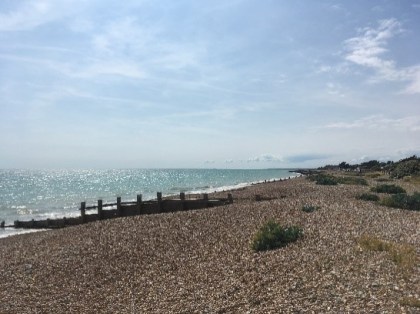 Pleasant groynes and pebbles at Rustington
I turned back about a mile further on. I’d passed through an area where there were low trees and shrubs hiding the beach from view on one side and a long, high redbrick wall that looked quite ancient on the other. I figured this wall had maybe once been a feature of the country estate. Behind it, rising higher and higher as the route progressed, projected the upper stories of houses that stood in their own extensive grounds. Some of them would not have been out of place on The Bishops Avenue in Hampstead. I was now feeling uncomfortable and a bit out of place. At the eastern end there was a gate that looked a bit of a challenge and a couple of older women with large dogs who had the bearing of uninhibited “shouters” about them (the women, not the dogs). Despite the clear message from my mentor back at the beach huts, I bottled the barrier and slowly retraced my wheels to a gap in the walled fortifications and a path leading towards a road within the estate.
 No Parasan
I proceeded up the path, trying desperately to appear invisible and snatching glimpses to the left and right trying to identify any prying CCTV. I reached the road and within a few minutes was back at the barrier, but on the other side. The path had clearly run out on the beach at this point but a bit further back up the lane there was road leading to another part of the estate with a barrier gate. “Don’t be intimidated by the warning signs. Just keep going,” danced around in my mind. I was not going to be intimidated and as the peddles started to turn again and the bike set off towards the half-opened gate my eyes alighted on a white sign with black writing and red symbols. “Private Road – No Entry – No Public Right of Way.” In other words – bugger off! Why didn’t it just say that?
What a wimp. Maybe some sort of inferiority complex was creeping in, but whatever it was it was enough to send me further inland and eventually through some streets that led me back to the beach at Angmering. A nice spot with a café but no further progress was going to be possible along the beach so back inland and along a road called the South Strand and then it all went a bit wrong.
I can’t recall exactly which streets I took after this, and may well have missed a more coastal opportunity, but what with the intimidating signage, the useless visuals that the phone map was giving me and a rattled self-belief, I began winding further inland. At one point I followed a track to a field and then across the field on a footpath, which at the end gave two options, both of which appeared to lead nowhere of obvious use, and so turned back and then onto more roads that were not only taking me north and away from the coast, but to my horror back west.
This was still the private estate, judging by the endless warning signs and gated roads, but whereas some of the properties by the sea were big, now I was entering the world of enormous. Not all, by any means, but quite a few which were on a scale that I wasn’t quite sure I was equipped to understand. Not Virginia Water or Runnymede of course, but certainly higher up the aspirational scale. Architecturally many of the buildings reached back to the 1930’s. Large, and no doubt built for the local captains of industry and commerce in a world before television, where space alone and a transistor radio allowed a necessary detachment from the nearby community hubs. But there was something else going on here now. Those 1930’s homes, the sort you can find in the suburbs of all towns and cities…well some of them were now going through a transformation, a contemporary make-over. You can see this process almost everywhere now. It’s a process that is largely under the radar. Unlike the huge new apartments going up in the cities, or the new estates emerging on the fringes that strike you immediately as tangible signs of change, what’s happening to the houses in these 1920’s and 30’s enclaves is a slow metamorphosis that most of us won’t even know has happened. It’s piecemeal. Someone dies, or just moves on, and the home that’s been in the family, maybe for several generations, passes to a new clan. The new clans, it seems, have more dosh than the last lot. They don’t hold the same historical associations. Now they look at the buildings and the sites (or garden for the more traditional amongst us) and reappraise the possibilities. Maybe that 1970’s extensions looking a bit jaded, or just too damn small. No problem, it can be doubled in size. Actually, those City bonuses coming through in the Autumn?
Hey, why tinker? Why not just knock it down and start again? New visions, new scales, new heights, new wiring (maybe not even required), new burners and enough hardscape to take the weight of several new and vintage motors. John….we’re not just dancing here, we’re creating new nirvana’s that are literally burying the jaded old Shangri-la’s.
I don’t know how long this process is going to take? Maybe decades, but I am sure that if the money still flows, and if we could revisit these places in a hundred years from now, the only 20’s or 30’s buildings still in these districts will be solitary mock Tudor affairs, set in a well-manicured public space gardens, with a café in the last 1970’s extension that still keeps out the rain, and open to the public Wednesday’s to Sunday’s. Possibly listed too. Archaeologists who come along a thousand years from now and start sifting through the remains (assuming current predictions – by then located about a mile out to sea and covered in silt) will no doubt conclude that there was an early 20th century middle to high status culture that built with brick, wood and Bakelite, but which in the 21st century, and through some economic wizardry that magicked money out of nowhere, was replaced by an uber status class, that with the new magic wealth and the power of more advanced technology, kicked the rustic, and possibly dowdy, quite literally into the long-grass (that also coincidentally disappeared around the same time under a lava flow of tarmac and concrete drives). I don’t know who, or what sort of people live (or maybe don’t) in these splendid isolation’s but something doesn’t feel quite right. The phrase “An Englishman’s home is his Castle,” is slightly tongue in cheek I suspect, though clearly many people do take it seriously regardless of the size or location of the home in question. And who am I to judge? Here though they seemed to be taking it literally, though the new emerging style is possibly more 21st Century Chateau, or maybe chic Russian mafia bunker, than the traditional Norman or Tudor model.
Well, whatever this social commentary may or may not imply or mean (and I will try and stay clear of it unless seriously provoked), I didn’t have to worry about it. As I headed further west and north I knew for certain that even if I was tempted (and I wasn’t), the means and wherewithal were seriously lacking.
 Nothing of obvious note
After some meandering west, and then north, I cross the railway at Angmering, then along a slightly nasty section of the A259 (a road that will feature again), and then south again to Goring-on-Sea and I think missing out Ferring – although I could be wrong on this. One way or other I was now back on the coastal road heading east with the gentle prevailing wind. Before long Worthing emerges. Time to take a coffee break. I don’t know Worthing, or if I do it doesn’t register on this occasion. There’s a pier and a few standard seafront things which provide chips and ice-cream but nothing really stands out. I’m a bit disappointed but just before the town peters out there’s a café that looks a bit different. The Coast Café des Artistes stands alone, but also stands out. On a broiling day sitting outside and looking out to sea, you appreciate that with a little bit of thought, a bit of panache perhaps, and a bit of clever design, the quality of life can genuinely be enhanced (if you can recover from the slightly manic scrum when placing your order at the till).
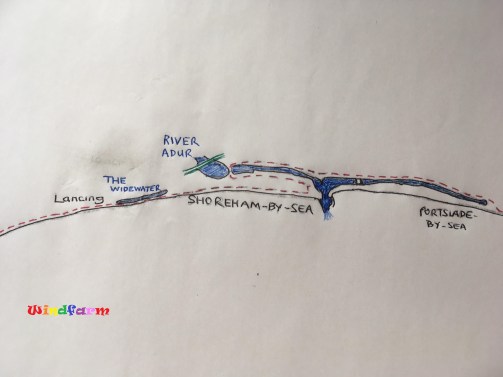 Water features – Lancing to Portslade
Refreshed and onward. Brighton is visible now but there’s still some way to go. A good bike lane on the front, between the sea and the A259 gets you to Lancing in quick time. One thing the Coast Café des Artistes that hadn’t provided was a decent wodge of grease, bread and tomato sauce that I felt my body needed to continue the journey. Fortunately, at Lancing, I fell across an open window in an old building advertising a comprehensive range of lard-based products. In competition, and in what seemed to be a revamped pavilion of some sort, was what looked like a very fancy restaurant but I couldn’t be lured (time, money stuff). Not exactly fast food, but eventually my number was called and the huge sausage roll arrived and then disappeared in seconds. Looking directly out to the horizon the new industry of the sea stands in regimented lines and stretches for what looks like miles. I’d passed a point a short while earlier where the power generated by the wind farm is channelled to the land. As I ate I counted the structures. It was hazy but I settled on a final figure of 127 slim symbols of hope. Sadly very few seemed to be turning. Maybe, like Staines, the town could look at a re-branding exercise. Maybe a change of name to reflect the new. How about Lancing-at-Windfarms? It was time to stop daydreaming and for this Don Quixote to get back on the bike and cycle down the last section. Sadly, there would be no modern-day Sancho Panza to keep me grounded, and remind me I’m only mortal too.
And so, shortly after the cholesterol bomb, and at a point almost equidistant between Lancing and the outskirts of Shoreham-by-Sea, an unexpected feature begins to appear on the landward side of the sea wall. A long, but not very wide expanse of what seemed to be shallow water with reed beds and sandy dunes to the south, and lined on the north by a string of modest looking homes, each with the back garden abutting the water and many with small boats either resting on the lawns or tied to stakes set into the mud or sand below. This was so unusual I stop to take in the vista, the bird life, and even read what is quite a lengthy information board that explains that the feature is a shallow saline lagoon formed by sediments deposited by the River Adur. I could go on but figure that if the reader hasn’t already fallen asleep, or has skipped onto another site, or even both, then any additional trivia about the saline lagoon could be the proverbial straw or reed, but just for the record it’s called The Widewater, which if it isn’t already, ought to be the title of a Paul Weller song.
Oh my God, it was suddenly 4:35 and although Brighton looked in touching distance I had a memory of cycling some of the next bit a few years back and knew that there were still some good miles to go before I’d get some Brighton Rock. Pounding on, and eventually I’m tackling the almost straight Old Fort Road. A largely residential area with a wide range of types, styles and sizes, there’s almost something of a Florida Keys feel to the place. Houses are evenly spaced, as if this was a highly planned location, and those to the coastal side of the road will have exceptional sea views. At one point, through some marginal vegetation, there is a path between the houses that leads to the beach. There’s another information board, next to a bus stop, and where someone has dumped an old tyre. It tells you what you might be able to see. All pretty standard stuff though I don’t recognise, or even believe, that there can be such a thing as a Wall Lizard, until some days later, in the spirit of investigation, I looked it up and find that indeed there is a European Wall Lizard and that some have established roots in the south of England. As a voracious lizard watcher (always on the “what I must see?” list when abroad or just messing around on a common), this is big news, and indeed they are bigger than our indigenous specie. Sadly there wasn’t time to hang around and meet a few of the guys so it was back to Old Fort Road and east again to the tip of this landmass where err….an old fort stood! Shoreham Redoubt no less. There will be one or two more Redoubts en-route around the coast, and as alluring as the word is, there wasn’t going to be enough time to stop and inspect.
And so, after inadvertently cycling into the Adur Sailing Club, and the consequential dirty looks received, I turned tail and now found myself cycling along the river side through Sussex Wharf, and once again heading west. Properties here were new, and being new and shore-side, inevitably four or five storey apartments, each with a balcony and a view of the Adur and Shoreham to the north. Quite pleasant as these sorts of developments go and just a little bit of me wondered about the possibility. What looked like a relatively new footbridge took me over the river, with views to the east and west, and into Shoreham. A busy town which looks like it may have a “scene” of some sort, it’s river front high street is more old than new. On the surface it has some appeal but with the shingle beach out of sight and beyond the houses on the spit to the south it misses the coastal feel I’m thinking about.
 The last leg (s)
Onward on the A259 (you can’t escape it here) and to the right, on the eastern side of the River Adur drain is the industrial area, based around quays, warehouses and boat yards, and where a few cargo ships are lurking. Some are being loaded with the products of the hinterland, which in this area, and a lot of others along the south coast, is sand and gravel. Timber is also piled high in places and some of the boat yards look like they may be operational. Climbing out of Shoreham and then into Portslade, where the predominant housing type seems to be almost entirely Council, the road is covered in a thin veneer of cement dust and when looking more closely, the same material colonises walls, lampposts, roofs, footpaths and even the verges where grass improbably sprouts. It’s not that bad in truth but it does mark out that the area is industrial and still active.
Shortly the road drops down and starts transitioning between Portslade and Hove where there is a sharp contrast between the working harbour and the Western lawns and boating ponds.
There’s not a lot to say about Brighton and Hove beach that most people don’t know already. It’s monumental. With the largely Victorian and Edwardian backdrop the shingle piles up in terraces from the point where the shifting land plunges into the sea. Like a Bronze Age hill fort, a bastion. I lock up the bike about a mile short of the east pier, trudge across the shingle and finding a spot that looks relatively flat and less intimidating than other parts. I put down the pannier, and a thin tartan travel rug designed for such occasions, and then lay down hoping for forty winks. Twenty minutes later I’ve given up the fight. Comfort is an impossibility here. There’s a comedian from Croydon called Alistair Williams who tells a neat joke about Brighton beach. A French family arrive from London on the train. On the walk down, they buy buckets and spades. When they eventually reach the front, the son, who has in his excitement run on ahead, turns to his dad aghast and says “papa ou est la plage?” He then follows up with a family from Manchester in the same position. A very different response and possibly funnier.
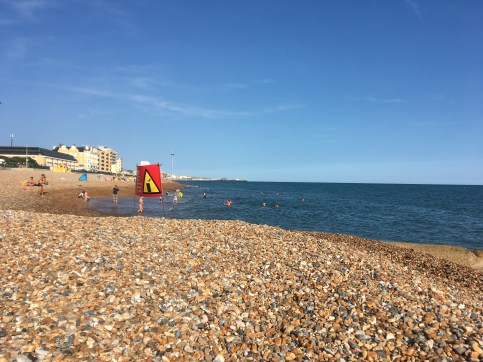 No rest till the pier.
It’s a brutal beach. I cycle the last mile or so along the super bike route that flanks the road and the wide greens which divide the front from the town and before heading home drop down to the beach just before the pier. Cafes, bars and restaurants. It’s still early but already buzzing. There’s a stall selling seafood and I buy a cola and a punnet of prawns. I find a table a few yards from my bike and put down the punnet and drink. I sit down but immediately decide to bring the bike closer (this is Brighton, not Rustington). As I walk towards the bike a moment of intense panic sets in and instinctively turning around a gull has already landed on the table. I run back shouting and waving my hands and (probably embarrassingly so) making sufficient impact to discourage the bird on its mission. Now, clutching the prawns, I return to the bike and manoeuvre it back to the table. I’m now back in charge of the situation, despite the continued interest of the gull and its mates. And relax. The cola is cold and hits the spot. The prawns are good too and top up body salt. Reflecting on the day I considered what I’d learned. Littlehampton appealed. Several plus factors and a sense of diversity, although being so far west could create some unintended fractures with family and friends. Worthing was quickly discounted. Despite the arty café it appeared to lack cultural dynamism. The various features that made up Lancing to Portslade, with the hub at Shoreham, held some appeal but maybe not enough, and the sea at Shoreham was too far from the town. And Brighton and Hove? Well without doubt it’s unique and bubbles with life. The Jam played their last Beat Surrender here so many years ago and despite this, the Lanes, the youth, the playfulness and diversity of the town, in many ways being a little Camden on the coast, is precisely what I want to avoid. There’s a lot more to see and maybe the place for me is further east?
Winding up the day I peddle up to the East Pier and then through the Lanes and back to the station. On the way I’m passed by hundreds of people, dressed casually and heading for the beach after work or maybe college. And why not. What a great way to end a long hot day if you’ve been slogging all through it. Twenty years or so ago I visited my brother for a couple of days when he was young and starting out in the working world and living in a squat in Brighton. After an interesting weekend, and with a day off from work for me on the Monday, I put off returning to London and went to the beach instead. It was a late September, or maybe even an early October day, but the weather was still holding out. I paid for a deck chair and soon started dropping off. As the sun warmed through, and with the sound of sea churning shingle, I slowly forgot my own worries and considered that if at exactly that moment I didn’t wake up again it would have been precisely the most perfect way to go. It wasn’t in any sense a negative thought.
At the station I’d missed the 5:15 by some margin, but why should I care? More annoyingly I managed to miss a later London train mainly because of the perplexing array of ticket options at the machine. When I eventually worked out that it was going to be cheaper to buy a day return (it was now past 7pm), than a single ticket, the train was leaving, but hey I’d saved a few quid and if I did get to London, and suddenly had a burning desire to spend the night back in Brighton, I could take in a West End show and then train back afterwards to find a “soft spot” on the beach and with a view of the stars. But then again, such a thing, as I already knew, probably didn’t exist.

 El Colmado 57