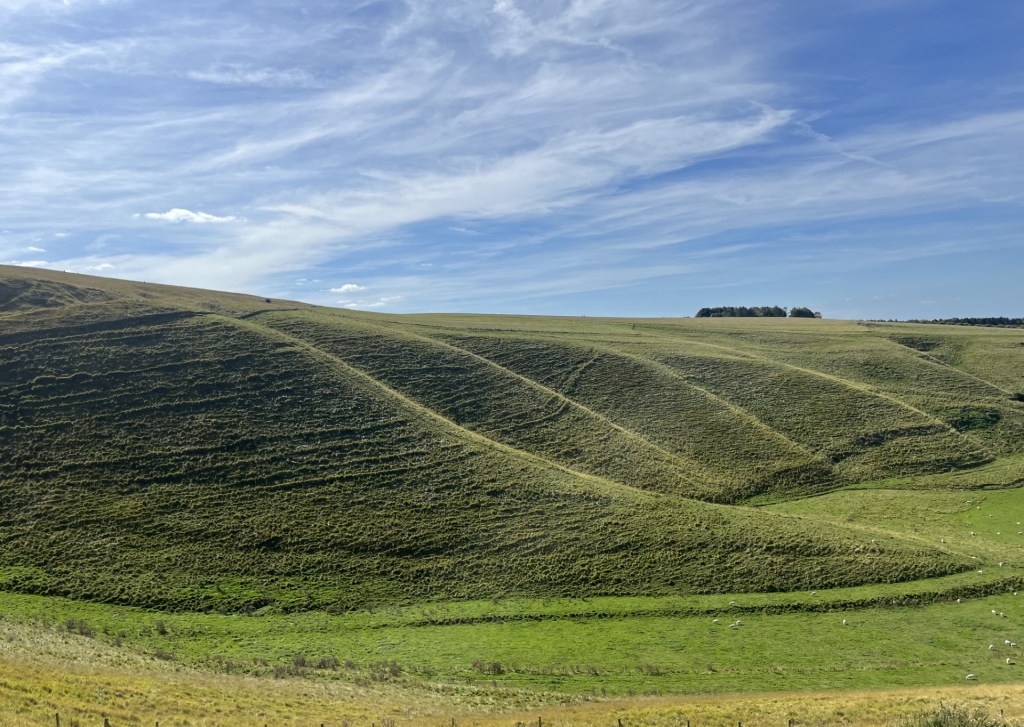
Cresting the County – First year Review – May 2024 to April 2025

I hadn’t seen it coming, but when it did, I had to confront the beast. The Unitary Authority! But before we meet the beast, time to reflect.

On the 10th May 2024 I parked up in Westerham, Kent, marched north out of town and fifty minutes later was standing by a wall, looking across a field where my very basic research had established the highest point in Kent. Betsom’s Hill. It was a small start, but as the months progressed, further counties’ highest points were reached, either on foot, or drive by. I’d have liked to have done one on the bike, but that may remain a pipedream.

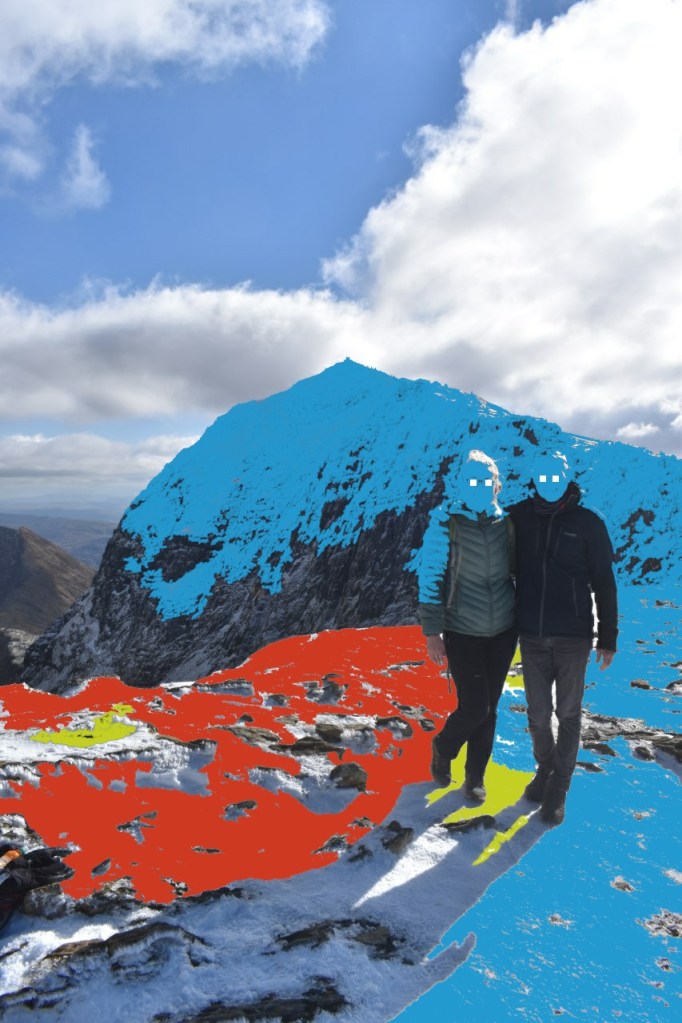
I had initially been inspired to take up this arguably pointless activity after a climb to the top of Sugarloaf Mountain in Monmouthshire, with my daughter and her partner J. After the climb, in March 2024, I read that Sugarloaf was the highest peak in Monmouthshire, and I realised that there might be other opportunities, either by chance, or by deliberate choice. Indeed, as I began to research the topic, I realised that over 66 years I had achieved some already. Just a few weeks later, again with my daughter and J, we were standing at the top on Ben Nevis, in a thick, cold cloud. It didn’t matter, I had done it once before thirty odd years earlier with my son, on a glorious Highland day. Just getting there had been an adventure. On the way back home, and due to far too casual planning, I narrowly missed out on the highest point in West Lothian, but three days later I drove to the highest point in Nottinghamshire.

Early on I realised that if I was going to take it a bit more seriously, I would need to compile a list of counties and establish the highest points. With the immense power of the internet this would surely be an easy matter and completed in a couple of hours.

Days later, and despite numerous searches, I hadn’t yet found what I considered to be a definitive list of British counties. Eventually I settled on a list that, from all the indicators, felt about right. It contained all the counties in Wales, Scotland, England and Northern Ireland. I created a table and placed each county in alphabetical order. Whilst I had included the six counties of Northern Ireland, but with no friends or relatives to justify a visit, I rationalised that it was unlikely any would be trod. The list understandably included Greater London and Greater Manchester.

Over the following weeks I researched the highest points and began to log by county, nearest place and height. What this process began to reveal was that I wasn’t alone. I hadn’t been naive enough to think that I had come up with an original concept, but as the weeks went by, I came across more and more sites written by others (all men so far) who were committed to the cause. In due course it became apparent that far from being a micro niche activity, after angling, it was almost certainly the largest mass participation leisure activity in the country. Oh woe…!

Well, it was what it was, and I was enjoying going to new places, finding out more about areas I may have been to before, but more interestingly, the places I had never been to before and, up until that point, had never intended to go to at all (Warwickshire being the best example so far).

Ebrington Hill, at the western most point of Warwickshire, was the last to be achieved in 2024. Winter set in, and that involved it raining almost every day for the first few weeks of 2025. I wasn’t going anywhere, not least because the roof had surrendered to the elements and I was going to have to dig deep to get it fixed.

To fill the vacuum, I went online and purchased a very large and basic map of the UK, divided by county. Simple, but beautiful in its own right. Once I had carefully mounted it onto a sheet of ply, cut from a much larger sheet that I left in B&Q when I realised it wasn’t going to fit in the car, I could now sit comfortably and gaze lovingly at the entire UK and contemplate options for the coming months. When I wasn’t hypnotised by the map or watching steady rain on the window and getting more and more anxious about the arrival of the scaffolding, I started to research the underlying geology of each of the heights. I’d previously downloaded the British Geological Survey’s Geology Viewer (BETA), and this amazing work of science, art and technology was all I needed to not only establish the underlying geology, but also accurately pinpoint the highest points (believe me not everything published online about highest points is correct or accurate).

In late March 2025 I set off for a few days in Bristol and the West County. Before leaving I sat down and took a close look at the enormous map.

An Enormous Map

The good news was that I would be passing through the north of Hampshire, where Pilot Hill marked the county’s highest point. The City of Bristol was also on my list and would be an easy win. But, looking more closely at the region around Bristol, it became clear that any previous assumptions had been misplaced. Somerset had been on my radar, but the map, published in 2014 was showing far more “counties’” than I had expected, not least South Gloucestershire.

Back in September 2024 I had climbed Cleeve Hill in Gloucestershire and had assumed it had been a done deal, but no, not according to my map. It was a mystifying blow. What had I missed when I created my original list? Turns out that what I had missed was the huge change in the political landscape that has taken place in the last half century. Of course, I knew that some of the old historic counties had long gone, Middlesex and Caithness for example, but it had completely passed me by that much of the country, (especially England) had since been subdivided (presumably due to shifting demographics, or let’s be a tad more cynical, gerrymandering?).

What my planning strategy to visit the West Country had revealed was another entity, with, from what I could glean, similar powers to traditional counties – the Unitary Authority (UA).

On one level this was deeply troubling. At the time I didn’t have the gumption to count how many additional regions were about to enter the fray, but a brief look suggested at least some tens more. But on a more positive note, this now offered up many more opportunities, not least the many Unitary Authorities that now presented themselves for inspection over the coming days. South Gloucestershire for starters, but also Bournemouth, Poole, Christchurch, Southampton and Portsmouth, that I would be passing through on my drive home a few days later. And that didn’t include North Somerset, and Bath and Northeast Somerset, which, whilst being near Bristol would have been too much to attempt during my tour.

Over the last few weeks of the self-imposed calendar year (May to April), I started to update my list of counties by adding in the Unitary Authorities. This revealed other troubling difficulties. Again, working from information on the internet, inconsistencies began to emerge. For instance, my map had shown there to be three UA’s sitting next to each other in Dorset; Poole, Bournemouth and Christchurch. This had led me astray when I had passed through the area on my way to Portsmouth. The reason being that in 2019, long after the publication of my map, these three authorities had merged to become BCP Council (Bournemouth, Christchurch and Poole). Shucks!

What this confirmed, had I not already known it, was that whilst the map was helpful, it was already out of date, and couldn’t be relied on to provide a definitive list. Again, I faced the difficulty of trying to locate an accurate list of all the UA’s. In the end I decided to opt for the information on Wikipedia, which from what I could tell, was likely to be as accurate as anything.

Needless to say, my list has expanded exponentially and is likely to keep me occupied for some time to come.
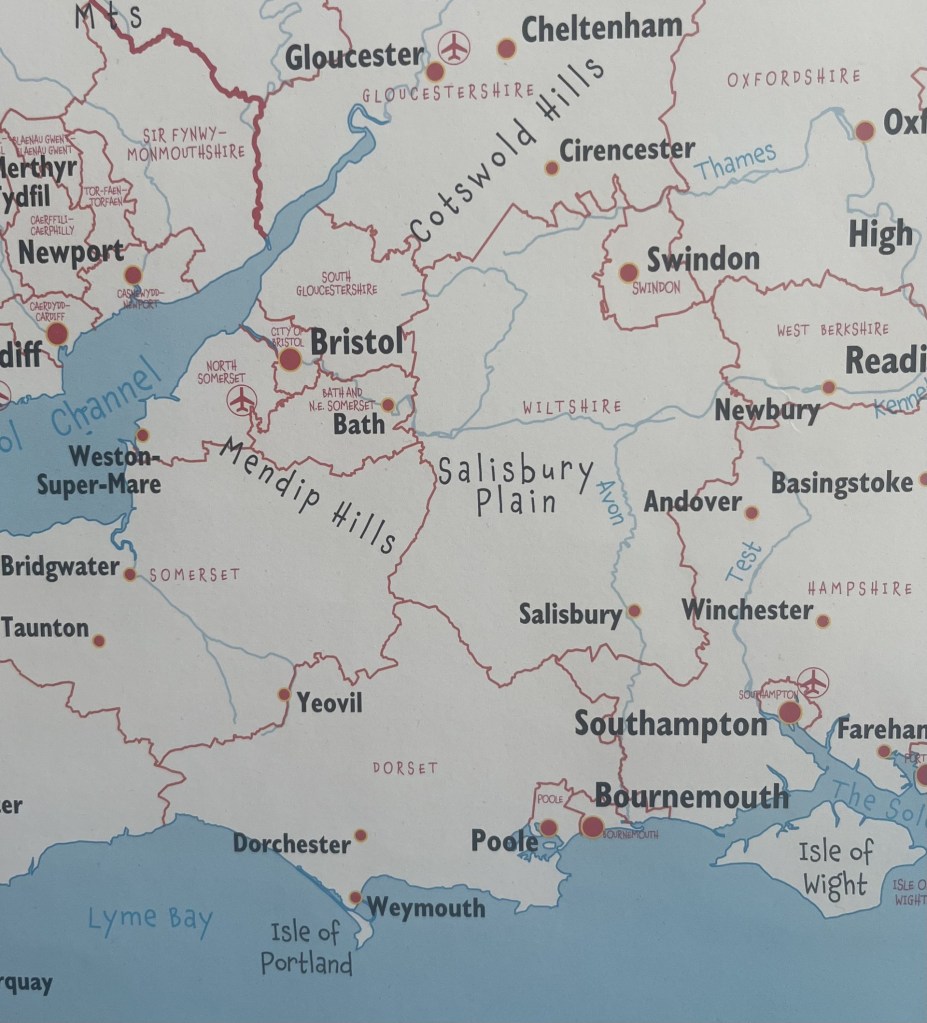
The UA/County, West Country complication

Local authority elections were held in England in May 2025. I spent most of my life in London but now live in East Sussex. I am pretty sure that when I was growing up the county of Sussex was a “thing”. But I am wrong. Sussex has been divided between East and West Sussex for centuries, and maybe as long ago as the 12th century. 1889 was the year that saw them fall under separate council governance, and in 1974 this was formalised following the Local Government Act of 1972. Now what constitutes the entirety of old Sussex consists of East and West Sussex, and the Unitary Authority of Brighton (yet to be topped).

Along with all residents of voting age in all three authority areas I was unable to vote in May. Along with several other areas across the country the government paused elections whilst a period of consultation took place to decide on whether the whole of the county should come under a single authority. Because the outcome is due in the next year or so, it was decided that it would be too expensive and impractical to hold elections for councillors who may, or may not, be out of a job in just a few months. Not only could that see the end of East and West Sussex and Brighton, but potentially lower tier authorities such as Lewes, Worthing and Hastings.

Sussex covers a massive area. It stretches from Camber Sands in the far east, East Grinstead in the north and to Wittering Sands in the far west. It’s approximately 90 miles from east to west along the coast, and, just for the record, takes bloody hours whether by road, or even worse by rail. And, apart from the Channel, what these places have in common is probably restricted to the consumption of the rather fine Harvey’s Best. Of course there is an argument that in an age of austerity, and where confusion presumably reigns over the plethora of computer and information systems that must operate, combining the authority into one, would, in a nutshell, bring obvious efficiencies of scale. I can see some benefits in that, and am yet undecided, but my gut instinct is that if it is agreed, local democracy will be stifled. At a time when there appears to be a thirst for more localism, this feels to fly in the face of that process. A single authority and an elected Mayor running this huge, and hugely economically, politically and geographically diverse area? Hmm. I’m not so sure. I certainly need to give it more attention. At least (except for Brighton, which I guess I may need to do pretty sharpish) I have stood on the highest points of both East and West Sussex.

My last walk before the end of the calendar year took me on a train ride into Kent, and from Snodland Station up to the top of the Medway Unitary Authority (yup, this wasn’t a place I had anticipated visiting until recently). That day marked the first day of Reform UK gaining control of Kent County Council (not subject to any consultation on a single authority). Hmmm, well we’ll have to see how that goes. Their first act in office was to remove the Ukrainian flag at County Hall. Gesture politics, tokenism, who knows but feels like Vlad the Invader has just got his little tippy toes on the beach at Pegwell Bay.

Before I end this introspection, a word of warning to anyone thinking of putting on the boots and pursuing the county tops (and UA’s, and Metropolitan Districts – Oh, did I not mention them?). Speaking of Sussex and putting it back into the context of this arguably futile pastime, whilst looking at some of the many blogs and websites by other committed county toppers, one in particular caught my eye. I can’t now remember how I got to Richard Gower’s site, but not only was he going after all the current counties, he had gone so far down a wormhole (and I say this with affection), that he had completed all six of the ancient “Rapes of Sussex”. These ancient administrative areas divided the county, running west to east, into six areas: Chichester, Arundel, Bramber, Lewes, Pevensey and Hastings. It’s fascinating stuff, but it’s a cause too far for me. It may be that as the sands of time catch up with me and I find myself less able to travel, visiting their respective highest points (and as it happens, I have already unwittingly done at least two of them), could become an attractive option. I’m also imagining that if the rest of the country was at one time divided into these ancient domains, the quest would become an unending toil in every sense. All that aside, I must take my hat off to Richard Gower. It’s a pukka site. **      

Just a final note on the website (if that’s what it is?). It’s rubbish. Moons ago I completed several bike rides along the coast from London, around Kent, and most of Sussex, and after each wrote up some notes on a Word document. All very well but once done, would I ever revisit them? My daughter had started posting some things on a website/blog. I liked the appearance, and as importantly I could read them on my phone without the word blindness that normally prevails. For no reason, other than I had heard of it, I started to transpose the words from Word to WordPress, added a few photos and some infantile art, and began to post each leg of the bike journey under the perhaps less than original title of Pier to Pier. *** Whether or not people read the posts (on one day I had 15 odd “likes” from what I had to assume were “bots” and emanating out of the US, given that it appeared nearly all were teenage females whose likely interest in a cycle ride round the Isle of Sheppey was deeply suspicious), didn’t concern me. What I gained from it was the thought process and then, whenever I chose, being able to read them on my phone, or any other device, to remind myself of what I had done.

I’ve been writing since I was ten (to paraphrase Marc Bolan). Immature diaries, essays, short thoughts on bands and gigs, futile attempts to write a book, and then over thirty five years, millions upon millions of words in memos, letters, works order tickets, emails, reports, presentations, minutes and many moments of long reflection when things might be getting too much, and when self-articulation through pen and paper, or keypad and screen, relieved the pressure; like lancing a boil. It may sound a bit contradictory, given that each escapade I publish an account online, but I write (primarily these days) for myself. The accounts reflect how I was feeling at any one moment, what I might have been thinking about, if there were local or international events that might influence the narrative and any significant landscape or features worthy of note. They are not intended to be a fully formed guide to other intrepid walkers, so beware should you choose to make one of these ascents solely based on one of these reads. Unless it’s obvious or easy, always take a map, and of course a phone (and keep in mind that a phone can run out of battery or connection, a map never does). 

None of the above justifies the utterly useless presentation. I have honestly tried for hours to create a landing page where different threads and menus are clear to see (like everyone else’s), but I’m no further forward that I was years ago. The next time anyone younger than me visits, I’m going to have to collar them. In the meantime, what it is will have to endure.  

The music – well that’s just an afterthought if something about the day has brought a tune to mind.  

So, having walked to the top of Betsom’s Hill, and with some more county tops on the near horizon, so to speak, it made perfect sense to commit each experience to the page, and then the world. 

I discovered one other key detail, and as such see the need to advance a precautionary slice of advice. Some weeks after climbing it I discovered that Sugarloaf Mountain was not the highest point in Monmouthshire, it’s the highest peak. When I found this out and given that it had been   the motivation to start this project, it came as a bitter pill to swallow, not least because at some point I’m going to have to go back and climb to the actual highest “point” – Chwarel y Fan, which sits a few miles to the north of Sugarloaf. Well, at least now I know. Here’s coming for ya..?

* https://geologyviewer.bgs.ac.uk/?_ga=2.58458858.1363630663.1720815697-999374144.1720815697

** https://www.richardgower.com/blog/sussexrapes

*** https://elcolmado57.co.uk/2018/10/16/pier-to-pier-a-coastal-caper-with-occasional-calamities/
Cresting the County – Greater London

Westerham Heights

245 metres (approximately)

804 feet

10th May 2024

Tales of the Unexpected

Today marks the first anniversary of having intentionally set out to bag a county summit. On the evening of the 10th May 2024, I ran, or rather walked, the gauntlet of incessant traffic, climbing up Westerham Hill on the A233 out of Westerham to Betsom’s Hill (the highest point in Kent).

But, for the moment it’s bonus ball time. What is the highest point in Greater London (the clue is above so don’t peek)?

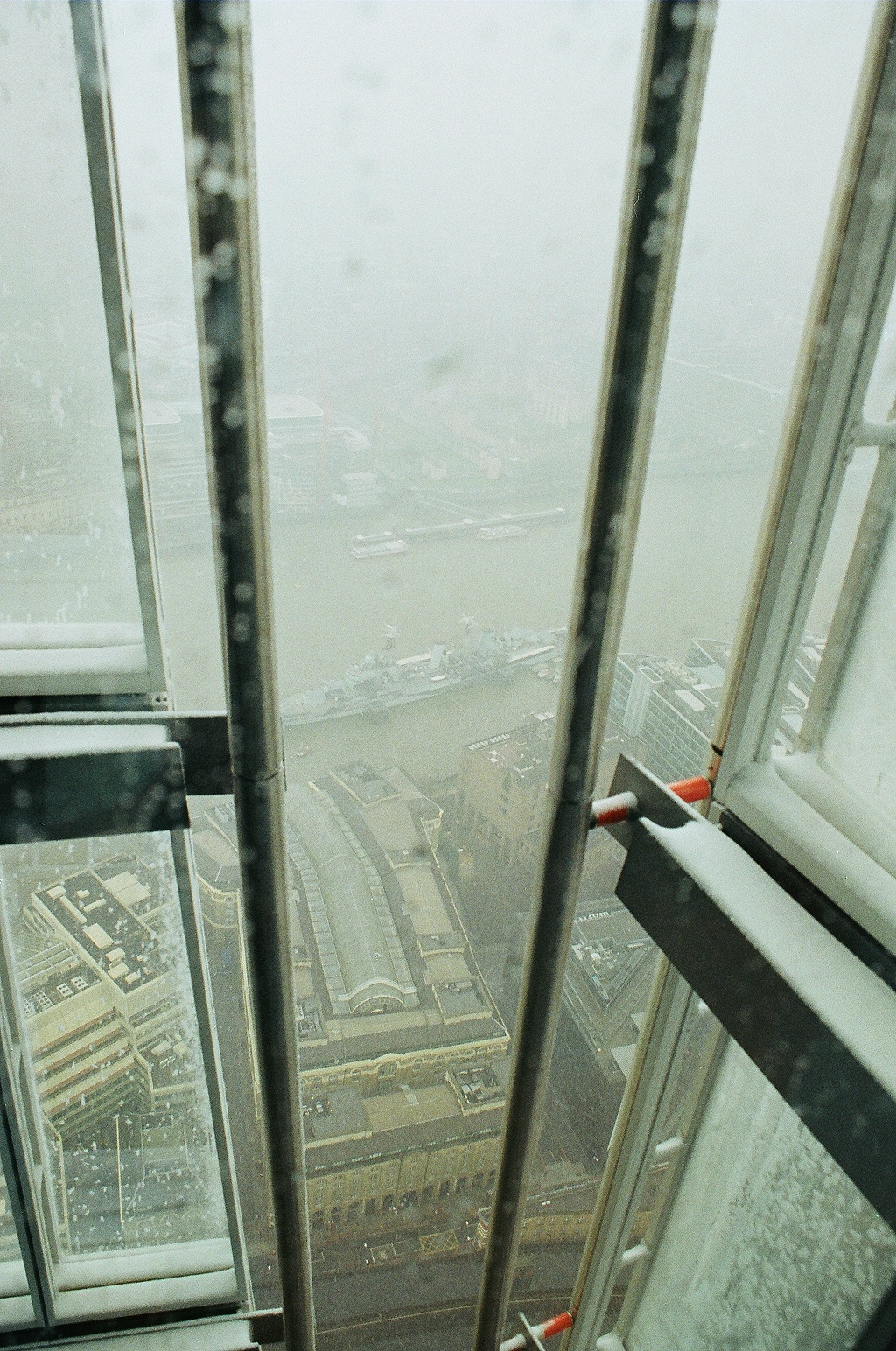
Anyone familiar with London, and asked what they think is the highest point, will probably offer up The Shard. Might they be right? Just for the record, I have been up to the public observation point of The Shard, with a friend, in a snowstorm so bad you could barely make out London Bridge Station directly below, and with snow drifts forming inside the viewing platform!

The View from the Shard when the weather’s pants!

We took the lift. At that moment, some years ago now, were we at the highest point in Greater London? According to Wikipedia we were (although of course we weren’t because there were a couple more floors above). But, when I came to write up this account (and rest assured it is not an account of how my friend and I paid for tickets and then took three or four lifts to the top of The Shard in a snowstorm), something nagged away at me. Could it really be true that this tower, with its base almost at sea level, be higher than the two Crystal Palace TV transmitters set high on top of Beulah Hill and Sydenham Hill some miles to the south? Due to the almost zero visibility on the day of the Shard ascent, it was impossible to make any comparison, and trying to get any clarification from Google has proved almost impossible.

At first, and instinctively, I was prepared to trust Wikipedia, but for whatever reason I expanded my research and doubts began to creep in. To cut a long story short (I made several attempts at it, having landed on a variety of confusing and sometimes contradictory sites), I came across what appeared to be a definitive and humorous account by Bron Maher (link below). *

Working on the basis that the writer of the article comes across as sincere and impassioned, I suggest that the highest man-made elevated point in Greater London, where the eagles fly, is the Crystal Palace television tower, erected in 1957 (a rather fine year I should add) at the top of Sydenham Hill in south London. At an estimated height above sea level of 330 metres the tower is about 27 metres above the top of the Shard. Thankfully, for this exercise, I don’t have to find a way to get to the top of the Crystal Palace television transmitter, because here we are focused on the highest point of land in Greater London.

Once upon a time you could live in any part of London and consider yourself to belong to one of the established Home Counties. Surrey and Kent south of the river and Essex and Middlesex to the north (I have no editor, so you’ll just have to hope this is correct). If, say, you lived in Deptford in south-east London before 1965, and gave your address, you would have added Kent at the end. Surbiton would have been in Surrey. Hounslow would have been in Middlesex and West Ham was in Essex. Surrey cricket club play at the Oval and Middlesex play at Lords. And so forth. No matter. Times change. Scotland was once an independent country. The Greater London Authority has existed as a political entity since 1965, but you could be confused for not knowing this.

So, getting back to the core subject (apologies for earlier wormholes), if you asked most people who know London what they thought was the highest point of land in Greater London, I am pretty sure that there would be a range of opinion. Primrose Hill is trendy and wrong, but the views of London are excellent. Others, depending on their geographical bent and possible prejudices, may say Highgate Hill, Westow Hill, Ally Pally, Blackheath, Muswell Hill or perhaps even Richmond Park. But Greater London is more than location, location, location. Beyond the noticeable clay and sandstone ridges of Hampstead and Highgate in the north, and Crystal Palace and Sydenham Hill to the south, the land gently rises again, stretching out towards the suburban rim and Green Belt. In the north, parts of Enfield, Harrow and Barnet reach over 400 feet. But the big hitters, towering a whole two or three hundred feet above the north London rivals, are far to the south, and beyond the view of most Londoners.

From central London one approach could be to head directly south-east and to one of the country’s largest and possibly least known post war council estates. New Addington is the size of a small town but is largely hidden from view. Whether or not that was a deliberate decision by the planners it’s hard to say, but as a teenager who occasionally ventured up Lodge Lane to meet with friends from school, it boasted one of the largest packs of stray dogs I’ve seen anywhere, and a rather fearsome reputation for violence (not including the dogs). Those days have largely gone, but whilst on a dreary winters day it still feels like a place beyond every other place (its colloquial name is “Little Siberia”), its fringes are surrounded by farm and chalk downland. If you can navigate through the estate and exit at the south-eastern end on King Henry’s Drive, you’ll soon get to Biggin Hill, and beyond that South Street.

If you wanted a short walk to the highest point of land in Greater London, South Street might be the best place to park up (if you’ve driven). But I wouldn’t know, because I arrived at Westerham Heights from precisely the opposite direction and hadn’t a clue I had ticked it off until some months after tackling the highest point in Kent. When I was putting together the list of the highest county points (sometime after I had climbed Betsom’s Hill), it became apparent that at a point in that walk I had passed Westerham Heights by a matter of a road’s width. Located just beyond a hedge to the east of the A233, and on the opposite side of the road to Westerham Heights Farm (an obvious giveaway that passed me by on the day). If you want to read a short account of my inadvertent discovery of Westerham Heights, it’s contained in the first of these tomes, Cresting the County – Kent. **

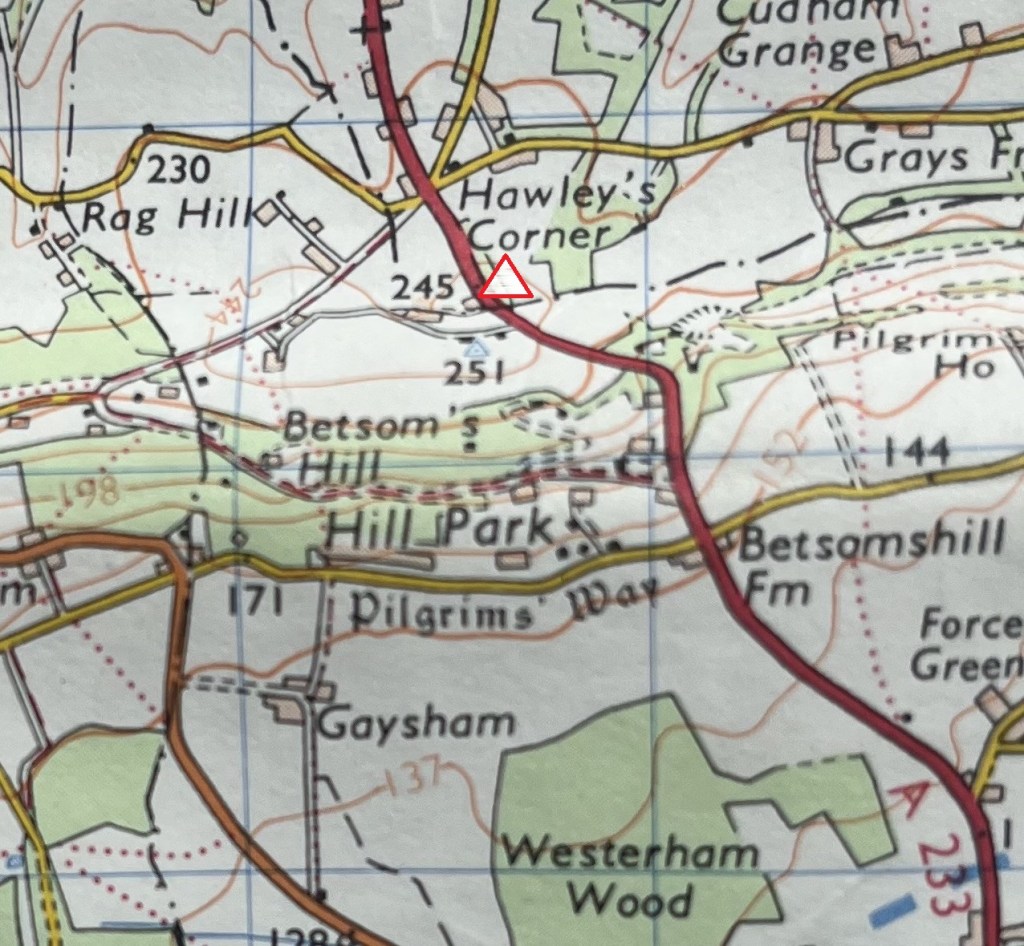
Westerham Heights – At the orange triangle – approximately. The thick black dash/dot line marks the boundary between Greater London and Kent. The barely discernible blue trig point just below marks the highest point in Kent – Betsom’s Hill.

If you make it to the moment where a local resident points me in the direction of Betsom’s Hill, but also explains it cannot be accessed, that’s the spot. Curious that he didn’t mention the Greater London massive on his doorstep! I’m not complaining though. Two in one day and I didn’t even know it – Hey Ho! 

There is a website called PeakBagger.com that I have since referenced a few times to check information, particularly on heights. Just to ensure I had indeed reached the highest point in Greater London I double checked, and in doing so noticed that the Westerham Heights link showed a few names of site members who had previously “bagged” it. It was the first time that it had dawned on me that “bagging” county tops was even a thing (I have long known that there is no such thing as original thought or action, but I was becoming increasingly aware that what I had assumed was, at best, a very niche activity, was actually a widespread pastime). I clicked on the last person to have made this trip. David Darby, an American judging by the list of 15k feet plus mountains that he had climbed, almost exclusively in North America. The highest was over 20,000 feet. At some point in his obsession, London came a calling, and he had to bag it. I wonder then what he thought when he arrived on the 19th of November 2023, having possibly travelled up through New Addington, clinging to the roadside hedges and hoping to live another second besides the 804-foot Westerham Heights. Well, I know one thing, from his records on Peak Bagger, he didn’t bag Betsom’s Hill. Poor research I reckon, particularly if you’ve come all the way from the States. Mind you, check out David Howell’s (who seems to have lived quite a life and has stratospheric ambitions), who, like me, completed the double on 2nd July 2023. The things we do…the things we do.

After cresting Greater London and Kent, and a couple of hours later, I arrived home, and soon after, for the one and only time in my life, watched in dismay the Northern Lights. Happy anniversary.

(Apologies – this scans horribly)

  * https://londonist.com/london/secret/shard-not-tallest-building-in-london-crystal-palace-transmitter-is

** https://elcolmado57.co.uk/2024/05/28/cresting-the-county-kent/
Cresting the County – Dorset

Lewesdon Hill

279 Metres

915 Feet

31st March 2025

The Eight Thousand and 39 Steps

Having spent the weekend with my daughter and her partner in Bristol, and having successfully claimed Hanging Hill in South Gloucestershire, rewarding myself with a strong coffee at the Swan Inn at Swineford, I drove south down almost vehicle free roads through Somerset, then east Devon and eventually into Lyme Regis in Dorset. A couple of nights booked in the Nags Head before heading back east to see friends in Portsmouth, then home.

After booking into my small room in the Nags Head and then having spent a couple of hours near the sea front trying the fish and chips and a couple of pints of the local ale, I set off up what felt like a 45% hill back to the Nags Head. By the time I arrived, panting and crawling over the threshold, with one of the patrons saying to me “have you been out there the whole time?” to which I had no answer, I flopped at the bar, rationalising that I desperately needed a small whiskey before bed. With fortification in hand, I took a seat whilst the last of the punters supped up and left. On gazing around my eyes fell upon a picture on the wall. It spoke of more optimistic times and for a moment I felt privileged to be in this space.

Toasting the man

Lewesdon Hill, Dorsets highest point, was a thirty-minute drive northeast of Lyme Regis. I decided on parking up in the village of Broadwindsor, located just north of the hill. As I neared the village, driving along the B3162, a stationary police car was parked up on the road ahead. I drew up behind but was waved on. Just up the hill, a second police car was pulled over next to what appeared to be an abandoned car, and a couple of officers stood silently by, with arms crossed.

I drove on and within a minute was parked up in a small close to the south of the village. The weather was perfect. Almost too perfect. I had no summer clothing so chose to leave my coat in the boot. The OS Explorer map (116) showed a route out of the village and straight to the top of Lewesdon Hill. It required walking into the village, which was fine because I needed a snack and guessed that the settlement was just big enough to support a shop. Fortunately, there was a profusion of old-fashioned signposts, and on each the words, Village Shop, as if it was the biggest attraction in the area. Maybe it was.

Surprisingly, being a Monday, the small community shop was open, although in truth it was rather lacking in immediately edible stock. Reluctantly, (I had walked in and so walking straight out would have been seen as a tad rude) I settled for a rather unappetising looking vegan sausage roll thing, made by a large food company that rhymes with “balls.” The shopkeeper was almost certainly delighted to see the back of it, but hey, needs must.

After procuring the snack and a cola, I walked back up to the White Lion Inn (closed Mondays) and headed west on err… West Street. A small house on the corner had a stone sign above the door that claimed Charles the Second had stayed there for a night in 1651. What it didn’t say is that he was fleeing from Parliamentarian troops after the battle of Worcester and escaped the village dressed as a woman. Just the previous day I had stood at the top of Hanging Hill in South Gloucestershire where, eight years before, a large force of his father’s military sustained appalling losses against a Parliamentarian army, taking the high ground before retreating.

Perhaps more interestingly, Broadwindsor also had a 17th Century vicar called Thomas Fuller who, apparently, often had his congregation in stitches. Who wouldn’t have wanted to live in a place which, whilst plague, and the warring elite ravaged the land, had a Sunday morning comedy club? I have an image of Paul Merton standing at the pulpit and drifting off into a flight of fancy, although having read a couple of Fuller’s “jokes” I think it’s likely that these days we would struggle to understand the nuance. By the time Charles the Second sought refuge in the village, Fuller was no longer the vicar, so missed the opportunity to crack a line at the King’s expense.  

West Street wound down a hill to a bend in the road (which headed on up beyond). A footpath sign pointed south and confirmed the evidence on my map. Passing between a handful of buildings the path crossed a sparkling stream before reaching a large gate, with fields beyond. So far, so good. The gate, of course, was locked. There was no sign to indicate why. I don’t get annoyed in these situations, but it happens too often these days and can be mildly disconcerting. I looked around to see if I was missing something and noticed a small track leading away to my right, following the stream and through some woodland. It felt a bit unlikely, but I was in no rush so decided to follow the path and see where it took me.

Which was about 200 metres. The path petered out as it became overwhelmed by marshy ground. A delightful spot, but for me it was back to the drawing board, which meant a retreat to the gate. I looked beyond the gate and eyed up the path that clearly led to the top. No sign of a bull. I looked at the map, which showed an alternative path, but which required beating back through the village. I looked around. No one was in sight, so without further thought I was up and over and then stepping boldly along the path.

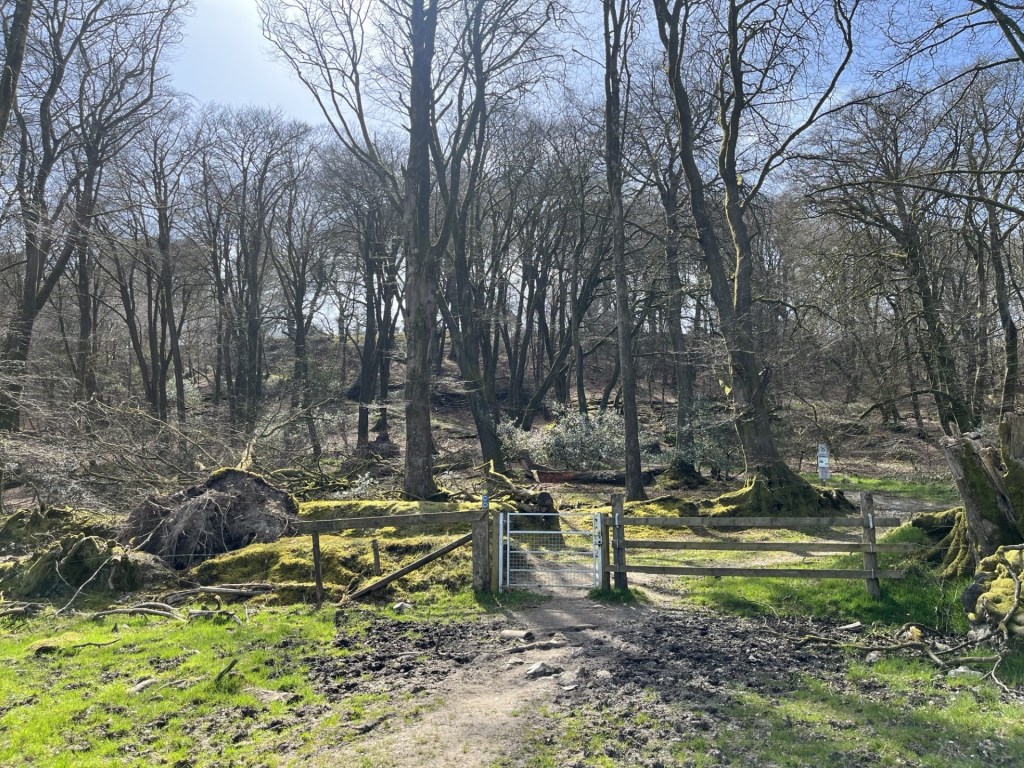
From there on it was reasonably straight forward, although at another locked gate a sign pointed east towards an alternative route, which I duly observed. After twenty minutes or so I arrived at a gate that marked the entrance to the Lewesdon Hill site, managed by the National Trust. Ahead lay dense woodland, with a variety of mature trees climbing up the steep slopes towards the top.

The approach to the enclosure

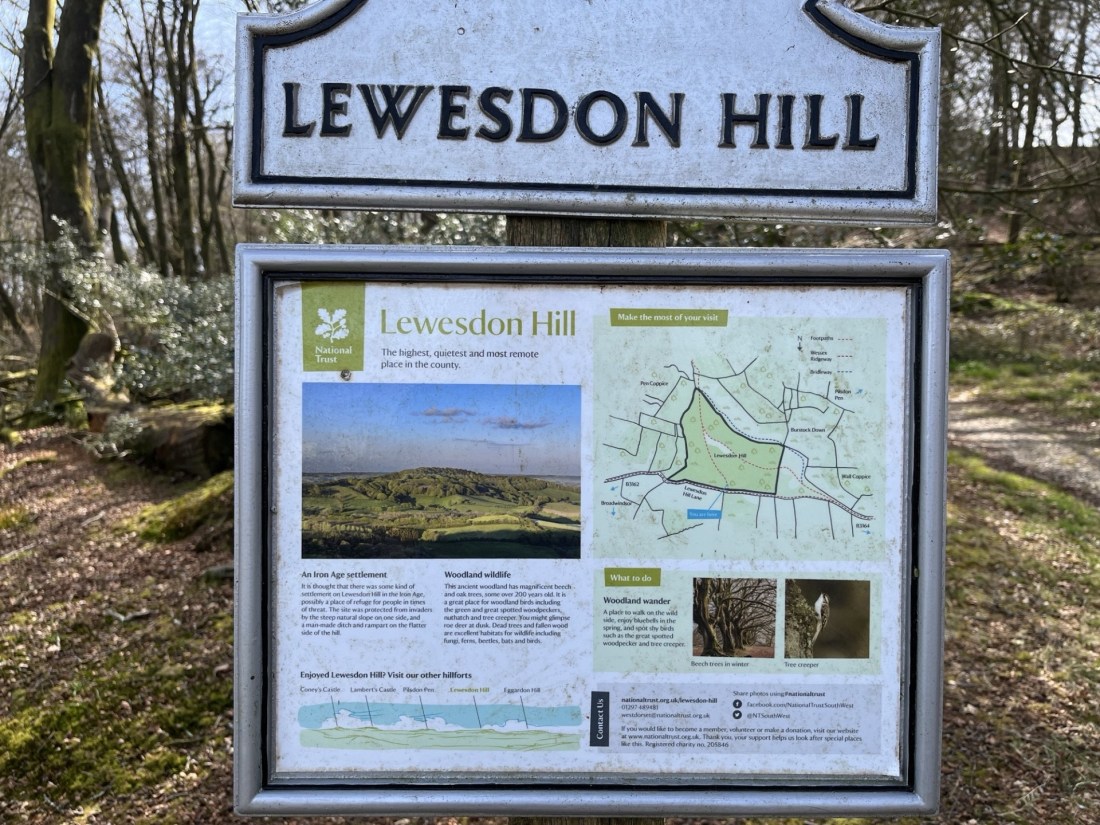
Proceeding through the gate, a large, mounted sign provided information about the area, the flora, the fauna and that an Iron Age settlement had probably existed on the site. That this seemed to be any doubt felt odd. It seemed to be a perfect setting. The board also stated that Lewesdon Hill was “the highest, quietest and most remote place in the county”. From what I had witnessed so far it felt a little bit like stating the bleedin’ obvious, but I wasn’t complaining.

A few steps on and a second sign. Slate grey, with the image of a Spitfire flying overhead in the top right-hand corner. I anticipated a sombre story.  

In summary, on 15th March 1942, Jean Verdun Marie Aime De Cloedt, a Belgian in the RAF, in poor weather and with a faulty engine, crashed into the top of Lewesdon Hill. The commemorative board also mentioned that it was still possible to see the destructive path the plane had taken through the trees at the top. It felt like an unnecessary detail, but regardless it was a poignant tale. An intimate human story at “the highest, quietest and most remote place in the county”. Wars and hilltops. It was becoming a theme.

Chert stones that must have travelled down from above and onto the sandstone bedrock, scattered the path that headed south towards the top. Unusual, but would almost certainly have made this an attractive spot for early flint pioneers.

Within five minutes the path broke from the cover of the trees onto a heathy plateau and continued towards the only point that looked slightly higher than the surrounding topography. There was nothing of note to pinpoint the spot, but a hump of grassy earth seemed to be the place. I looked out to the south and towards the sea some miles away. Rays of sunlight swarmed through the large gaps between the trees. Looking down the steep escarpment the sun on the otherwise stark branches revealed the first, almost indiscernible, green blush of new growth.

From the top – Looking south southwest towards Morecombelake

Despite the delay in making progress at the foot of the climb, (due to the locked gate) I had made good time, and so after taking a few bites from the almost inedible vegan roll (cardboard wasn’t included in the list of ingredients, but I think it should have) I followed another path heading west and above the drop to the south. And a considerably steep and long drop it was too. Despite almost qualifying as a cliff, ancient birch and oak trees rose up from below, climbing and clinging on bravely to the thin earth. At some point it occurred to me that this was likely to have been the area where Jean Verdun Marie Aime De Cloedt’s plane had torn through the trees. I chose not to try and work out where.

Reaching the end of the plateau area another notice board gave more information, which must have made no impact on me at all, given that I can’t remember a word. A view opened out. The land fell away, but then rose again to the top of Pilsdon Pen, about two miles to the west, which even from a distance revealed features consistent with a hill fort.

West towards Pilsdon Pen

Scrambling down the north slope, on land recently cleared of larger trees, I was back on the main track which forms part of the Wessex Ridgeway and banked up to the right. The sound of a helicopter overhead intruded but tailed off as it headed north. Soon I was back at the entrance with the information boards, and after a quick look back set off across the first large field. I had noticed on the map that at the end of the field another path veered to the northeast and past Fir Farm. This was a more direct route back to the car and avoided having to negotiate the closed gate.

Objective Broadwindsor

By a large farm building I found what appeared to be the route, heading into some woodland. The noise of the helicopter should have long gone by now, but it was still audible, somewhere just to the north. Entering the woods, it was evident that the trail was little used. A sign had been attached to a tree, informing people like me that due to storms the previous year some of the trees were unsafe and walkers proceeded at their own risk. The sign itself was a year old, and I figured that the landowners would, by now, have taken the necessary action to make the area safe.

This was a lovely spot, a proper dingle dell. A low wall appeared ahead, with a nook cut out to allow the traveller to cross with ease. As I stepped over, something about its appearance had me confused. What kind of stone was this? I looked more closely. What I had thought was a stone wall was in fact a massive fallen tree, so embalmed in moss and lichen that it mimicked a human structure.

Not exactly sycamore gap, but art in nature nevertheless.

Carrying on down through the winding path the noise from the helicopter began to increase, annoyingly. Perhaps it was the military on manoeuvres, or a crop being sprayed with agent orange. Either way it was taking the edge off the afternoon. A bit further on and the path began to flank a track leading back to the farm. Looking ahead something stopped me in my own tracks. Through the trees and hedges, and about 200 metres further on, I could clearly make out the intermittent red and blue lights of a police vehicle.

In the 1935 film, The 39 Steps, Richard Hannah (Robert Donat), is on the run on a Scottish hillside when out of the blue (and out of all context given that Buchan’s novel was set before the Great War) a helicopter appears, hunting him down. Now, I should say at this point, nothing remotely interesting has happened to me for a very long time, although two evenings earlier in Bristol I had witnessed what might well have been a stolen motorbike being crashed at 5mph, and completely bizarrely, into a wall, before a car pulled up and swished the fallen rider away. Surreal. Nevertheless, and just for a moment, with the sound of the helicopter above, and knowing the cops were hovering somewhere just down the lane, my thoughts were suddenly hinting at the prospect of a manhunt! But who, and why? Was it fight or flight time?

Momentarily I engaged in mental research. Who was I? Robert Donat, Kenneth Moore, or, controversially, Robert Powell. I settled on Robert Powell, largely on the grounds that I had liked him a lot alongside Jasper Carrot in the TV show The Detectives. Now all I had to do was to get past the police checkpoint. Did I have my papers? It’s essential to have papers on you in these situations. I patted the inside pocket of my jacket. Hmm… would the Nectar loyalty card suffice? I was about to find out and started to walk purposefully towards the blues and twos.

I noticed that the police car lay beyond another vehicle and realised that I had reached the point I had passed in the car on my way into Broadwindsor. Whatever was going on seemed most particular. I reached the end of the drive and volunteered a “hello” to the two officers idly guarding the mysterious car. I think they may have said something back, but either way I wasn’t subjected to any stop and search, or interrogation, for which I was most grateful, although as I carried on along the road back into town, with the helicopter still bothering around above, I wondered whether the officers might have been a tad neglectful in their duties.

Back at the car I checked the app which had been recording the walk. 2.79 miles. 411 ft elevation gain. 670 calories. 8k steps. No more, no less. Oh, for 39 more! But never mind, for an hour or two, in a remote part of Dorset, which had once been the home of “Have I Got Sunday Morning News for You”, I had been away from the numbers.

Cresting the County – South Gloucestershire

Hanging Hill

236 Metres

781 Feet

30th March 2025

A Battle to the High Ground

A beautiful Spring morning in Bristol, and a few hours to spare with my daughter and her partner J, before heading south after a short but very enjoyable weekend visit. They were both aware of my growing interest in seeking out county high points and indeed had previously enabled me to the tops of Ben Nevis and Snowdon. Was there somewhere locally where a short walk could take us to another county top? Well, up until a few weeks earlier I would have said no, and time was too short to hop over to south Wales. But that was before I had discovered a new county (or so I thought).

In October 2024, when I had climbed Cleeve Hill, I thought I had ticked off Gloucestershire. As winter came and held me in the grip of my local area, I found a map of British Counties online and ordered it. When it arrived it was exactly what I had in mind. Very simple, with the key information, and massive. I bought a large piece of plywood and carefully mounted the map using double sided tape. Now, all I had to do was work out a methodology of categorising the high points (by height obviously, but also by geology, for no other reason than to complicate the process), and then begin to annotate it as and when a new cresting occurred. I should say at this stage that it’s become quite a complex beast, and I’m a while away from any annotation, but something happened a few weeks ago that radically altered the dynamic.

One of the joys of having a huge, mounted map is that it’s easy to look at and take in geographical relationships and direction. When it comes to looking at maps on my phone, or on a PC, my spatial/visual awareness seems to go out of the window. I guess I was just born too late but give me a map in the hand and by and large I feel like I am in control. Of course, I couldn’t fit this map into my hand, but when I was planning the weekend in Bristol I had sat down and looked at the big one to see what counties might provide opportunity, either on the way there, or on the way back. It all seemed straight forward, until err… until, just past Wiltshire (yet to do), appeared a county called South Gloucestershire. What the what the? 

South Gloucestershire wasn’t on my original list of counties, but sure enough it exists, as a Unitary Authority since 1996, and after the abolition of the previous authority of Avon. Whether or not including it in the itinerary is open to debate, but it was on my map and delivers all the services provided by Gloucestershire council to the north. It couldn’t be ignored and given that its high point was just a few miles to the east of Bristol, I offered up Hanging Hill as a short walk option before parting company.

We drove out of Bristol on the A431 (Bath Road), and just before the Swan Inn at Swineford turned left and along a track through a farm, pulling up at a small, very serviceable and free, car park set in a thicket of trees. You don’t get many of these for the pound these days, but without the need to have a ten minute confrontation with a pay by phone pay and display machine, I wasn’t complaining. J had done the research, and we set off east, past an old mill stream, and then into a large field with what appeared to be free range ostriches in the one adjacent.

Passing through a line of trees we entered another field, with the path then rising steeply until reaching another tree grouping flanking an ancient drover’s lane. The track, with steep banks on either side, continued up, but without being obvious, started taking us southeast, and away from our objective.

Steeply hollow

After plodding on up for nearly half a mile a path leading away from the track appeared to our left. Following a straight path we entered the seemingly exclusive hamlet of North Stoke. A road continued taking us east. A small red-letter box set into an impressive stone wall forming part of one of the more impressive buildings gave rustic charm. Continuing on and then left again past the modest but aesthetically pleasing St Martin’s church, we started to ascend another steep track that formed part of the Cotswold Way.

I should just say that, having stripped off various layers, and now down to my T-shirt, I hadn’t expected to still be climbing UP at this stage! I hadn’t really been paying much attention to the route and had assumed that we had parked quite close to Hanging Hill. I made my first inquiry whilst panting at each weary step. “Are we nearly there yet J….?”

Reassuring noises came back. Suitably reassured, I found a new lease and before too long (at least another half mile!) we reached a bench next to a gate leading onto a golf course. We were now on the Cotswold Way and that meant more walkers. A shame for me as out of nowhere an enthusiastic group appeared and colonised the very bench that, as we had approached, I had coveted over the previous two minutes.

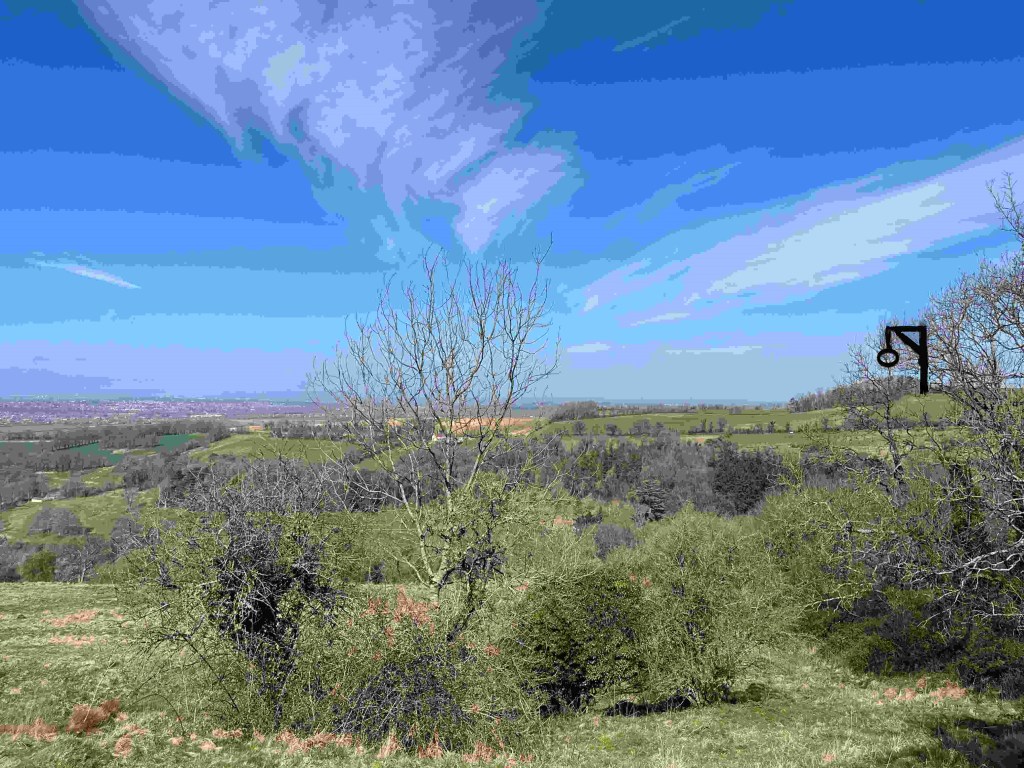
We stopped, standing, to get our breath back (well, that’s what I was doing at any rate) and took in the impressive panorama looking west and towards Bristol, the Severn, and the Welsh mountains beyond. From the lie of the land, I assumed that we weren’t too far. “Are we nearly there yet J….?”

J consulted his phone. “Yup,” he replied. “That’s it just over there.”

Of course it was…

I looked north. The land fell away steeply into a valley and then rose again towards a clump of trees at the end of a ridge. Just over there, yup, about a mile just over there (as the crow flies). Now, I had all day, but it was a Sunday, and I hadn’t wanted to eat into too much of my hosts remaining hours before their new working week. If, at that moment someone had said that getting to Hanging Hill was going to take too long, I would have surrendered the task there and then, to return another day. But nothing was said and so we continued on, flanking a pleasant looking golf course to the right and woods to the left. At least now we were on the flat.

Just past an old farm building, in a fallow field, a collection of metal fantasy sculptures had been let out to rust slowly in the elements. I’m not necessarily a fan of “industrial” art, which I find somewhat contrived (I can’t find an emoji of Morrissey, but if one exists, insert here), but on this occasion I was suitably impressed. Something about the location perhaps, but also the aesthetic and the way the Grim Reaper with dog, and other Tolkienesque characters had been positioned pulled me in. I considered taking a closer look, but time was pressing, and the need was to move on.

Sculptures by David Michael Morse – Deceased 

The track continued up to a crest, with the golf greens now on our left. We headed northwest, still on the Cotswold Way. A delightful wood, covered in a carpet of thousands of wood anemones stretched out to our right. A suggestion to wander through these woods was vetoed. We appeared to be at the limit of our time window. The greens we passed seemed to stretch forever, and judging by the disastrous tee-shot swing (and hope) by a possibly hungover weekend golfer at the nearby tee, his game was going to be a stretch too, far.

Here the course ended and just ahead a gate beckoned us into a large field that vanished to the horizon, which was dispiritingly far away. By now there was a palpable tension. I’ll leave out the details, but entertaining the old man’s cranky new hobby had clearly run its course, and I had run out of credits. We had come too far to turn back. My own assessment of the land and the area suggested that we could make a dash back to the cars an alternative way, but for the moment it was important that I focused solely on apologising with conviction for my selfishness and trust for the best!

We crossed over the large field, a path clearly pointing us towards our destination. Minutes later, and to my overwhelming relief, we reached the trig point that marked the top of Hanging Hill. I was tempted to say we didn’t hang around, but sensibly we stopped and took a five-minute break. Hanging Hill? No idea. The next one to the north was called Freezing Hill. You get the medieval idea here.

Just hanging around. Trig points are handy things to rest on.

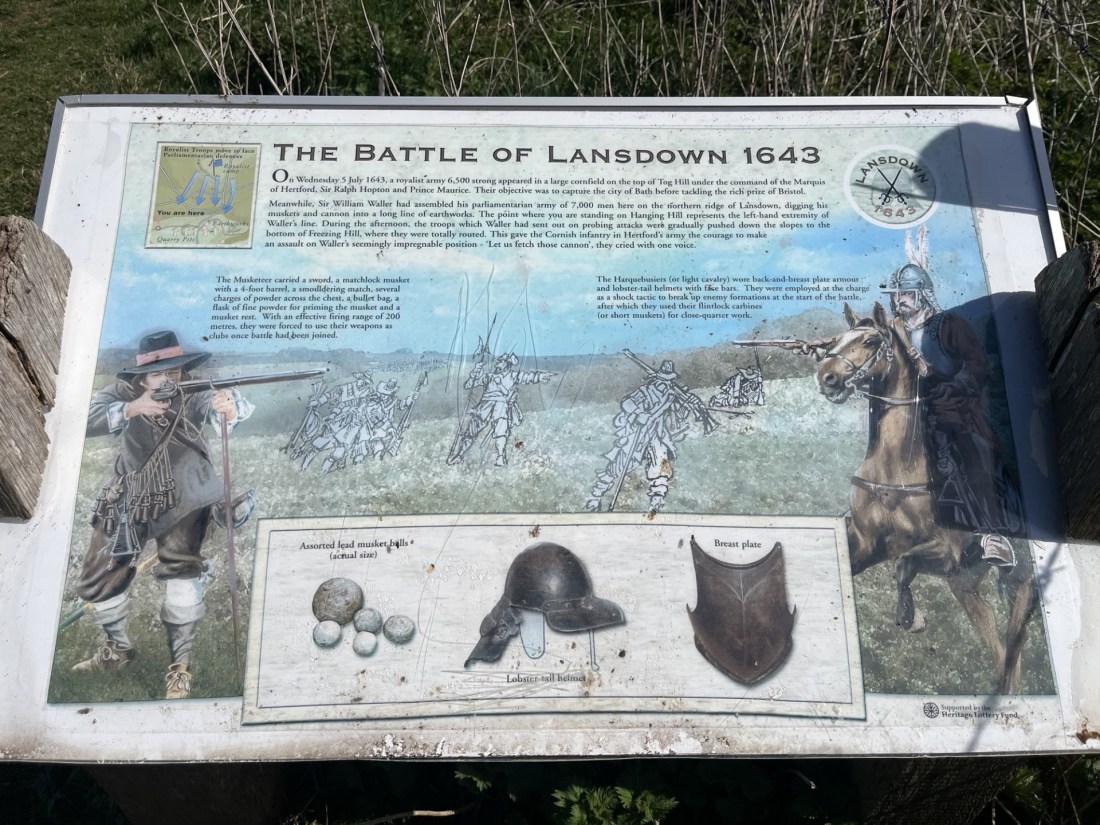
Just past the trig point, an information panel told us a bit about the Civil War battle of Lansdown, fought on this spot in 1643. With time pressing I chose to take a photo and read it later.

Limited information

This is not a history lesson, and in truth, as I found out later, neither was the information panel. * If we had had more time, it might have been possible to survey the scene and appreciate more the scale of the carnage that had occurred here four hundred years earlier. But the research would have to wait.

The killing field

The prerogative now was to get back to the cars as sharp and as shipshape as possible. We’d been out too long. The good news was that it looked like it was going to be all downhill from now on. Except we chose to set off northwest, heading away from where the escape vehicles were parked up. We trod carefully down a steep track through dense woodland, with the first signs of new growth all around. With continuing murmurings of discontent amongst some of the team, I quietly hoped the correct decision had been made. The track continued for, in my mind, too long, but eventually we spilled out onto a narrow road, and despite some hesitation decided to bear left and head west.

Marshfield Lane proved to be the win bonus of the day. Hardly a vehicle passed us, and progress was swift. A bank to one side of the road stretched for some distance, covered by hundreds of yellow primroses. Soon after we were passing the rather appealing looking Upton Arms in Upton Cheyney. No time though to contemplate the achievement over a coffee or cold drink. Onwards and downwards on Brewery Hill and then, at a sharp bend in the road, we followed the footpath directly down through a farm, then through a gate, and within minutes we were sitting in the garden of the Swan Inn at Swineford, the sun beating down and all was right with the world. 

Mothers Day at The Swan Inn Swineford

It had been a longer hike than anticipated, with an unexpected, almost continuous 700 feet of elevation from the start to Hanging Hill, and much tougher than expected. Just under five miles, but thoroughly worth it, and in the end we were all still friends.

* The battle of Lansdown hill makes for an interesting read. Not that you would necessarily have known it from the information board, which gave the impression that the Royalist forces inflicted a crushing defeat on the Parliamentarians (under the leadership of Sir William Waller). The forces appear to have been pretty evenly matched, with Waller’s troops dug in at the top of the ridge, his left flank at the trig point. A fuller account is provided in the link below, but in a nutshell, it was a long and hard-fought battle over many hours and into the night. With ammunition low, Waller chose to retreat to Bath in the dark of night. With ammunition low but having sustained severe casualties (not least to many of the commanding officers), the Royalist forces gave up the chase and set off to Oxford in disarray. It had been but a pyrrhic victory for the Royalists. The two sides met again for a rematch a week or so later at Devizes, where the Parliamentary forces were soundly beaten after Royalist reinforcements arrived in the nick of time. The losses at Lansdown Hill are speculation but the estimate is that on the Parliamentarian side, 20 troops died, and 60 were wounded. Multiply both those figures by ten to get an idea of the scale of the losses on the Royalist side, not to mention the high casualty rate amongst its senior officers (Wikipedia). It must have been a brutal and bloody affair, with deadly skirmishes taking place between infantry and cavalry in the woods that we had walked down through. Sobering indeed. 

After I read the fuller account of the battle, I was able to picture vividly what the calvary and infantry clashes in the woods above Marshfield Lane must have been like. Loud, close and very bloody. This very rarely happens to me at any historic battlefields, where it is impossible to imagine mass slaughter in a vast corn field. I also realised that, other than a superficial understanding of the English Civil War, I really knew nothing about it at all. Given not just the struggle, but also the fundamental principles involved and how it changed the world, within the week I had bought The British Civil War – Trevor Royle. With 900 pages I may come to regret the purchase, but without seeking out the highest point of this unitary authority, my ignorance would remain complete.

Just Hanging Around

Cresting the County – Bristol

Lodge Hill

112 Metres

369 Feet

28th March 2025

A room with a View

Bristol is a hilly city and blessed with many high points that grant excellent views. To the northeast, the Dower House, located metres outside the city boundary in South Gloucestershire, is a striking, sandstone coloured Georgian pile that can’t be missed from the M32. To the southwest, and still close to the M32, the remains of the Purdown anti-aircraft batteries now hide under the soaring BT tower, but have grand views towards the city, and must have been an impressive, albeit salutary sight, when in action during the Blitz. In the city itself, the remarkably well-hidden Cabot tower at Brandon Hill gives some of the most impressive views of the City and its surrounds. And of course there’s the Clifton suspension bridge, and the “Downs” above, to enjoy and feel a sensation of elevation.

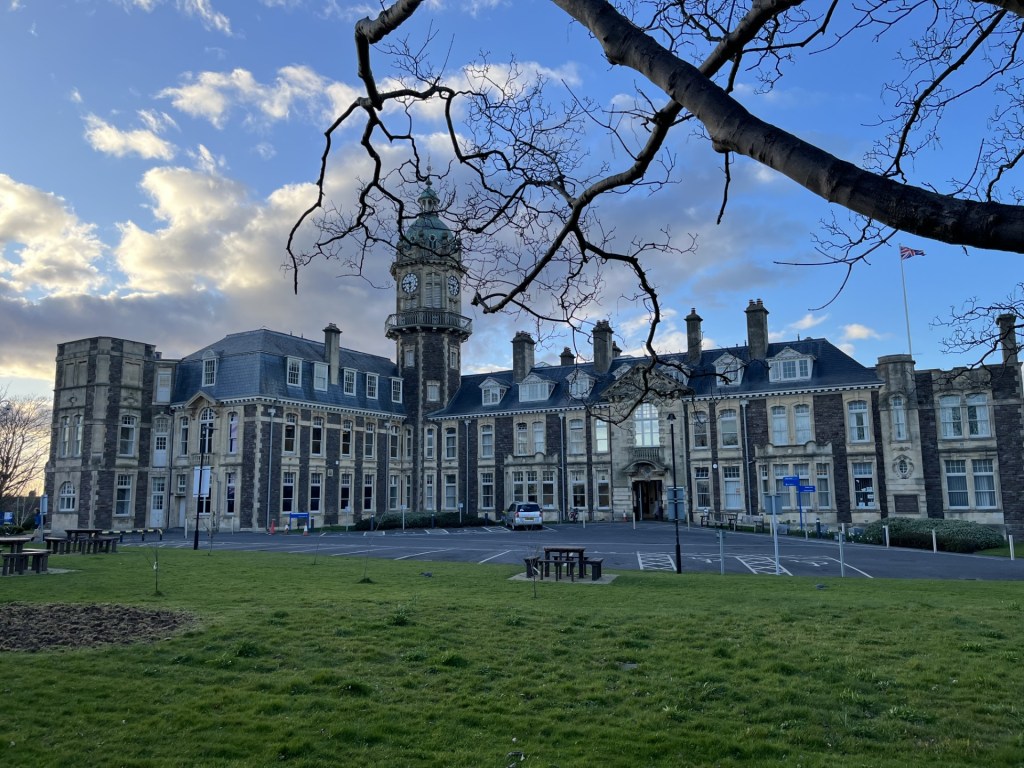
So, great, but none of these can claim the high spot. That goes to Cossman Hospital located at the top of Lodge Hill, found appropriately in the Lodge Hill area in the northeast.

On the 28th of March 2025, I had a few minutes to burn before imposing myself on my daughter and her partner J, who conveniently live in Bristol. A couple of hours earlier I had walked to the top of Pilot Hill, the highest spot in Hampshire, and now had little interest in further physical activity. I drove up Lodge Causeway from Fishponds, parked up in Selkirk Road and then took this picture before departing. The impressive clock tower is the highest (man-made) point in the city, and the view from there, and I guess some of the wards or admin offices below, must be pretty good, but from just outside the car park, it’s a moderately interesting, possibly Victorian building.

Rooms with a view (I imagine)

A slightly irritating side issue to my tremendous achievement was that as I stood on Selkirk Road (112 metres) I turned and looked to the east, towards the main road, and houses beyond. A side road continued past the main road and, in my mind, appeared to rise to what appeared to be a higher point. It was certainly industrial in nature and appeared to be fenced off. But there was no more curiosity in me, and I left. Of course, in the end curiosity, and a sense of duty to the topic, led me to double check for any localised height variation. Firstly, don’t bother yet with AI. If you type in Google “the highest point in Bristol” the AI overview will tell you that it is Dundry Hill and has a picture of a mountain that looks remarkably like Cadair Idris, a beautiful peak in northwest Wales (or, as I discovered on a second try, Blackdown Hill depending, I guess, on how the AI is feeling, or what it’s learning!). Don’t worry, I’m lost too. Dundry Hill, as of course we all know, is in North Somerset, and that’s a different county (and if you ask AI Overview for the highest point in North Somerset it will confirm this, doh!). **

At this, the casual reader may say, “I thought this was supposed to be about reaching the top points of counties. Why are you doing Bristol, given that it is in Somerset?” Until I started doing this arguably pointless hobby, I too might have thought the same and indeed would have been certain that in the 1970’s, when I went for a pub crawl around Bristol with my very Zummerzet friend Andy on a Saturday night, that I was indeed in Bristol, Somerset. Not so. Bristol, historically, was split in two by Gloucestershire in the north, and Somerset to the south, with the Avon River being the divide. In 1373 Bristol became its own entity (it is complex), which endured until 1974 when it became part of the County of Avon. That lasted until 1996 when Avon was abolished, and Bristol became a Unitary Authority. So, when being shown the sights of Bristol nightlife in 1977, I was probably in Avon. Anyway, when I initially found what appeared to be a reliable list of British counties, Bristol was included, and in my mind qualified. *

Where was I? Ah, yes, going off piste again (to be fair, it was 1977). So, at the top of Selkirk Road the land appeared to be higher than where I stood. I later checked the ever-reliable British Geological Survey Viewer and it confirmed that the land did indeed rise a further five metres. Annoying, although I’d be back there again soon and could always pop up to Castle Road to take a closer look. Oh, Castle Road, interesting! It seems that at some point there was a stately home, or manor house that was known locally as the “Castle”. That being the case, that the land rises here probably has more to do with human activity than with the natural contours of nature, and to that end I may feel less obliged to carry out another visit. Anyway, if you want to take this activity seriously, and finding the very top of Bristol is that important, walk away from the hospital and further up Selkirk Road.

As an aside, if you wish to find out more about the semantics of what is, or is not a county, I stumbled on this website. 

https://abcounties.com/news/which-county-is-bristol-

The Association of British Counties, with the mission statement “A society dedicated to celebrating and promoting the 92 historic counties of the United Kingdom and the important part they play in our culture, heritage and geography.”

A brief scan of the text and I immediately departed company with m’learned writer. I guess it had something to do with the smug pomposity of the language that turned me off, and of course the knowledge that all boundaries are in any case artificial constructs, which ebb and flow depending on demographic change, politics, and as we still see, war. Just a little bit of me wondered if the Association might also want to reintroduce imperial measures. Mines a pint.

** I doubt that I will engage much with AI options, though I can’t rule it out, and in time may have no choice. As I write this, a news item reported on the US Secretary of Education, Linda McMahon, talking about how AI will be taught in schools, but more than once called it A1 (A One). Four more years of this………..! Help.

Cresting the County – Hampshire

Pilot Hill

303 metres

938 feet

28th March 2025

Wild Life – Waking Up

The last weekend of March and the start of a new season. A trip to Bristol to stay a couple of nights with my daughter after a long, dour winter, during which the sun refused to remind us of its existence.

ETA in Bristol was 6pm, so I figured I would have enough time to chalk off Hampshire’s highest point on the way. When I think of Hampshire it’s the New Forest, south coast ports, and heathland environs stretching southwest of Surrey. I was surprised to discover then that its highest point, Pilot Hill, is far to the northwest, and not far short of Newbury and the M4.

I seem to have a knack these days of underestimating journey times, and so, after nearly three hours of picking my way up through the roads of the southeast of England I arrived at my chosen destination, the village of Ashmansworth, around two miles from the top of Pilot Hill, located to the northwest. Well, you need to start somewhere! As the morning had progressed, the main breaking news was of a terrible earthquake in Myanmar (aka Burma). A few people were thought to have died, but as the reports came in that was never going to be the final toll.

On the roads near Basingstoke, and then heading north towards Ashmansworth, I became increasingly aware of a high preponderance of Tesla cars. I may have just been more alert to their existence given the turmoil in the US in the previous weeks, but it did seem to be almost every fourth or fifth car.

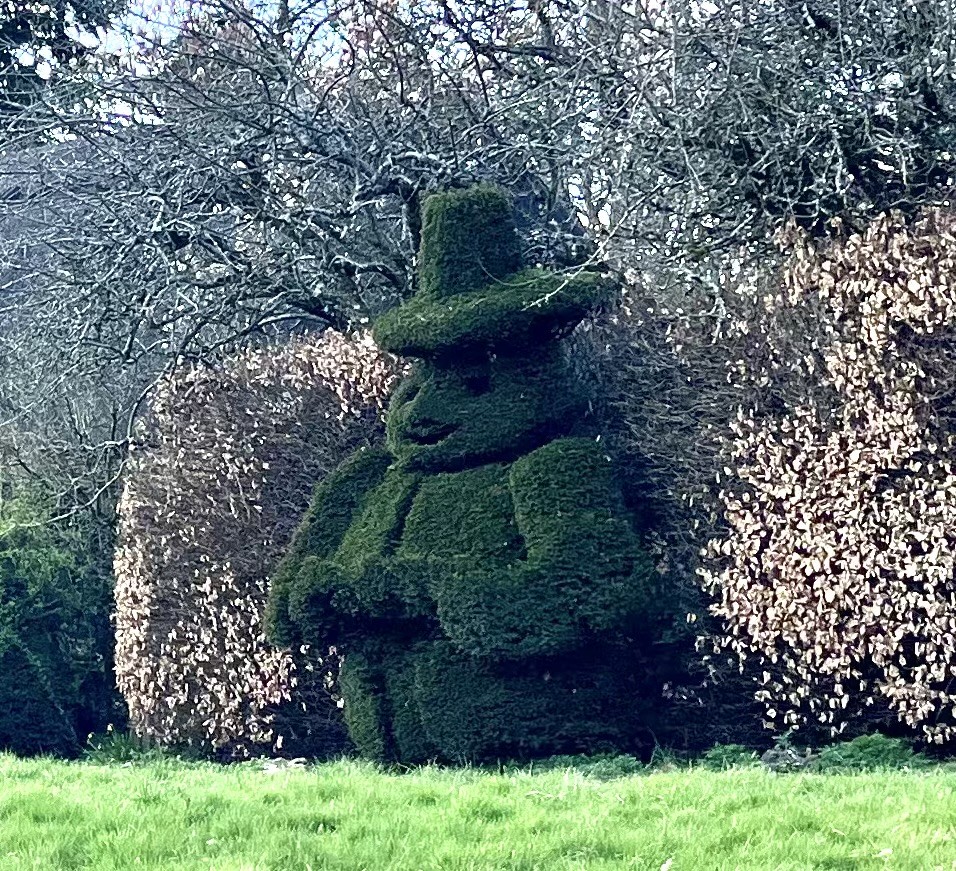
As I drove into the village, and along the main road, something became clear. Every house was old, large and came with a lot of ground. There were very few vehicles parked on the road, but those that were appeared to be larger than the average. I guessed that the Tesla’s were parked indoors for their personal safety. Exclusive. I reached the end of the village and looped around the small green with its war memorial and then noticed, and balked at, a large, sculptured bush outside one of the houses. What looked like a cross between a bullfrog, Humpty Dumpty and the Witch Finder General, it had been shaped by someone with a vivid imagination, and a seriously sharp pair of clippers.

I drove back along the way I had come, and found a spot to park up. As soon as I did, an unsettling feeling caught me. It may have been imposter syndrome, but at that moment it felt more like intruder syndrome. I had every right to be there, but, given the environment, the many Neighbourhood Watch signs, the peculiar and slightly sinister, shaped bush, and having recently rewatched the Wicker Man (1973), I made an instant decision and drove out of the village, turning left onto a lane leading towards East Woodhay.

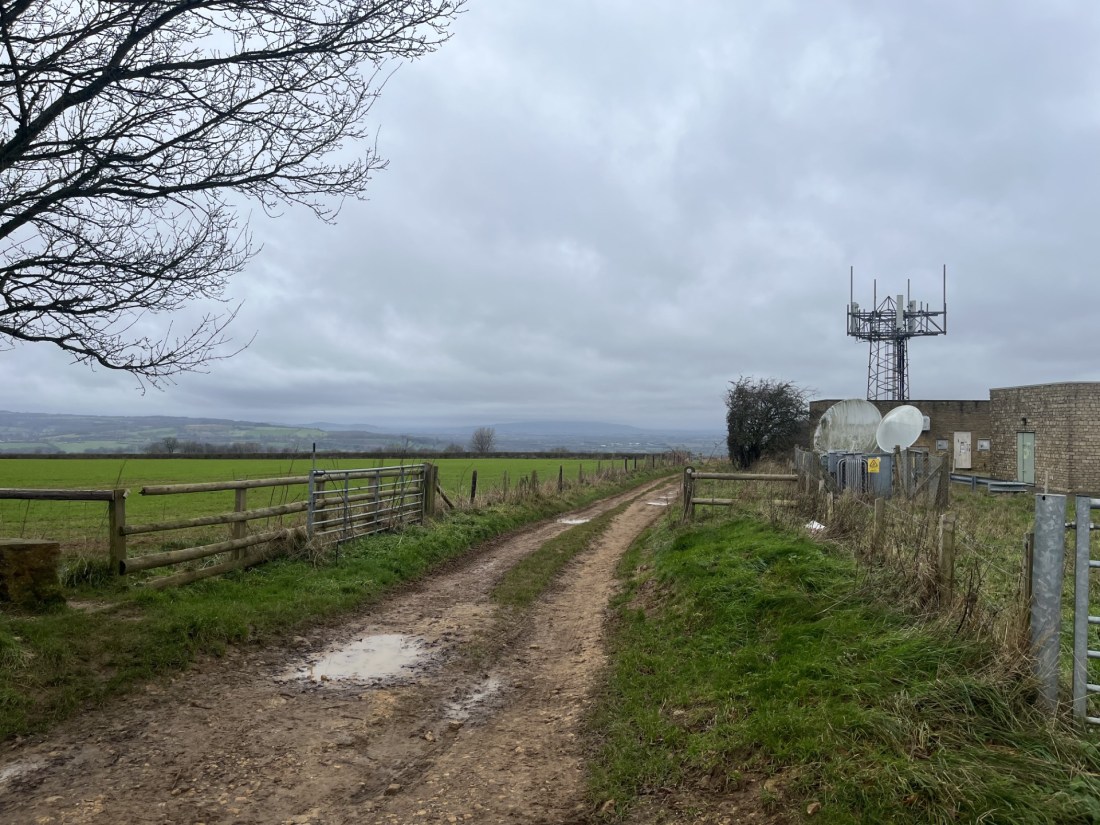
The road clung to the top of the chalk ridge and then, as it merged into woodland, started to head downhill. I figured going any further would be a mistake so stopped the car and reversed back a few metres, managing to park up on a patch of muddy kerb and as close to the adjacent bushes as I could, in the knowledge that one small clip from a passing tractor would be catastrophic. Opposite, a lane tracked west, marked by a sign that simply read “Charldown”. I consulted the recently procured OS map (Landranger 174) which confirmed a footpath heading more or less directly west towards Pilot Hill. Assuming I was at the correct spot I took the plunge.

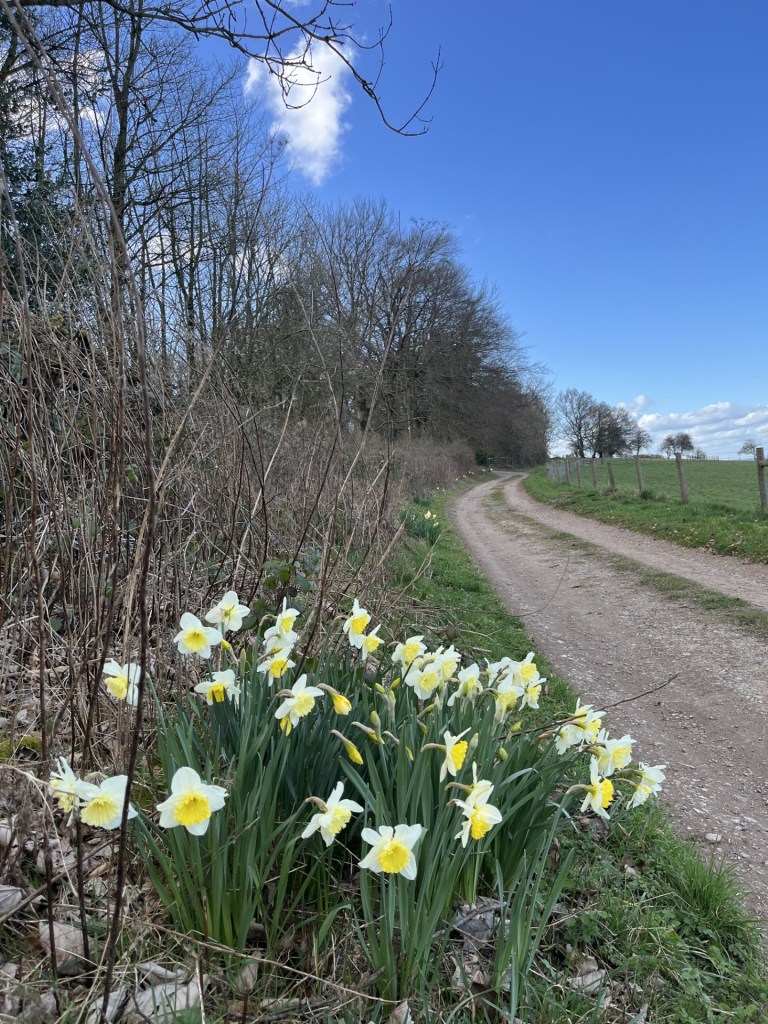
The track, a bridleway, led gently upwards. Pockets of wild daffodils at their best flanked the verge to the right, and a mournful buzzard screeched through the boughs.

The Yellow Flanked Road

I passed Charldown, a large modern eco looking building, presumably built on the site of an older substantial house. Everything was very pleasant, quiet and, the new house aside, as tranquil as could be. Past the house the lane veered left, then dog legged to the right again and became more of a path, with woods to the right and a large field beyond a fence to the left. Breaking out of the woods the views north over open countryside stretched for miles. It was an unseasonal, brisk, bright afternoon, and not a pylon in sight (a testament perhaps to effective lobbying or the price of land). Red kites and buzzards swooped above, and then out across the north facing scarp slope. 

A woman with a dog emerged from a path to the right. We said our hellos and I asked if I was on the right track for Pilot Hill (I was fairly certain that I was, but don’t ever miss an opportunity to double check with the locals). There was a slight hesitation in her reply, but yes, yes, I was and should keep going. Validation enough I decided, although in truth I was thinking that I must be close.

Into some woods and then the path wound out and once again open ground fell away to the north. I continued for a couple of hundred metres. A jogger was approaching so I stopped to let him pass. More hellos as he passed. “Great view,” he spluttered. “Yes,” I agreed. And then, for the same reason as before, “I’m looking for Pilot HIll.” He smiled and carried on. I turned and looked down into the plain below. The fields fell away like a green carpet and seemed to converge outside a large red brick stately home. I looked at the map. Hmmm….

“I’ve looked on my phone.” I looked back up the path. The jogger had stopped at the entrance to the woods. “Pilot Hill is back up here and then through the trees to the south.” Needless to say, I was taken by the man’s generosity. He had stopped an activity that was clearly a passion to assist a complete stranger, and I shouted back my profound appreciation. “It was really nothing,” he said, before disappearing and leaving me wondering if he was called William. I was already beginning to work out that I may have gone too far and would have decided to turn back within a few minutes, but under the circumstances the man’s generosity of spirit meant a lot. I’ll tell you now, that in these overtly selfish times, and with a certain self-proclaiming king narcissist telling his worshippers that there has never been a better time to get rich (whilst global markets plunge into oblivion), these small acts of thoughtfulness need protecting, by regulation if necessary (oh no, woke talk).

If you’ve reached here from the east, you’ve gone too far

Doubling back, I found a short track through the woods and then a field stretching to the south. By now I knew that the top of Pilot Hill was somewhere in the large field to my left but chose to track along the top of the southern hill, which had sweeping views and was bathed in sunshine. At a point that felt about right I dipped back into the hawthorn thickets exploding with blossom, that divided the fields, and found myself looking over towards the trig point that I presumed marked the spot. Unfortunately, due to an annoying electrified fence the prospect of reaching it seemed unlikely. The fence, protecting a scrappy, uncultivated field, extended away to the southeast and eventually to a large metal gate. There seemed to be no hope, and I considered calling it a day, but decided that there was nothing to lose by heading for the gate and finding out, one way or the other.

Beyond the fence. So near, so far!

I ducked back through the thicket into the other field and continued the trek. The retort of shotgun fire somewhere down the valley, and fifteen to twenty pheasants of all creeds, faiths, genders and none, broke cover in front of me. School child error surely? Will they never evolve and learn?

I reached the gate, and to my surprise and relief found it open. There was no footpath sign, but a quick look round suggested that no one was going to notice and so set off in a northerly direction towards the trig point. A small act of trespass perhaps, but somehow necessary.

On approaching the trig point, two objects laying in my path made me wonder whether I had made the right choice.

Empty boots. Message or metaphor.

Had I missed a sign warning me that trespassers would be persecuted, or even shot? Mindful of the sinister topiary back at Ashmansworth, and now confronted with possible evidence of human sacrifice, I scanned the horizon to double check that there were no signs of a wicker man being erected.

Whatever had led to the abandonment of a pair of walking shoes, at the very spot you might think you would have needed them most, something else was bothering me. Whilst the trig point logically indicated the highest point, the land appeared to continue to rise towards the west. It could well have been an illusion, and the OS map wasn’t detailed enough to clarify, but my instinct was to keep going. Another fifty metres to the west and I considered that I was now higher than the top of the trig point and, I figured I was at the top of Hampshire. *

True Top?

Well done me then, but an image of the empty boots popped into my head. It was time to skedaddle. I wondered if I could find a way back to the main path by heading straight across the field to the top of the ridge but was it worth the likelihood of almost inevitable entrapment by electric fence or mantrap. Nope.

I went back the way I came. Heading back on the main path, and with the Pilot Hill field now to my right, protected by the electric fence. I looked up to the ridge at exactly the moment a roe deer stepped into the view and taking the high ground. It stared directly at me but didn’t move, which gave me enough time to slip the phone from my pocket and take a couple of snaps before it got bored with me and skipped off towards nearby woods and the electric fence.

Monarch of the Chalk

I was back at the car (it was still there and unscathed), within fifteen minutes. The walk had not been much more than three miles, but the peace, and diversity of wildlife, had been unexpected. I headed back to Ashmansworth, before setting off towards the M4. Whatever had happened to the bootless walker, someone in this community held the answer, and I’ll say no more about that. **

* Trig points are generally located at the highest point of land, but not always. The line of sight to adjacent trig points being the determinate.

** For the record, and because I have seen stuff about the online crime investigator community (web sleuths), who have nothing better to do than poke their noses into the despair of others, I wish to make it perfectly clear that any suggestion of a mystery attached to the empty boots is simply an act of creative writing, and bears no relationship to anyone living etc. Just saying!

For no other reason than seconds after typing up the joggers comment this popped up randomly on the 7000 plus tune iPod!

Cresting the County – Gwynedd

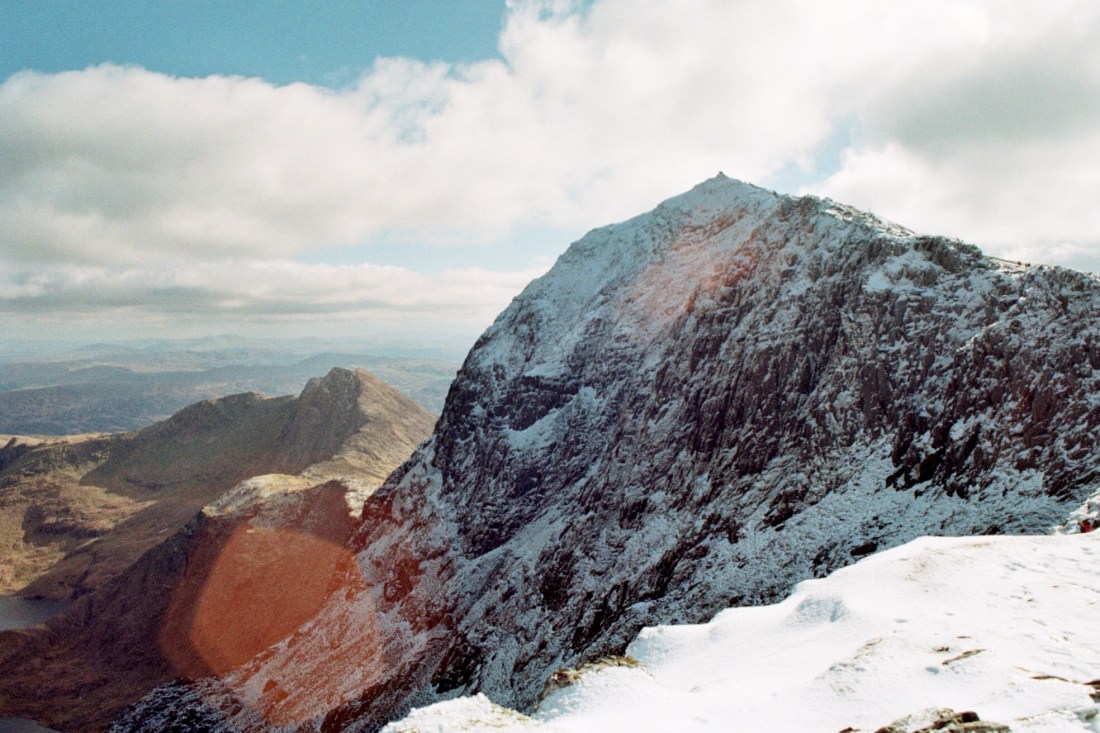
Snowdon *

1085 metres

3560 feet

Date/s:   1972? 2001? 16th May 2019 and 6th March 2022

Trains, Planes and Cafe Culture – One from the Vaults

Where do you start with Snowdon? Well, Llanberis generally, but other routes are available.

In the autumn of 1978, I was in my last year at a red brick University in the East Midlands, studying Geography. I lived in a small purpose-built room, in a purpose-built block, with nine other, not fit for purpose young male adults, a shared kitchen and bathroom, and the sound of punk and new wave painting the backdrop. In the third year an intake of new students had included a young man who I’ll call Dom. Everyone had hobbies of some sort, predominantly football and drinking as it happened, but Dom was a bit of an exception. Whilst unremarkable in many respects he was a fanatical rock climber. More worryingly he was also the only person still playing Tubular Bells, on repeat.

Often was the time when we’d return after a few pints in the cheapest bars in town and begin to climb the concrete staircase, only to be freaked out by Dom hanging directly over us as he shimmied up the walls in full kit. All outstretched limbs and magnetic rubber soled shoes. 

The winter of 1978/9 was one of the coldest in my lifetime. At the end of November, a wickedly cold period of snow, and then brutally low temperatures, embalmed the east of England in ice. A long-standing overflow pipe that wept water from the top floor led to a build-up of solid ice down the side of the block. Dom, never slow to miss an opportunity, laid his hands on a hose which, by running a slow trickle of water down the outside of the building, slowly increased the volume of frozen water to create an ice wall he planned to hone his ice axe skills on. Someone studying engineering eventually intervened, after assessing that if his artificial ice slope was to reach the required thickness for his ice pick, there was every probability of the house collapsing first.

Most weekends Dom would disappear with his friends to practise his art in nature. I don’t think any of us were ever told where he was going, and to be honest I don’t think we particularly cared, but he was always back on Sunday evenings. So, when one Sunday afternoon there was a knock at the front door, and whoever answered it was met by a journalist from the local newspaper and asking if Dom lived at the address, our curiosity was peaked. On being told that he did, but that he was not at home, the journalist was less than forthcoming and advised that we might want to watch the early evening news.  

And, sure enough, on the regional early evening news that night, all was revealed. A search had been going on all day for a couple of climbers who had gone missing on a massive cliff below the top of Snowdon. I think we were somewhat concerned. 

Some hours later, and late in the evening, Dom suddenly appeared in the kitchen. Consternation all round, but it was water off Dom’s back. What was all the fuss about? The day before he and a mate had made a start on one of the almost vertical 300 metre cliffs rising above one of the small tarns below. At some point in the late afternoon, and a long way up, a rope had failed, and he and the other climber had fallen a long way before being left to dangle on what was left of the rope, some distance above the base of the cliff. 

The night had drawn in, and then the realisation that there was no prospect of a rescue in the dark. The agreed solution was for one of them (I can’t remember who) to cut their rope and then climb down without any safety equipment to get help. Somehow or other this all panned out and early the next day the other climber was safely down, and they set off home. When Dom found out that the nations paparazzi had been trying to hunt him down, he was completely perplexed, finished his cup of tea and then went to bed (after a few finger pull ups from the second floor gutter for good measure). 

I have no such stories to tell, but I have climbed Snowdon in the more traditional manner, three or four times. My first visit to the top of Snowdon had taken place just six years before Dom’s adventure, on a summer trip in north Wales with family. I would have been 14, and yet to discover the interesting effects of alcohol, or the rarefied atmosphere of a provincial University and its less than bohemian, yet delightfully diverse community. My memories are slim, but one thing is for certain, we didn’t climb up. We took the train, had some snacks in the old cafe and then walked back down. Given that this was the first proper mountain I had been up, I may well have been left with a somewhat distorted understanding of what they offered. A train, a cafe and stunning views. All very Bavarian. 

I have what could be a phantom memory of climbing Snowdon many years after being at university, but for the life I can’t place it. I did spend some days in north Wales in early September 2001, and it could have been then. A day or so after, and having returned to London, I was ironing the afternoon away and contemplating the horrors of returning to work the following day. With the tele muted in the background, for no reason I can think of, I glanced up and watched as what appeared to be a plane smashed into what looked like one of the towers of the World Trade Centre. Thinking it was some weird afternoon disaster movie being shown on some dodgy TV channel I paid it no attention and got on with the job at hand. Looking up again some minutes later, it began to occur to me that all was not what it seemed, and I turned the volume up. Once the full enormity of what was happening had sunk in, I stopped ironing. So, it is entirely possible that at that moment, as I urgently collected the kids from their respective schools, any memory of climbing Snowdon a couple of days before was banished forever.   

Some years later, and with more freedom now that the kids had become more independent, I started to visit north Wales more often, either staying in Barmouth or Aberystwyth. There was always enough nature to keep me interested in and around these towns. However, in May 2019, I needed a major distraction whilst waiting on the outcome of the final mind bogglingly expensive and tortuous days of negotiations by a solicitor to buy the freehold of my, and my neighbours flat from a rogue freeholder (a distorted legal legacy from our feudal past). I slipped up to Aberystwyth and decided to take the hike. Anything to block out the never-ending flow of increasingly negative emails.

Driving up from Aberystwyth and through Blaenau Ffestiniog I was flabbergasted by the scale of the slate quarrying that had taken place over the centuries. If I hadn’t already had an objective in mind I would have stopped and spent the day exploring the area. 

I arrived at Llanberis and parked up. It all felt reasonably familiar to me, hence why I am pretty sure I had climbed it sometime between 1972 and 2019. It didn’t seem to be particularly busy, but there was one minor problem. Over the previous day or two I had developed a slightly debilitating pain in my right leg, between my knee and hip. This wasn’t a new issue and seemed to flare up from time to time, most commonly at precisely the wrong time. A year or two earlier I had set off on a spritely jaunt from Barmouth up the south bank of Afon Mawddach to Penmaenpool, but on the way back down the river, on the road to the north, my leg had seized up so painfully it took me nearly an hour to drag the throbbing knee gristle over the last half mile into town. At the time I genuinely thought my walking days were over, but the body’s ability to recover is a funny thing. 

Whilst I wasn’t going to let a bit of late morning leg pain put me off my plans, I was nevertheless just a tad mindful that if I had a repeat of the Barmouth debacle anywhere beyond halfway up the mountain, I might not have the resolve to make it back down. But, no worries, there was always an alternative if such would occur, and I went to make enquiries in the visitors’ centre. 

“Oh no dear, I don’t think that could be done, unless of course you book in advance.”

“OK. So, just to be on the safe side, could I buy a ticket back down for later?” I was at the old ticket office at Snowdon Railway Station, and had enquired as to whether, should I become disabled somewhere up the mountain, it might be possible to hop on a returning train. 

“Well, you can try of course, but you have to do it online.” That’s the sort of message that instantaneously causes me to go into a state of deep anxiety, along with an instant resentment towards the modern world. Nevertheless, if that was what needed to be done….

“Ok. What’s the website please?”

“Actually luv, you’ll probably be wasting your time. We’re so busy these days that you need to book months in advance.” 

Deflated, but grateful for the fact that the heads-up had quashed further unnecessary mobile phone induced internet curiosity and anxiety, I looked around the large shop, cafe and waiting room, and at the swathes of people holding walking sticks, crutches, or propped up by walking frames. It was obvious that the assistant was right. This was no place for the slightly enfeebled young at heart to be seen lurking. 

I seemed to instinctively know where to go (which again suggests another visit within modern history). Leaving the station I walked down Rhes Fictoria (needs no translation) and then started on the small road up through trees on the Llanberis Path. Again, it all felt very familiar, not least because I was reminded that the first half kilometre is a complete pig of a climb, so steep I was almost walking on tiptoes. As I rounded a bend, at a pace that if maintained would see me arriving at the summit sometime the following week, a poseur on a mountain bike slowly passed me by. We didn’t exchange greetings, on account that neither of us had the energy. 

And there, around the bend, just fifty metres on, was a cafe! I’d only been walking for ten minutes but the call of bun and coffee was too much. By now, in the crawling position, it still took me a while to get there. It was a busy little hub of activity, and there was just a suspicion that many of the customers had set off with good intentions but had surrendered at the first hurdle. I too came close, but that would have been shameful. 

So, on I went, continuing up the road until eventually turning left onto the path that headed southeast and gradually up. After a while, and looking towards the east, the sight of the gargantuan Dinorwig Slate quarry, rising hundreds of feet above Llyn Peris, a moraine blocked lake formed after the last ice-age, was breathtaking. Despite the utter devastation inflicted over two-hundred years by the roof hungry world on Snowdon’s neighbouring mountain, what should be an assault on the eyes somehow gets away with it. Not unlike a northern hemisphere version of Machu Picchu it once served a purpose, and now nature is slowly reclaiming the land. **

Dinorwig Slate quarry

Continuing up, the slopes rose to the east and slowly obscured the views towards the quarry, but a slight distance down the slope to the right, the narrow gauge vernacular railway track, that shadowed the path for most of the rest of the climb, made itself apparent when one of the trains (that I would be banned from riding on should I stumble and fall) cranked past and up. 

The climb was steady, only really problematic in places where it was necessary to stretch the limbs at low step features. The route worked up the valley with increasingly impressive views opening to the south and west. After three or four kilometres, and quite unexpectedly, another refreshment opportunity presented itself at a small snack shack. It hadn’t been in the plan but any excuse. It had turned into a warm day, so sugar, salt and liquid refreshment was becoming essential. In any case, a break to take in the view sitting on my backside, rather than on the hoof, was very welcome. 

After this point the angle of ascent began to steepen as the path swung to the east and on a more direct route up the valley slope. As the climb became a harder challenge, the reward was the increasingly pleasing views to the southwest, and the mystical slate blue, occasionally trout brown, waters of Llyn Du’r Arddu, a glacial tarn that sits on a plateau beneath the soaring cliffs that form the north face under the final ascent.  

Llyn Du’r Arddu

The path continued up, hugging the slope, with the tarn on permanent display to the west, and then eventually ducked under a small stone bridge supporting the train line. From this point on the main track was to the east of the line, and the view of the tarn now restricted. Slogging on south, and up, I was beginning to get a sense of height. Surrounding peaks were now to be looked down on, rather than up to. Continuing for another mile or so, the well-worn path presented little in the form of interest, although a particular feature of this zone was the extraordinary number of discarded banana skins (some of which may well become fossils in due course and in millions of years will create great confusion to geologists). 

At 1000 metres I suddenly broke cover from the bland slope, at a point where several paths met. Directly to the south was the craggy summit, with a line of human ants picking their way up to, and down from, the peak.

You have to imagine the hoards queuing at the top

To the east the land fell away hundreds of feet, worryingly, but spectacularly down to a beautiful tarn. A hazardous looking path zigzagged dramatically down the steep slopes and cliffs, and I thanked myself for not taking this route at the start of the day (it had crossed my mind as I had passed the busy car park at Pen Y Pass but had instead continued to Llanberis). Looking down the plunging cliff face below the peak, I momentarily thought of Dom, and shuddered. 

I can see for miles

This was the point which had made the whole experience worth it. Whilst not quite at the top the views in every direction were dreamlike, and I wondered briefly whether there was much point in carrying on. Of course I did, and with the path following the railway line for the rest of the walk I eventually reached the summit station, and the very modern cafe and visitors centre (the old pre-war café now long demolished).

Not far to the café now

Purchasing a coffee and sandwich in a space not dissimilar to your average motorway service station, but with a better view, I went out and sat on some steps, just taking in the vistas. It was a warm afternoon, but despite the altitude the number of flies and wasps was deeply dispiriting. As far as I could tell, such a gathering could only have been exceeded by Clive James’s outdoor dunny at his childhood home at Kogarah in suburban Sydney. A smell, similar to what you get if you have the bad luck of getting a face full of extractor outside a KFC or McDonald’s (and for the sake of any potential litigation, other big fast food brand frying smells are available) hung over the establishment and had clearly attracted every diptera in the Eryri National Park (sorry, I mean Snowdonia – see footnote). And not just flies. Hundreds of gulls swooped, in the hope of a quick snatch and grab, or just wandered around the perimeter picking off discarded rubbish but studiously ignoring the hundreds of discarded banana skins. 

Depressed by the scale of the human footprint just below the peak I took a quick look up. So many people were formed into a line winding up the hundred or so extra feet to the top, I rationalised that I’d done it before at some point and instead started my descent. Not long after, and with nothing particular on my mind, an almighty “whooshing” (old Welsh word) noise to my left, and in almost touching distance, the belly of a glider hurtled from below the ridge and then up sharply before disappearing out of sight. The whole thing lasted just a few seconds but I, and a few other witnesses, stood aghast wondering what on earth had just happened, and grateful that any underlying heart conditions hadn’t been accidentally triggered.

Despite my earlier concern about the durability of my right leg, it thankfully held up to the relentless impact stress on the largely stone stepped path. Relieved that I wasn’t going to have to resort to a dying swan act next to the railway track, I dug in and got on with the retreat. Back the way I’d come, and incident free. 

For six or seven hours of the walk I’d put any worries about domestic issue to one side, but back at the car the first thing I did was check my emails. Nada! 

The following day, the last of my short stay in north Wales, I drove up the northwest coast and circumnavigated the previously unexplored, and delightful Llyn Peninsula. I stopped at Aberdaron, a small village near the peninsula’s end and walked along the beach. There was no Wi-Fi signal of any sort, which was a curse and blessing in equal measure. Back at the village I grabbed a sandwich and cup of tea in a small cafe. The man serving asked what I’d been up to. I mentioned Snowdon. He knew it well, he said, and then explained he’d been up it numerous times, including three or four times on a bike (one time in snow). I should have been impressed I suppose, but I still had a lot on my mind. I asked him if they had Wi-Fi (the great equaliser). They did, and I took my drink and sandwich to a table outside and logged on.

I had been out of signal range for some hours, but I immediately registered a series of text messages from my neighbour pleading for me to read the emails. By now, and racked with anxiety, I opened Outlook, and the inbox was alight with emails. Judging from the jubilation being expressed in my neighbour’s emails, at long last (the whole process we had reached the end of a painful legal process (which had taken 18 long months – don’t do it unless you really must).

The good news was that we had finally gained the freehold. The bad news was that I was now broke. But the good news was that I could now get on and sell the flat, to address the now being broke situation. The bad news was that I would have to sell the flat. Oh well, as I looked out to sea, I realised that there could have been worse places to celebrate and commiserate at the same time. How many times did the lad say he’d cycled up Snowdon? Well, that was the last time I’d be attempting it either on foot, or by train. 

The phone pinged again. An email from our solicitor. “Congratulations, please transfer £X%@&ing1000’s of pounds by close of play!” Wails from Wales!

*

And so, it came as a bit of a shock when, in March 2022, and after two long years of lockdowns, I ended up staying with my daughter and her partner in a small cottage in a valley in the middle of a very rural north Wales, somewhere near Cerrigydrudion. It was so remote that at night, if a car entered the valley two miles away its headlights lit the roads and hedgerows like a 1940’s black and white film noir. I expected a knock on the door and two men in beige gabardine coats demanding to see my identity papers at any moment. The shock was that as part of the deal (it being in part a birthday treat), there was an expectation that a climb up Snowdon was required. “But,” I explained, “I vowed I would never go up Snowdon again.” Of course, and quite rightly, my feeble excuse fell quite literally on stony ground, and so on the morning of the 6th March 2022, I was back at the visitors centre in Llanberis. At least, I rationalised as I looked up to the snow covered peak, if my leg gives in this time, I had two young Sherpas to get me back down. 

We set off, and of course I’d forgotten again how gut bustingly steep the first half mile was. The route, of course, was the same as before, and before that and that, and despite the gloriously sunny day it was cold. Maybe it was the time of year, or maybe it was a consequence of Covid, but there was no sign of life at the halfway snack shack. Lynn Du’r Arddu was a challenging slate blue. No signs were necessary, but if there had been they would have said “Swim here – If you think you’re hard enough!” I assumed that the guy from the cafe at Aberdaron had already done it, before climbing up the rest of the mountain on his hands.  

The snowfield started at around 900 metres. A light dusting at first but gradually increasing in depth where the ground wasn’t fully exposed to the wind. By 1000 metres, and where the path emerged onto the col at Bwlch Glas, for the first time in my life I was high on a mountain in polar conditions. It was cold but the exhilaration of being at that location, there and then, and with my daughter and her partner blocked out any discomfort. I guess that if there had been the slightest of breezes it would have been a different matter, but we were lucky.

Compare and contrast (Spring 2019 above)

As we took photos and gawped at the magnificent views, I noticed my daughter and partner had started up a conversation with a couple standing nearby. It transpired that they were work colleagues from some time back. About the only time I have ever randomly bumped into an old friend was coming out of the tube at Tufnell Park station, so it seemed almost incredible that this was happening at 3000 feet on a mountain in north Wales; in winter. I was introduced to the couple, who were on their way back down after reaching the summit. I rather pathetically mentioned that at 64, and from what I had seen on the trek, I was almost certainly the oldest person on the mountain. But apparently not. They’d come up with one of their dad’s. He was 70. “Right. Where is he now?” I asked, embarrassed and somewhat deflated. “Oh, we left him at the top.” There was no hint of irony or further explanation. I looked towards the frozen summit. Perhaps, I wondered, it was a discrete form of assisted dying? I am sure I’m not alone in having an older relative say something to the effect that “if I ever end up like that just throw me off a cliff.” When it happened to me a couple of years ago, I had to explain that whilst I understood the sentiment, the consequences for me would be life in prison. However, being left at the top of a freezing mountain without walking aids? Hmmmm…. I haven’t had that conversation with my children…yet!

My daughter is waiting for me to say something. It can wait.

After parting company with the couple we carried on, following the line of the railway track, covered in snow and under maintenance. We reached the cafe, which was also closed. Fortunately, we had some bananas. We sat on the same steps I had sat on three years earlier, admiring the surrounding landscape and untroubled by any flies or the smell of hot fat. 

After a short break we joined the queue to the peak (resistance was futile), and not long after we attained the summit, took the obligatory photos and headed back down.

Near summit view towards the sea

I’d kept a careful eye on all the other climbers throughout, and at no stage did I see any man who looked remotely 70 years old. Curious?

Don’t leave me…just yet! We need to talk about it.

Despite my initial misgivings, climbing back up Snowdon in such invigorating conditions, and in good company, was wholly worthwhile. But I’ll never do it again! The kids left the next day, and I spent a couple of extra days staying in Barmouth. Someone had recommended taking a look at Cadair Idris, and despite still sore legs I made my way to Minffordd, a short drive from Barmouth. 

I could write another thousand words on my day on Cadair Idris, but that’s not the point of this exercise. At 2930 feet, it’s a long way from even being the second highest peak in Gwynedd, but from a purely aesthetic point of view it is a little gem of a mountain. A challenging walk with glorious examples of every glacial feature that physical geographers dream about (think roche moutonnee’s, but not for too long), and because of its solitary location, breath taking views in all directions, Cadair Idris is far more than worthwhile. A big thank you to the person who recommended it, and don’t tell anyone on Instagram.  

Cadair Idris. This view is for free

* Anyone who has had the endurance to read this far will almost certainly be concerned, positively or negatively, that I have stuck with the traditional English name, Snowdon, and not the traditional Welsh name Yr Wyddfa (Snowdon). There is an interesting (if you’re into etymology) discussion to be had as to what came first, and indeed what both these words mean. The English Snowdon is pretty straight forward. Don is “hill” and snow is – well pretty obvious. The first documented use of the Old English Snowdon was recorded in the 11th century – so, pretty old. Yr Wyddfa is a bit more ambiguous, and without walking into a linguistic minefield I have no understanding of, it either means a cairn or burial mound, or a high place. The use of Yr Wyddfa as a name for this place is recorded, but some centuries or two after the English version. Regardless, I have stuck with Snowdon on this occasion for the simple reason that the official name change took place late in 2022, some months after my last ascent.

I am 99% certain I will not be climbing it again, but if I do, and need to update this account, Yr Wyddfa it shall be. 

** As I was writing up this account a BBC news story popped up about wanton damage being caused by a large rise in people visiting, and recklessly exploring the Dinorwig Slate quarry. Unfortunately, in the process vandalism and damage was being caused to the historically important industrial heritage site, including buildings being set on fire. Arson aside, I’m not entirely sure where I stand on this. Given the centuries of industrial scale brutalisation on the landscape, trying to preserve its legacy in aspic feels somewhat ironic. No culprits were named, but the main driver had been identified. Instagram! 

Cresting the County – Warwickshire

Ebrington Hill

261 Metres

865 feet

20th December 2024

A Winter Warmer

Despite Warwickshire being almost bang central England, when I came to think about it (other than driving through parts of it, mainly on the M6), I had only ever been there twice. Once, for a day trip nearly forty years ago when visiting Stratford upon Avon and Warwick, and once to visit Coventry in my 50th year (by which time the fair City was no longer in the county).

That said, there was one other occasion, and it lasted about a year. I was born in Coventry in late 1957 but had left the city a few months later. In 1957 Coventry was enjoying a relatively short number of years (132 to be precise) back in Warwickshire, after being banished from the county in 1451, and not re-establishing its presence again until 1842. It was dispatched again, to become part of the West Midlands Combined Authority in 1974, where it remains. Looking at a modern map of Warwickshire it looks like a sea cucumber type creature that’s taken a kick in the stomach, with Coventry being the tip of the boot that’s sticking it in.

If you have been keeping up with this irrelevant preamble, you’ll see that by the respective dates, at the time of my birth, Coventry was in Warwickshire. That makes me a son of the county. Who knew? When I was fifty, I thought it was about time I took a diversion on a journey further north and investigate where I’d spent my first few months. By then of course, it was no longer part of Warwickshire (see above!). I arrived at the large estate to the northeast of the city centre and found the road where I knew the flats were located. Except they had gone. Demolished, presumably, as part of an estate regeneration program. From what I could see of what was left, it was going to take a lot more than a regeneration program, or a visit from Michael Heseltine, to breathe any life back into it. I didn’t get out of the car, and drove on with a sense of outrage and shame. * 

But this is not about Coventry. It’s about Ebrington Hill, the highest point in Warwickshire, (located on the boundary with Gloucestershire, to the very southwest of the county), how I got there, and then home.  

A week before Christmas, and a couple of months since I’d last topped a county (Oxfordshire and White Horse Hill), and I was getting twitchy. I had a family appointment in Bedfordshire on Wednesday afternoon. Normally I would have made the journey and then driven the three hours plus trip back home. But I didn’t much fancy that prospect. I looked at a map. Where could I get to in an hour or so after my visit that didn’t take me too far from home, and gave me an option on a summit the next day? 

It didn’t take too long, and the day before I left, I booked a reasonably priced room in an hotel in Royal Leamington Spa, a place I knew with all certainty that I had never been to before. On the day I arrived just before 8pm, and as quick as a flash had made it into town and sequestered the only remaining seat in the Copper Pot inn, just in time for kick off. Tottenham v Manchester United in the League Cup quarter final. I’m determined to avoid football references as much as possible in these accounts, but for 60 minutes I felt as if I was in a dream after Spurs marched into a three-goal lead, and with no hint whatsoever that United were going to be able to lay a glove on the boys from the Lane. And then, inexplicably, our goalie (good, but old, and not first choice) managed to pass the ball directly to an opposition forward, and it was 3-1. Then, just a couple of minutes later, the same goalie dithered on the ball in his own box, and another opposition forward, half his age, nipped in and slipped the ball into the net to make it 3-2, and suddenly Spurs were on the ropes. My little daytrip treat to myself was now beginning to feel like a monstrous mistake. But then, with just two minutes of the ninety left on the clock, Son Heung-min swung the ball directly into the net from a corner and it was 4-2, and we were safe. The United fans behind me at the bar, who had been urging their team on after the two self-inflicted calamities, were mercifully silenced and the United goalie spent the next two minutes running around after the referee claiming he’d been fouled. It was comically embarrassing. At least the Spurs goalie had just shook his head and taken his shots. With five minutes of extra time United made it 4-3, and despite a final nervous moment Spurs had won and were in the semi-finals. I hadn’t been that happy in years, and on the way back to the hotel popped into a nice local pub where the TV was showing an interview with the droll Spurs antipodean manager. I just sat with my beer giggling. 

The next morning, and after a hearty breakfast, I went back into town strolling the Georgian streets and the charming riverside park (even in mid-December), scratching my head and wondering why I had never been to Leamington Spa before. By the time it was time to go I had made a mental note that a visit on a warmer day would not be without reward, but also made a note not to bother revisiting the station, unless I was going to be arriving by train. Art-deco is not generally my thing, but I understand that at the time it was a valid art and design form and has occasionally produced significantly important architecture (think Hoover building at Perivale, or the Carreras Cigarette factory at Mornington Crescent). Whoever was responsible for the brutalist art-deco station in Georgian, Royal Leamington Spa (Percy Emerson Culverhouse to be precise), had clearly come from a splinter faction influenced by certain, in vogue at the time, European dictatorships.  

You can’t blame WW2 for this one

I set off from outside the hotel just after 10.30am and straight into a traffic jam that refused to release me for the next half an hour. A tad frustrating, but eventually I was just south of Warwick castle and looking at the map to find my way south to my objective. There were several options, all pretty much the same in terms of time, but the route that would take me along Flat Rabbit Road appealed, I guess for the obvious curiosity factor. Somehow, I must have missed the turn for Flat Rabbit Road, because a while later I was turning right at a roundabout and onto the Fosse Way and hadn’t seen a single flat rabbit. 

Taking the Fosse Way (the old Roman road from Lincoln to Exeter) had not been in my route plan but after a few minutes, as the virtually straight road rose and took the high ground, and with fine views across the Midlands, I was overcome by a sense of nostalgia. Forty-six years before, and living in Leicester, a housemate in the student digs I lived in offered to take me for a weekend in Bristol, near to where he lived. We set off in his moss-covered classic green Austin Morris 1000 Traveller, and instead of doing the obvious, taking the M1 and then M4, and probably because the engine was ill-equipped to pass muster, we stuck to the Fosse Way for most of the journey. As I drove on southwest, taking in the vastness of the unfolding views, the original journey was coming back to me in spades. My friend Andy was one of those people who just made life worth living. An intelligent bright spirit, great footballer and full of life, and who was so funny you could be in tears of laughter for hours. 

Generally, I loathe driving but fittingly my iPod, as if it was sensing the occasion, started chucking out some bangers. The volume went up and the miles passed by with the likes of the Manics and Jimi Hendrix pounding out the soundtrack. Every so often, red and white signage at the side of the road reminded people that it was a High Risk Crash Route, and came with casualty statistics. It made grim reading, and whilst I was doing my best not to get carried away, and sticking to the speed limits despite the motivational music, I could easily see how less disciplined motorists might find it very tempting to put the pedal to the metal on the Fosse Way.

For three or four years after leaving university I kept in touch with Andy, but eventually the letters stopped, and we went on to have our separate lives. There was nothing particularly odd about that in those days. Decades on, and with the ability to connect to anyone on the planet with the touch of a keypad, occasionally I have tried to search him out, but to no avail. I guess, having a Christian name that at the time would have been one of the most common in the country, and a surname that very much is the most popular in the country, my failure to track down the charming man, has perhaps not been unexpected. I miss him and his company. Thanks for showing me the Fosse Way, Mr Smith. 

At Halford the road I’d hoped to take to Armscote was closed. With a bit of guesswork, I found another narrow back road that took me into what appeared to be a very exclusive village. I headed west out of the Armscote and some minutes later arrived in the larger village of Ilmington. I parked up on Grump Street, which overlooked a large green, and checked my bearings. I could see from the directions on the phone app that I was near my destination, but for the moment I took a few seconds to look over the green towards the fine solid buildings, and beyond the stone tiled roofs of the village. Without exception, and despite the overcast conditions, every building, old and new, radiated an exquisite orangey, yellow colour that I assumed to be sandstone. (Nevertheless, and overcome by a sense of curiosity, I later looked at the area on the British Geological Survey’s Geology viewer. Much to my surprise I discovered that this was the start of the Cotswolds, and that the building material in the area was Oolitic limestone). On another day I would have parked up and walked through the village and found a way up to the top of the hill. But rain was in the air, the wind was whipping up and it wasn’t another day.

Driving out of the village and heading west, the road suddenly started a steep climb that continued for about a mile. Instinctively I knew I was heading in the right direction, the direction being up. The bright low midwinter sun of the early morning that had illuminated Leamington Spa, was now a distant memory. The road began to flatten out and large muddy fields opened out on either side. The last remaining leaves were being cleared from their parent branches and being flung at the windscreen. Now driving west on Nebsworth Road I knew I would soon arrive at a small road on the right. Moments later, and about a hundred metres on, a small and immaculate vintage sky-blue tractor pulled out of a turning on the right and started towards me. A contented looking man sat on the open seat. From what I could see the tractor was pulling a small trailer with a couple of bales of hay. I hadn’t seen a quaint rustic sight like this in decades, but one thing was for certain, that turning was my road. I could very easily have missed it if the farmer hadn’t chosen that moment to deliver some hay to his flock.

The land that carried this one-track road appeared to be flat. Hardly the stuff of county peaks, but after a quarter of a mile I recognised Lark Stoke transmitter station on the left-hand side. I had read that the highest point was just nearby. Despite the narrow hedged lane, a verge on the left (and just short of the transmitter entrance), allowed enough room to pull over and park up (remarkably I had noticed this tiny detail when I’d checked out the location on Google). I changed into my boots and stepped out into a gale. For some reason I had imagined that at this moment twenty Disney cartoon red breasted robins would descend chirping merrily from the nearby trees and knowingly escort me to my destination. But, for some reason they didn’t, and I was left to my own devices.  

Just opposite the transmitter station (a building that looked like it had another more sinister purpose to that advertised) a signed footpath led me between two fields. I tiptoed through muddy puddles for about a hundred metres until I was certain that the land was beginning to dip away, turned my phone camera into the brutal wind, took a single shot (my eyes were streaming so much I couldn’t be arsed to take a second), and beat the retreat back to the car.

Somewhere around here, I think. Ebrington Hill and a seasonal crop?

I had just enough interest in the moment to have a glance around and took a second photo of the wide-open landscape to the west, where hills cropped up here and there and onto the horizon, before surrendering and falling back into the car. I had had my moment on the Birdlip limestone peak of Mount Ebrington. **

Lark Hill Transmitter – Not the right direction to the top

Whilst I wasn’t entirely sure that I had taken the right path (some posts about this location give the misleading impression that the top of Ebrington Hill is along the track past the transmitter station, near a trig point set in a wall), I was pretty certain that I had been there or thereabouts. I may have missed it by an inch, but it was getting on and I needed to get home. 

I didn’t bother changing back into my trainers. Turning the car around and heading back south, some distance down the lane a couple with a dog were sauntering in my direction. As I neared them it was obvious that the road wasn’t wide enough to allow continuous safe passage, so I stopped to let them pass. As they neared it suddenly struck me that being in such a remote setting there would be customs to observe, and it would be rude not to say something (although of course I could have just smiled and nodded). They were virtually by the side of the car when I let the window down. The problem with my plan was that, at just the moment they looked down at me, I hadn’t come up with anything to say other than an awkward “hello.” Whatever the impulse was that had led me into this potentially disastrous course of action was now horribly exposed, but they smiled, and I knew I had to say something more. The problem was that the “something more,” which had suddenly popped into my head, was going to sound so insane that initially I couldn’t spit it out. Nonetheless, I could see they were hanging on, as if waiting for a punchline.

“Ehhmm… err.. I err.. hmmmm,” (I had made an appalling start), “was wondering if that err.. field back there is… errrr… the, hmm….,” (I knew they were now worrying for their personal safety), “maybe the hmmm.. highest point in…. ehhmm…err…. Warwickshire?”    

It seemed (from my perspective at least) that the tension was broken, and indeed they both smiled a bit more confidently. “Yes, yes,” the woman said, “just down the path a bit and at the hedge opposite the wireless station.” It was a huge affirmation, which of course I hadn’t really needed, but hey!

To my great relief, and almost certainly as a consequence of being spared further embarrassment, I immediately turned into a chirpy cockney type, gave them a big smile, said that that was great and I could now tick it off my list, and then thanked them profusely. They smiled back sympathetically, giving looks that implied they were asked the same question every other day. I figured that the local neighbourhood watch would be notified regardless (and correctly), and with a little wave set off south. 

I should really end this narrative around now with a succinct summary, but I still had to get down South, and home, so I’m afraid there is a little bit more to consume. 

I headed off in the general direction of Chipping Campden, but would be veering back east at some point and heading for Banbury, the M40 and then the three-and-a-half-hour journey beyond. It was the Friday before Christmas and the radio was alive with warnings about it being the busiest day on the roads all year. Great!! I hadn’t factored that scenario in at the planning stage.

A mile or so from Ebrington Hill, and on a road that headed downhill, four jays emerged out of the surrounding hedges and flew (knowingly perhaps) in front of the car for a couple of hundred metres. I have never seen more than one jay at any one time, so to have four – well perhaps it was the Disney moment I’d hoped for earlier. 

The B4035, that headed east, and would get me across the county to Banbury, was picturesque, even in the bleak midwinter. Villages and small towns that were so rural pretty they looked like they had been built with the sole intention of being photographed for Christmas cards and biscuit tins, came and went. I don’t exactly know where the alleged north/south divide starts and finishes (I think it used to be Watford), or even if it has any real meaning, but judging by the apparent affluence on display in this part of Warwickshire, if this really was north the societal characteristics are being well hidden.  

Approaching the outskirts of Banbury I stopped driving and sat in a jam for twenty minutes. Forty minutes later I was slowly squeezed out of Banbury and onto the M40. The forecast of road chaos had been accurate, at least in and around the small market town, and with deep foreboding about what would happen at the M25, I started to head south. After a few minutes I recognised the tell-tale embryonic signs of a migraine, an irritating event that comes out of the blue from time to time. That said, on this occasion I had half an idea why. A long day driving the day before, followed by three pints of the local best in Royal Leamington Spa, and then being woken before 6am by the extraction system from the kitchen in the nursing home opposite my room (surprisingly, not advertised in the on-line blurb promoting the rooms benefits), almost certainly played a part. Knowing how things might pan out, a couple of miles on I pulled into Cherwell service station. An hour, and two rejuvenating strong tea’s later, I had recovered. Somehow, I’d missed a bullet. It could have been a lot worse. If it had, I may have had to abandon further travel and book into the on-site hotel. As I sipped on my tea, eye’s half closed and avoiding bright lights, I thought about the hundred or so migraines I have had over the last two decades. About 50% had been of the mild variety (like the one I was having), and about 50% had left me debilitated for hours. Fortunately, I don’t get the serious headaches that can have a major impact on other people’s lives but trying to explain to anyone what my migraines are like is an almost impossible task. As I thought back on the day it occurred to me that the next time someone asks me what one of my bad one’s is like, I would say that I felt like a flat rabbit.

As I went back to the car I checked emails on my mobile phone. There was one from a delivery company saying they were delivering a package that afternoon, and at a time I knew I wasn’t going to be home in time for. Given that I hardly every order anything on-line it was frustrating. I tried to open a link that said I could give further instructions if I wasn’t going to be home (where was that function when I had ordered it?), but there was insufficient signal so that was that. 

I carried on south, feeling okay, but increasingly anxious about the delivery and the prospect of it being dumped outside the door in the pouring rain. With the M25 approaching fast I saw a sign to Beaconsfield services. I still had an hour to influence the delivery, and so pulled in and parked up as far from the main building as possible. This time there was a signal and I managed to open the link. The options were limited (like, where was the option to leave it behind the white Grecian style planter with the eucalyptus bush?), so I nominated a favoured neighbour (and apologised in my head at the same moment). After I was as satisfied as I could be that I had completed the task, I looked up. And there it was! In the parking bay opposite, and in the photo below. Wrong colour, and the driver a different gender, but a ghost from the past, nevertheless.    

What, I wondered, were the odds?

Whatever all the fuss was about, the anticipated nightmare on the M25 failed to materialise, and I circumnavigated the south of London faster than I had in years. The migraine aside it had been a very satisfactory 48-hours, and I’d connected another bit of the puzzle. On this occasion to Gloucestershire, Oxfordshire and Worcestershire. The other adjacent counties, Northamptonshire, Leicestershire, Staffordshire, and, it now seemed, West Midlands Combined Authority, would have to wait until next year (or the next, who knows?).

The following day, browsing as you do, an ad popped up. Big Country (the band) were playing Leamington Spa in April 2025. Hmmm…?

* Just three days after writing this piece a news feed popped up on my phone informing me that, for the moment, no decision was going to be taken to merge Warwickshire with the West Midlands Combined Authority. As if that had ever been a thing! But it was, and it is. I’m going to have to check to see if the West Midlands Combined Authority is on my list and where its highest point lies. This is getting trickier. 

**The birdlip limestone at Ebrington hill is the same formation that outcrops at Cleeve Hill in Gloucester, which I had been to two months earlier. Without looking this up I would never have made any connection between these two very differing landscapes. It’s a big county indeed.  

To my old friend Andy Smith and the spirit of the Fosse Way. 

Cresting the County – Highland

Ben Nevis

1345 metres

4413 feet

22nd June 2024 and August 1994?

In the Bleak Midsummer – The Big Yin

When you stand at the top of Ben Nevis, the nearest higher point, roughly to the northeast, is in Norway. That means that if you manage to climb to this point, and unless you’re standing next to someone taller than you, you are the highest person on this part of the planet for 700 kilometres, in any direction. If you draw a line directly south, the first higher point is near Santander on the coast of northern Spain. If you draw a line directly east, and this is not entirely scientific, the first higher point is an undefined location north of Lake Baikal in Siberia. If you do the same going directly west, and again this is unverified, it’s somewhere in the Rockies in British Columbia, and not a million miles from Dawson’s Creek. Taking this one last step, heading directly north, the 4413 feet elevation height line goes over the North Pole, and I’d like to think all the way across the Pacific Ocean until you reach another undefined point in Antarctica (although it is possible that there might well be higher ground somewhere in the Chukotskiy Khrebet range of mountains in the very northeast of Russia and somewhere south of a tiny settlement with the unlikely name of Billings. *)

Of course this is all entirely academic (just to clarify, no academic research was involved), immaterial and perhaps even meaningless. But though Ben Nevis, compared with much higher, and indeed colossal mountains around the world, is relatively small fry, it represents the highest point on Earth for an astonishingly large part of the planet. Mind you, and for what it’s worth, at Oakwood Station at the northern end of London’s Piccadilly underground line (height 282 feet above sea level and approximately 4200 feet lower than Ben Nevis), there is a sign that reads ‘This station is the highest point in Europe in a direct line west of the Ural Mountains in Russia.’ Which also means that Ya Souvlaki, the Greek restaurant next to the station, is the highest kebab shop in a direct line west of the Urals too.

The first ascent

I first climbed Ben Nevis in the summer of 1993 or 1994. A family holiday at Dunoon, a three-hour drive south, on the banks of the Clyde estuary. It was hot, and the midge count was set at maximum (that’s eleven times eleven million per square cubic metre). With my brother-in-law and our respective sons, both no more than seven years old, we drove north, and eventually, after an excruciatingly long journey, arrived at the car park of the visitor’s centre, where we met up with the brother-in-laws father (who had come over from the east coast and, it transpired, in his role as a teacher, had previously taken many school trips to the top).

The visitors centre lies a mile or so out of Fort William and is not too much higher than sea level. Given that it is the biggest mountain in the British Isles, that means any walk to the top starts at or near sea level. So, you are in for the full slog.

Given the length of the drive, we eventually set off late morning and reached the top some hours later. Despite the mid-summer heat, a north facing gully near the top still retained a healthy layer of snow, which came with a calamity warning about its risks from my brother-in-law’s knowing father. It had been a long, hot day and the kids had been heroic. Despite the elevation and purity of the air, I can remember a slight disappointment in the view. At the summit there were no plunging vistas, just a rock-strewn plateau with the rounded summits of hundreds of similarly sized peaks disappearing in all directions. But hey, a minor detail.

By the time we began the descent it was late afternoon, and shades of guilt began to bite knowing that the two lads had so far to go before a well-deserved Irn Bru and mutton pie.

I would like to share one or two photos of this day, but due to a technical error (owners incompetence), I can’t. The technical error occurred a few hundred feet down from the summit, where, and I can’t remember the exact circumstances, my standard issue Canon instant camera detached itself from either my hand or bag and was last seen bouncing down a scree slope that stretched into eternity. For a moment it felt like a death had occurred. How ridiculous! Nevertheless, it contained real bonafide evidence of an epic day, which years later would have brought happy memories. Of course, children being children, the instant scope for adventure kicked in and they were both over the top and heading down the treacherous slope in pursuit before parental responsibility kicked in and they were brought back under control, and safety. Over the years that moment has come back to me again and again (possibly when risking life threatening dashes over insecure scree slopes), and I wonder if anyone ever found it. Highly unlikely, but I also wonder how long it would have taken before the elements did their worst and killed the film. Maybe not that long. I need to get over it.

The Second Ascent – Journey to Base Camp

Thirty years on, the journey to the visitor’s centre was from an entirely different direction and had taken a good deal longer than anticipated. I had an appointment to meet with my daughter (who would have been no more than two or three at the time of the first ascent) and her partner near Fort William on Friday the 21st of June, with the purpose of riding the steam train across the Glenfinnan viaduct on the Sunday.

Nine days earlier I left the south of England and headed up to Scotland. I had intended to make this trip the previous September to catch up with relatives, but after meticulously booking various hotels going up and back, I caught Covid a few days before and had to abort, losing a shed load of dosh on the bookings in the process.

Being June, and based on previous June encounters with Scotland, the prospect of a few days of nice weather led me to picturesque Stonehaven (on the east coast south of Aberdeen) for a couple of nights, and with the intention of launching north and then west to Achmelvich for a few nights camping on the beach.

On the second washed out day in Stonehaven, and having assessed the weather over the coming days, it was clear that camping anywhere in Scotland was no country for an old man.

And there was no going back opinion. The best of the weather (the distinction between best and worst was entirely marginal and should perhaps read “the best of the worst weather”) seemed to be further north and east. To that end I booked expensive rooms further up the coast. After a night in the previously unknown (to me) town of Tain, by Tuesday I was hunkering down in Thurso. On the journey up I had passed over the historical border of Caithness, now subsumed into the much larger county of Highlands. The road north is almost entirely coastal, but at some point I looked inland and caught a fine glimpse of the very distinctive peak of Morven (Fiona), the highest point in what was once Caithness. I was almost tempted. But it was getting on, the weather was entirely unpredictable, and I had already set my mind on an unexpected shot at John O’Groats. Some things only present themselves once.

I’d booked two nights in Thurso, having had absolutely no intention of ever being there, but it was clearly the least wet part of northern Scotland at that moment in time, and the room was just about affordable. After passing Morven I eventually reached John O’Groats, and in almost horizontal drizzle (that was a first) I walked out of town and made it to the furthest north-eastern point on the mainland – Duncansby Head. An impressive cliff scenescape stretched south, which would have made a fine view had it not disappeared into the mist.

Duncansby Head – An impression

The following day I made it to Dunnet Head, the most northern point on the mainland. Hundreds of nesting seabirds, a couple of puffins after an hour trying to spot one (another first, and probably last), and murky views across the briny to the Old Man of Hoy, Scapa Flow and Orkney.

Spot the puffin

Earlier in the day I’d been tempted to nip over on a ferry, but the sea was excitable, and the prospect of being stranded on Orkney for a couple of days ruled it out. As I was about to leave the Dunnet Head car park I realised I had mislaid my binoculars. I retraced my steps and they’d gone from the spot I had put them down at. They say rural crime is on the rise. They had gone, and in my mind, there were only two potential culprits, but they weren’t fessing up. Humph!

I could have dwelt on this misfortune (I mean, I did of course) but rationalised that having finally spent fifteen minutes observing two puffins through them, they had duly served whatever purpose they had been manufactured for.

Thursday the 20th of June was the longest day, but with the dreich still lingering you wouldn’t have known it. Staying in the northeast was no longer an option. I needed to be at Spean Bridge, near Fort William by Friday, and there was just a hint on the weather app that there was a threat of sun later in the day to the west. I set off along the top, and as time passed the cloud slowly lifted. A long day’s drive, but with empty roads and the increasingly beautiful, glaciated landscape south of Loch Eriboll dazzled this old geographer’s eyes. Time was inconsequential. Everyone should do this trip once (free school trips for all kids in Britain to be made compulsory). By the time I was heading south (having abandoned any loose plan to get to Cape Wrath – the most northwestern point on the mainland, and mainly because it appeared to be almost inaccessible without detailed advanced planning), the sun was breaking through for the first time since I had left home.

At a remote village (that will remain unnamed on the grounds of national security, the possibility of being sued, and the avoidance of it becoming an Instagram “go to” location), a cafe had me calling. After an awkward few minutes, I’d eventually negotiated a tea and something to eat. Whilst we shared a common tongue, the person serving had so little insight as to what she was able to furnish me with that it took me to suggest a cheese roll before the eyes lit up and we were back in business. Sitting on a lump of granite, overlooking a small harbour, I sipped at the milky tea before taking a chunk out of the huge roll, stuffed with grated cheese and some pickle (I had had to suggest the pickle as a topping option).

One bite was more than enough. Without doubt the processed everything was quite simply the worst cheese roll I had ever had to ingest. I was sorely tempted to take it back and seek compensation on the grounds of it being a breach of the Trades Descriptions Act, but sensitive to the precarious nature of any business at the end of nowhere, I decided to swallow my aghast and bin it. I walked back to the car. There was no bin, but a sign passively aggressively instructed me to take my litter home with me. As I continued my journey the super sub sized disappointment sat on the passenger seat, cooking and sweating in its wrapper.

By now the sun was well and truly making an appearance. Glory bloomin’ be. Crossing the bridge at Kylesku, to the southeast the inspirational views of Ben More Assyant (the highest point in the old county of Sutherland), and its neighbouring peaks reminded me of what an astounding part of the planet this area is.

Slumbering peaks

An hour on and I was putting up the tent on the edge of the coast at the incomparable Achmelvich Bay. The sun slowly disappeared behind thin clouds, but the air was, for once, warm. I sat in daylight, with the gentle swell of the sea lapping the rocks below, reading Great Uncle Harry by Michael Palin until 11.30pm. Total peace. Instant karma.

Peace in our time. Midnight at Achmelvich

An early start on the Friday, but the drizzle and low cloud was back. Despite an overwhelming desire that I had clung onto for days, any thoughts of a second ascent of the most beautiful mountain anywhere in the world went out the window. I had climbed Suilven on my one and only previous visit in 2010. Just south of Lochinver there had been a carpark with a small cafe which marked the start of the long walk inland to the Falls of Kirkaid, and then on across the moors before the almost vertical climb to the low, rounded, and stratified summit of Suilven, with its unimaginably beautiful views in every direction.

Suilven… centre stage 2010 (note typical June Highland weather)

Now, arriving at the small car park, the gate on the road leading to the cafe was locked and it was clearly no more. My plan had been to grab a coffee and some breakfast before setting off towards the Falls. The cafe’s absence, the steady rain, the empty car park and the fact that a few brief sightings of Suilven revealed that most of it was sitting under a heavy cloud altered my thinking, and I drove on. It was probably for the best. Even with the weather being the pits the occasional views remained epic, especially the cluster of low peaks (including Stac Poli) on the route to Ullapool. But getting anywhere in these parts was just as epic, with hardly a hint of human occupation for mile after mile. Despite having set off by 10am it was well past midday before I pulled into Ullapool, and eventually obtaining some sustenance. At least, I thought as I chumped greedily on a rare crab sandwich (astonishingly the crab was not locally sourced), I had cracked the back of the journey and I’d be at Spean Bridge within a couple of hours. As I watched the small fishing boats (not employed in catching crabs it seemed), entering and leaving the harbour, I checked the map on the phone and entered my eventual destination. “What the %@*#?” I sighed out loud as the journey time of four hours flashed up on the screen. At least two middle aged couples strolling nearby stopped in their tracks before taking a wide berth around my bench, under which a discarded can of Tartan Super Strength gave the wrong impression. And that was by far the quickest route.

At this moment, a secondary plan (given that I had abandoned plan A to climb Suilven), to carry on south by clinging to the minor, minor coast road, was also kicked into touch. I reluctantly bit the bullet, headed back east to Inverness, then back southwest along the banks of Loch Ness, obscured almost entirely by thick vegetation and a thin veneer of mizzle. After a brief stop at the Commando memorial, just before five I eventually pulled into the accommodation at Spean Bridge.

“Hey Tam, do we get vitamin D rations too?”

My daughter and her partner had already arrived, having taken just a handful of hours to drive the 255 miles from the north of England. Just a few miles to the south the Big Yin heaved high above the lochs and rivers below, shrouded by clouds but challenging us to take it on. Tomorrow. I went to bed with a feeling of dread hanging over me like a low cloud, and then barely slept.

The Final Ascent

Despite reaching the main visitor centre car park at 9am we were lucky to grab what must have been the last parking space. A bright morning, but with leaden clouds gathering up the River Nevis valley, there was no sight of the summit. Never mind, it felt like a pleasant day and the sun might win out in time.

I felt pretty good, but it had been a couple of years since I had taken on anything similar (Snowdon) and had spent the previous year trying to exercise (relatively successfully) my way out of the pain and discomfort of a right heel disorder called plantar fasciitis. Because of this I had a realistic expectation of abject failure. I made it perfectly clear that if I gave up, the kids needed to carry on and I’d work my way back. As heroic gestures go, I had half expected some resistance to this suggestion, but the response was resolutely “Yeah, we were gonna anyway!”

The path started with a bridge over the river and then a gentle slope across a field to a stile over a wall. And that was the last of the “gentle”. The “gentle” had lasted three or four minutes. The plod had begun, and the well-defined stone-based path took a more or less straight line up the lower slopes of Meall an t-Suidhe, a subsidiary peak on the same massif.  Within ten minutes, with the sun unexpectedly breaking through, I had stripped off the layers and was already down to the T-shirt. Now the bag was heavier, and if it was going to get hotter, then there wasn’t going to be any escaping the fact that I might end up in a spot of bother. The priority at this stage, twenty minutes in (huh!), was regulating the breathing, and not talking.

Over a mile in, and at a reasonable pace, the path crept slowly away from the river valley, but at an increased angle up! I was doing ok, and the no talking in the first hour policy was working. A bridge crossed a stream, with a small waterfall above, and a lot of picture opportunities. Whilst it was still clear, the sun had gone missing in action (confined to the lower valley and peaks to the south) and I had slipped a thin jumper back on. After the waterfall the path’s gradient steepened again, with a steady slog on up to Lochan Meale on a more challenging rocky surface. By now the path was busy. Many early risers had been to the top (some, including a friend of my daughter, doing the Three Peaks challenge) and were now hurtling back down. Those with walking poles were marching straight through the middle of the throng, seemingly indifferent to the safety of others picking their way gingerly up through the relatively difficult terrain. 

Towards the top of this grind, the path dog-legged directly back west for a distance, before another turn and a longer, less arduous climb to the north-east across boggier terrain on either side of the path. Time for a stop and some calorie intake (some sort of energy bar that my daughter had bought me after I had specifically requested a Mars Bar – she told me that the Scottish grocery shop didn’t stock Mars Bars – as if???). The views up the glen still hinted at the prospect of the elusive sun making an appearance at some point soon, but for the moment the sight of a couple of wild campers over towards the mysterious glacial relic of Lochan Meale, a distinct and spectacularly grey expanse of water at around 550 metres, was a salutary reminder that whilst in Scotland you can camp just about anywhere, actually putting that into practice comes with a degree of recklessness. (On a cliff top walk to Dunnottar Castle, near Stonehaven, a week earlier, a couple had pitched a small tent just off the path at the edge of plunging cliffs below. I wasn’t sure whether or not to tell them that, judging by the evidence all around, and the incessant rain falling on already saturated sandstone, the likelihood of a catastrophic collapse seemed high. At that moment I became distracted by a cow in an adjacent field, which was doing its level best to figure out how to unlock the large gate, and subsequently forgot to mention my concerns. The cow was demonstrating significant skills in its attempt to escape, but the reality was that it would take many more centuries of evolution before it was going to be able to unpick the padlock).

After crossing what was in effect the only less difficult gradient on the whole climb, it was back south and then step by step up and up. Precisely two hours after starting the journey, and with what felt like very little distance achieved, the cloud started to swirl into our faces and all the remaining layers were back on. Within minutes, Lochan Meale disappeared from view and for the next few hours.

The Last View

I couldn’t say for sure what the route looked like after that. The path became increasingly rocky and knee jarring, but to all intents and purposes I was getting on with the slow slog, in a world of my own, but mindful of the on-coming hordes making their various descents.

Another bridge across a tumbling stream, but I was too tired to register the aesthetics. The slope was now fully exposed to the cold westerly wind, and with the swirling mist there was no view beyond the next walker ahead. Despite its zig zagging approach to the summit, and presumably designed to make it slightly more achievable to the average walker, the path was remorseless. The final 300 to 400 metres was dedicated to navigating carefully through a barren scree slope. Somewhere down one of those treacherous slopes lay a Canon automatic camera, over thirty years old and with a film that had documented my last visit. A moment of regret, but after decades of rain, sun, ice and snow, it was time, as they say, to let it go.  

Because there were no reference points it was impossible to say how high were, except, every few minutes I was being given an elevation check from the kids. Every step was now a struggle, but I had no doubt that I was going to get to the top. It would have been a major disappointment if I had stopped at that point, but the regular updates were having an unintentional negative impact, and so I asked politely for them to abate.

Evidence that the summit was getting closer appeared through the mist in the shape of a wide expanse of grey snow. In the sunshine it might have been white, but there was no indication that the sun had shone here since the last millennium. Surely it was just a few more minutes now.

Further time elapsed. My walking style had now been reduced to short forward steps, with my hands clasping my thighs. I have no idea what this brought to the party, but it felt necessary to maintain forward momentum. Another section of dirty snow that I recognised from my last visit. Like a saddle, the small patch of snow topped a ridge, that, in the appalling visibility, hid a plunging ravine, that certainly had stories to tell (not least the one told by my brother-in law’s father some thirty years before).

No warning sign necessary

I knew now that we were nearly at the top, and anxious to get there, had no curiosity whatsoever in peeking down the chasm. **

We were nearly at the summit when the gradient began to ease off, and the land began to flatten out. By now, and being so exposed, the wind was blasting across the shattered landscape, with waves of fine drizzle lashing into our faces. Miserable is one word to describe it. Mind you, compared to the many people wearing not much more than shorts and T-shirts, I felt like the best dressed man on the mountain.

As we approached the last few yards, spectral figures emerged, and disappeared just as quickly in the clinging cloud and mist. Bit by bit the handful of stone buildings that marked the top came into view and as impressed as I was with the fact that we had made it, my only objective was to get out of the wind and eat something solid, even if it was a fruit energy bar. A low structure with demolished walls on three sides grabbed my attention, and with the agility of a mountain goat I was over, in, and hunkered down in seconds.

Proof…if any was needed.

After the much-needed sustenance break, my daughter and partner went off and climbed to the top of the stairs on the remains of the old observatory. I guess for a few moments they were the highest people on the planet for 700 kilometres (I won’t repeat the narrative around this). I didn’t have the energy, nor interest, and rationalised I had probably done it the first time (and that somewhere down a nearby scree slope a decaying roll of Kodak film held the evidence). In any case there was zero view, but for some reason it didn’t seem to matter. It was an achievement after all.

It had taken four and a half hours, and it was time to get back down. And so, slightly dried off behind the wall, we turned back and into what was by now a fierce, wet and bitterly cold wind from the west. It was just another hazard to endure. Going down is never as easy as you hope it to be, and with the conditions, and a still steady flow of people going in the other direction, it was step by careful step for an hour or so.

Most years in the last twenty or so I have a week or two away, somewhere to the south, mainly Greece to be precise. Most times this requires a flight out of, and then return to Gatwick. On the return flight the planes generally fly over the channel somewhere between Eastbourne and Hastings before banking and making the final descent towards the runway, almost always from the east and into the prevailing wind. And it doesn’t matter what the weather is like anywhere nearby (usually gloriously sunny), there is always, always, a moment when the plane sinks with a judder into a bank of cloud, remains in it for what seems like too long, before suddenly emerging just below. For a few minutes or so, the plane dances in a zone between cloud and clear air. Gatwick is the only place I know where this happens, but it happens every time, and I can only conclude that this part of the south of England rarely sees the sun.

As we continued to clamber down, we dropped out of the cloud, and momentarily glimpsed the world below. And just as quickly it was gone again. This process, now formally known as the “Gatwick paradox”, continued for some considerable distance before eventually our heads managed to break free of the cloud for good.

Lochan Meale….three hours on. Spot the difference.

We made it back to the sham plateau, with Lochan Meale in view. From nowhere I felt a bounce in my step and given that the path was relatively flat and easy, set off on what must have looked like a pantomime jog. I figured that I was the weak link and was holding my much younger and fitter comrades up. After a few minutes of this hop, shuffle and hope, I looked back and seemed to have put a few hundred metres on them. Encouraged as such, and with a mind of a 12-year-old, I continued to skip down what was now becoming more of a boulder challenge. I should of course have stopped at this point. So, it was almost entirely predictable that when I overextended my range and landed my right foot in an unorthodox position on an angled stone, which in turn rocked alarmingly, the realisation that something was amiss was immediate.

Having once managed to insert my entire right foot down a rabbit hole whilst replicating a perfect Glen Hoddle volley, I knew that the pain from this moment of indiscretion could have been much, much, worse. I sat down, and within minutes my companions had caught up. Apparently impressed that I had launched off so effectively on my own, they were naturally keen to press on. I mentioned my slight misfortune and admitted some discomfort. With some considerable effort we set off, me limping shamefully.

An hour on and we were eventually on the home run down the long straight path at the foot of Meall an t-Suidhe. Except I had endured enough. My ankle had lost the earlier intense pain but my energy levels, particularly my legs, couldn’t sustain the pace any longer. I stopped and told them as much and encouraged them to head on. I would see them back at the car park. There was no resistance to this offer, and off they skipped, no doubt relieved to be shot of the old whinger for a while.

It was a chance to take stock. Sitting on a rock for a few minutes I gazed across the valley below. To the west the sun shone on the tops of the lesser mountains. Looking back towards Ben Nevis there was no sign that the cloud base was going to lift anytime soon. Of course, it would have been better to have reached the top on a clear day, but I wasn’t fussed. I had been to the top on a clear day with my son, and on a climatically, diametrically opposite day with my daughter. Both occasions had equal value and were as meaningful on a personal level. Mind you, I was proverbially shagged, and any suggestion that I might be persuaded to accompany the grandkids up sometime in the future was for the fairies. It was unquestionably the last time.

Taking stock. The last look…

When I was younger, having Scottish roots, but growing up first generation in the English diaspora, whenever the subject of Ben Nevis came up (which was daily of course), my party trick was to inform the listener/s that it was 4412 feet in height. I didn’t get any help from AI, just a quick search of my memory banks and filed under “Useless Trivia.”

So, it has been a bit of a disappointment to find that searches on modern databases (my phone) contend that it is now 4413 feet. I guess a foot here or there is immaterial, but it has dented my confidence a bit. As a result of the last ice-age, the north of Britain, which was covered by huge ice sheets, is slowly rising. It is a consequence of a bounce back effect now that the ice has gone. Inversely, the south of Britain is sinking (after it was lifted like one end of a seesaw in the ice-age). Bad news for the south. Maybe Ben Nevis was 4412 feet in the 1970’s and has since risen a few inches to reach 4413. As I say, entirely immaterial.  

*  Checking heights on Google maps has been beyond my technical skills. Despite owning a very respectable Times world atlas, the level of detail needed to ascertain exact heights at specific points on the globe, makes much of the twaddle written here dubious, to say the least.

** At the foot of the north facing cliffs, approximately six hundred metres below the summit, I had noted on the 1:25,000 scale Ordnance Survey Explorer Map (2009), gifted to me before the trip, a red public telephone symbol located on the hostile terrain. I had never seen this on an OS map before. Red was obviously indicating an emergency resource. Curious to see if there was any indication of its existence on Google Maps, I discovered instead the Charles Inglis Clark Memorial Hut, which lies precisely on the spot where the phone is shown on the map. It was built in 1928 and can accommodate a fair few walkers and climbers foolish enough to take this route. I’m guessing that in an emergency it is just the sort of place you’d want to stumble across. That it’s not shown on the OS map makes no sense.  

By the same token, and perhaps more importantly, when I looked on Google maps to find the name of the pub that we stopped at for a celebratory pint, just off the road to Spean Bridge from Fort William, there was no mention and no evidence of its existence at all. Maybe it was all just a dream? ***

Footnote

Sorry, I do go on!

*** My daughters partner was eventually able to solve the missing pub mystery. The Factors Inn, Torlundy. It’s by no means obvious on Google Maps, but does show on the OS map. There’s a thing. And very nice it was too.

Cresting the County – Oxfordshire

Uffington Castle

262 metres

860 feet

14th September 2024

In the Footsteps of Alfred Watkins – Part 2 – Chalk Art and Car Parks (Part Two)

As I drove carefully along Station Road towards the B4507 at Kingston Winslow, to the east of Swindon, I knew with absolute certainty that I had never been anywhere near this rural delight before. I was returning home after a few days exploring and contemplating Alfred Watkins theories on the possibilities of ley lines in the Hereford and Worcestershire area. Whilst I was left unconvinced, his 100-year-old book “The Old Straight Track” provided a charming account of a bygone ideal. I was now heading towards a point of reference that was oddly missing from his account, the Uffington White Horse (the nearby “castle” being the highest point in Oxfordshire). For once, it was a glorious day.

A narrow road to the south of Woolstone took me up to a busy National Trust car park. At the pay and display machine several confused people stood around trying to figure out the least complicated way to part with their money. My heart sank when it was my turn. The machine refused to give me an option to pay by card (unless I was a member?). Having not quite recovered from a brutally traumatic experience at the National Trust car park at Beacon Hill in West Sussex, it was with a deep sense of foreboding that I called the pay by phone number. The mind-numbingly awful, computerised voice was hideously familiar, and when it asked for my PIN number (you know that number that’s so embedded in your brain that it is instantly memorable every time you use it, once or twice a year), I knew I was going to lose another valuable part of my life to the task. And I did and I’ll say no more.

On the plus side, the cold blast from the north that had dominated the week had subsided, and it was now warm and sunny enough to wear just a T-shirt and light jumper. Bliss. After the frustrating pay by phone debacle, I left the car park through a gate to the east and was immediately on the open chalk down. The hill fort was a few hundred metres up a gentle slope. This was going to be over a tad too quickly.

As I reached the lower ditch a track headed away to the south, and keen to stretch the legs I flanked round the structure, watched a kestrel and then two red kites patrolling the farm fields nearby, and then met up with the Ridgeway path to the south-east. There was no point putting off the exploration of the hill fort any longer. A short walk north and I was at the trig point sited at the eastern point of the massive earthworks.

At the top already..

The trig point stood at the top of the eastern rampart of the deep ditch (the terminology used here is likely dubious). The earthworks on the other side of the ditch seemed to be marginally higher, though surely that was just a trick of the eye. I clambered over and at the top was able to get the full view of the ancient structure. I have no expertise in these areas, but even to my untrained eye, the huge expanse of ground that lay within the single, broadly circular ditch and earthworks, was quite obviously not a defensive structure. Whilst the ditch would have been deeper and the earthworks higher, to describe it as a castle or hill fort is fundamentally misleading, but possibly increases tourist numbers. Even imagining a wooden fenced structure around the perimeter left me in no doubt that trying to defend this huge area would have been a completely pointless exercise.

Keen to guarantee I would stand at the top of the county, and extend the stroll, I decided to walk the full circumference. As I ambled along the rampart, I mused on what its purpose might have been. It reminded me, in size and shape, of a cricket ground. A proto-Oval or Lords perhaps. As there is absolutely no evidence (yet), of cricket being played in the Iron Age I ruled that possibility out, but the idea that it was an arena of some sort persisted. I wasn’t alone in beating the bounds, and as I passed couples and families out enjoying the day, the same observation kept cropping up in conversations. “What an amazing view.” Despite the relative lack of elevation, on a stunning day like this, they weren’t wrong.

On the ramparts looking west towards Swindon

Having completed the full circuit I chose to do what no one else was doing. I left the earthworks and walked in something of a direct line to what I figured was the centre. The ground seemed to rise slightly from east to west which meant that until I got to the approximate centre it wasn’t possible to see the western ramparts. The untidy vegetation had been left to grow, which further ruled out the possibility of cricket being played, at least until the first cut next year. An enormous mushroom emerged from the undergrowth, reminding me that what we buy at the local supermarket is a pale reflection on what you can obtain in the wild. I was tempted to pluck it, but decided to leave it in the ground as I would never get through it.

I headed northeast and towards one of the three or four entrances. A small metal plaque explained a bit more.

Keep off the grass.

Beyond the embankment a sort of path took me to the area above the White Horse. Understandably, it was roped off, but trying to pick out the chalk detail was easier said than done. I think I was able to make out the head and neck, but it would have to wait until a later inspection of the photograph I took to get a better understanding.

Who knows? Dragon hill below right.

Below, a beautiful sweep of land with a dry valley and a flat-topped hill made for an impressive vista, and invited the observer to descend, maybe for a better view of the horse. A path continued above the carving and then gradually descended with another stunning dry valley to the right.

A classy dry valley

The path eventually crossed a narrow road and continued to Dragon Hill, with steep steps leading to the top. Whilst a natural feature, the top has been flattened. The story goes that George (he of the Saint status) killed a dragon here, and that the blood of the dragon poisoned the ground at the northern point, so now no grass grows. That’s one explanation… I guess. I mean, I just about get the dragon thing, but the idea that George ever came to these isles is clearly prosperous. I was drawn to the patch of bare chalk. Like thousands of people every year, and no doubt down the millennia, it’s about the only spot where you can get any sort of view of the White Horse. And perhaps that’s another explanation for the bare patch? But, even at this point the view was limited.

You still have to use your imagination. The bare chalk in the foreground remains a mystery, apparently!

I left the hill slightly disappointed. It was obvious that this exceptional work of art wasn’t going to reveal itself when up close and personal, and that being able to see it in its entirety was probably only possible from the Vale to the north. On the plus side, a chalk ridge, its scarp slope wave-like notches formed in the ice-age, curved away to the west to dramatic effect.

The Manger. I suppose it could be a dragon’s tail. I might be onto something.

Retreating from Dragon Hill, and avoiding puddles of dragon’s blood, I followed the narrow road back towards the top, taking in the views at every opportunity. Two kestrels, unperturbed by my presence, patrolled the field just below me.

Halfway up the hill and looking back, it was just possible to get a more complete view of the horse.

Ah yes, that’s better!

The image is very familiar to most of us, and unquestionably it is a work of art. The sense of motion is palpable. The people who dug it out of the soil were not only deeply artistic, but also observational scientists. It wasn’t until the 1870’s that a photographer (Eadweard Muybridge) was able to demonstrate convincingly how horses moved their legs whilst galloping (and I’m not going to attempt to explain it here), but you only need to look at an image of the White Horse to see that the ancients had already nailed it.

Unless it’s supposed to be a hare?

Back near the ramparts I headed towards a plinth. A circular steel directional plate lay on top. The third toposcope in four days. One of the many arrows pointed northeast towards Muswell Hill at 46 kilometres. I hadn’t realised I was so close to London, and was no less mystified that they had chosen to highlight the home of the Kinks rather than Highgate or Hampstead. Well, it was a mystical place, so I guessed there must have been a reason. *

I drove back down the steep road from the National Trust car park, and onto the B4507. The amount of roadkill here was extraordinary but, to be fair, it was of the highest quality. Mainly pheasants! I heard recently that the entire biomass (total weight) of all game birds reared for the purpose of being shot in Britain is greater than the entire biomass of all our wild birds. I suspect that’s pretty shocking, but I don’t know for sure. Either way, these dead ducks had skilfully managed to avoid death by traditional lead shot. Whether taking a broadside from a Range Rover Defender is a more, or less, dignified way to die is hard to say, but as I rounded a bend in the road I had to brake sharply in the old Ford to avoid terminating a buzzard that was lazily dining off the King’s asphalt table.

A moment or two later one of the seven thousand plus tracks on my iPod kicked in. Given the Muswell Hill reference at the toposcope, I had been chewing over which (of surprisingly many), Kinks tracks could neatly bookend this quintessentially English piece, but with the windows down, instantaneously the song randomly playing on this high, blue-skied late summer’s day, just outside Swindon, was entirely perfectamundo. It wasn’t Elgar, but it was XTC.

* The Muswell Hill indicated at the toposcope lies beyond Oxford, in the middle of nowhere and certainly nowhere near the Clissold Arms, East Finchley.

Footnote on the White Horse

The White Horse at Uffington is unique. But Alfred Watkins failed to mention it in the Old Straight Track. Having re-read his theories (after something of a fifty-year interregnum), it’s now very easy to pull apart most of his examples, not least because the science of archaeology has since been transformed.

Nevertheless, given Alfred was so convinced he was onto something significant, not to present some evidence of ley lines associated with the White Horse seems inconsistent, not least because whilst not on his doorstep, it wasn’t a million miles away either. One of the examples he relies on, more than once, is the Long Man of Wilmington on the north slope of the South Downs, between Eastbourne and Lewes (and many, many more miles from his home). It’s an impressive feature on the landscape and can be seen for miles. Watkins contended that the figure, standing erect and holding a staff in both outstretched hands, was conclusive proof that the pre-Romans were skilled surveyors and that the Long Man evidenced how they would have created the leys.

At the time you certainly wouldn’t have been able to write this thinking off, until along came the pesky archaeologists with their fancy new dating techniques and discovered that it was only a few hundred years old! That was in 2003. Just a few years earlier, and before all this science stuff got in the way, two of Watkins’ apostles, Nigel Pennick and Paul Devereux, published their own updated money maker, Lines on the Landscape. Rather stupidly, at the time being part of a history book club that specialised in slightly off the planet theorising, I bought it. It must have been a lean month subject wise.

In this book the authors go one step further than Watkins. They do indeed reference Uffington, detailing a supposed ley line that passes through (interestingly not the middle) of the nearby hilltop fort. Whilst they mention the White Horse, it’s only noted as being “nearby.” That, though, is very important. On the same page they also illustrate ley lines that pass through the Long Man of Wilmington, and a ley line that passes “near” the Cerne Abbas Giant in Dorset. It is possible that the rather alarming looking Cerne Abbas is somewhat older than the Long Man, but using the same contemporary dating techniques, applied just a handful of years after their claim, it too, at its oldest, is probably Anglo-Saxon. Given what we now know about the age of these landmarks, and without giving Pennick and Devereux much more undue attention, it’s probably time to lay the leys theory to rest. It’s clearly a busted flush.

Yet the Uffington White Horse, an abstract work of art, etched with passion and care into the landscape, is very actually pre-Roman. Since visiting, I have hardly stopped thinking about it. It has been regularly maintained ever since its creation over two thousand years ago, including during the Roman period and the Dark Ages. If it had been left to its own devices for just a couple of decades throughout this time it would have disappeared for good. It has a story still to tell, and I have an ominous feeling I’m about to disappear down a labyrinthine rabbit hole (and my middle name is Alfred too!). My book, The Uffington White Horse, Thoroughbred or Carthorse in the Neolithic Astral Plane, will be published (honestly, it will!).