Cresting the County – Pembrokeshire (Sir Benfro)

Foel Cwmcerwyn

Metres 536

Feet 1759

11th September 2025

Rosebush Village Limits

Day four of five in the far south-west of Wales. I had been staying for three nights in St David’s, an international attraction for walkers, pilgrims and casual visitors to its ancient Cathedral. Givin its popularity I had reluctantly paid a small fortune for the privilege of a bed in the cheapest room left in town – a Premier Inn. The weather had been just about as bad as it could have been for the time of year, with the almost relentless rain gusting in at speed from the Atlantic being some sort of revenge for the relentlessly hot, dry summer. On opening the blackout curtains and peering out through the three-inch-thick double glazing, the sky was blue, and early sunshine bathed a distant hill beyond the rugby posts on the nearby recreation ground.
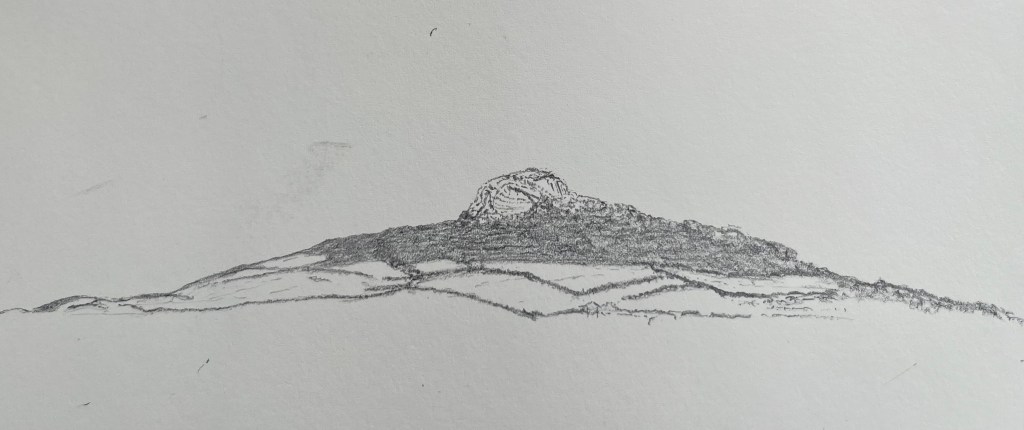
Carn Llidi Tor from the Premier Inn St David’s – weather conditions indeterminate

The previous evening, after being unsuccessful in getting a seat at either of the two snug olde-wordle looking pubs, I retreated to an alternative in a back street to have a quick pint before returning to the hotel. As I sat nursing a freezing cold drink that called itself a “bitter” a middle-aged American couple entered the empty saloon bar, where they stood for a minute or so. The woman who had served me was yacking away with punters in the public bar. It struck me that it might not have been the sort of place the couple were expecting, but if you’ve come 3000 miles on a pilgrimage, needs must.  “We’re trying to book in,” the man said to the woman, after she eventually emerged from the public bar to cater to them.

After checking in and receiving the keys the couple went upstairs, at which point the woman who had served them slipped back into the public bar and proceeded to mock the man’s use of English. ‘” We’re trying to book in”, he says. “We’re trying to book in!” What does he mean, we’re trying to book in?”’ There was some laughter from the locals. I proceeded to carry on reading my old paperback. Ten minutes later the man came back into the bar. The woman went over to him. His wife, he explained, had noticed black mould around the shower. Was this normal and could be cleaned off? At this, instead of expressing empathy to her “guest” who, given he was from the States, may never have seen classic British bathroom black mould, the woman started a long, possibly rehearsed, load of nonsense about the rooms being cleaned down thoroughly every day and that no matter what they did it was impossible to remove. In an almost absurd escalation in the excuse stakes she then went on to explain that they could renew the putty every week, but the mould would be back the next day. That she had used the word “putty” nearly had me snorting into my beer, but apart from that it was an appalling example of how to overwhelm your victim (sorry – guest) through bluster, misinformation and subtle sarcasm. Distracted by this interaction I had stopped reading my book – ironically The Quiet American. The poor man had no effective retaliation in his armoury. Somewhat humiliated, and in the knowledge that he was going to have to go back and explain all this to his disappointed partner, he merely mumbled that “he guessed that was all that could be done then” and retreated sadly towards the stairs, head down. The quiet American alright!

I may have stayed for a second pint, but I didn’t. As soon as the man had disappeared upstairs, I could hear the woman in the other bar repeating almost word for word to the other customers what she had told him. There was some more laughter. I supped up and left. *

The reason I mention this is that the next day, and halfway up Foel Cwmcerwyn (the highest point in Pembrokeshire) I kept thinking about it, every so often shaking my head and wondering about the state of things, and indeed what she might have said to the other punters about me after I had left. ‘”A pint of bitter, please. Please, what does he mean by please?”’  Too late to worry about it now.

I had left St David’s and headed out of town on the north Pembrokeshire coast road. Past the Blue Lagoon at Abereiddy, the charming little post-industrial village of Porthgain and the pretty village of Trefin. The day before I had given up on any walking ambitions and had stopped the car in Trefin seeking refuge in the Ship Inn for an hour until an almost apocryphal downpour had stopped as quickly as it had started, after which I was at last able to go back the way I had come and finally check out some of the hidden gems.
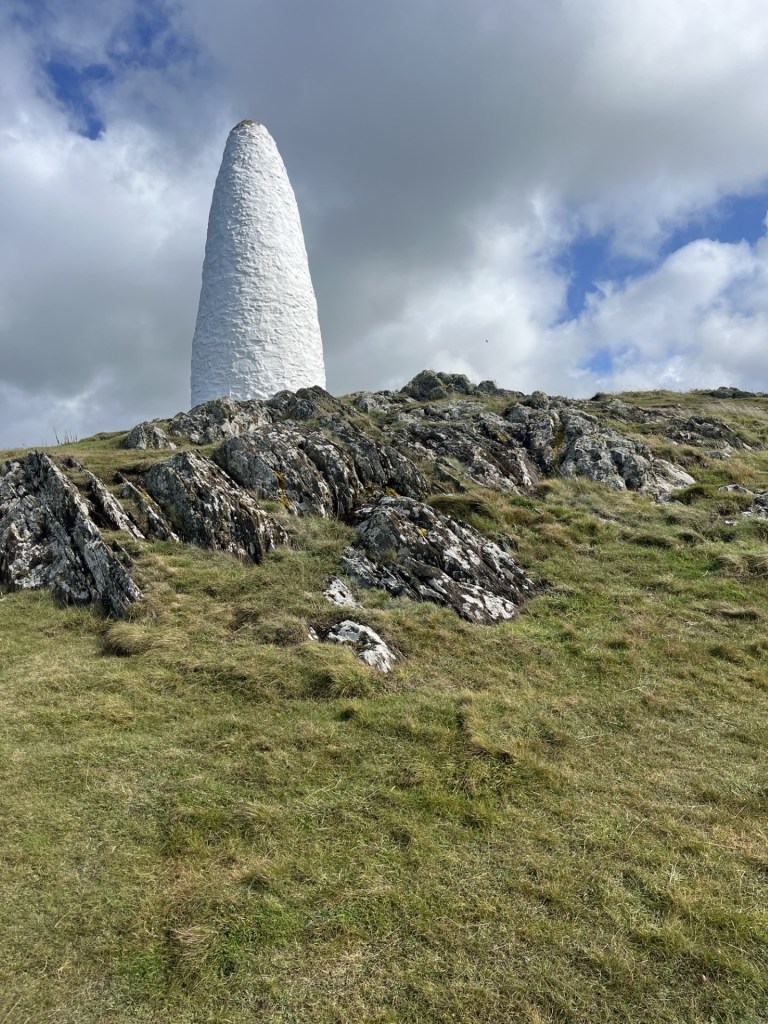
Above Porthgain
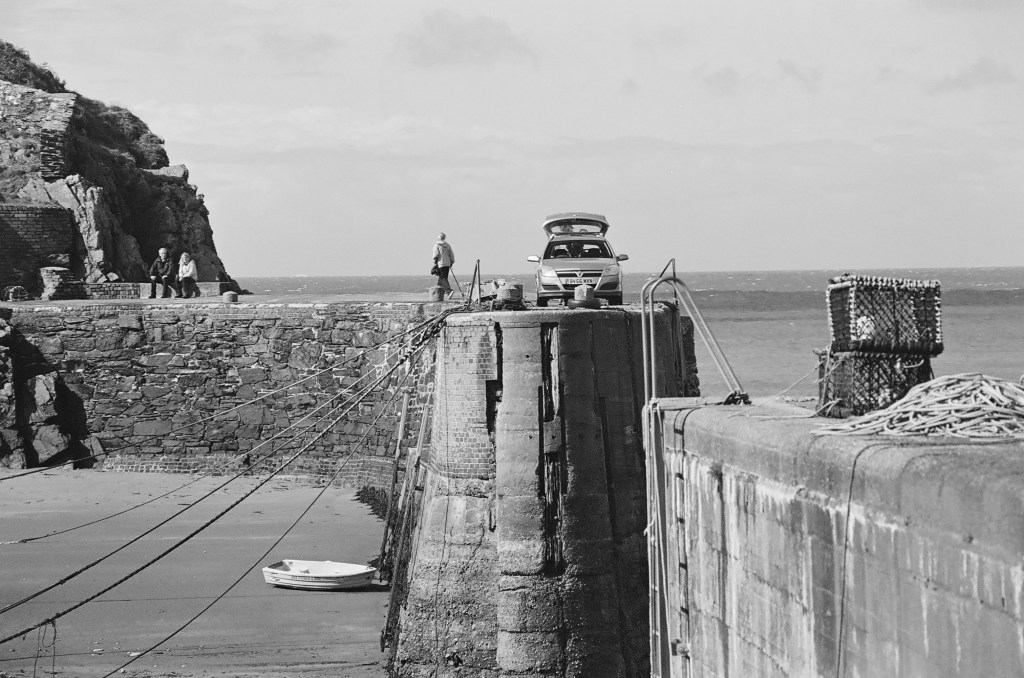
Porthgain – the harbour. The two people on the bench are, like me, trying to work out how the car is going to exit. On the horizon the Fishguard the Rosslare ferry battles against the elements
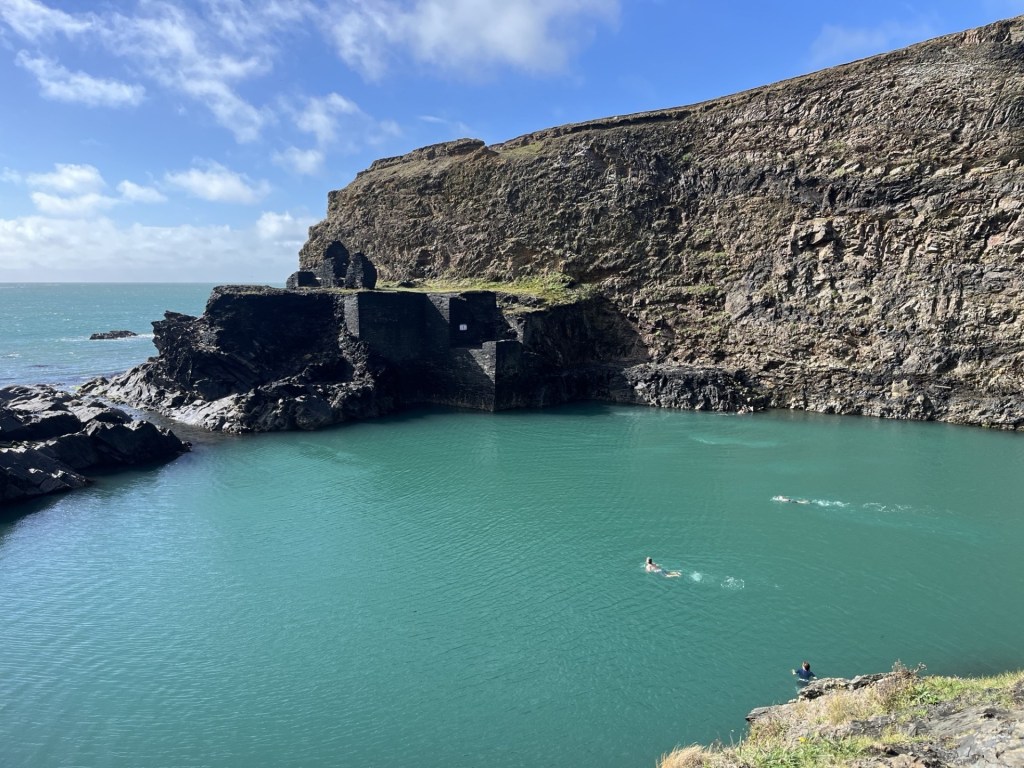
The Blue Lagoon. I wasn’t tempted
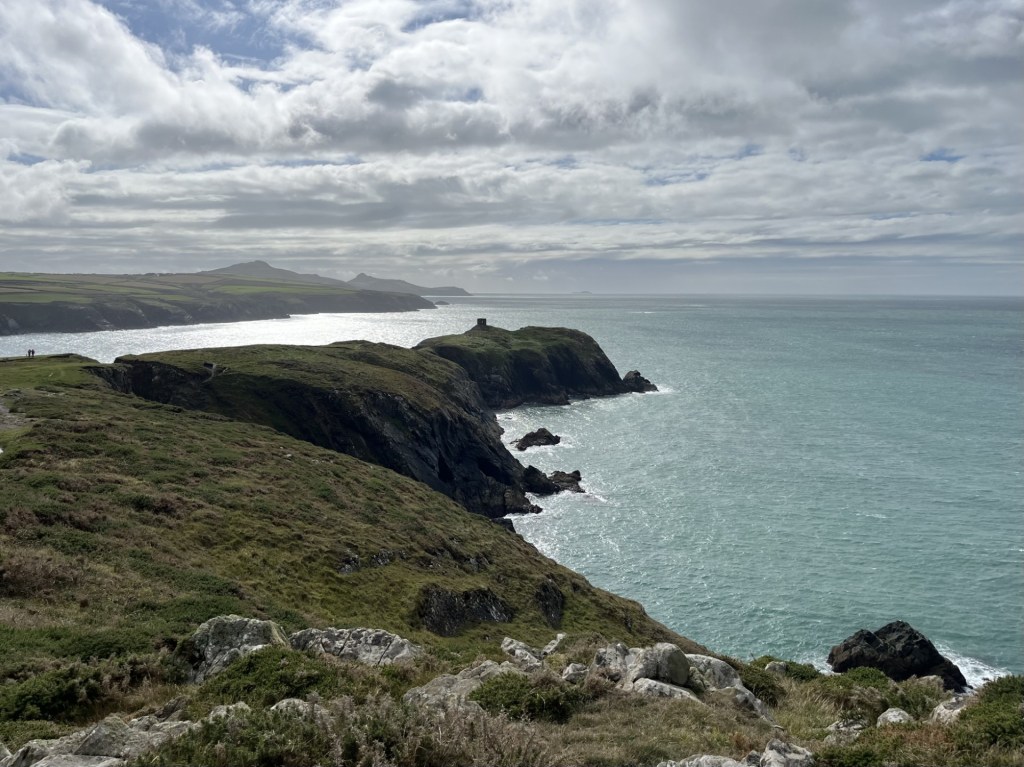
Beyond the Blue Lagoon at Abereiddy

Despite almost persistent rain and gale force winds over the previous two days (these photos deceive), I had managed to squeeze in some short walks along parts of the coastal path. Bracing, soaking but also delightful, with huge Atlantic waves smashing into the igneous and sandstone ramparts defending the rolling hinterland, it was a place that screamed “come back.”

With one night left in Wales, the evening before I had booked a room in Cardigan, situated to the north. Foel Cwmcerwyn was, with a bit of a diversion, on route and in the heart of the Preseli hills of Stonehenge fame (arguably). I reached Fishguard midmorning. The weather forecast was ambiguous, but for the moment it was warm, windy and bright and I decided to stop and find somewhere to eat. I can’t tell you about the initial attempt to park in a pay by phone car park because it’s too painful to recount, but if you want to get close to how I felt I can recommend reading my related accounts of similar experiences with the same service provider in West Sussex and Oxfordshire. Needless to say, it was hideous in extremis. After a brief interaction with a local man who recognising my unstable condition and gave me some profound words of advice, I gave up.  Minutes later I discovered an entirely free car park just a few metres further down the bay.
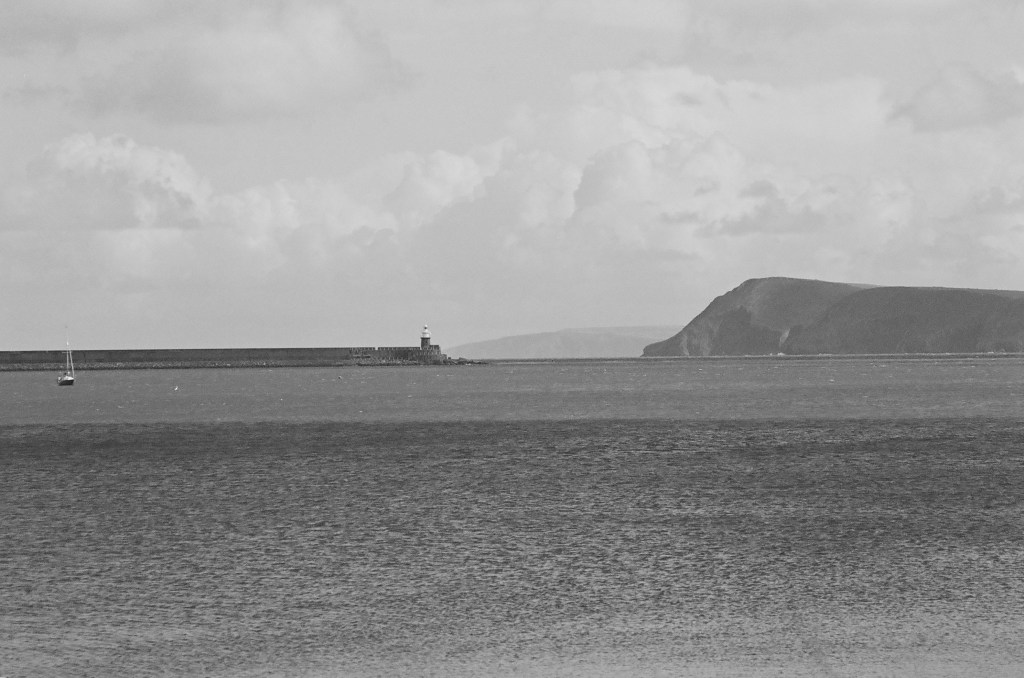
Fishguard – Gateway to the Republic, and the EU, from the free car park

Tempting as it was to stay a while and look out into the bay for the chance of spotting the odd seal pop its head above the surface, I had to crack on. I left Fishguard on the A4313 heading inland and east through picturesque country. I reached the village of Rosebush at around 2pm and found a small car park just past the old railway station (more later).

To reach the top of Foel Cwmcerwyn I had to work my way up to the north-east. I had a rough idea of my route but after an abortive meander north along the line of the dismantled quarry railway I backtracked to the car park and climbed back into the car. Heavy downpours were visibly operating in the area, and one was threatening now. I knew there was a chance I’d get caught out at some point, but who needed a drowning at the get go? The shower somehow missed Rosebush. Once I was reasonably satisfied that I was in the clear for a bit, I walked up to some cottages and then onto a signed footpath that led steeply up past some farm buildings and then through a large field. **

By the time I had climbed to the top of the field, I was, to put it mildly, knackered. It wasn’t a good start, but I figured I’d got the tough bit out of the way, and now on a more significant track with impressive views opening up in every direction, my motivation returned.
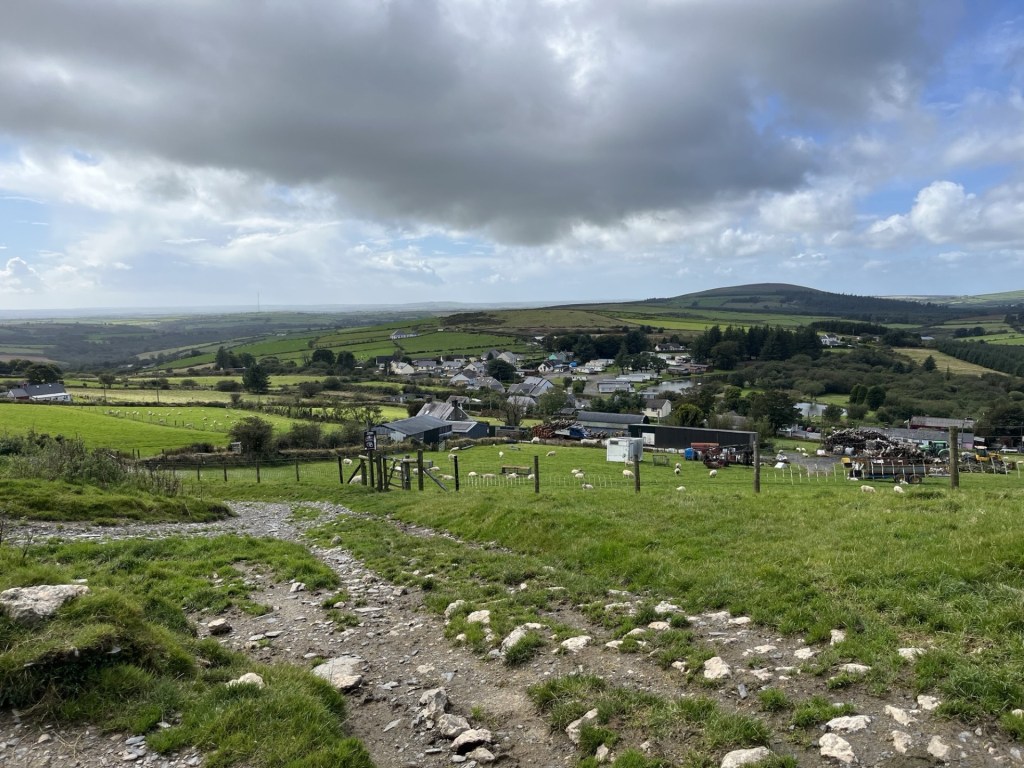
On track, after the initial lung buster. Looking down on Rosebush

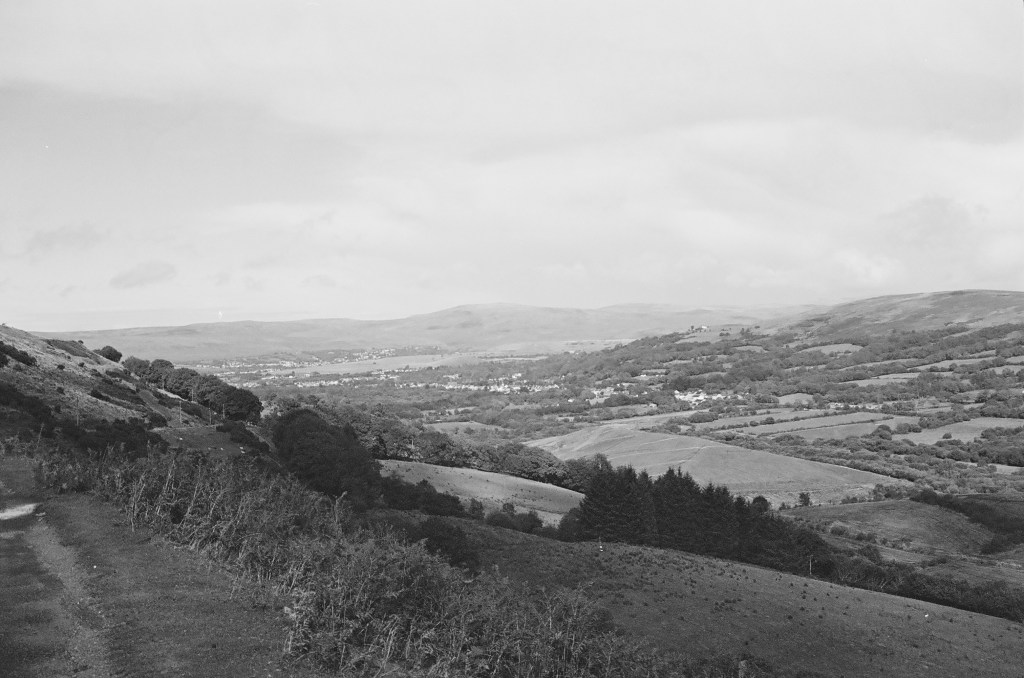
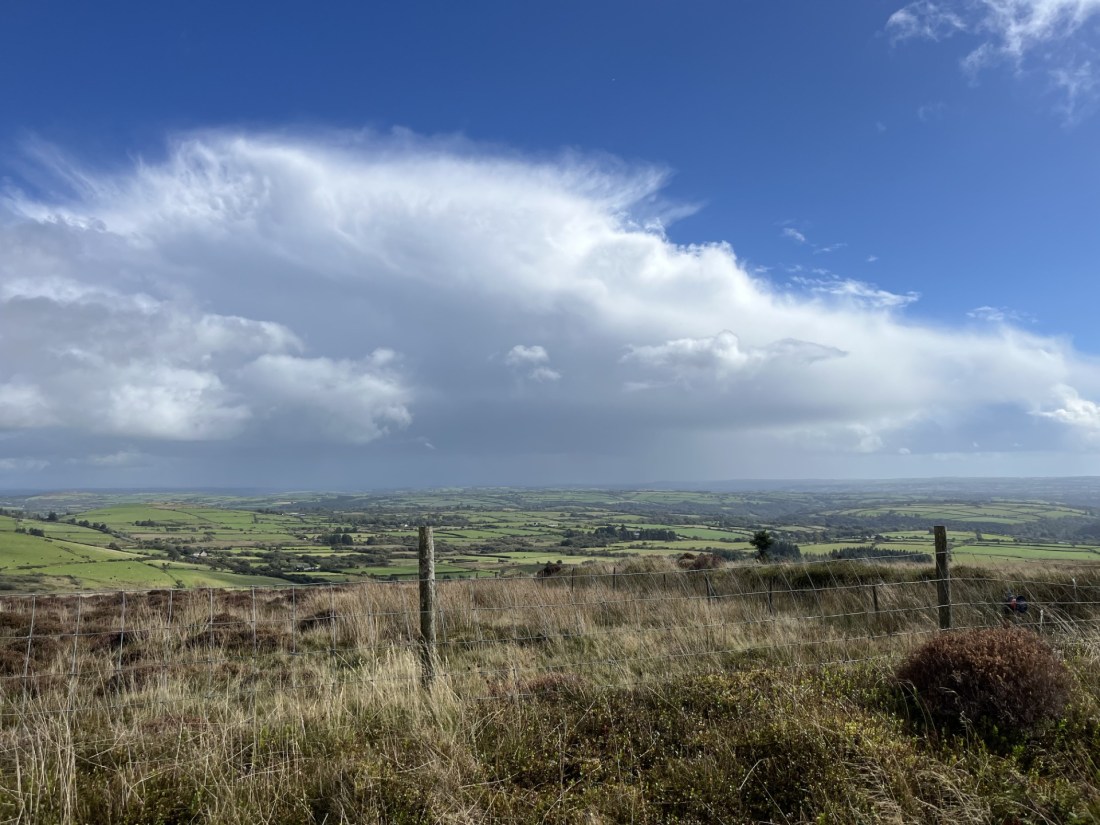
I’ve already mentioned that the weather forecast was ambiguous, by which I mean that it predicted a lot of rain at any moment and very strong winds. I had come fairly well prepared, but now in hot sunshine, and walking resolutely up the well-trod track, I was beginning to wonder if I had overdone it. Looking south a vast battleship grey cloud shedding its load was engulfing a large industrial structure (presumably Milford Haven) dozens of miles away. Already the views were impressive, but so too were the weather systems steaming in from the Atlantic.

The track maintained a steady course heading north-east and on a reasonably tolerable gradient. Soon forestry plantations appeared on the left, and sweeping views opened up down the lush valley to the right.
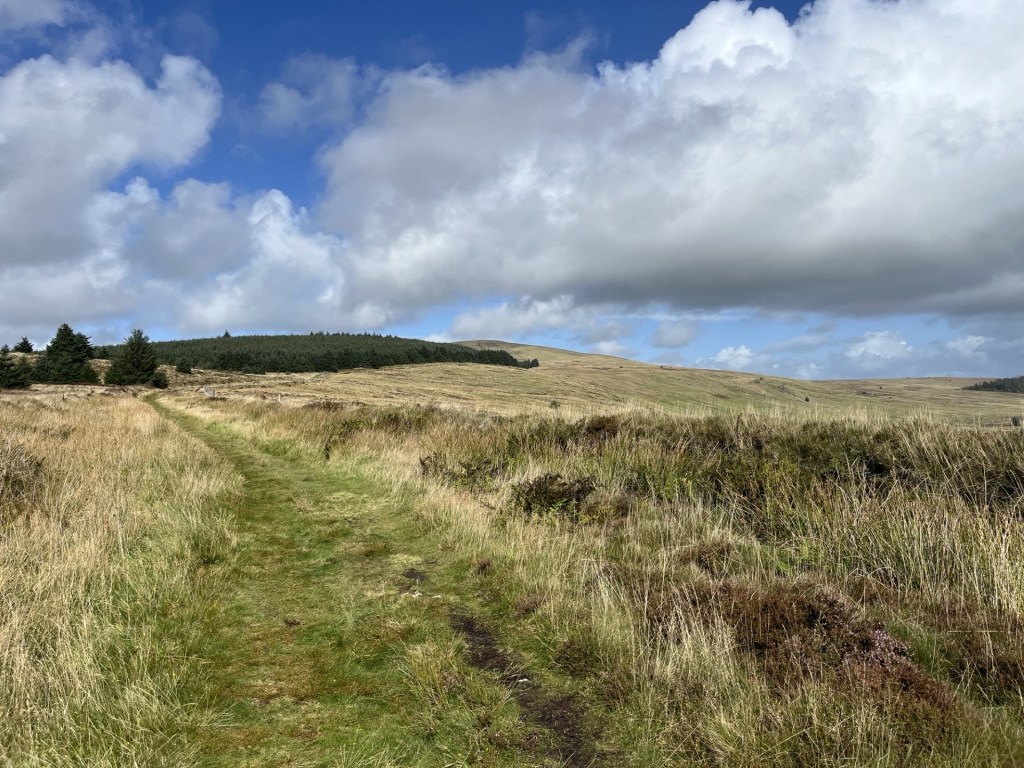
Towards the forest
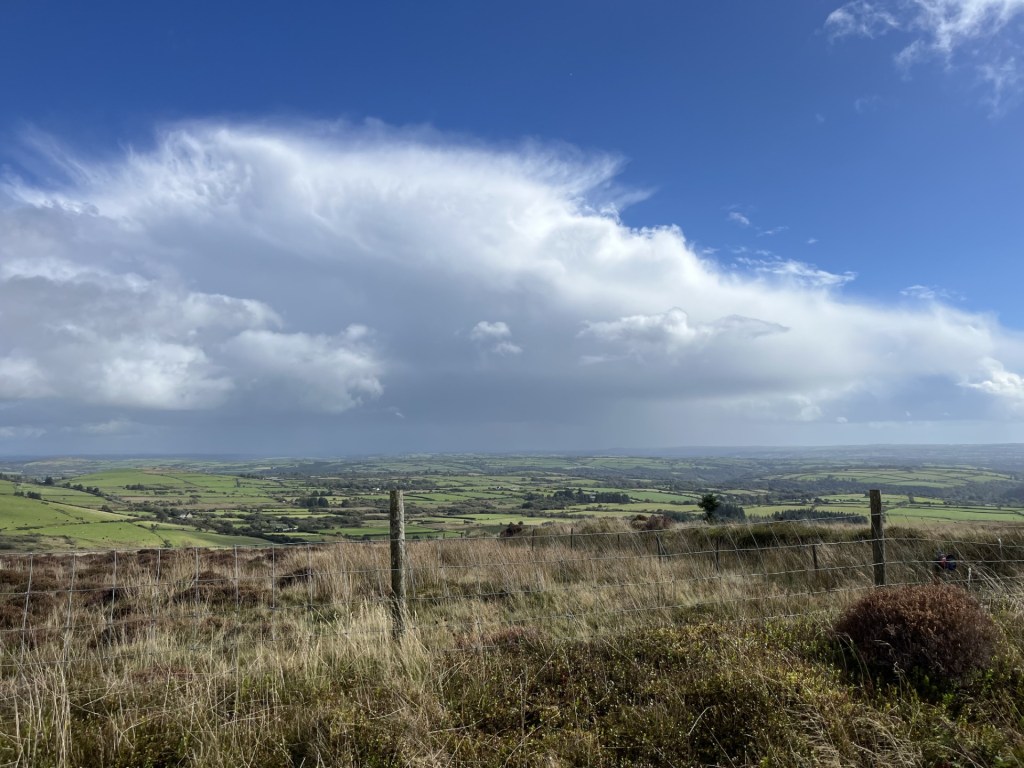
Towards the rest of South Wales and storm alley.

Up until this point I had been the only person on the path, but now, coming down in my direction, a couple appeared on mountain bikes. They stopped and we spoke for a bit. Like me they were from the South-East, although a decade or two younger. The man was on a bike fitted with a battery, although I wasn’t so sure the woman was. We talked a bit about cycling (me admitting I was running out of enthusiasm), and by the time we had said our farewells, I was pretty much sold on the idea of battery power. We’ll see.

I carried on across boggy ground before more trees appeared to the left, and the gradient started to increase again. Beyond the trees the wind suddenly hit me like a brick. I made it to a wooden gate which would take me onto the open hillside. Here the path steepened significantly (the cyclists had warned me although I’d been sceptical). Now tip toeing up, the wind battered me from behind, bizarrely hindering rather than assisting progress. It took about ten minutes to wearily trapeze the final couple of hundred metres to the trig point at the top. I knew it was going to be there, and with each step I relished the prospect of being able to hunker down behind it to give some respite from the gale.

So, on arrival, and finding a group of four other intrepids completely surrounding the concrete structure, my little heart sank. All I could do was loiter around for a bit in the hope they would move on, although that didn’t seem likely given their insatiable need for selfies and group photos (I didn’t begrudge them doing it, given it was an achievement worth recording, but I was a good three decades older and feeling like I’d been sandblasted). Thankfully, after some minutes, they departed in the direction of Rosebush, and I was at last able to grab hold of the trig point and stabilise my condition. The views in all directions were magnificent. Here, at the top of Foel Cwmcerwyn I could see the whole of Pembrokeshire and beyond to Cardigan Bay. To the far west the Rosslare ferry was slipping out of the safety of Fishguard harbour and smashing itself directly into the wild wind and waves of the Irish Sea. Now able to stand reasonably steady I took a few photos that probably don’t do the view justice.
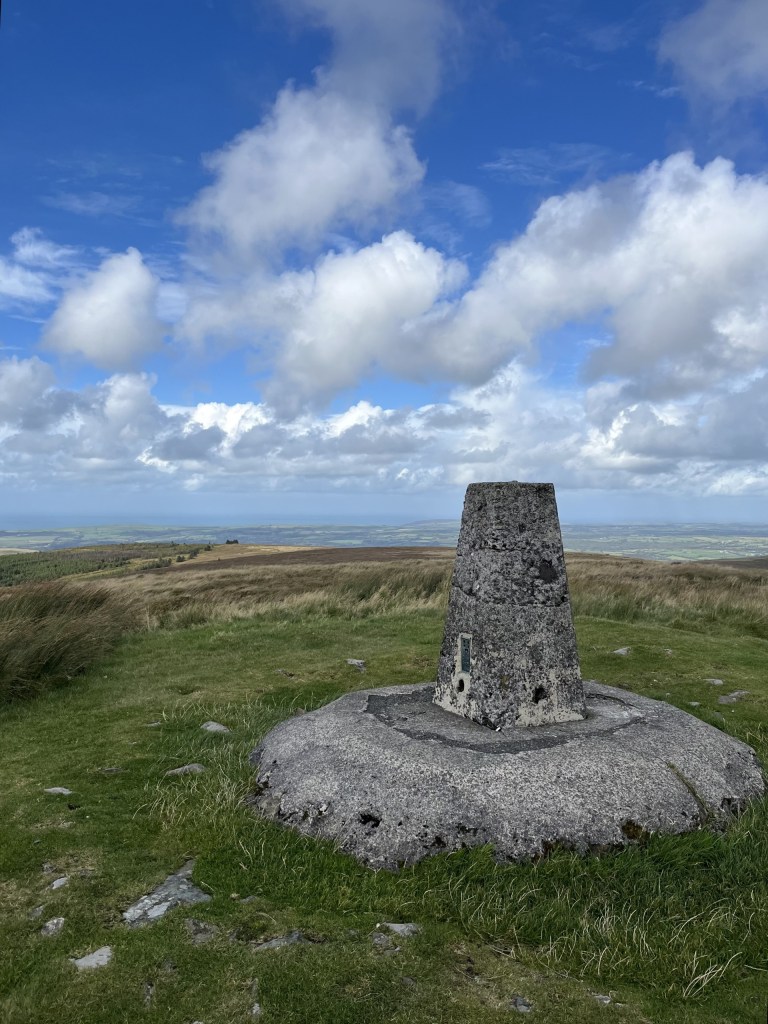
A wild westerly and the resolute Trig
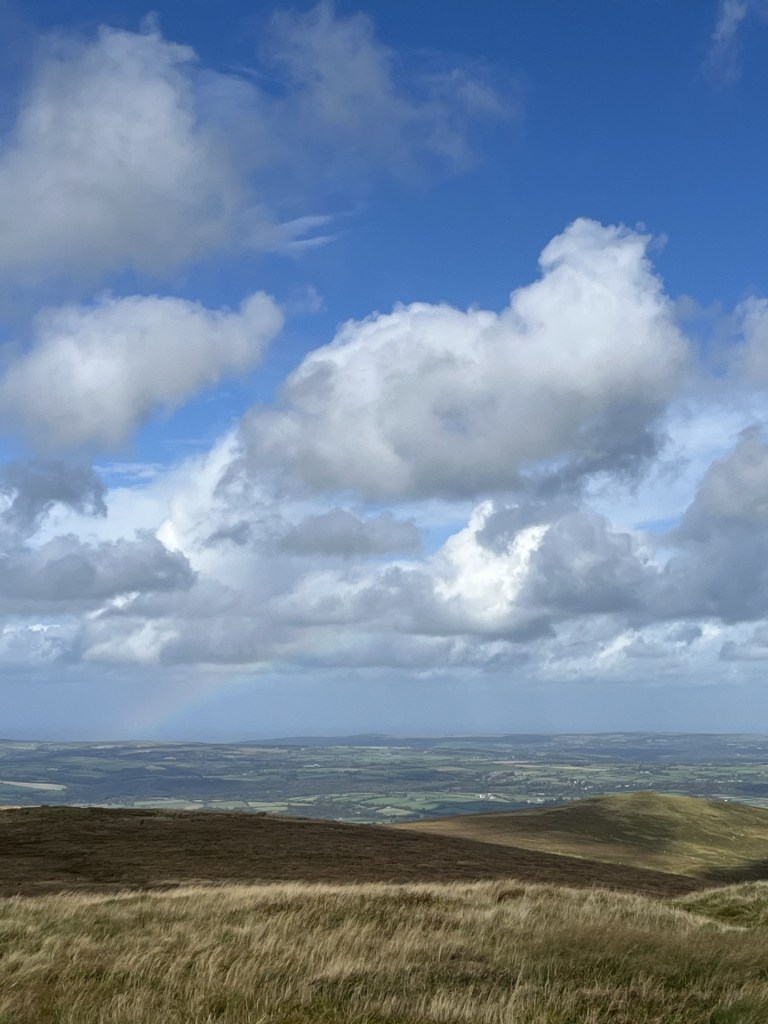
Rainbow over Cardigan Bay

So far, I had been lucky. Rain clouds were dotted around in every direction. It was time to head back. Launching down the path was like trying to walk into a wind tunnel. Without gravity I’d never have made it down to the gate. Beyond the gate the trees once again gave cover, and I was proceeding at a reasonable pace. Now more relaxed I was able to get a better appreciation of the views down the valley and beyond towards south Wales proper.
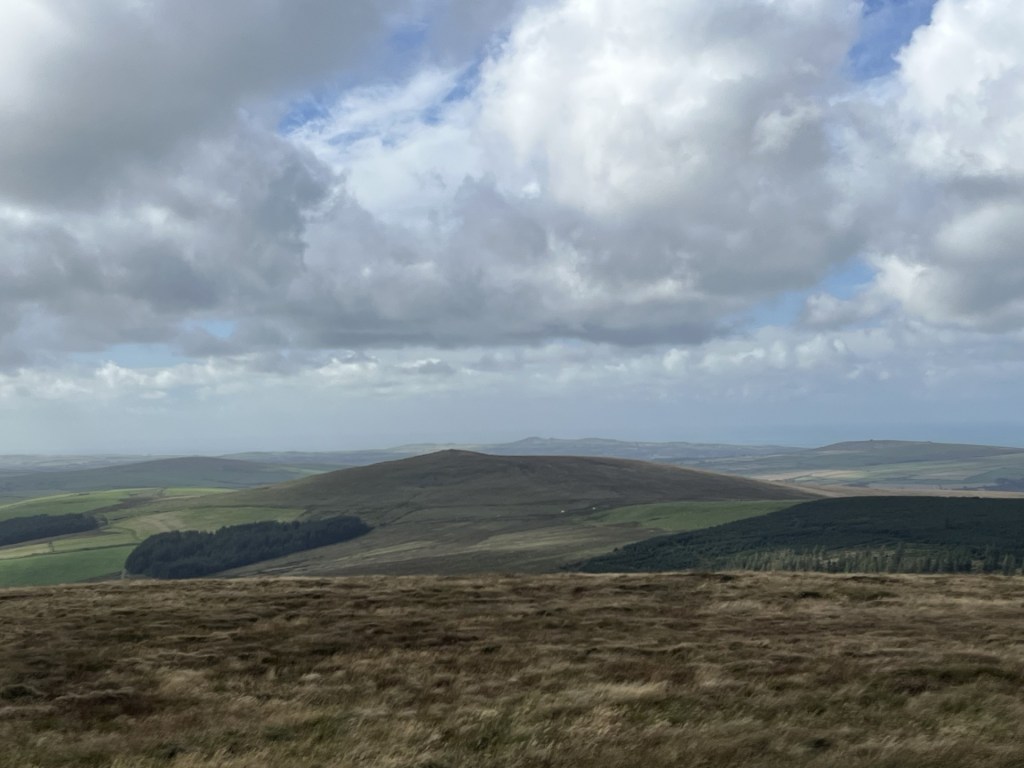
Towards south-west Pembrokeshire

I stopped for a bit to take in the dramatic view. A farmer on a quad bike was heading up the slopes and corralling a long line of white dots from one field to another. The commotion had spooked three horses that were now galloping away under sun and shadow.
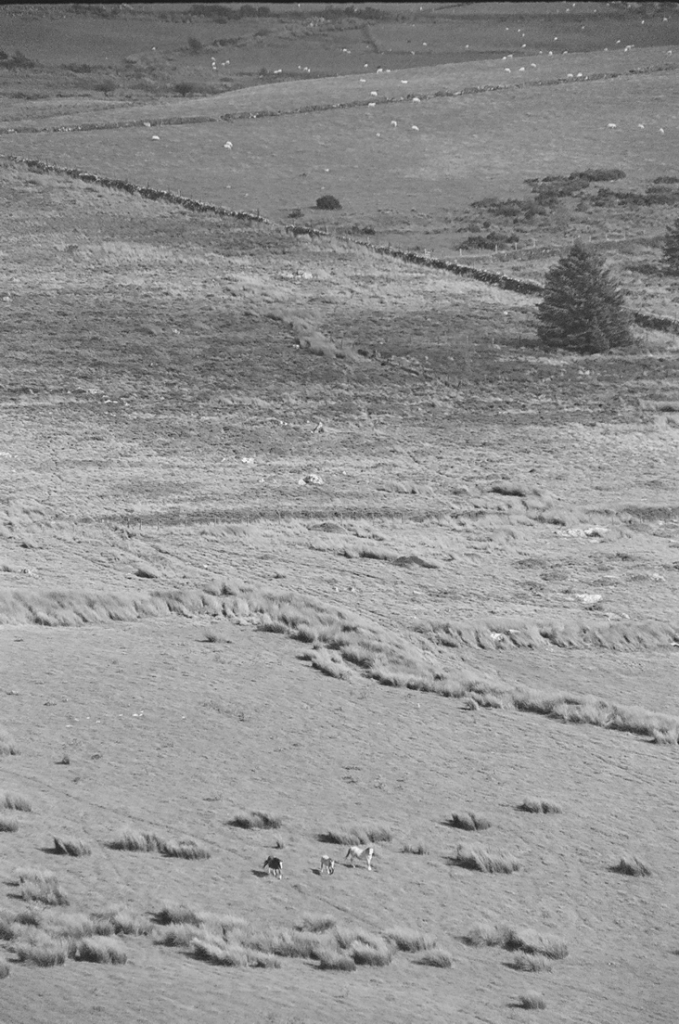
Cantering on the range

By the time I reached the end of the plantations to my right, I was becoming increasingly concerned by a large looming mass of dark cloud scudding towards my position, and with my name on it. I had nearly caught up with the gang of four who had earlier been hovering back at the trig point. A footpath led west along the edge of the forest. There were two options. Take the path under some tree cover or continue down across the large and exposed field above Pant Mawr farm. I chose the path with the trees. The others chose the field.

Large drops of rain began to fall. Sadly, the isolated tree cover was less than useless so I was forced into a light jog until, on the slopes above the old quarry, I found a large well leafed tree that offered more protection from what was by now an epic deluge. Fortuitously I had packed a small umbrella, which was deployed to surprisingly good effect.
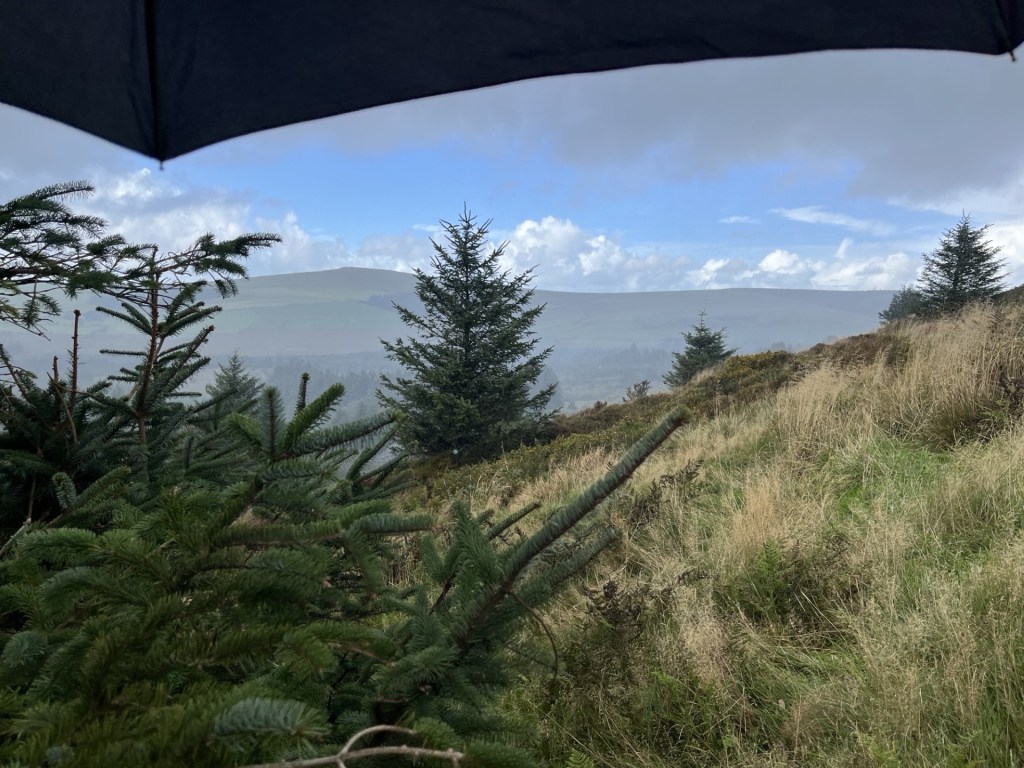
Unaccountably well prepared

The lashing quickly passed, and I headed on down the lumpy and sodden ground to the route of the old quarry access road and railway line.
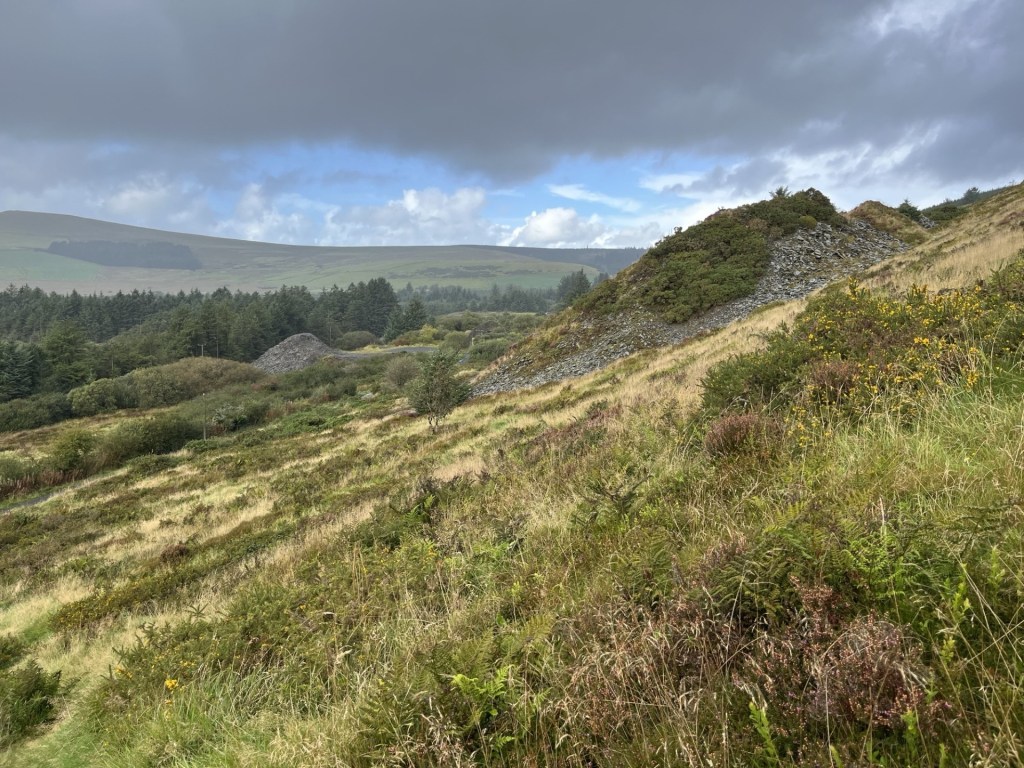
Slate heaps after the rain

By the time I reached the community run pub at the old station (Tafarn Sinc) I’d walked exactly four miles. Along with the wind and rain it had felt a lot longer but had been worth every step. I’d found a part of Wales off the beaten track, but with a great walk leading to impressive views of the south-west and Pembrokeshire .

I took my coffee out to the open terrace. A small garden area led to where the tracks had once been, and beyond the remains (or possible recreation) of a platform. Three plastic dummies, dressed in period working-class clothing had been assembled, presumably to remind us how it must have been for passengers back in the day. The intense and distant stare on the face of the woman suggested it had been thoroughly miserable, yet despite the passage of time, relative prosperity and different clothes, that look is still familiar on most station platforms today.
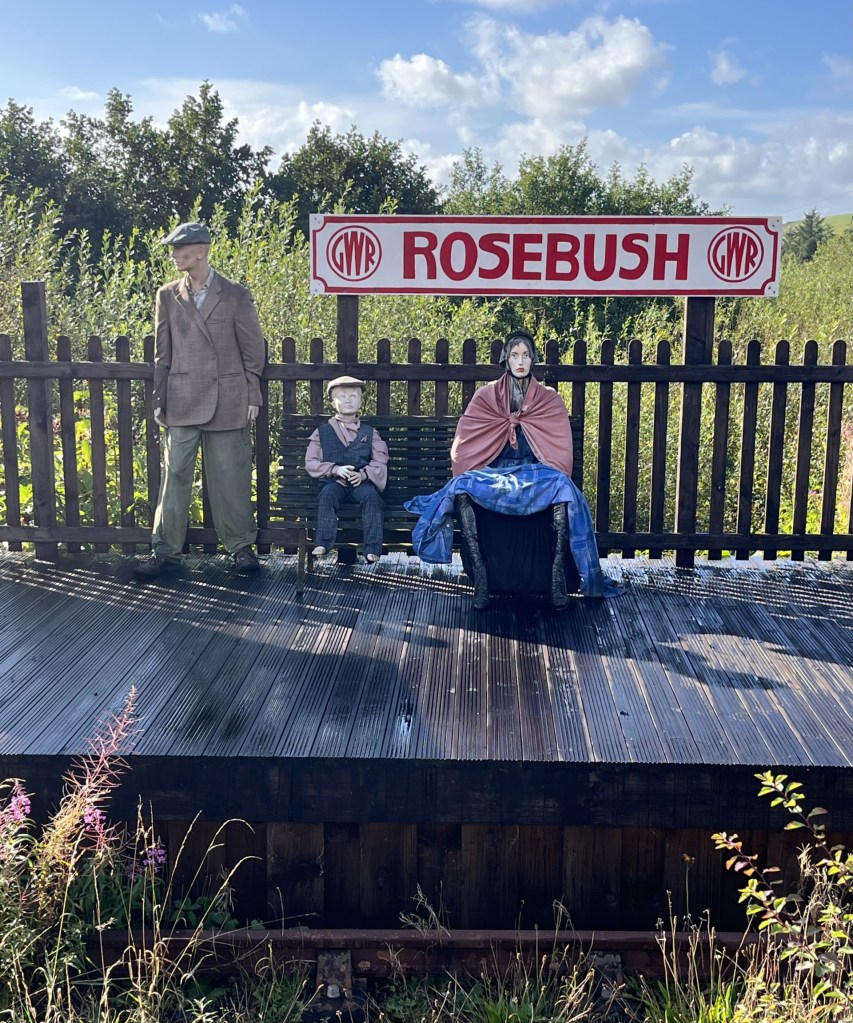
A distant echo

As I drove away from Rosebush and towards Cardigan, with the wind still whipping around the nearby trees, the news on the radio announced the end of a political storm that had been brewing away for days across the Atlantic. Peter Mandelson had been sacked.

* I ought to own up here. Whilst I really was appalled by the bar woman’s behaviour towards her American guests, a few weeks earlier I had met up with a very old friend in a small town in the Peloponnese. I was staying in the town, and he was passing through in his camper van. As we sat outside a taverna waiting for food and observing a mink casually saunter up the road on the prowl for anything that moved, I mentioned the sequence of wildlife sounds that had been routinely waking me up in my room every morning. Starting with a crescendo of sparrow chirping around six, followed minutes after that by the sound of a mouse running backwards and forwards in the ceiling space above my bed (it might have been a rat, but I wasn’t prepared to countenance that possibility), and then finally the cicada’s early morning conversations.

The mention of the mouse took my friend back fifty years to a distant moment in time when he had worked at the Waldorf Hotel in London in the mid-1970s. He explained that for a time he had been the night manager and that the worst part of that role was the almost nightly complaints from new American guests about the sound of mice in their room. My friend is one of the funniest people I have ever known, so it was no great surprise that over the next ten minutes he rolled out a long list of all the excuses that the night manager was expected to respond with under these circumstances, and that by the end I was on the floor in hysterics. Without going into specifics, the essential aim was to express immediate and incomprehensible dismay (“A mouse sir! Surely you’re mistaken.”), that the possibility of a mouse in the Waldorf was an impossibility in modern 1970s Britain, that perhaps sirs wife had oversensitive hearing, or that they may have been confused by another source of the noise, or even whether it might have been possible that the guests had brought the mouse into the hotel in their hand baggage. Only in the last resort would a room change be agreed. Of course, it was the 1970s, and not just the Waldorf, but almost every structure in the whole of London was riddled with mice.  

** Not visible at ground level, but when I looked at the area around Rosebush on Google earth, I noticed what appeared to be huge letters spelling the word CAWS in the tree plantation just to the east of the cottages. Surely my eyes were deceived. Well, a bit of research and sure enough, around twenty years ago the local farm, which produces its own cheese, planted a large number of conifers that do indeed spell CAWS, which apparently is the Welsh for “cheese”. Smile! Here’s a free ad for them.
https://pantmawrcheeses.co.uk/

Cresting the County – Swansea Unitary Authority (Abertawe)

Mynydd Y Betwys – Penlle’r Castell

Metres 373

Feet 1224

8th September 2025

On the Road to Mynydd Y Betwys

I’d started the day in Chepstow and by the late morning had undertaken a short one mile walk to the top of Newport Unitary Authority (or County depending on your cup of tea). By the end of the day, I hoped to be in St David’s in the very south-west of Wales, an area of the mainland completely new to me.

South Wales is festooned with Unitary Authorities (also known as Principal Authorities in Wales – yeah, I know, I’m learning this stuff as I’m going alone). Twelve at least. From what I can tell most of these fall within the footprint of the old county of Glamorgan. Given my stay was just a handful of days I had to be realistic about what I could achieve. I plumped on one more on my way to Pembrokeshire.

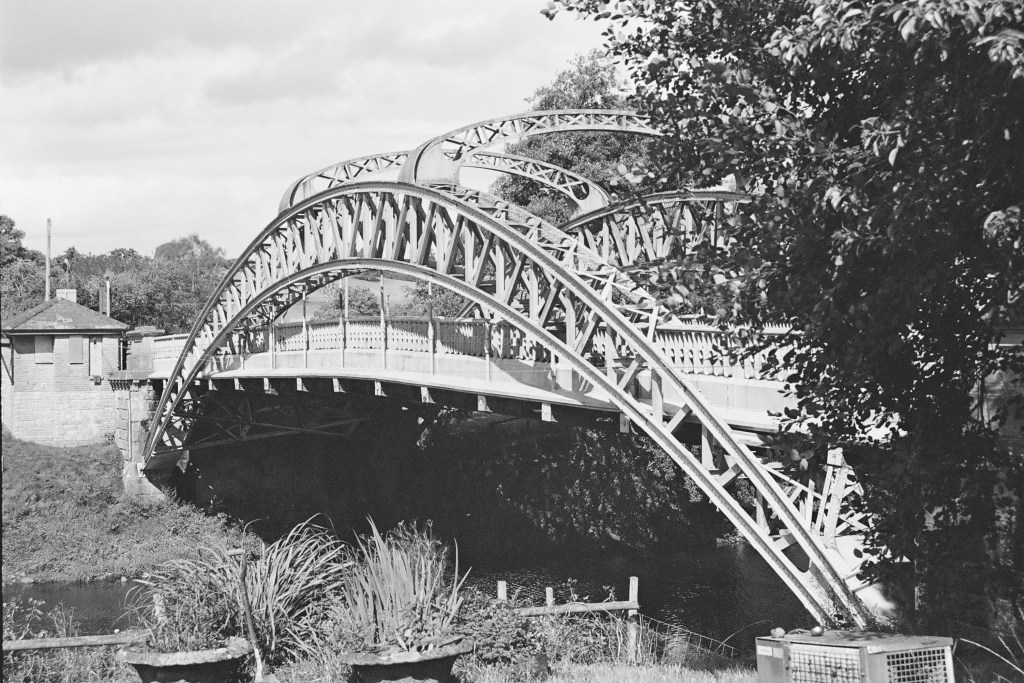
Leaving Wentwood forest to the north-east of Newport I headed up to Usk, an attractive small Georgian town with its very own well designed but slightly incongruous, Victorian prison. Past Usk and in need of a refreshment, I stopped at the Chainbridge Inn on the banks of the River Usk, adjacent to its namesake bridge (built in 1906 and not a chain bridge!). 

The chain bridge, in black and white. In colour it’s an oddly attractive pastel green.

Rehydrated I carried on to Abergavenny then onto the A465 and the revelation that is the Head of the Valley’s Road. I knew this road headed west but had no idea what to expect. As far as I knew the only major road in south Wales was the M4, which I’d vowed to avoid if I could. The first thing I noticed as I drove away from Abergavenny was the enormity of the rain that suddenly appeared from nowhere and within seconds turned the dual carriageway into a fast-flowing riverbed. The flash flood was so extreme that for the first time in my driving career every other driver slowed down to around 30 miles an hour and took extreme care (I know, I was shocked at having no-one diss).

After ten minutes or so the rains passed, and now in bright sunshine it was possible to get a better sense of the road, and to be fair, it was staggering. Obviously recently improved, the dual carriageway made its way upwards with hills and country to the north, and valley by valley, the old coalmining towns of fame to the south. Blaenavon, Abertillery, Ebbw Vale, Tredegar and then Merthyr Tydfil, just to name a few. This was an impressive and at times spectacular piece of infrastructure, which, it seems, had only been completed in May 2025. It was hard to imagine that not so long ago it would have been a two-way high road with an endless stream of open topped lorries lugging wood and various carbon-based minerals east to west and then south, beset by roadworks, traffic jams and all happening in black and white. If, and when, I come this way again, the A465 is the road for me. And, for context, if I’m to carry on cresting counties, I’m going to have to come back this way as several of the “tops” are on the slopes just to the north of the road. 

Before we get to where we’re going with this account, there is something I need to say about Welsh road signs. And before I say it, I wish to make it clear that it’s my problem, no one else’s (coward!). * So far, it had been so good. What I mean by this is that by and large I had coped with the road signs, primarily because I was familiar with most of the names of the towns en-route. Welsh road signs (in case you’ve not been) are in Welsh and then English. The problem for any non-Welsh speaker is that it’s got to be one of the most impenetrable languages on the planet. I’ve been to quite a few European countries and despite not knowing the languages usually manage to get around fairly easily. Even in Greece, where a lot of the road signs appear in the demotic Greek alphabet, I can usually get a grasp of the look and sound to help me on my way. Sadly, and to my shame, I can’t say the same about Welsh.

Past Merthyr Tydfil I was instantly out of my depth (having yet to get my phone to successfully pair with the in-car audio system) as the road signs came and went without me having the time to fully digest their meaning (the Welsh appears first). To reach Mynydd Y Betwys, the “top” of Swansea and my chosen second “top” of the day, I first had to get to a place called Glynneath, about ten miles west of Merthyr. For the life of me I couldn’t get this to stick in my brain – and it’s an easy one! I had pulled off the A465 twice to check my location before eventually reaching the Glynneath junction. It wasn’t the name that helped me identify the junction but the fact that I had looked at the map so many times I was interpreting the topography and landscape rather than the signage.

Past Glynneath I was now on the A4109 heading up a steep hill and with the radiator grill of a huge articulated lorry looming close in the rear-view mirror. My little old Ford had no gear equal to the challenge and all I could do was metaphorically close my eyes, grip the steering wheel, and hope. Towards the top of this long drag I was eventually able to get clear of the maniac but for a minute or two I had felt like Dennis Weaver in the exemplary thriller Duel.

By now, the road signs had become irrelevant. I was driving by wire and instinct. I knew I needed to get to a place that started with a Y, followed by at least twelve other letters that could have been in any order, and I would never have been able to pronounce it. At one point the road forked in two and taking the left fork, I immediately decided to stop to get my bearings. I got out the phone and looked for the town which started with a Y and decided I had taken the wrong fork. As I put down the phone and set off, I checked the rear mirror (as you do) and there, parked up, twenty-five metres back, on the other side of the road, was the lorry. Don’t panic, it was just a film for forks sake! I made a swift exit onto the A4221. If I could just make it to Y……….. surely I’d be safe. **

The town beginning with Y was a place called Yynnwddsypondywynnagogo. No, of course it wasn’t. It was actually called Ystradglylias, a large town that I had never heard of before. And it wasn’t the only one. There were loads of them. Given that (unaccountably) 2% of my DNA is south Wales I’m ashamed of my ignorance of these places.

Anyway, past Ystradglylias I headed on down the A4067 (the main Swansea road), turned right into Pontardawe and then further inland on the A474. Lost again I pulled over and punched in the destination on my phone. I knew I was close but with my complete inability to absorb any of the information being presented on the road signs I might as well have been shooting at ducks in the night. Ok, so all I had to do, according to Google maps, was to keep heading north on the A474 and take the first left and then uphill for a mile or so and then… well, I’d check again then.

I took the first left onto a small road that headed down into a small valley. So far so good. I reached a municipal recycling centre on the right. The road continued west, but a sign, helpfully in English (No Entry), unhelpfully claimed that further progress was, if not illegal, then certainly not possible. Despite the wondrous progress made on the A465 I had been driving for over two and a half hours. The thought of turning around and trying to navigate another route now was a tad demoralising. Well, whatever was going to happened next, I could only try, and so long as the nutter in the lorry wasn’t coming the opposite way it would probably be okay.  

Just past the prohibitive sign the road narrowed rapidly and then started tracking steeply up and around super tight bends. It reminded me of the sort of roads that in the 1970s, those of a sportier spirit drove small low bodied cars up as fast as they could just to find out how quickly it could be done and as a bonus appear on Saturday afternoon TV. But I wasn’t in a sporty mood and made every effort to reach the top in a record slow time, aware that at any moment I might be confronted by a large slab of concrete.

Coming towards the top a tiny wedge of land opened to my right – just large enough for me to pull over to check the view and how close I was to the edge.

How Green was my Valley? Hmm… wrong film colour! The Upper Glyndach River valley

The road soon reached a plateau. Turning right I was now heading west on a straight road crossing moorland that offered up impressive views in every direction, and numerous sheep that hadn’t yet worked out sensible kerbside etiquette. The road descended again, this time into the Lower Glyndach River valley before ascending steeply again up to another plateau.

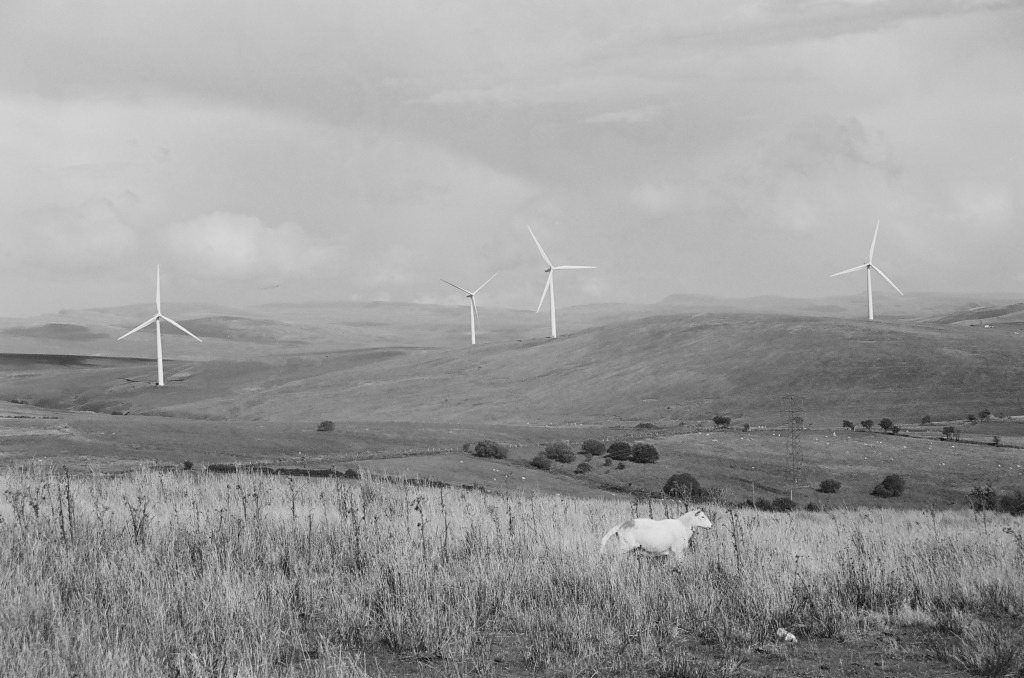
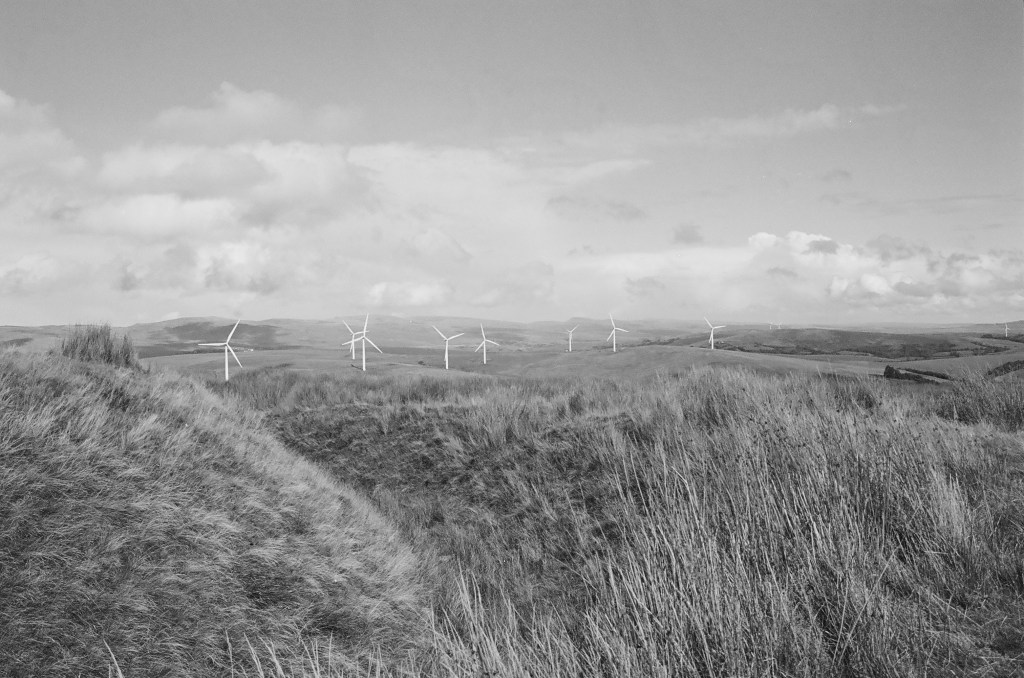
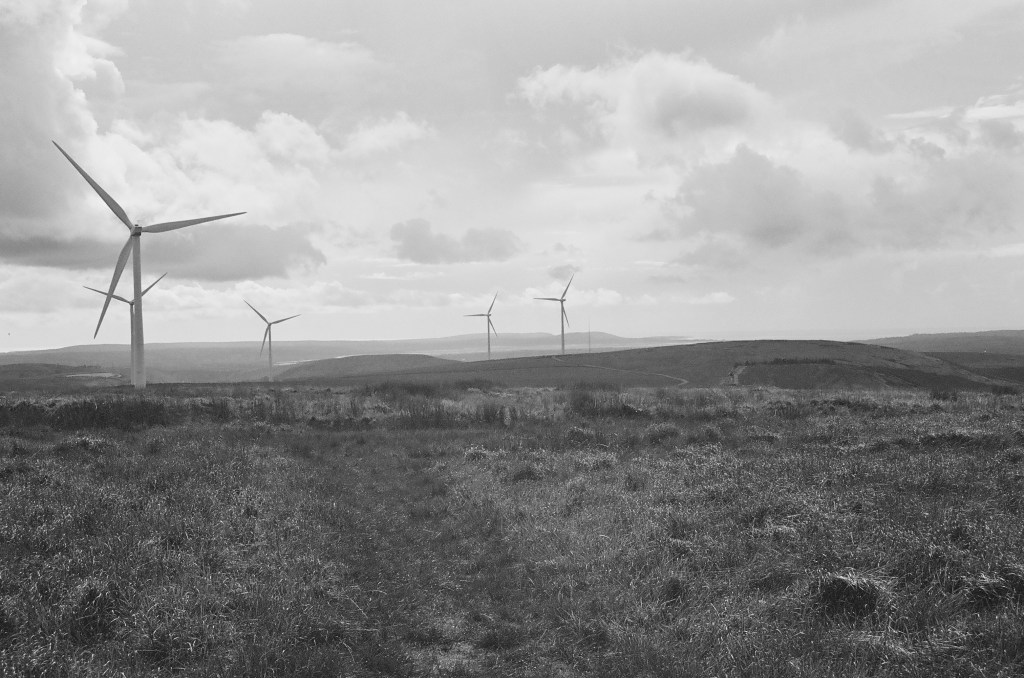
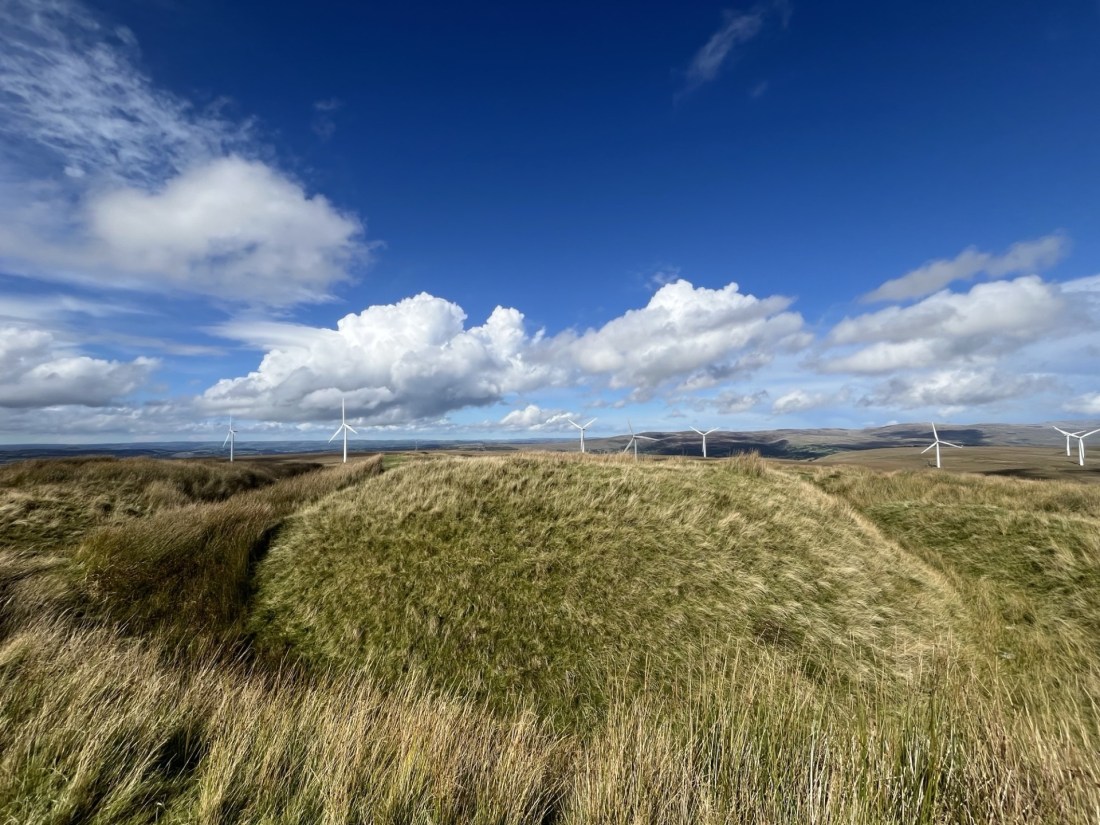
I pulled over again to appreciate the view, which now included an impressive set of wind turbines stretching away to the north.

Wind mining and the noble sheep

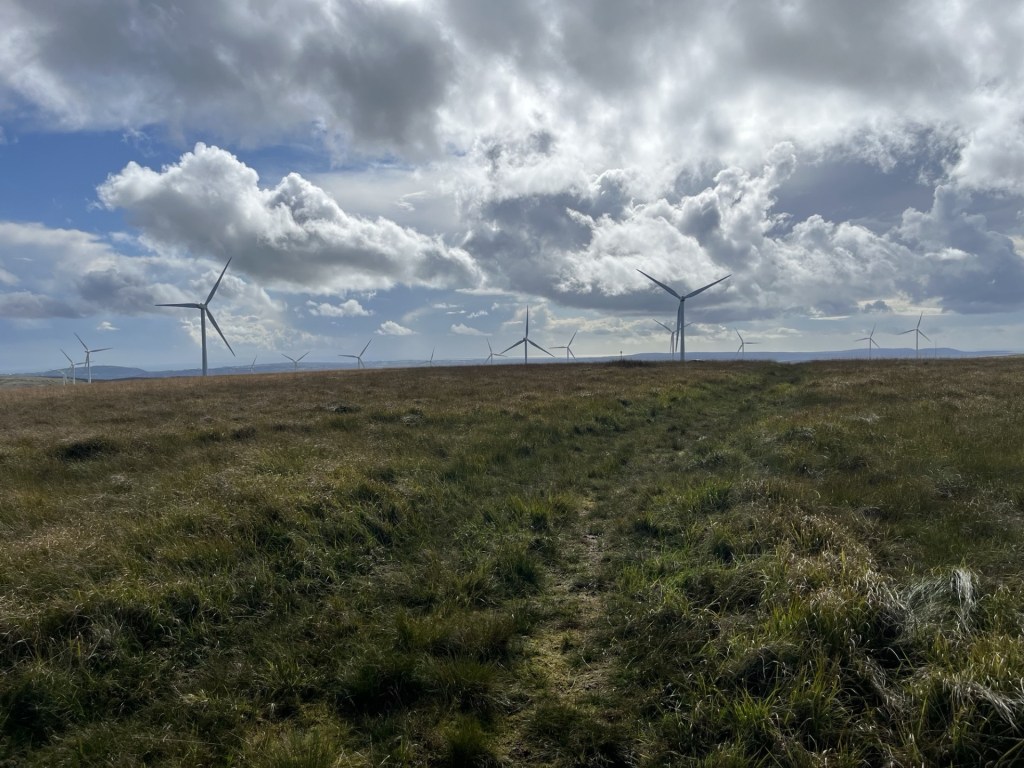
After the short stop the road curved round to the south-west. Wind turbines were popping up all around. An impressive sight, and no doubt an impressive site. A left turn (my mental map was now switched on and working), and the road continued around the contour until on the left a sliver of a stopping place that I had noted on Google earth presented itself. I wondered about the legitimacy of parking at this spot. Whilst there was no signage to indicate it was a passing point, and the road was reasonably wide; it remained a very exposed spot. I rationalised that the “top” wasn’t too far to the east and given that there wasn’t another vehicle in sight I locked up and set off up the slight incline across the boggy moor. If it hadn’t been such a dry summer the ground underfoot would have been a boot sucking minefield, but as it was it was sufficiently tolerable to make good progress. Sheep and turbines abounded at the top, which was no more than 100 metres from the road.

The approximate top – Mynydd Y Betwys

I knew to carry on for another hundred metres or so to reach the little treasure on the top.

Even when I found it, it wasn’t entirely obvious, but slowly the low ditch and ramparts of Penlle’r Castell emerged. I had assumed it was an Iron Age structure but turns out it was more likely to have been a medieval stronghold of some sort. What exactly they would have been strongholding against wasn’t entirely clear (Knights tilting at windmills perhaps), but the views in all directions were remarkable.

Penlle’r Castell looking north

Penlle’r Castell looking east and as it would have appeared in the 13th century

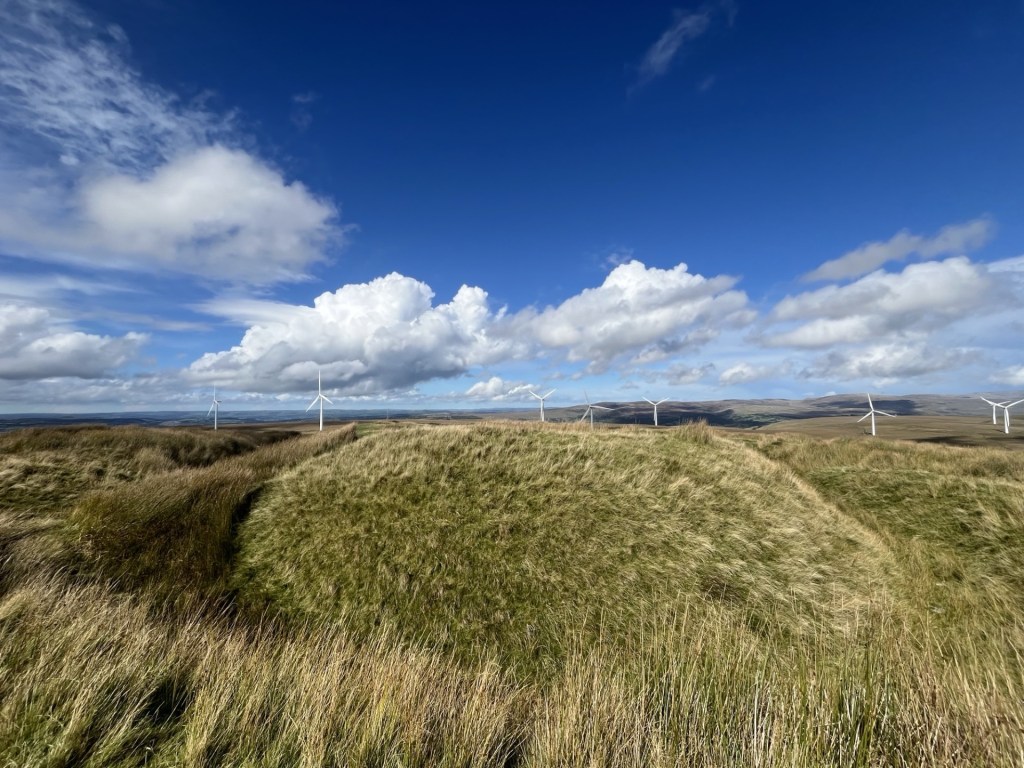
I skipped across the sphagnum, moorland grass and sheep offerings and back to the car. The wind was hammering in from the west, and the turbines were doing their job. I may have said it before but word from across the pond is that wind turbines are already old technology. Apparently, they are a waste of money, that there is no climate change problem to worry about and they are a blight on golfing landscapes (I’m sure someone once said the same thing about golf courses). Seems that there’s a new technology in town and it ticks all the boxes. Spelt OIL. It’s great to know they have our backs. ***

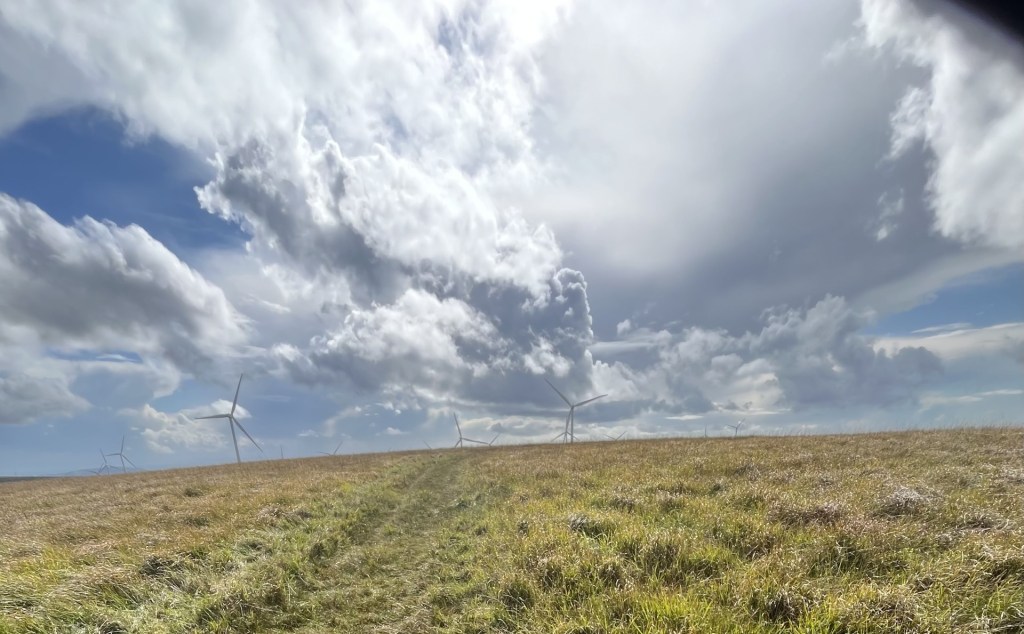
Big Wheels Keep on Turning, grouse moors keep on burning.

There were no plunging views from the top of Mynydd Y Betwys but you could see for tens of miles in every direction. A gem of a low peak where the energy of the movement of the earth and the seas is trying to turn the tables. It may be too late, but at least someone’s trying.

Can you tell what the forecast was?

I still had 70 odd miles to go in the day, and so it was a relief to find the car still there beyond the roadside ditch. And not a lorry in sight!

*It’s probably just as well that hardly anyone reads these accounts as I am sure if anyone did I would be in hot water over this observation.

** I didn’t see the lorry again and rationalised that the driver had stopped for the very same reason I had. English and lost.

***US oil companies generously donated $445million to Trump’s last election campaign! Who could possibly tell?

Cresting the County – Newport (Casnewydd) County Borough Unitary Authority

Wentwood Forest

Metres 309

Feet 1013

8th September 2025

The Hidden Trig

The last heatwave of the summer had come and gone. I seemed to have missed most of the August one, driving between home, hospitals, care homes and petrol stations but the personal hiatus had calmed down. Before winter set in I decided to head off somewhere new and seek out some more county tops if the opportunity arose. Hmm… but where?

Sunday the 7th of September and I’m to the south of London, heading west on the M25. The day before I had booked a room for the night in Chepstow, just over the big river and just inside Wales. I had plumped for three nights in the extreme south-west of Wales, but the idea of taking that journey on in one day felt a bit too ambitious.

I had only been on the motorway for ten minutes before the almost inevitable slow down. It was still early on a Sunday morning but the M25 has a knack of buggering up your day at any time it wants to. As the stream of traffic plodded along under the scarp slope of the North Downs, at around twenty miles an hour, ahead I could make out the figure of one of our new breed of “patriots” standing on a footbridge, with a balaclava over his head and waving a St George’s flag at the passing motorists. It was a warm day. The window was down, my right arm shooting the breeze and with Cerys on the radio playing sweet Sunday morning melodies. And this “proud” boy had just gone and crushed my karma. In that moment, and just seconds before I passed under the bridge, my right arm made an entirely involuntary movement of the Churchillian variety. I doubt he saw it, waving as he was to someone who had honked, I assumed in support. Sigh… 

Four hours later, and what felt like an over exposure to footbridges sporting St George’s flags (I should say, for balance, that the Women’s Rugby World Cup was on and England were the favourites), I drove over the River Severn at close to low tide, entered the Principality and fifteen minutes later was checking in at the Beaufort Hotel in Chepstow, a town I had passed several times before, but had never peeked.

With the sun beginning to sink I took a walk down to the River Wye. The Chepstow side (Wales) was flat and nestled in a large curve in the river. On the opposite side of the river (England) an impressive limestone cliff reared up. A hole in the cliff was explained away on a noticeboard as being used for different purposes over the centuries, including storing dynamite. Nothing explained away the huge Union Jake chalked onto the surface of the rock just to the right of the hole, but refreshingly it had nothing to do with recent “disturbances”. The tide was still going out, the dirty brown river thundering along and generating a mass of swirling eddies. Not too far downriver the Wye meets the Severn. It crossed my mind that if an opportunity arose in the future, I’d want to see the Severn bore. Looking around, the Castle took me by surprise and as castles go, it was the business. The rest of the town was an interesting mix of Georgian, Victorian and the occasional 1950s concrete misfire. Back in the Beaufort and a quick pint before bed Motorcycle Emptiness by the Manic Street Preachers issued from the speakers at a satisfactorily loud level. I was being welcomed to Wales, and I wasn’t complaining.

Monday morning and a coffee outside the Ugly Mug Cafe whilst planning my routes for the day. Until the construction of the first Severn Road bridge in 1966, the high street in Chepstow was the main road between England and South Wales. The road through the town is a bog standard small town road, but half way up it narrows to one lane as it passes through the medieval town gate, set into the defensive wall. Trying to imagine what it must have been like here before the construction of the bridge and M4 was enough to make the brain hurt. The ultimate destination was to be St David’s in Pembrokeshire. Still a long way to go but I had all day, the sun was still smiling, and so far, I hadn’t seen a St George’s flag. I wove out of town on the B4293 and then the B4235. (I had an uncle, no longer with us, who had the remarkable ability of being able to describe almost any journey to any destination – particularly if it ended in Scotland – by naming each and every A/B and M road on the route, and the exact locations where one became another. If you’d driven to his house from Cape Wrath, it would be time to go home by the time he’d explained to you in detail the way you had come in the first place – Scotch Corner often featured).

I was heading west to Wentwood Forest and the location of the highest point in the Unitary Authority – also referred to as a County Borough – of Newport (which would explain why its football team is called Newport County AFC). Wentwood Forest lies at the authorities’ north-eastern limit and on the boundary with Monmouthshire. The drive up from Chepstow was pleasant and almost traffic free. I wasn’t entirely sure where I was going to end up but as I drove in the general direction of the forest, I met the Usk Road, and a sign pointing back east to the Cadeira Beeches car park. Parking up I checked the phone and was satisfied that it would do. An information board explained that the forest was unique and one of the oldest ancient woodlands in Wales.

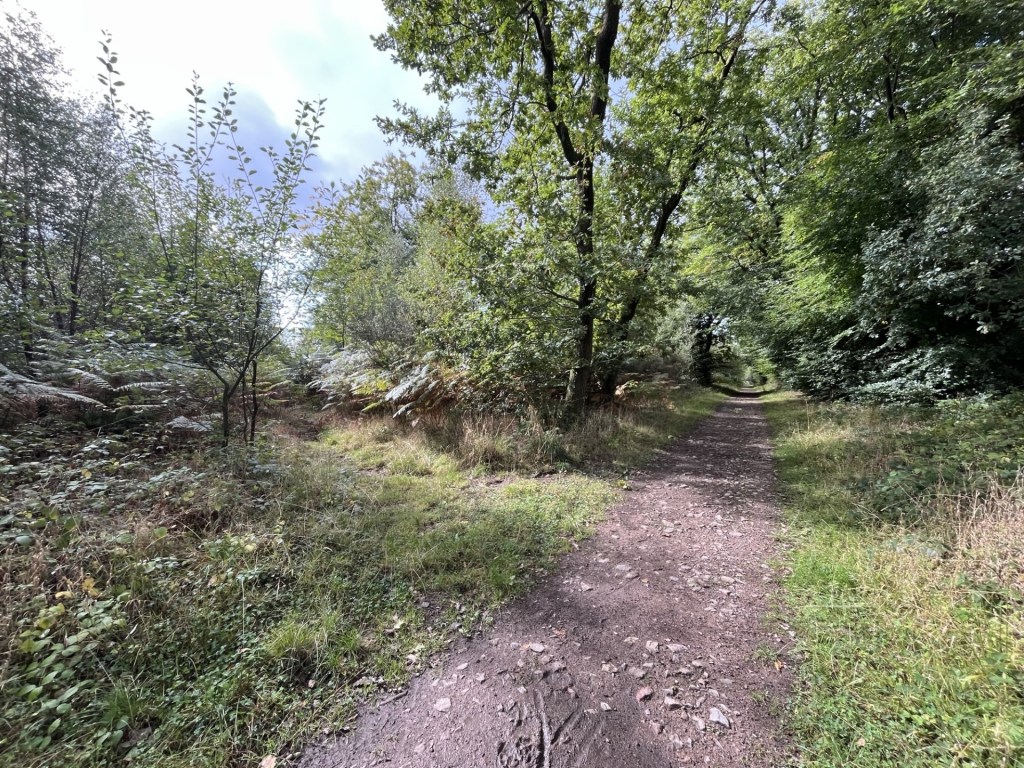
Setting off on a wide track to the west of the car park, all I needed to do was keep on going. The track rose gently. A car approached from the opposite direction, which suggested I could have driven closer to the top, but I needed the stretch.

After about a kilometre the track bore to the right. A few metres on a sign pointed into the woods and to Wentworth’s Ancestors? These were two low Bronze Age burial mounds lying in a small clearing in the woods.

The view from one Ancient (me) to another

I climbed to the top of the larger mound. It took three seconds. A moment to ponder what it all meant, but no answers came. Back on the track and what was indeed a road quickly deteriorated into a muddy puddled quagmire that would have certainly swallowed up my little Ford. I’d made a sensible decision.

The track met an unnamed road which I crossed and then into a large carpark with just one vehicle, looking slightly vulnerable. A wide track led on west, but I chose to take a smaller path just to the south, on the basis that it, rather than the track, appeared to continue heading gently upwards.

On the drive up there had been a point near where I had joined the Usk Road where a dramatic view had opened to the north towards the Brecon Beacons and most obviously Sugar Loaf, the distinctive peak that was responsible for all this endeavour in the first place (requires reading the introductory premise). Whilst the walk in the woods was nice, given that I was near the top of the hill, it was a slight disappointment to realise that there wasn’t going to be a similar view at some point. I guess that every tree is sacred, but still!

Another 100 metres on and a communication tower to the left, a good sign at any location that the top is nearby. The path was wooded on both sides and after another 200 metres I sensed that I must have been near, or at the top. I knew that a trig point was somewhere in the neighbourhood, but it wasn’t obvious. Scanning the surrounding thickets I eventually picked out what looked like something of a track leading into the woods just off the main path.

Left turn to the top

It wasn’t immediately obvious but having discovered the indistinct path I took the bait and then, stooping below the brambles, took careful steps through the undergrowth. Every so often flattened vegetation indicated others had recently passed through. Other Crest hunters, it seemed, had been here too.

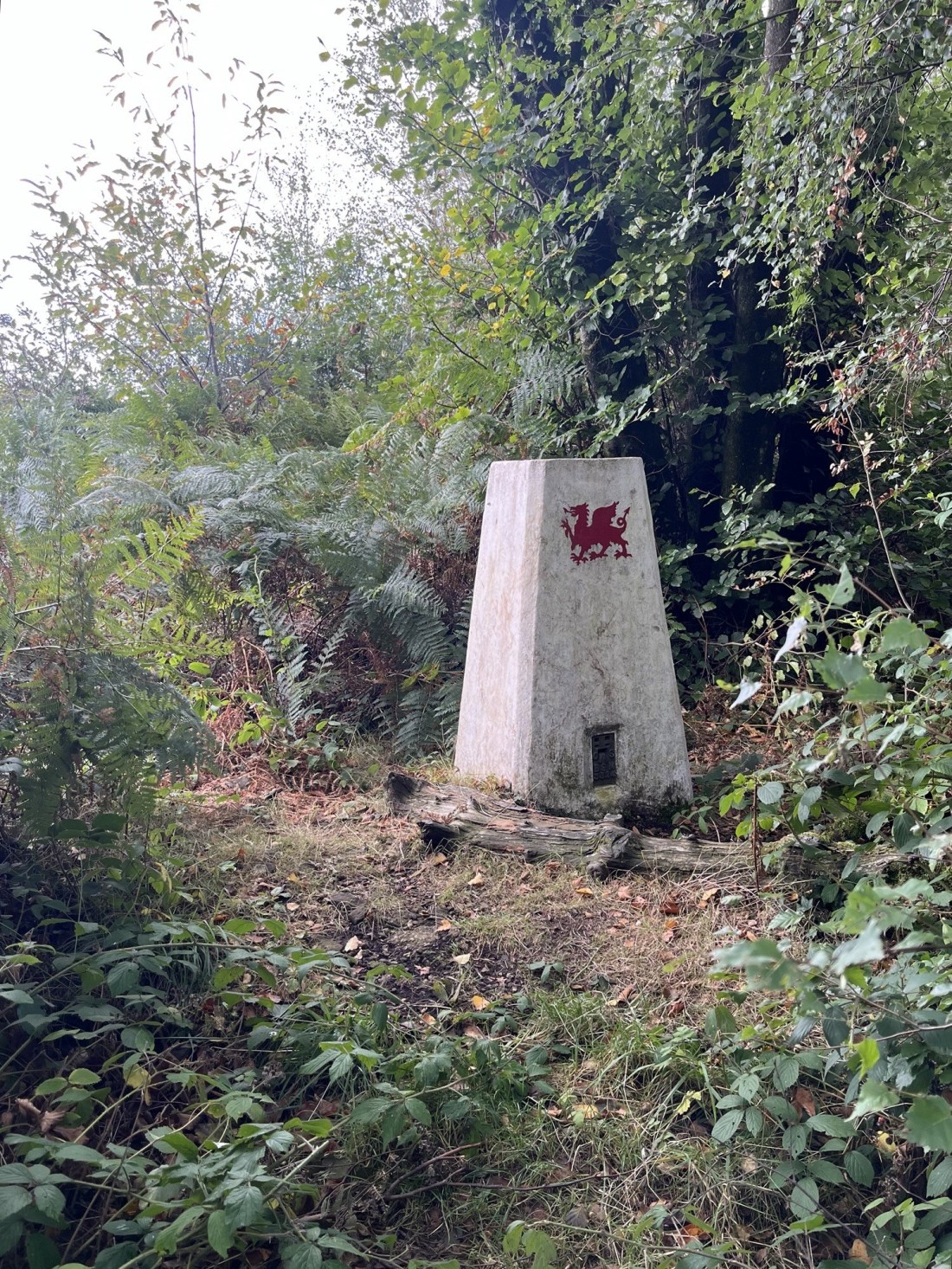
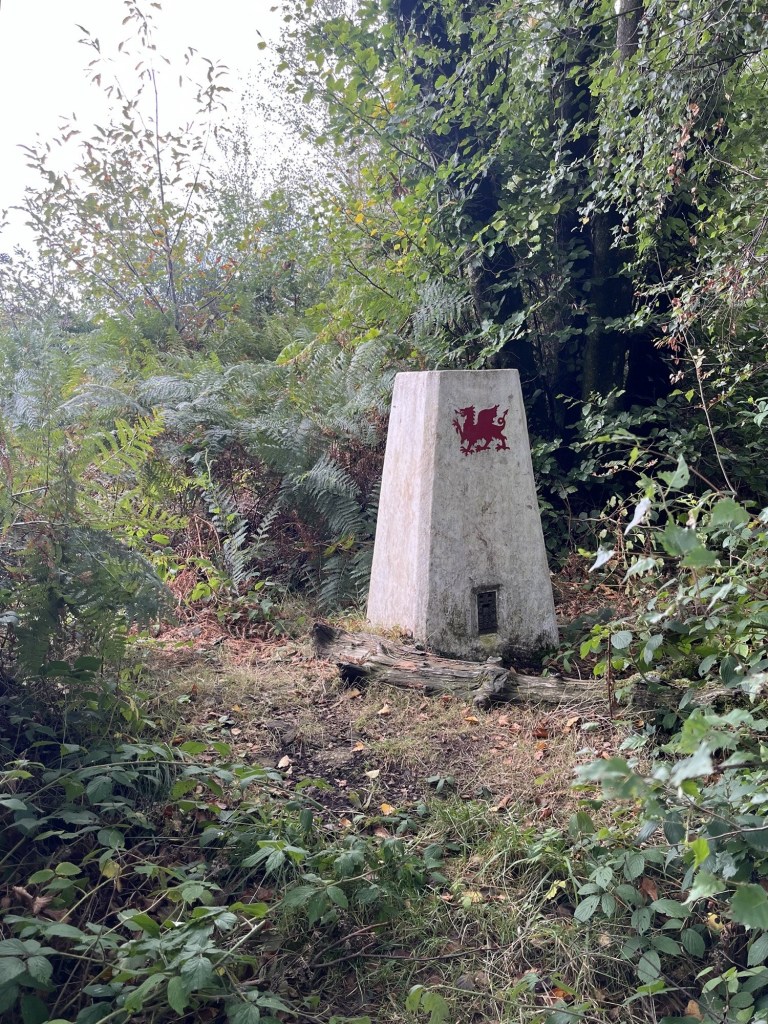
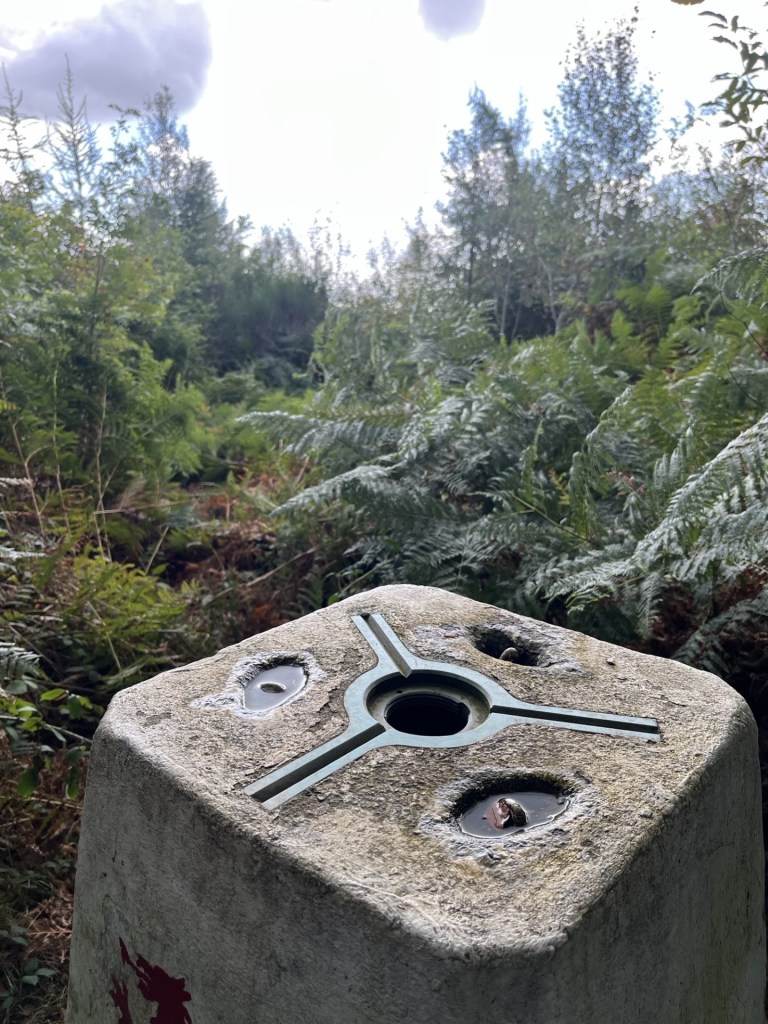
Within a minute or two I emerged into something of a clearing and there it was. The concrete trig point, painted white and with a red dragon to boot.

The trig in the woods

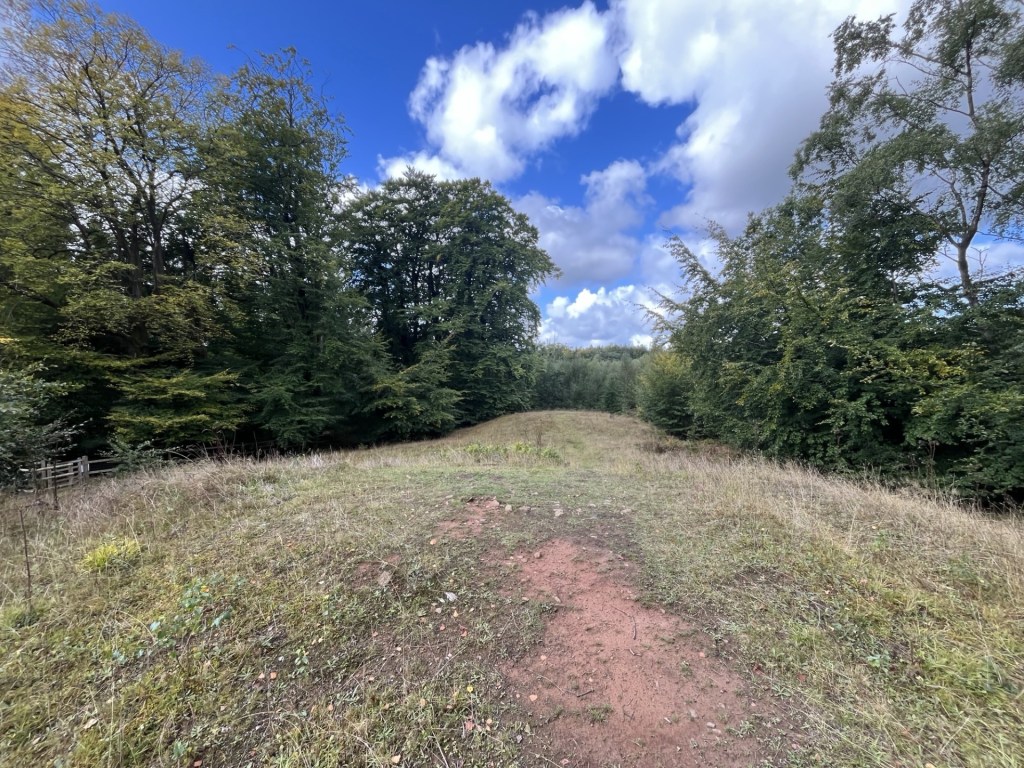
Any hope of a view here was dashed. The thickets and low trees continued into the distance.

A restricted view

That said it was a serene spot, and the painted trig point an interesting feature. I have an old friend who spent much of his youth growing up in Newport. I sent a photo of the trig, asking him if he could guess where I was.

There was nothing more to do but return the way I had come. I was slightly relieved to emerge onto the path unseen by anyone else. It might have looked a bit odd. The big car park had gained another three or four vehicles in the time I had been to the top, and dog walkers were heading off in various directions. 

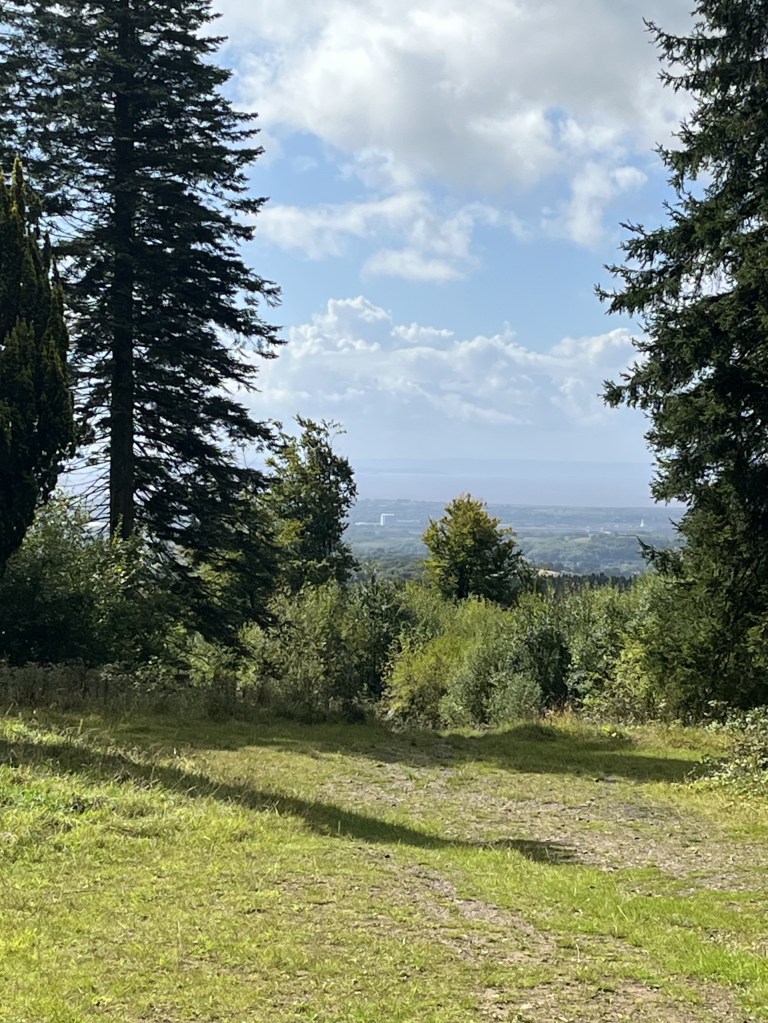
Just past the Ancient’s I noticed a break in the tree line and the entrance into what turned out to be a much bigger clearing than anything so far. Sun was occasionally breaking through the clouds. Walking down into the clearing a view of Newport, the Bristol Channel, and far beyond the north Somerset coast, shimmered between isolated tall pines. I stopped for a while to take it all in.

Glimpsing the county

I set off back to the car park, scanning between the trees for just one inch of a view to the north, but it never came.

Back in the car and taking off my boot, a ping announced an incoming text. It just said “Wales?”

I texted back. “If I said no? Well… yes. One-point smart arse.”

Perhaps unsurprisingly, a month on and he’s not replied.

The walk was just two miles, but this was a nice spot, and deeper into Autumn the trees will radiate here. Just a few miles to the west lies Blackwood, the home of the Manic’s. Sorry, any tenuous excuse!