
Holly Hill
174 Metres
570 feet
6th May 2025
The Battle for Medway
I arrived at Ashford International station on a small train. On leaving the carriage, the intention being to catch an onward train to Paddock Wood, the early warmth of the day had dissipated. As I waited on the desolate platform, a cold wind from the north knocked the stuffing out of me. Poor old Ashford. Battered by Brexit and then Covid, the last of the Eurostar’s left from here some years ago, and they ain’t coming back anytime soon.
After twenty minutes, by which time my fingers had gone an unhealthy yellowy white, and I was pondering on the wisdom of the decision to do this journey, my onward train arrived. As it sped west through Kent, I read that today was the day that Reform UK succeeded the Tories by taking control of Kent County Council. Well, good luck with that, I thought, before reassuring myself that I was, at least, going to spend part of the rest of the day in the Unitary Authority of Medway, a chunk of the world on the south bank of the Thames that had once formed part of the wider Kent (the summit of which – Betsom’s Hill – I had reached on my very first outing nearly a year to the day before, and also before I had decided to include Unitary Authorities within the scope of these investigation). *
At Paddock Wood I changed trains again, and shortly I was heading north, with the river Medway to the right. This route was entirely new to me. Despite having lived in the South-East for much of my life, somehow this area had eluded me. And very pleasant it was too! The short train stopped frequently, and it struck me that at some point in the future a walk along the banks of the river from station to station would make for a productive afternoon.
I was excited at the prospect of passing through Maidstone, a town I knew nothing about other than last year their football team had made impressive progress in the FA Cup. On arrival, the prospect on show was pitifully disappointing. No sign of the town beyond the tatty old warehouses and poorly designed modern flats.
Heading north out of Maidstone and towards Snodland (my destination for the start of my walk), heavy industry flanked the line, although at a distance the ridge of the North Downs stretched away to the east.
Snodland, for reasons I can’t account for, seems to crop up on the news, and on the sort of programmes made by middle aged male “has-beens” professing their love for our railways (I’m just jealous really). I had no idea what to expect as I left the quaint Victorian station and headed up a road leading west and towards the town. I had an Ordnance Survey map (OS Landranger 178) and had an idea of my route to Holly Hill, but I hadn’t expected to be taken over a depressing road bridge that spanned the miserably busy A228 road below.
Having made it across the bridge, an even less inviting pedestrian path to the right (not a place you’d want to hang around in the dark) took me down to the start of the town, and a dead end which would, at one time, have continued to the station had it not been for its amputation by the A228. A few Victorian terrace houses, one having been a long-closed pub, lined the road on the left. A very impressive Tudoresque house stood to the right, with a very expensive car, covered to protect its identity, parked outside.
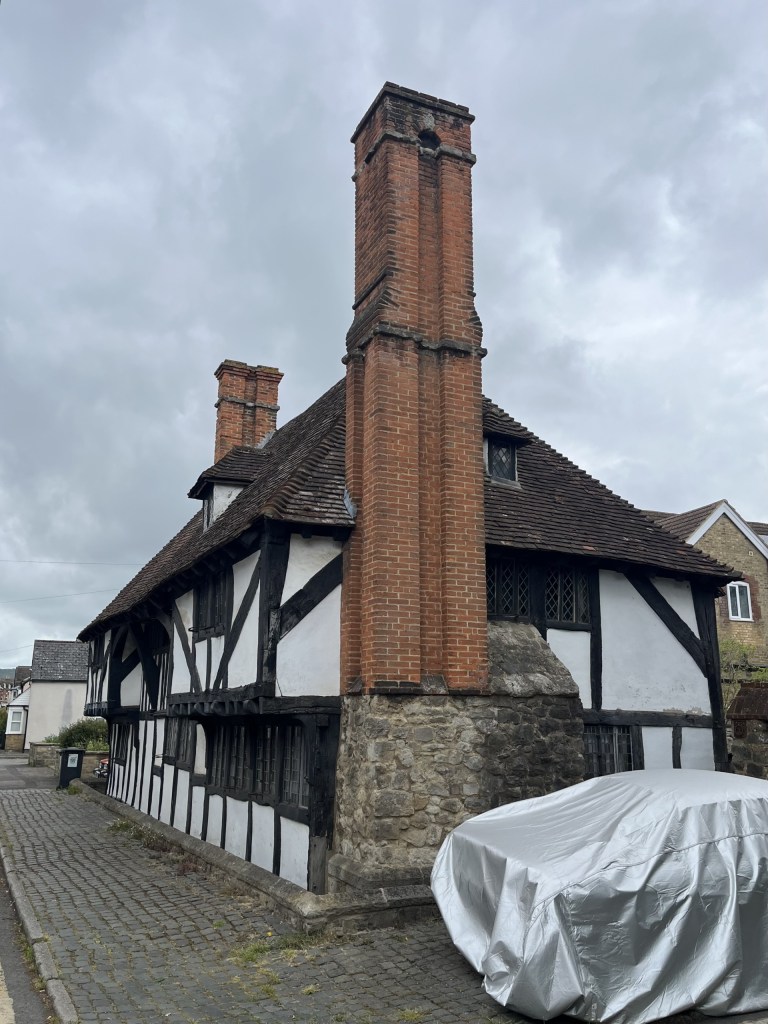
It was all downhill (or was it up) from here
These few buildings aside, I’m afraid to report that the rest of Snodland offered up nothing of interest. I walked up the High Road into the town, crossing another main road, and then after a few minutes had reached the end of Snodland and was onto Paddlesworth Road. Almost immediately this narrow and very rural lane took me out of the urban sprawl. I knew from my map that at some point soon I would find a footpath on the right-hand side and momentarily got excited when I came across a fairly new and robust looking metal kissing gate, obviously intended for public access. Disappointing then to find it strapped up with heavy duty padlocks, and thoroughly overgrown. What had been the intention? I’ll never know.
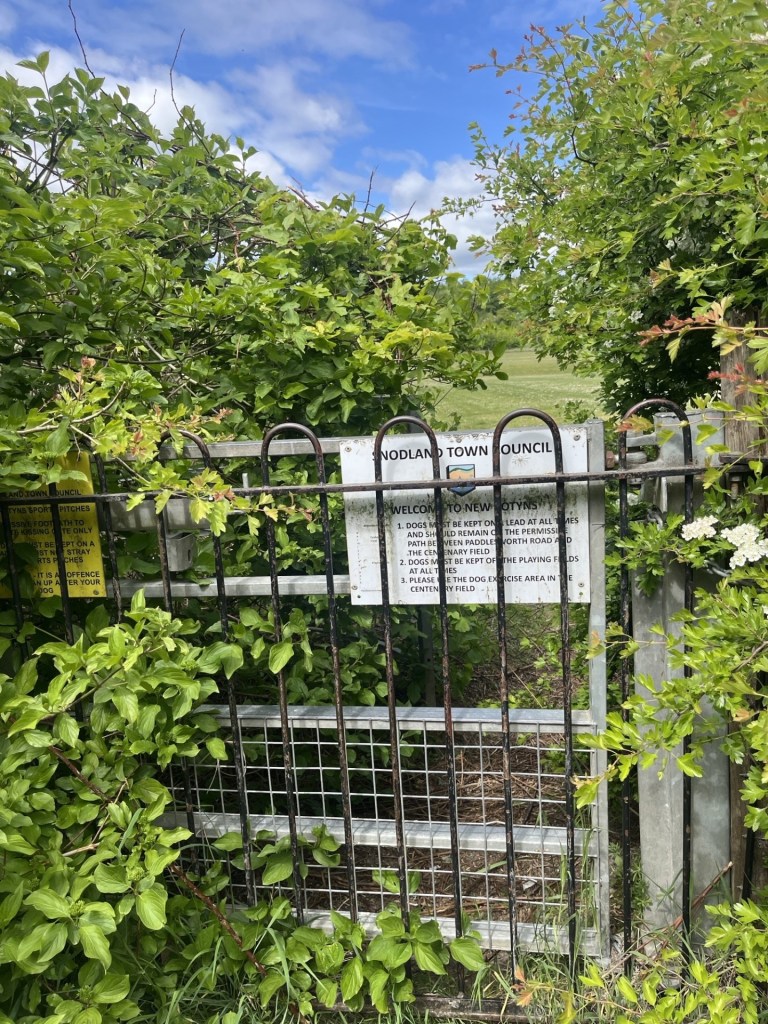
Best laid plans
Further up the road, which, when a vehicle appeared, required one to back carefully into the hedgerow, a footpath sign to the right, and I was now off the road and following a straight chalk path up through the middle of a large field. Halfway up I noticed increasing evidence of broken pottery and other bits and bobs that indicated that at some time in the fairly distant past this area had been used as an early fly tipping site. Very Kent – now the beating heartland of rural desecration by organised crime.
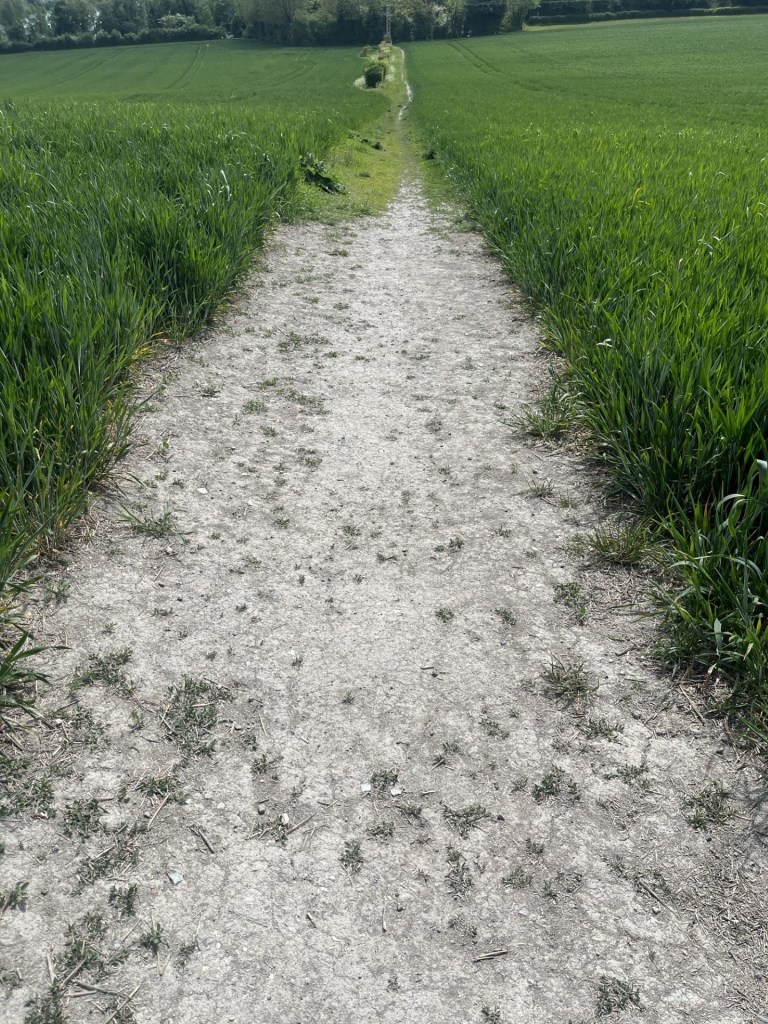
The old straight tip track
At the top of the field a wide track to the left, flanked on both sides by enormous, recently trimmed hedges, pointed me in the direction of my destination. The land ahead rose towards thick woodland and somewhere beyond that was Holly Hill. The track took a while to navigate, and the recently trimmed branches proved surprisingly awkward to traverse. To my right I could see a very solid green metal fence with pointy bits on top, clearly intended to protect people like me from the unknown danger that lay beyond.
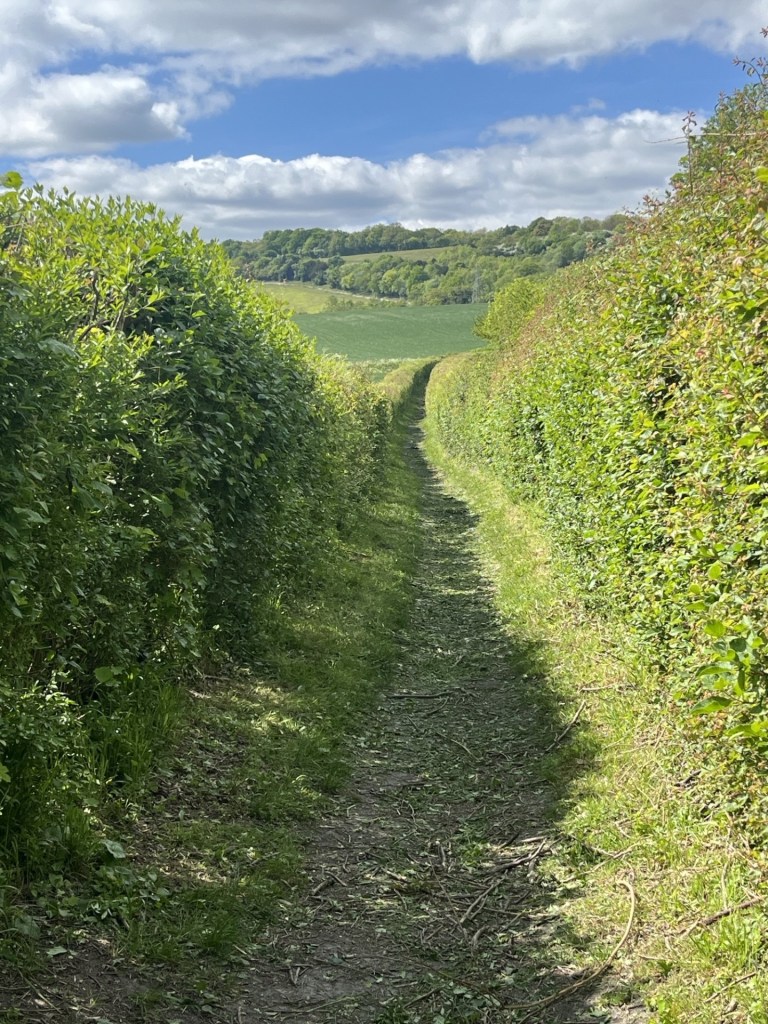
Beware of recently cut hedgerow because it’s sure to get you
Eventually I was free of the hedge track, and now on a more traditional country path with fields to my right. I stopped to take a look over the more traditional barbed wire fence. Beyond, and stretching for hundreds of metres, was evidence of what must have been a huge chalk quarry (or pit). I have a certain thing for chalk pits. My second year Geography degree dissertation in 1978 had been about the chalk quarries of south Croydon. I mean, you know, someone had to do it. And at times, whilst also trying to earn a few bob working in the electrical department of a now long-gone department store, it was quite enjoyable cycling up and down the steep terrain, with a camera and notebook, trying to figure out what was what and trying to formulate a suitable narrative. I even ended up being invited into a Coca Cola bottling factory on an industrial estate which occupied one of the old quarries, and being told about the danger to life and limb of their employees from the kids on the estate above who specialised in throwing rocks down into the quarry after school. This of course was a very long time before the internet and PCs. Academic research was confined to whatever the main Croydon library had to offer, which was probably more than I could have expected. Once I had written up my opus magna it had to be professionally typed up (and blooming well bound), at a cost that left me in debt for some years to come. Once submitted, that was the last I saw of it. It became the property of the University!! Huh! And there was no feedback, or indication on whether it had any merit.
Many years later I came across a small exhibition somewhere in Croydon, which seemed to me to cover some very familiar territory (if not the copyright of the University). It piqued my curiosity. Where had my dissertation ended up? I wrote to the University and asked if I could be sent a copy or at least have access to it. The reply came – they no longer had a copy! Huh – again! Along with all the effort, expenses and the £20 for the typing, I felt slightly robbed. Am I straying a thousand miles from the subject matter here? I’m over it now though. In 1980, and not to be caught out again by the typing scam, I obtained a cheap typewriter and taught myself to type. Never very proficient, and for many years I felt that all the effort had been a complete waste of time – until, well, until the modern world intruded and the keyboard was now the only thing on earth of any value. Bingo! Unintended consequences. **

Towards the Quarries
But none of the quarries on the scarp face of the North Downs in Surrey were on anything like the same scale I now saw before me. As I contemplated this scene I could hear the sound of excited dogs somewhere ahead. A kennel I suspected. A little ominous too. Carrying on up the path, I became aware of movement quite a distance ahead. A young woman was coming in my direction, being, from what I could tell, dragged along by a dog the size of an adult pig, and with the appearance of a Baskerville hound. It had already been the driest Spring on record, but the amount of slobber sloshing from this abomination’s mouth would have been enough to rejuvenate the driest of streams. There certainly wasn’t room for the both of us to pass and so; to give myself a chance, I climbed high up the embankment to my left and uttered a cheery “afternoon” as they passed. I assumed that the dog was a temporary inmate at the nearby kennels which were at the end of the path, but to the person, somewhere, who has created this breed, whatever it was, and to the people who purchase similar, please stop!
At the top of the path (just to confirm I survived the dog moment unscathed), a track led left and right, but I chose the gate directly ahead and a path that started to ascend up through some woods. To the right, an old derelict house sat in amongst the trees. A sign attached to a fence said Keep Out – Property of the Blue Circle Cement Company, which explained a lot. The path continued through beech and birch trees in the first flush of new growth. A teapot, naturally, sat wedged in the cleft of one of these trees. Art, a tiny house that tiny things lived in, or just fly tipping, it was hard to tell, but in truth it looked quite at home in the tree.
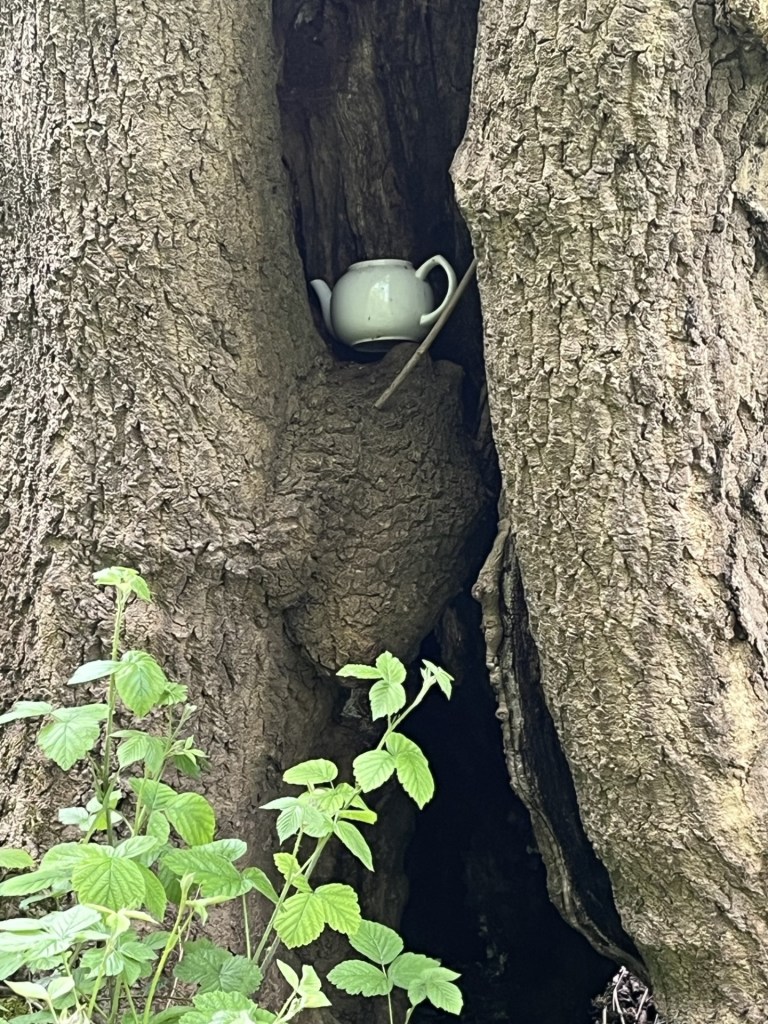
Brewing Up
At this point the path began to head downhill. Welcome to a degree, but with the caveat that all height lost meant more pain later. I emerged into a large glade, surrounded by pines and other varieties. A dirt road passed east to west, and a solitary dead tree stood in the middle of the glade sporting a large sign explaining that something was private property. Given that there was no sign of any fencing it was hard to determine what this instruction referred to, other than it might have been the dead tree. I had no plan to climb it.

I didn’t get the message
I chose to follow the track that ran westwards, and a while on did indeed come across a fence to my left, and a large field of scrubland that stretched up to the north. In places the last primroses of Spring clung to the edge of the track. Consulting the map, I could see that somewhere at the top of this open ground there was a footpath that led into some woods that emerged into bigger fields which would lead up to the top of Holly Hill, and so it was onwards and up.

Up the scrub and looking towards the Medway
It was a fair old hike to the top of the scrubland (for an old person anyway). Having reached the top, I worked around the dilapidated fencing and came across a similarly dilapidated stile. Anyone who does a bit of recreational walking in the country will know that slightly deflating feeling when coming across an unmaintained stile or gate. It was patently obvious that this location was rarely ever troubled by the public and had not been interfered with for some weeks, or months. Chest high nettles had grown with vigour on both sides. I considered going back down to find a better route, but that felt slightly defeatist so instead I took some minutes preparing to climb over; grateful that I wasn’t wearing short trousers. With a brave heart and hands held high I progressed purposefully and made it without incident.

Travelling in stile
Now I was in a small glade. The remnants of a path took me so far before evaporating in a jungle of more nettles and enthusiastic young brambles. The land ahead rose sharply up through dense woodland. Somewhere within this tangle of nature there was a legitimate route, but it was no use. I began to pick my way up as carefully as possible, trying not to brush skin on anything that represented a threat, which was everything. This was hard going and I’m not the nimble gazelle I once was. Trying to pick the least worst route took ages, and even the least worse routes involved repeated trouser snagging. This was a very short climb, but it took me about twenty minutes.
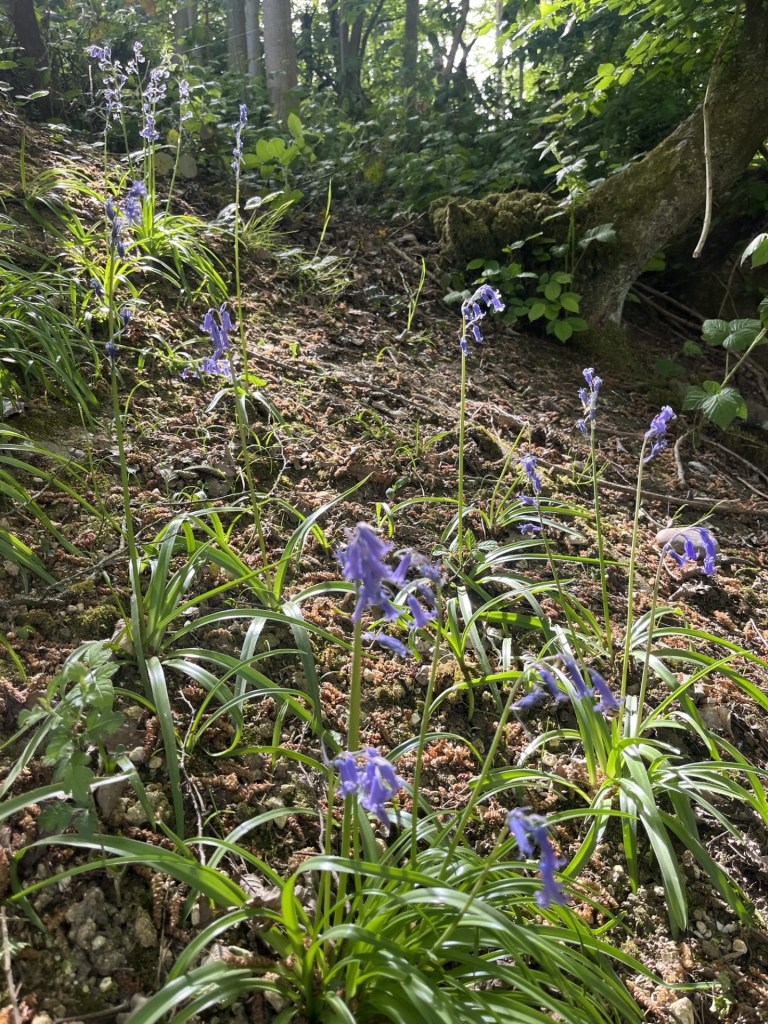
Don’t be deceived – These bluebells were lethal
At last, and to my great relief, I was out of the morass and standing at the edge of a large agricultural field. Disorientated, I had no idea where at the edge of the field I was and the map couldn’t help me, but I knew that heading north and keeping to the edge of the field would get me there eventually. A while on and to the right, another less than useless stile indicated where I ought to have emerged.

Somewhere in a field, somewhere still in Kent
Keeping to the edge of the field eventually I headed directly across rough ground and to a hedge line that I hoped was the top. It wasn’t. A settlement a short distance away confirmed I had another large field to go. By now I was certain of the objective. A large old tree stood on its own in the field beyond. I aimed directly at it, despite a minor uncertainty as to whether I was trespassing or not. Near the tree a large area of the field, about the size of two football pitches, had been turned over, for no obvious reason I could think of. I guessed that some sort of greening subsidy was being used to make something of this otherwise neglected field.

A few steps into Medway
To my north the field was lined with dense woodland, where, if I was to believe some of the literature online, the highest point in Medway lay just beyond the hedge line. The thing to note about this endeavour was that whilst almost the entire field area, stretching to the south, was in Kent, for reasons that simply can’t be explained, expect by the officer who plotted the boundary, the county line (not to be confused with County Lines – which is a completely different pursuit), makes a triangular shaped intrusion into the field. This Medway intrusion must be very confusing for the landowner and must lead to inter authority bureaucratic squabbling over incidents of fly tipping.

The Medway Unitary Authority salient (in orange). Kent/Medway boundary marked by dash/dot black line
I sniffed a bit along the hedge line at approximately the location that PeakBagger had indicated was the “top”, to see if there was any sign of higher land within the woods, but it didn’t seem as if there was, and looking back at the field I had crossed, despite being something of a plateau, I was fairly convinced that the land past the tree, and where the field had been turned over, was marginally higher than anywhere else. ***

Somewhere, just to the right of the tree, the top
Having, one way or another, crested Medway UA, I certainly wasn’t going to battle back down the way I had come and already had an alternative route in mind. Back down the field a bit, and to the east, a decent enough gate led the walker into dense woodland, and as I passed into its embrace, I was back in Kent.
A short walk into the woods and the path split in two directions. One carrying on with the contour and the other falling away down a slope. At the junction I beheld a quintessential English country landmark. None other than a plastic litter bin overflowing with plastic bottles and dog shit bags. There was obviously a good reason for it being there i.e. the compulsion of a large minority of people to drop their drinks containers and dog shit bags on the ground, rather than the inconvenience of taking them home. So, cause and effect, some kind heart/s had installed the bin to limit the impact. Bless them, but poor sods too, having to come out here probably every day to empty, rinse and repeat cycle. Depressing really.

Where the path diverges. Dog shit marks the spot.
I opted on the downhill route, on the basis that it was downhill and I rather desired to get down sooner than later. Not as easy as it looked. Quite a lot of branches blocked the way. Not enough to prevent further progress, but I hadn’t done my stretching exercises in the morning. I was now.
And then the trail took a much steeper dive. The ground was bone dry, but I was going to need to take some care. At this point I noticed what appeared to be lumps of iron sticking out of the ground, and they spoke of instant disaster. I also noticed to my left a rope that fell away along the side of the path. What was I getting myself into? It slowly began to make sense. The foot wide lumps of metal, hammered into the ground every couple of feet, were there, along with the rope, to aid the walker, or in this case, climber. In wet conditions I am certain that the metal steps would be extremely useful but covered in dry dirt and a lot of vegetation, they now made for an almost inevitable trip feature. I took the greatest care of going down, and it continued down for some minutes. Eventually, uninjured, the path exited the woods at a small road.

Believe me, every one of those steps hides a trip hazard
Walking up the road it soon bore to the right. It felt logical to follow it, but just to my left a footpath sign and a sturdy kissing gate invited more interesting countryside exploration.
The gate took some negotiating. It clearly hadn’t been used in a very long time, but once in the field, and having looked at my map, a footpath could just be discerned heading across the large, tatty field. Overgrown, largely with thistle type plants, this part of the stroll was particularly unpleasant, and I now regretted not having stuck to the road. Eventually this annoying part of the journey ended, with the path dropping back to the road through a thicket so thick that a machete would have come in handy.
I followed the road for a while and occasionally looked at the views towards the north and east. Across the river Medway to the east and more evidence of vast chalk quarries hacked out of the North Downs.
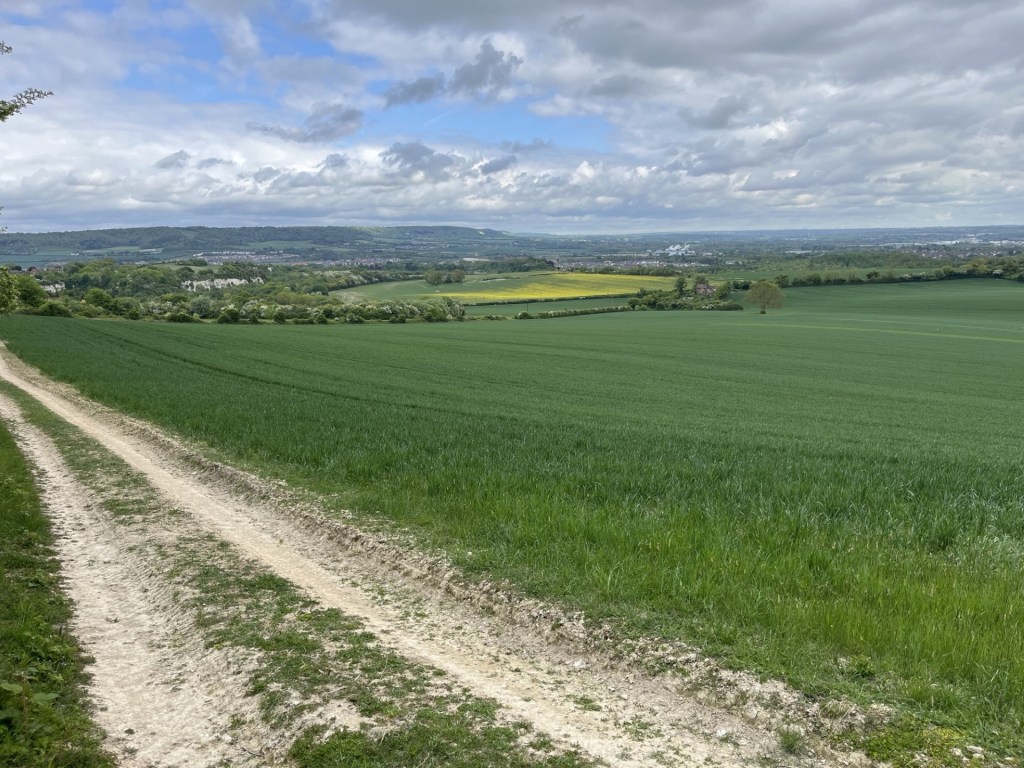
Into the Medway
The road became more of a dirt track as it entered the top of the large field with dense woodland to the left. The track then turned downhill, heading southeast until reaching Ladd’s farm at the junction with the Pilgrims Way. The farm buildings, apart from long ago extensions here and there, remained remarkably, and you could say charmingly, unaltered since the 19th Century.

Ladd’s Farm
A small road (Ladd’s Lane) ran roughly south, almost directly opposite the farm, but a small sign pinned to a lump of wood at the side of the field opposite caught my attention. Another sad memorial to the dead of previous wars. This time, Denis Page, Pilot Number 127990, killed when his Mustang fighter crashed into the nearby field. He was just twenty!
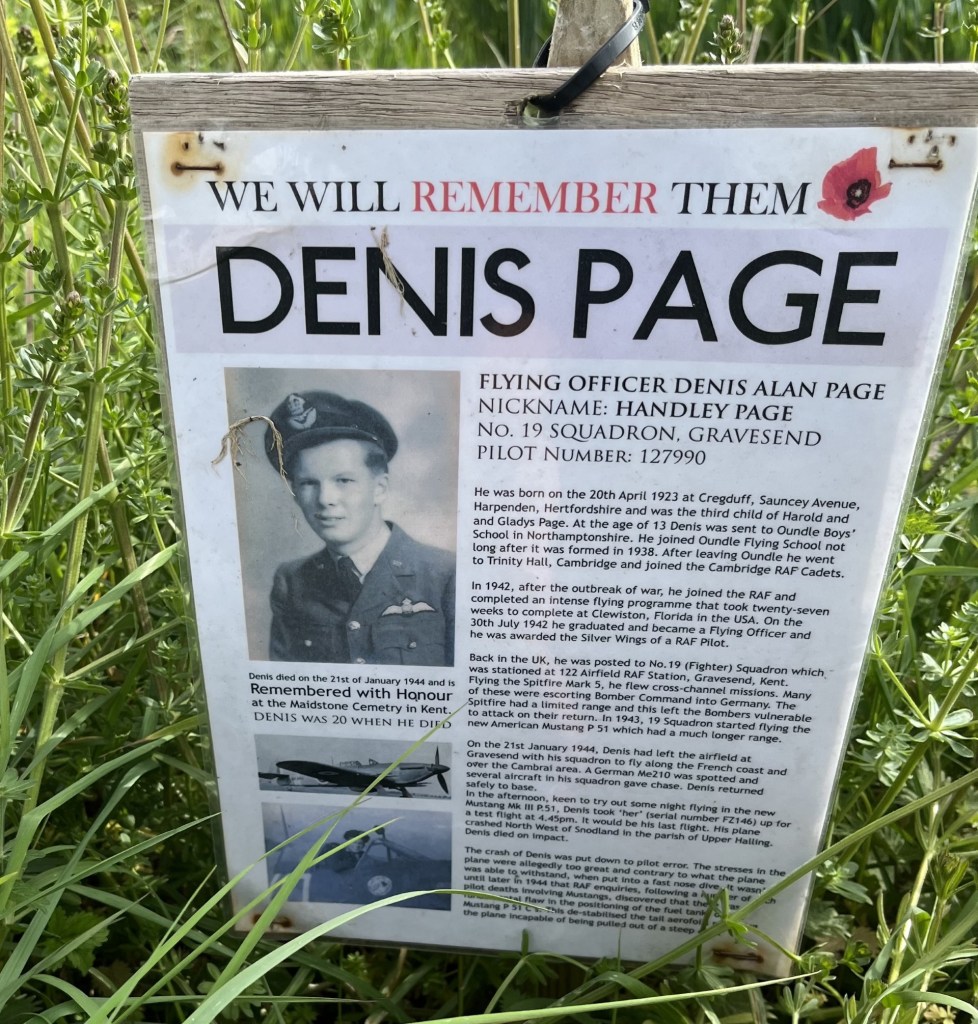
This poignant story was counterpoised by the huge field opposite, where a yellow swathe of rape flowers lay like a carpet over the chalk, and where beyond a long low chalk cliff formed the base to a small community above.

The artificial chalk cliffs of Halling
With the field to my right the lane started to head east and back towards Snodland. In the late afternoon, and apart from the odd vehicle coming out of Snodland, it made for a pleasant end to the walk. Eventually the fields gave way to the heavy-duty green metal fencing with pointy tips that I had encountered earlier in the walk. Clearly intended to prevent access to the huge old quarries and pits lurking beyond.
The road eventually reached an area called Holborough where, before reaching the A228, a large newish estate with pond features created on land reclaimed from the old quarries. As modern estates go it looked pretty good. A path headed south along the backs of older housing, which at least meant avoiding contact with the dual carriageway, and I was soon back in Snodland and then the station, just as a freight train pulled by a class 66 locomotive thundered northwards (sorry, it’s a niche sideline).
I had twenty minutes to wait for my train back to Paddock Wood, but that was okay. My son rang to touch base. When I explained the day he expressed some interest, which was kind! It had been an unexpectedly excellent seven mile walk in an area I knew absolutely nothing about, but which I now felt I knew a lot more.

Snodland Station – next stop Paddock Wood
* Medway Unitary Authority covers the area of Rochester, Chatham, Gillingham and the Hoo Peninsula. Some years ago, when I was a tad younger and fitter, I wasted some time on my bike sticking as far as I could to the coast, and if you are desperate for more of where this comes from these links will take you to the north.
** In a moment of extraordinary serendipity, as I was coming to the end of writing this account, I was also multitasking, having decided to reorganise my clothes draws. I started on the bottom draw, having completely forgotten what it contained, and having not opened it in some years. No clothes, but instead random “stuff” that included a plastic bag. I felt in the bag and the first thing out was a cardboard envelope, in which, and to my amazement, a draft copy of my dissertation. For the next hour I sat and re-read it. In parts it was naive, and in truth (I had had a very Comprehensive education) at times the spelling and grammar left a lot to be desired. I suppose I was only 20 years old at the time, yet despite these minor self-criticisms, it made for an interesting and informative read. At the end I considered that one day it ought to be possible to rejuvenate one of these old chalk quarries as a leisure water park. And so, when looking on Google maps and at the area to the north of Ladd’s Lane – St Andrew’s Lakes. A deep water “aqua” leisure park, built into an old chalk quarry some years ago. I had missed a trick!
Kenley Chalk Pit 1978 – Car free adolescence
*** This is the point that Peak Bagger claims as the top, and I believe they are correct. On the other hand, Peak Visor, which is another clever looking site, places the top of Medway a bit further to the north at a place called Round Hill, which, according to the BGS App, falls short by 10 metres.
 El Colmado 57