Mapperley
134 Metres
440 feet
22nd May 2025
Wednesday Night/Thursday Morning
After the night before (when Spurs had beaten Manchester United in the UEFA Europa League Trophy final, and after I had chalked off Rutland and the City of Leicester), I had one more day in Nottingham and felt the need to visit its highest point. I say I felt the need, but that’s not strictly true. To be honest I was just slightly hungover. Nothing that I was regretting, but just that slightly off feeling that thankfully I hadn’t felt in some years. Either way my brother was working from home, and it was important that I got out of his hair (of which he is still blessed, and I am not).
I’ve been to Nottingham many times; on a couple of occasions in the 1970’s on day trips from Leicester to the Old Trip to Jerusalem and other hostelries, but many more times after my brother moved there in the late 1980’s. I have to say it never occurred to me that it had any land higher than the site of the castle (which remains one of the world’s biggest disappointments, especially if you’ve ever seen any Robin Hood films). For everything else you’ll ever need to know about Nottingham, and the engineering beauty (!) of Maid Marion Way, I can’t recommend enough Mark Steel’s – In Town – Nottingham on BBC. *
I had discovered that the highest point in town was a place called Mapperley located vaguely somewhere in the north-east. Dosed up on coffee I drove directly towards the city centre, which involved passing the Trent Bridge cricket ground. There were a lot of people mingling around but I didn’t put two and two together (probably a county match I mused), and carried on over the bridge, with the Forest ground to my right. I should say a couple of things about Nottingham Forest’s City ground (just to string this relatively brief account out a tad more).
I’ve been there a few times with my brother and sister-in-law over the years, but mainly during Forest’s leaner years. The first time I went was with a die-hard Brighton fan called Trevor. From memory it was the second leg of the League cup quarter final, on a freezing winter night in December 1978, and for the life of me I can’t remember what convinced me to go or (being that I was from Croydon), why he had invited me in the first place. This was about the time when Forest were about to make history and had the classic Brian Clough line-up. We took a bus up from Leicester and by kick-off we were in with thousands of Brighton away fans.
It was an exciting game. The Brighton fans were boisterous throughout, but in the end Forest were triumphant, and eventually we set off back to the station (the surroundings of which have changed out of all recognition in the intervening years: the delightful Victorian Bentinck Hotel pub, now a desultory Starbucks) with the thousands of others who had made the long journey from the south coast. And that of course is where they left us, and we had to make our way to the bus station, on our own, in the rain, and with Trevor refusing to zip up his coat and cover his blue and white Brighton and Hove Albion scarf, despite my whimpered pleas to his conscience. With the streets still crammed with celebrating Forest fans, I had never felt more exposed. Dirty, threatening looks, abuse and the possibility of violent intervention at any time convinced me that if we survived the night and escaped Nottingham unharmed, I would definitely not travel with Trev to a Brighton away game again. We eventually made it out of town on the late bus to Leicester, and I kept my promise.
The other significant moment, just outside the City ground, was some years later when walking along the river Trent footpath with my brother and their dog. We were the only people about until ahead of us a group of male athletes on a powerful jog headed towards us. As they closed in my brother speculated that it was the current Forest team, and sure enough, as they passed, I recognised one or two. “Morning lads,” came the heavily Glasgow accented greeting from the older man at the rear. On the 11th of June 1978, Archie Gemmill had scored the greatest Scottish goal of all time against Holland in the World Cup in Argentina. As a Scottish family living in the diaspora we had watched the game, more in hope than expectation. When Archie scored his wonder goal the roof nearly came off the house, and in many Scottish towns and cities there are still buildings with structural damage from the resultant seismic aftershocks. Scotland won the game, but it wasn’t enough to qualify for the knockout phase, but it didn’t matter. Archie was God, and he had just spoken to us.
I drove further into the town centre and, without incident, managed to find myself heading north-east on St Anne’s Wells Road. I turned left at Ransom Road, simply on the basis that it headed upwards, often a useful clue in these situations. To my surprise the road rose steeply with interesting parks to the left and right. At the top I turned right onto Woodborough Road and eventually pulled up in the carpark of an Aldi to get my bearings. I was in Mapperley, and a quick check informed me that the highest point was just a short walk further to the north-east. The sign said I had two free hours, so long as I shopped in the store. It was going to be a risk, but I figured that the chance of parking up, not making a purchase and being caught, was low.
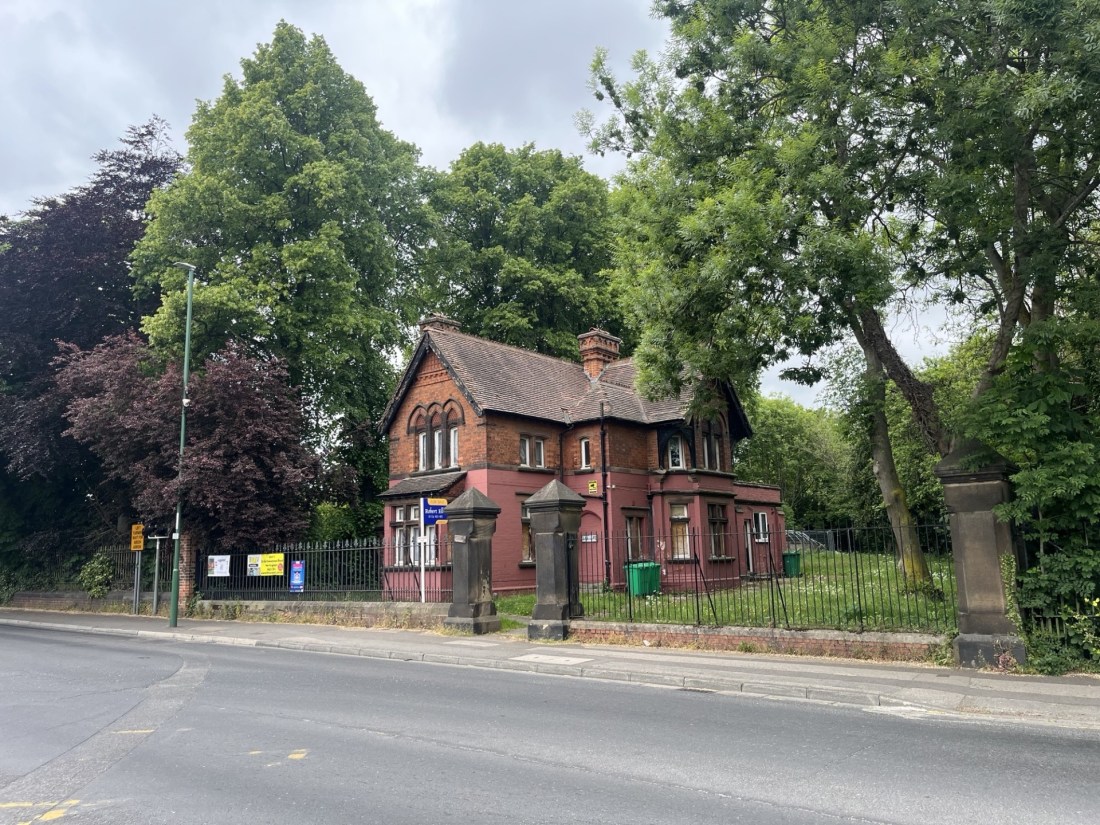
It was just a three-minute walk. The highest point seems to be at the rear of a bleak looking Victorian block of flats set behind some grim railings and gloomy woodland just opposite the busy and confusing junction with Porchester Road.
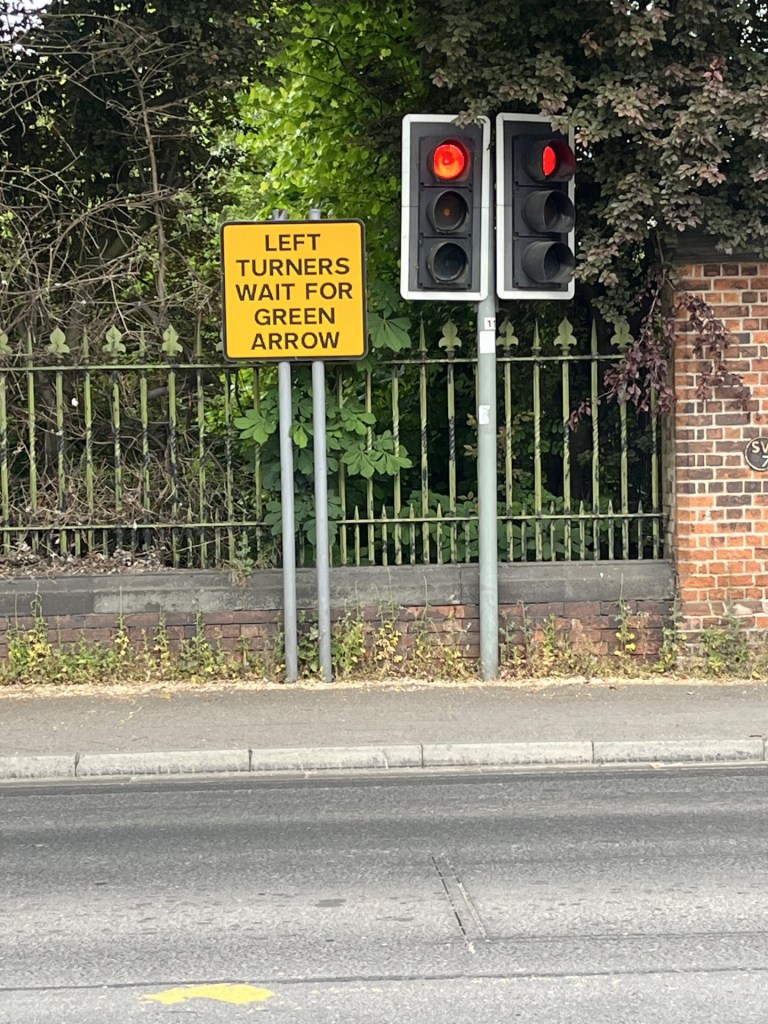
There was no helpful instruction for Right turners.
I passed on by. The oppressive heavy-duty railings continued to line the left-hand side of the road, behind which was what appeared to be a grass covered reservoir.

The grassy uplands of Mapperley

The highest point appears to be the back garden of this indeterminate bleak house
Walking back to the car I looked around at the most eclectic collection of buildings you could find in any place in the country. Mainly Victorian and early 20th century not one of them looked like the next, and without exception, other than a strange quirkiness, none had any architectural interest or value. It seems that high ground to the east of an industrial city does not a garden suburb make.
I’d chalked Mapperley off the list but still had a few hours to continue my Nottingham investigations. I had an objective. Something I had been aware of for some years but had not had the opportunity. I drove back into the centre, navigating tricky road layouts, past the castle and then west, eventually reaching the area of Toton an hour or so later. I parked up on a new estate and then headed into the Toton Fields Nature Reserve. After twenty minutes or so the rising land took me to a point I had hoped existed. I knew I was there because there were a few other people with cameras and binoculars looking down the slope to the west, and the noise below was distinctive.
I was overlooking the Toton marshalling and freight yards. A hive of railway activity with locomotives slowly moving north and south, vying for position. Every so often a long freight train pulling through. Immediately below two peripheral sidings were the final resting places for scores of redundant diesels, just waiting to be scrapped. In a way quite a moving sight but somewhat inevitable given our rejection of railways as a means of tackling our multitude of problems. But beyond, the activity suggested that whilst the rail freight business might be down, it wasn’t quite out. And the only reason I am talking about this at all is that the site contained the largest selection of Class 66 diesel locomotives in one place that I have ever seen (and they weren’t all red) **
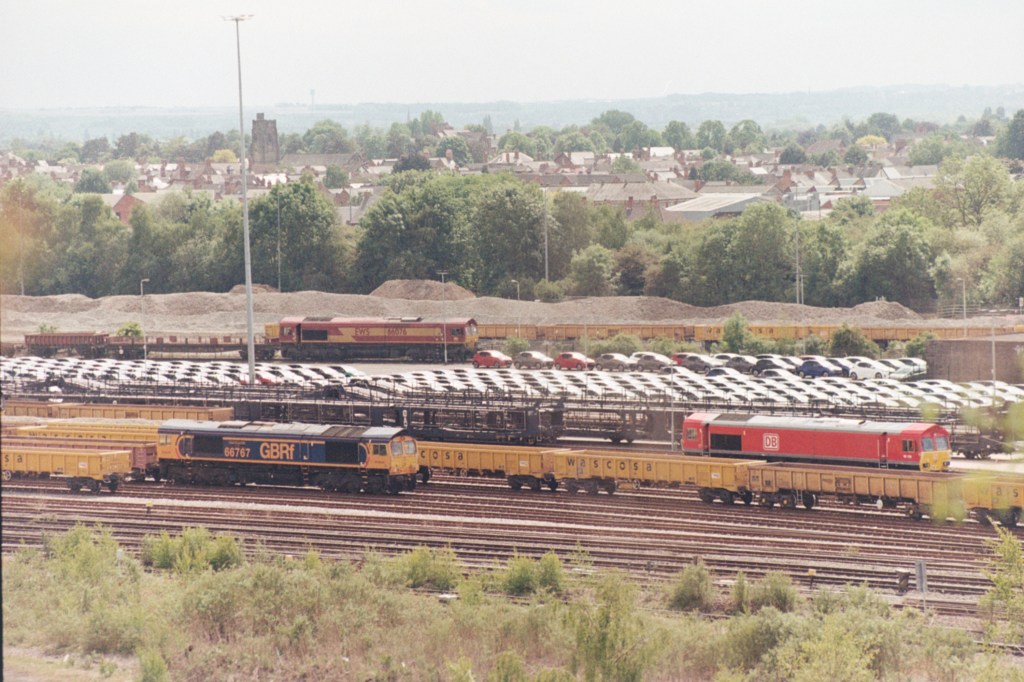
A colouration of Class 66s.
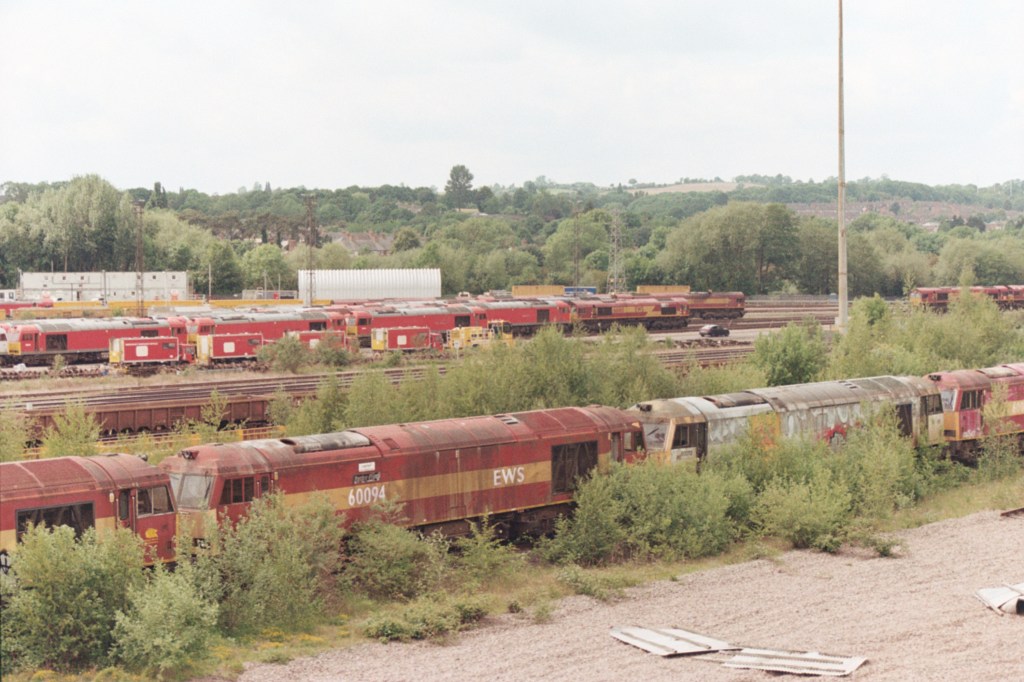
The end of the line at Toton
I could have sat and watched the activity at the Toton yards for hours more, but it was time to go back to West Bridgeford.
I walked back south on the low ridge (which I guessed was artificial) and just as the yard was coming to an end, with my route out of the reserve to the left, I looked up. On the horizon, perhaps a mile or two to the south, the huge cooling towers of the old Ratcliffe on Soar power station reared above the low Nottinghamshire plain. It occurred to me that it might be the last time I would ever see it, it having been in my line of sight on hundreds of occasions since the mid 1960’s. Coal powered and out of date, it nevertheless always had an uplifting, cathedral like and overwhelming appeal. But, despite the unaccountable nostalgia, it must go and for the last time I took a photo.
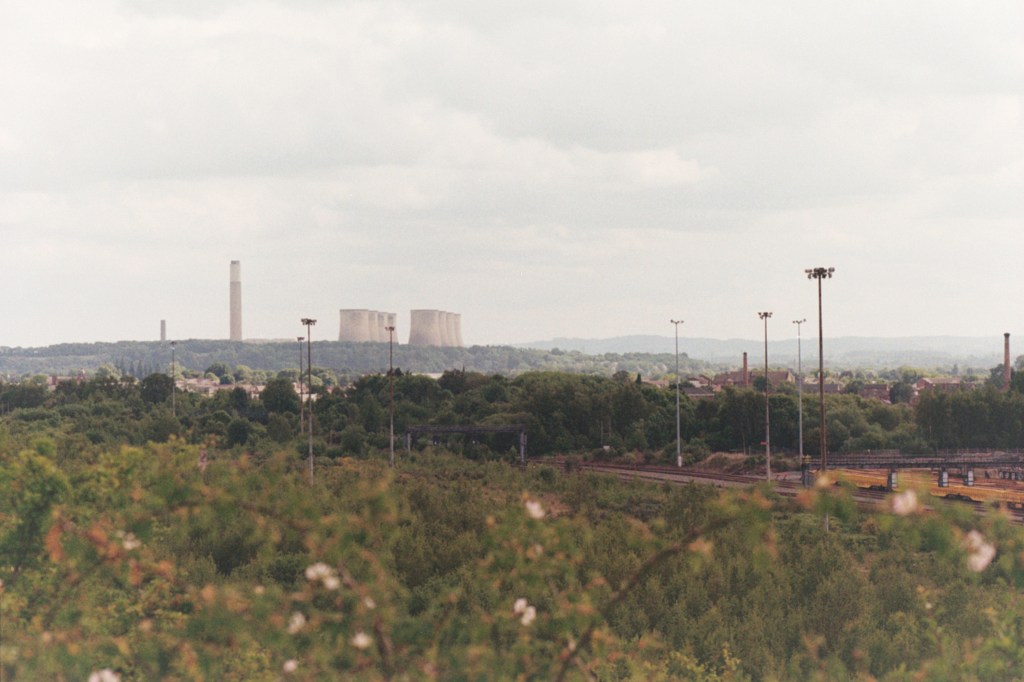
Fair ye well Ratcliffe on Soar.
After navigating through the usual late afternoon urban congestion, I found myself driving back past the cricket ground. It was heaving, which was a surprise. The radio had been on and suddenly they had gone over to Trent Bridge for an update on the cricket! England v Zimbabwe one off test match. And at that moment I was there, but not. How could I have missed this opportunity? I reflected that I could have spent the day in the sun watching the great game, but then, just think what I would have missed if I had.
* https://www.bbc.co.uk/sounds/play/m001bgrp
** Red Class 66 locomotives have joyfully received a mention in at least two other Cresting the Counties (Rutland and Medway)
 El Colmado 57