Leith Hill
294 metres
965 feet
8th July 2024
Ploughing Inn a Well-Worn Furrow
I finished this short ascent and descent in the garden of the Plough Inn, Coldharbour. The sun had momentarily picked a hole through the now familiar blanket of grey cloud but by the time I had reached the large back garden, juggling a pot of tea, a jug of milk, and a saucerful of sugar it had inevitably gone, and a light drizzle danced in the breeze. But that was okay.
On a handful of occasions, over many years, I had sat in this place with friends, supping warm beer after strolling to the top of Leith Hill, not just the highest point in Surrey, but the whole of England’s southeast.* Today, being a Monday, with the recent weather dialled down to “it really can’t get much worse,” the garden was empty, but to all intents and purposes, it hadn’t changed too much.
I can’t remember much about getting to the top of the hill the first-time round. It was an end of year school outing from south-east London in the early summer of 1973. The whole year dispatched to Dorking to expand the minds. The comprehensive school had only opened three years earlier. We were the top year throughout, having all of us completed our first year of secondary education in other establishments, and consequently we were small in number.
From what I know of end of year school trips these days, a visit to the nearest theme park seems to be the order of the day, but the nearest to a thrill ride back in 1973 was when a handful of the lads jumped on the back of a milk float a mile out of Dorking, on Coldharbour Lane, treating themselves to mid-morning pasteurised refreshments.
I am pretty sure that some of the accompanying teachers made small efforts to educate us about the history and geography of the area, but in truth we weren’t really an intellectually motivated bunch, and anyway Walk on the Wild Side was in the charts, and it was the summer of glam and retro rock n roll. We’d all let our hair down (even the skinheads).
Just in case you might be interested, here’s a selection of the tunes that formed the backdrop to life at that time (and be warned – it’s not as great as I remember it).
https://www.everyhit.com/retrocharts/1973-June.html
The walk along Coldharbour Lane wound up the lower slopes of the hill and then through a mile long section of high, overhanging beech trees that lined the flanks of the tight road, creating an impressive tunnel effect. I can hardly remember any of the ascent to the top of the hill, but for reasons best known to the enlightened teachers who accompanied us, we ended up (or at least some of us did), in the garden of the Plough Inn at Coldharbour.
With dedicated ambition, and some subterfuge, the bolder and perhaps more mature looking students, procured warm pints and pork pies for those interested in being educated in the art of beer drinking (I, being one). The Plough Inn at that time, was a typically rural affair, with a sprinkling of locals enjoying an afternoon pint or two, but now inundated by feral urban youths’ intent on having fun. My abiding memory is of taking a chunk out of my allocated pork pie, and possibly being a tad tipsy, watching, as if in slow motion, what remained of the pie roll gracefully out of the wrapper and bounce onto the dusty floor below my seat. Having then loudly announced that I wasn’t going to eat the rest of it, an old boy sitting opposite, and closely resembling Ted from the Fast Show, explained assertively that having served in the trenches during the First World War, I was an insult to him and humanity in general, and demanded that I pick it up and eat it. A dreadful image entered my head but there was no arguing with his logic. I ate the pie and learned an important life lesson. Don’t waste anything.
The second ascent took place just three years later, in 1976. Two mates and I (including my friend Bill from school), took the same journey by train to Dorking and then on foot up Coldharbour Lane. Having now reached our majority, the plan was to complete the walk, revisit the Plough, have a few and then sway back to Dorking and home. If only! The weather was of a completely different composition to that of 1973. Wet and cold (which, given that it was 1976, strongly suggested that this was not a summer campaign). Having completed the climb, and now soaked and freezing, it was just a question of legging it back to the pub. Which, in the best traditions of the times, and the then licensing act…. had closed two minutes before our arrival. With the rain now hammering down, no cover in sight and desperately disappointed (you can imagine), the thought of walking back to Dorking was the last thing we wanted to do. That said, there didn’t appear to be another option.
As I write this, I am very aware that I have strayed a million miles off subject. The subject of course, in case that’s already been lost to the wind, was about getting to the top of the highest points in each county. Back in the present I had driven up from home, with some time to kill before a later appointment back in southeast London. Through Dorking and up the familiar route of Coldharbour Lane. I once drove this road at a ridiculously early hour of a Spring morning, with dawn beginning to break, and after having dropped a friend off at Gatwick for a first out flight. I could have gone straight back to north London, but opportunities like this didn’t come round every day and in the weirdness of the early hour I took these narrow, high lanes. As wondrous and mystical as the Surrey Hills were in the dawn, it was hideously counterpoised by the appalling slaughter that the endless roadkill evidenced on these small backroads. And that was in the days when 4X4’s were exclusively owned by farmers!! I dread to think what dawn might be like now.
There was no evidence of mass slaughter today. Maybe the recent incessant rain had washed all the roadkill away? I reached Coldharbour and parked up in the small car park opposite the Plough. As far as I could see nothing much had changed, although a large sign on the car park gate advertised a music festival in a field somewhere in Surrey, with a range of old bands that back in the 1970’s I may or may not have seen in the Greyhound in Croydon. *
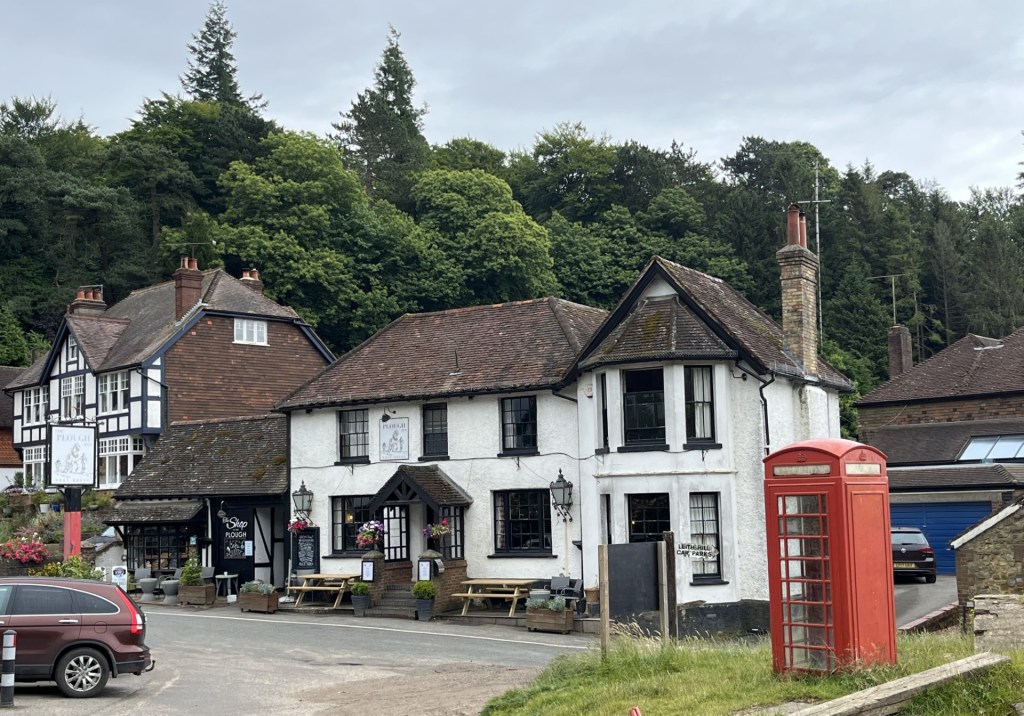
The Plough Inn and shop – Coldharbour – 2024
Whilst it wasn’t raining, it was overcast and a bit muggy. To justify parking in the pub car park, and because I quite fancied a drink, I went over to the pub, which looked a tad closed. However, just to the side, and by the arch that would have once seen coaches and horses pass through to take up stables for the night, was a small cafe, obviously associated with the pub, but thankfully open. The cafe came with a small shop which sold a range of random essentials, almost certainly a bit of a lifeline to the handful of locals.
I finished off a coffee and then set off on what I knew to be a short climb (other routes are available but don’t start and finish at an ancient pub). The route started opposite the pub and up a metalled road. Within thirty seconds I was reminded of just how steep this section is. Driving for two hours and then quaffing down a coffee was irresponsible preparation. I stopped and took some deep breaths. I couldn’t just give up. Could I? Off again and the gradient increased! Another stop. Ludicrous. Just two weeks earlier I had managed over 4000 ft. Further up I could tell that some people were coming down in the other direction. This was no time to look like an old man walking (which of course is exactly what it was), and so after a deep draw I trudged on, managing to mutter a “good morning” as the couple passed, and after a few more minutes was over the worst of the gradient. By now the road had become a track, and with it huge muddy puddles where only 4X4’s and ponies could cross. Carefully picking my way through muddy paths away from the main track I eventually broke the tree cover and there it was. The cricket pitch. I had almost completely forgotten what must be one of the most remote and eccentric pitches in the land. The fact that it was still there and clearly still in use, post Covid, was good to see.
At this point I had two options. Left or right. I took the left, and the path up through the woods. It all felt very familiar, except for the signs warning you not to stray from the path into the woods, where the evidence of storm damaged trees was scattered widely. On and up, and then the final push up a steeper section, with a new mountain bike trail close by on the right.
Over a decade earlier, and working in an inner-city concrete jungle, where youth crime and disorder was the backdrop to everyday life, and which I had some responsibility in trying to address it, I was invited by a colleague to take a group of young people, identified as being at risk of offending, on a day’s mountain biking in the Surrey hills, not a million miles from Leith Hill. I can’t think now why I agreed, but at the time it felt like saying no wasn’t an option. My colleague was very persuasive.
A minibus ride from the heart of north London with 15 or so kids who had rarely been out of their postcode, and a couple of hours later we were in paradise and being put through our paces. As a moderately keen cyclist, I was looking forward to observing, but the reality was unexpected, not least because I hadn’t expected to participate, and would have been more than happy just to watch and shout encouragement. But no. Along with everyone else I was allocated a bike and told to cycle as fast as I could towards a large log that lay across a dirt path. This felt completely mad and counterintuitive to anything I had ever done on a bike before. The problem was that so far, all the kids had fearlessly taken on the challenge and passed with literally flying colours. Now there was a small issue of kudos at stake (“kudos” being a parochial north London gang term for someone who shows a lot of front in the face of establishment, and other gangs). The front wheel of the bike hit the log with jaw juddering force and my time was surely up, but a miracle occurred, and I was over. The kids from the estates even clapped.
A few minutes later I was on my arse and plucking leaves, bark and twigs from various parts of my clothing and skin after showing too much kudos trying to take a bend that came with a hump, logs and insecure stones. Two of the lads (remember they would have been at risk of offending) immediately dropped their bikes and helped me up, concerned that as an old person I may have needed immediate medical attention. Maybe I did, but this wasn’t the time to show it. By the end of the day everyone was exhausted, and ecstatic, at the same time. It had been a great day, but it had come to an end, nonetheless. As the saying goes, you can take the boys and girls out of London, but you can’t take London out of the boys and girls. One less day in the summer holidays when otherwise they could have been getting into trouble outside their door, but it was time to go home. I am certain that that day of taking risks in the Surrey hills would have made a small impression on these great young people, but also that it alone wouldn’t have been enough to change things in the long term. Since then, our youth services and provision has been devastated by cuts and I doubt very much if these sorts of trips still happen. I strongly suspect not.
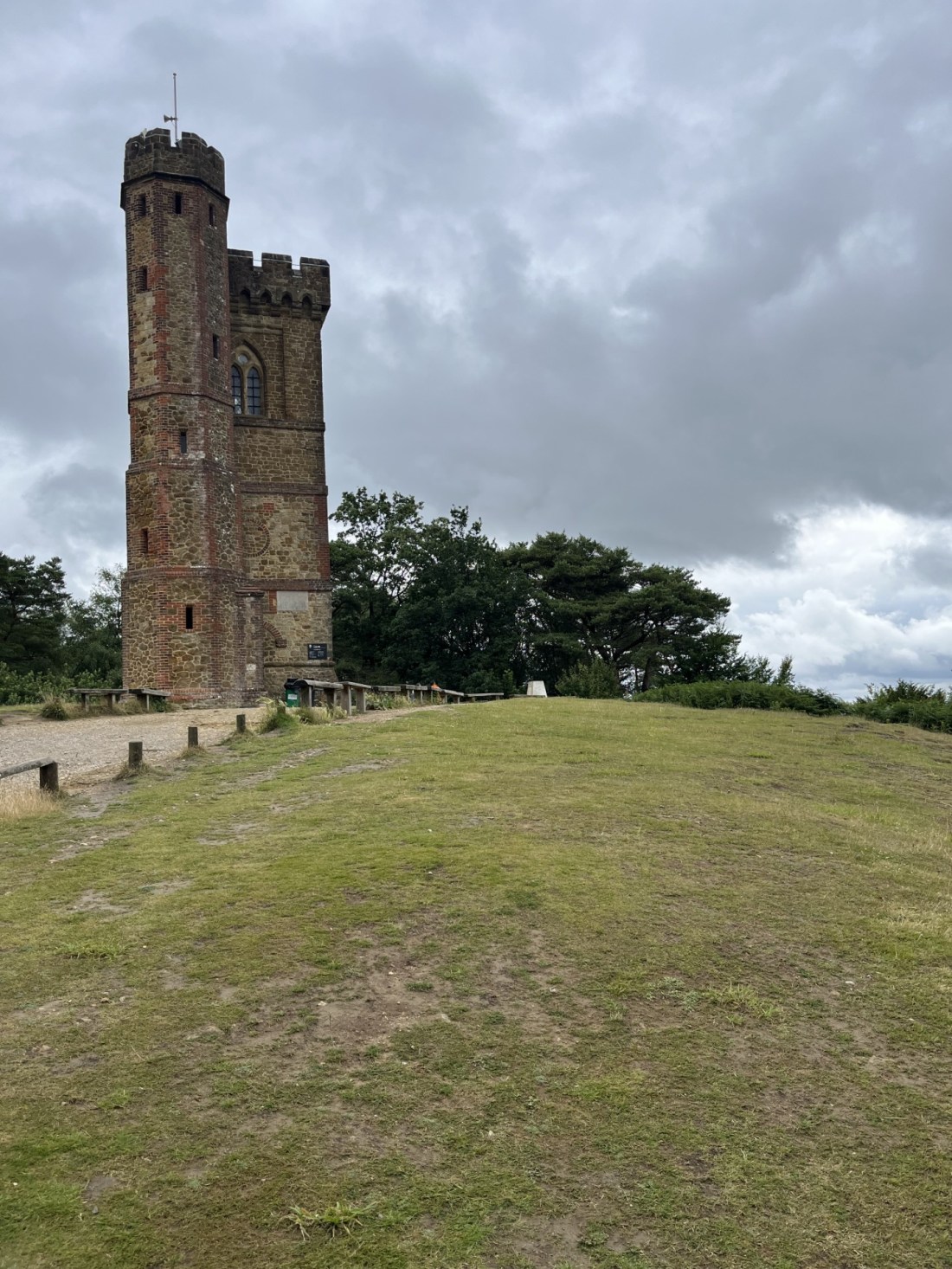
Back in the present, after the final steep ascent the tree canopy ended and directly in front was the iconic red brick tower, built in 1765 by Richard Hull, ** a Bristol based merchant philanthropist, designed to elevate the intrepid walker over 1000 feet, and open to all (until it fell into disrepair!).

Hull’s Enlightened Folly
The walk from the pub had been about 250 metres in elevation, but little over a mile in distance. I was a bit pooped, and rather than add to the effort, chose not to climb the 65 further feet to the top of the tower. I sat on a bench just back from the trig point and took in the views to the south.

Somehow this photo managed to miss all the other walkers with their dogs
The day had brightened up a bit and the South Downs were clearly visible. Whether it was my imagination or not, and given my eyesight isn’t what it was, on a couple of occasions I was sure I could make out the wind turbines off the coast beyond Worthing. And looking far to the southeast I was sure I could see the Fire Hills at Fairlight. If so, it was quite a view. I was tempted to get a drink at the small cafe at the foot of the tower, but decided instead to wait until I was back at the Plough. After a few minutes I wandered round to the north of the tower and to another bench that I thought was slightly higher than the base of the tower and the trig point. I guessed this was the highest point and took in the view of London beyond, regretting having not brought binoculars.

The South Downs towards Brighton
Setting off back down I followed part of the mountain bike trail, where to the left more signs indicated that due to storms and other weather-related activity (rain I guess), the woods were unsafe to walkers. After a short distance an option was presented to take alternative routes. I’d forgotten that there were other paths down. A sign to the left pointed to Friday Street, a route which I had done with my old school friend and another old mate when we were in our forties.
Dead ahead was the Duke’s Warren. Sadly, I didn’t have time for the romance of a diversion towards Friday Street and so headed into Duke’s Warren and its outstanding sandy heathland.
For a few years, when I was young, I lived in Woking, located a few miles to the northwest. A pretty average town with a railway station, the oldest mosque in England, and virtually in London. Except, and brilliantly, it was almost entirely surrounded by easily accessible heathland. As a child in the 1960’s, and old enough to be out of the home all day when it wasn’t school or mid-winter, I’d spend hours either on my own or with mates on the heaths. Playing war and mods and rockers, starting fires (I know, I know!!!), exploring World War 2 pill boxes, breaking bottles (I know!!!!!!!!) and catching frogs and lizards. Very fond memories and I’m not usually much for nostalgia, but the stroll through Duke’s Warren reminded me of the beauty and richness of Surrey’s heathland. I am pretty sure there’s not as much now as there was then, but what’s left must be left. I stopped for a bit to see if there were any signs of reptile life.
Whilst my trip to Leith Hill with the school in 1973 was the first official visit, I have subsequently learned that I had been here in the 1960’s with my parents, on a day trip. Whilst I had no idea at the time that it was Leith Hill I do have a very vivid memory of us arriving at a sandy point on a hill and my mum throwing down a rug, only to realise that it had landed on a huge basking snake, which offended, did some sort of slithery thing and hissed off into the bracken. Given that it was definitely an adder, we grabbed the rug and ran. I say we ran, but in truth I dawdled, fascinated and hopeful that it might reappear. It didn’t, and whilst there are certainly adders to be found in these parts, it was far too big, and was almost certainly a grass snake.
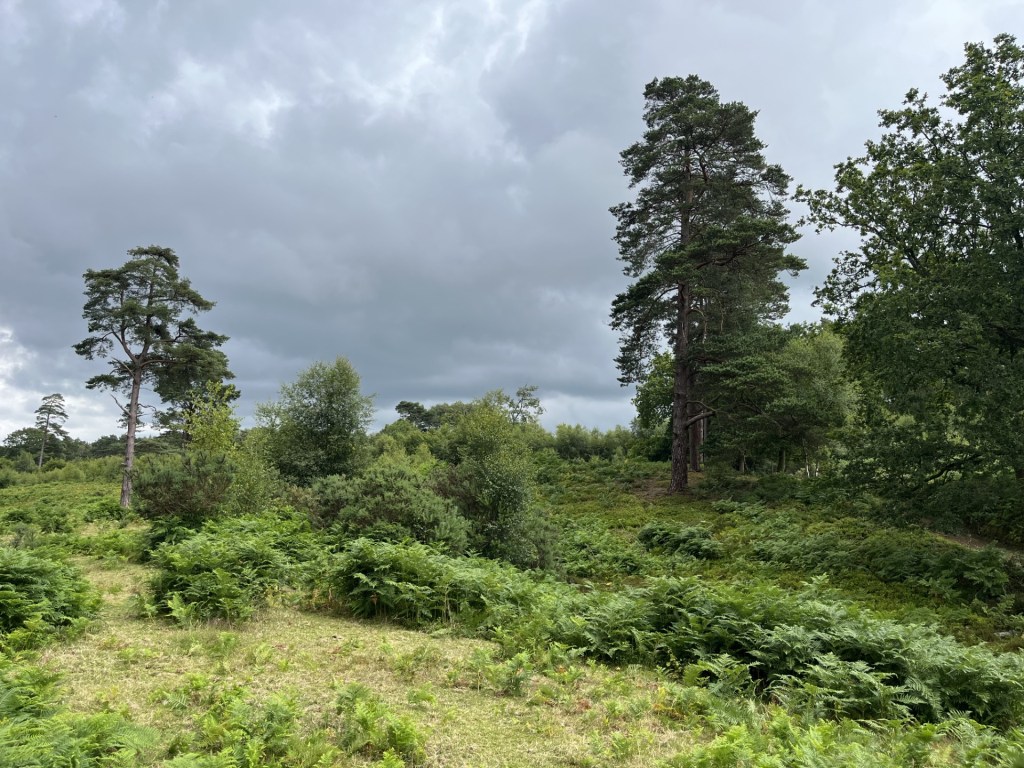
I sat alone, but nothing happened. It didn’t matter.
The path eventually emerged from the heathland back at the cricket pitch, which was now a hive of activity. A man was out in the middle with a lawn mower, and contractors were working on the roof of the small pavilion, and from what I could tell, installing solar panels. I guess if they want to play evening 20/20 matches here against Gomshall Mill or Abinger Hammer, they’re going to need flood lights too. The old pavilion, not content with providing changing facilities, is also available to hire for parties, weddings and bat watching. And why not?
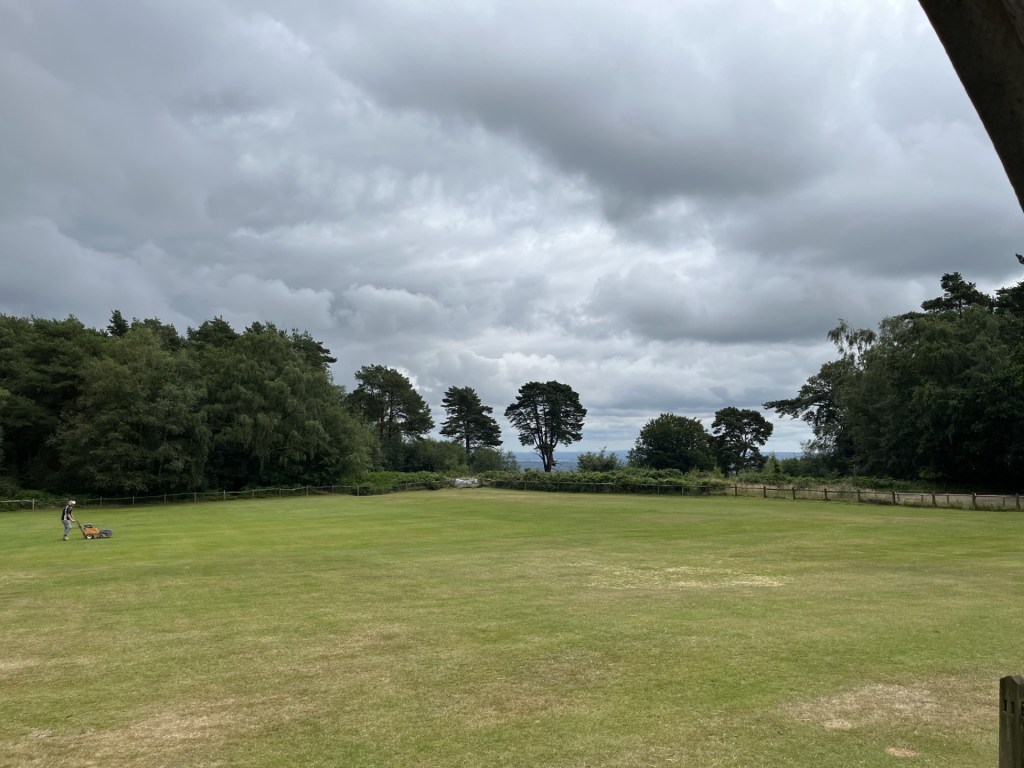
One day the sun will shine above our heads, and a new energy will power the karaoke – Catch!!
Fifteen minutes later I was back at the bottom of the steep road and looking towards the Plough Inn. Emerging at this point in 1976, and more than ready for a well-earned pint or two, you’ll recall (surely!) that the pub had closed two minutes earlier, it was cold and teeming down with rain. The only cover at all was to be found in the public phone box. We squeezed in, with no hope in our hearts. I guess we were fortunate to be trapped in a phone box in a tiny settlement in the middle of nowhere. The chance of an operational public phone where we were from was almost nil, vandalism being an endemic hobby locally in the 1970’s. So, here was a phone that worked, and we had a few pence that now wasn’t going to get us a beer. I guarantee that if we are lucky, most of us only know one phone number. Our own mobile number. Before mobile phones you not only knew your own number but could usually recall the numbers of most of your friends, because you regularly had to call these numbers using your digits. And so it was that Bill took the initiative, and a bit of a punt, and called another friend back in London. This friend was slightly older and owned a Fiat 500 (I’d insert an image here, but you wouldn’t believe it and think I’d created it digitally). He agreed, quite why, to drive down and pick us up. Another hour or so passed, and maybe longer. There was no way of knowing if he was going to come through with the goods. By the time he eventually arrived the phone box was wetter, with condensation and cigarette smoke, on the inside than out.
Somehow, we squeezed into the tiny Fiat 500 (which in respect of cubic capacity was almost certainly smaller than the phone box), and an hour later we were back in suburbia and recovering from the ordeal in one of our regular inauspicious haunts.
But today I had my own car and a bit of time on my hands. I fancied a tea. I walked up to the door of the pub. Hmmm. There didn’t appear to be any lights on. And when I tested the handle there seemed to be more resistance than I had anticipated. I gazed through the window and took in all the smart tables that were set out for fine diners. I was perplexed by the notion that 48 years on it still closed at 2pm? It looked less than hopeful, and the little cafe annex had closed too. I turned away just at the moment a sound came from behind the door. A woman stepped out with an enormous dog in tow. She looked like she had just woken up. “Err …sorry, I’m guessing you’re closed?” I think the woman’s initial instinct might have been to say yes, it was, but maybe she took pity and a minute or so later I was sitting on my own in the large rear garden nursing a welcome pot of tea and a packet of crisps (unsurprisingly they don’t do pork pies anymore!). Not a lot had changed except it seemed to be a bit bigger and the quality of the furniture had improved considerably. I sat and contemplated. There were no locals or Western Front survivor’s here now. Was it nostalgia or just curiosity?
I sent a text to my old school friend Bill. “When did we go to Leith Hill with the school?” Moments later the reply. “1973.” Not even a question mark. I guess some memories are bigger than others. Minds Alive. ****
* Along, I’m sure with most people, Leith Hill has always been sold to me as the highest point in southeastern England. Except, nobody has ever mentioned Walbury Hill in Berkshire, which is nine feet higher. Another bubble burst.
** Actually, apart from seeing Hugh when he was with the Stranger’s a couple of times, I haven’t seen any of ‘em!

*** Richard Hull, to my surprise, given that he hailed from Bristol, does not seem to have had direct connections to the slave trade, but after his death the estate (Leith Hill Place) was owned by William Philip Perrin, who had inherited his wealth from his father’s five Jamaican sugar plantations, and the 135 slaves who worked them. The various links to the Leith Hill tower seem to tell different tales, but either it fell into ruin after Hull’s death and Perrin then renovated it and added to the height (by 1808 it seemed he had lost his entire fortune), or it just fell into ruin and sealed up for another 70 years, or it was sealed up and not fully reopened again until 1984. We may never know.
 El Colmado 57