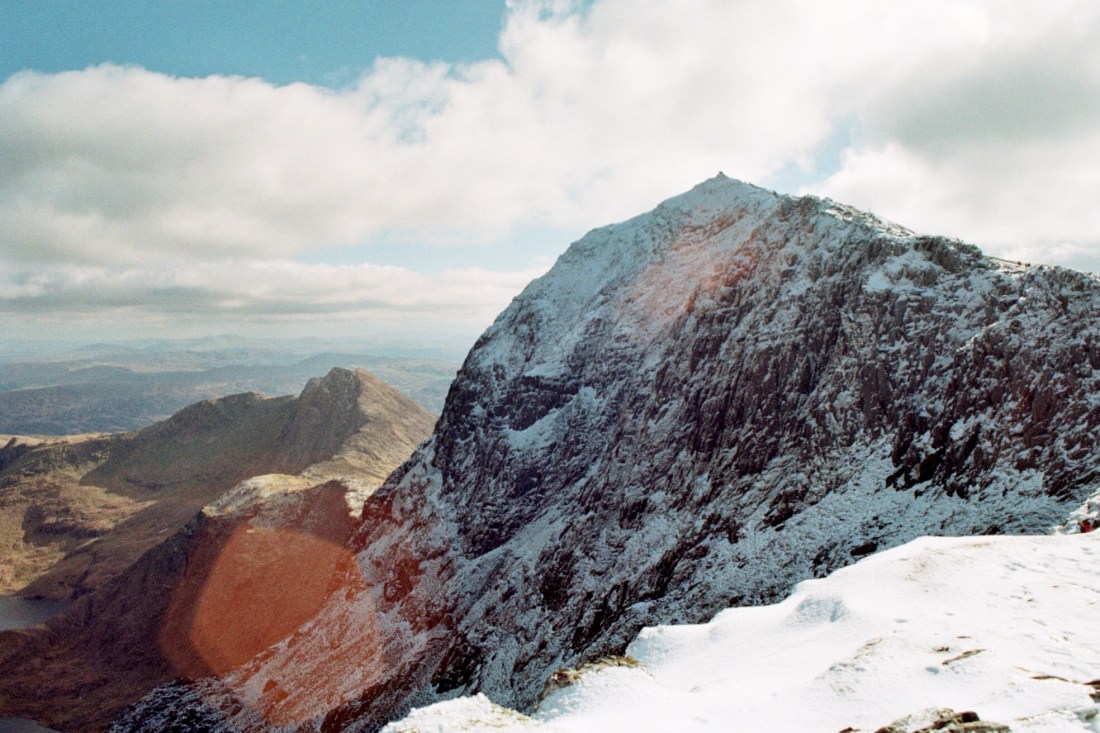
Snowdon *
1085 metres
3560 feet
Date/s: 1972? 2001? 16th May 2019 and 6th March 2022
Trains, Planes and Cafe Culture – One from the Vaults
Where do you start with Snowdon? Well, Llanberis generally, but other routes are available.
In the autumn of 1978, I was in my last year at a red brick University in the East Midlands, studying Geography. I lived in a small purpose-built room, in a purpose-built block, with nine other, not fit for purpose young male adults, a shared kitchen and bathroom, and the sound of punk and new wave painting the backdrop. In the third year an intake of new students had included a young man who I’ll call Dom. Everyone had hobbies of some sort, predominantly football and drinking as it happened, but Dom was a bit of an exception. Whilst unremarkable in many respects he was a fanatical rock climber. More worryingly he was also the only person still playing Tubular Bells, on repeat.
Often was the time when we’d return after a few pints in the cheapest bars in town and begin to climb the concrete staircase, only to be freaked out by Dom hanging directly over us as he shimmied up the walls in full kit. All outstretched limbs and magnetic rubber soled shoes.
The winter of 1978/9 was one of the coldest in my lifetime. At the end of November, a wickedly cold period of snow, and then brutally low temperatures, embalmed the east of England in ice. A long-standing overflow pipe that wept water from the top floor led to a build-up of solid ice down the side of the block. Dom, never slow to miss an opportunity, laid his hands on a hose which, by running a slow trickle of water down the outside of the building, slowly increased the volume of frozen water to create an ice wall he planned to hone his ice axe skills on. Someone studying engineering eventually intervened, after assessing that if his artificial ice slope was to reach the required thickness for his ice pick, there was every probability of the house collapsing first.
Most weekends Dom would disappear with his friends to practise his art in nature. I don’t think any of us were ever told where he was going, and to be honest I don’t think we particularly cared, but he was always back on Sunday evenings. So, when one Sunday afternoon there was a knock at the front door, and whoever answered it was met by a journalist from the local newspaper and asking if Dom lived at the address, our curiosity was peaked. On being told that he did, but that he was not at home, the journalist was less than forthcoming and advised that we might want to watch the early evening news.
And, sure enough, on the regional early evening news that night, all was revealed. A search had been going on all day for a couple of climbers who had gone missing on a massive cliff below the top of Snowdon. I think we were somewhat concerned.
Some hours later, and late in the evening, Dom suddenly appeared in the kitchen. Consternation all round, but it was water off Dom’s back. What was all the fuss about? The day before he and a mate had made a start on one of the almost vertical 300 metre cliffs rising above one of the small tarns below. At some point in the late afternoon, and a long way up, a rope had failed, and he and the other climber had fallen a long way before being left to dangle on what was left of the rope, some distance above the base of the cliff.
The night had drawn in, and then the realisation that there was no prospect of a rescue in the dark. The agreed solution was for one of them (I can’t remember who) to cut their rope and then climb down without any safety equipment to get help. Somehow or other this all panned out and early the next day the other climber was safely down, and they set off home. When Dom found out that the nations paparazzi had been trying to hunt him down, he was completely perplexed, finished his cup of tea and then went to bed (after a few finger pull ups from the second floor gutter for good measure).
I have no such stories to tell, but I have climbed Snowdon in the more traditional manner, three or four times. My first visit to the top of Snowdon had taken place just six years before Dom’s adventure, on a summer trip in north Wales with family. I would have been 14, and yet to discover the interesting effects of alcohol, or the rarefied atmosphere of a provincial University and its less than bohemian, yet delightfully diverse community. My memories are slim, but one thing is for certain, we didn’t climb up. We took the train, had some snacks in the old cafe and then walked back down. Given that this was the first proper mountain I had been up, I may well have been left with a somewhat distorted understanding of what they offered. A train, a cafe and stunning views. All very Bavarian.
I have what could be a phantom memory of climbing Snowdon many years after being at university, but for the life I can’t place it. I did spend some days in north Wales in early September 2001, and it could have been then. A day or so after, and having returned to London, I was ironing the afternoon away and contemplating the horrors of returning to work the following day. With the tele muted in the background, for no reason I can think of, I glanced up and watched as what appeared to be a plane smashed into what looked like one of the towers of the World Trade Centre. Thinking it was some weird afternoon disaster movie being shown on some dodgy TV channel I paid it no attention and got on with the job at hand. Looking up again some minutes later, it began to occur to me that all was not what it seemed, and I turned the volume up. Once the full enormity of what was happening had sunk in, I stopped ironing. So, it is entirely possible that at that moment, as I urgently collected the kids from their respective schools, any memory of climbing Snowdon a couple of days before was banished forever.
Some years later, and with more freedom now that the kids had become more independent, I started to visit north Wales more often, either staying in Barmouth or Aberystwyth. There was always enough nature to keep me interested in and around these towns. However, in May 2019, I needed a major distraction whilst waiting on the outcome of the final mind bogglingly expensive and tortuous days of negotiations by a solicitor to buy the freehold of my, and my neighbours flat from a rogue freeholder (a distorted legal legacy from our feudal past). I slipped up to Aberystwyth and decided to take the hike. Anything to block out the never-ending flow of increasingly negative emails.
Driving up from Aberystwyth and through Blaenau Ffestiniog I was flabbergasted by the scale of the slate quarrying that had taken place over the centuries. If I hadn’t already had an objective in mind I would have stopped and spent the day exploring the area.
I arrived at Llanberis and parked up. It all felt reasonably familiar to me, hence why I am pretty sure I had climbed it sometime between 1972 and 2019. It didn’t seem to be particularly busy, but there was one minor problem. Over the previous day or two I had developed a slightly debilitating pain in my right leg, between my knee and hip. This wasn’t a new issue and seemed to flare up from time to time, most commonly at precisely the wrong time. A year or two earlier I had set off on a spritely jaunt from Barmouth up the south bank of Afon Mawddach to Penmaenpool, but on the way back down the river, on the road to the north, my leg had seized up so painfully it took me nearly an hour to drag the throbbing knee gristle over the last half mile into town. At the time I genuinely thought my walking days were over, but the body’s ability to recover is a funny thing.
Whilst I wasn’t going to let a bit of late morning leg pain put me off my plans, I was nevertheless just a tad mindful that if I had a repeat of the Barmouth debacle anywhere beyond halfway up the mountain, I might not have the resolve to make it back down. But, no worries, there was always an alternative if such would occur, and I went to make enquiries in the visitors’ centre.
“Oh no dear, I don’t think that could be done, unless of course you book in advance.”
“OK. So, just to be on the safe side, could I buy a ticket back down for later?” I was at the old ticket office at Snowdon Railway Station, and had enquired as to whether, should I become disabled somewhere up the mountain, it might be possible to hop on a returning train.
“Well, you can try of course, but you have to do it online.” That’s the sort of message that instantaneously causes me to go into a state of deep anxiety, along with an instant resentment towards the modern world. Nevertheless, if that was what needed to be done….
“Ok. What’s the website please?”
“Actually luv, you’ll probably be wasting your time. We’re so busy these days that you need to book months in advance.”
Deflated, but grateful for the fact that the heads-up had quashed further unnecessary mobile phone induced internet curiosity and anxiety, I looked around the large shop, cafe and waiting room, and at the swathes of people holding walking sticks, crutches, or propped up by walking frames. It was obvious that the assistant was right. This was no place for the slightly enfeebled young at heart to be seen lurking.
I seemed to instinctively know where to go (which again suggests another visit within modern history). Leaving the station I walked down Rhes Fictoria (needs no translation) and then started on the small road up through trees on the Llanberis Path. Again, it all felt very familiar, not least because I was reminded that the first half kilometre is a complete pig of a climb, so steep I was almost walking on tiptoes. As I rounded a bend, at a pace that if maintained would see me arriving at the summit sometime the following week, a poseur on a mountain bike slowly passed me by. We didn’t exchange greetings, on account that neither of us had the energy.
And there, around the bend, just fifty metres on, was a cafe! I’d only been walking for ten minutes but the call of bun and coffee was too much. By now, in the crawling position, it still took me a while to get there. It was a busy little hub of activity, and there was just a suspicion that many of the customers had set off with good intentions but had surrendered at the first hurdle. I too came close, but that would have been shameful.
So, on I went, continuing up the road until eventually turning left onto the path that headed southeast and gradually up. After a while, and looking towards the east, the sight of the gargantuan Dinorwig Slate quarry, rising hundreds of feet above Llyn Peris, a moraine blocked lake formed after the last ice-age, was breathtaking. Despite the utter devastation inflicted over two-hundred years by the roof hungry world on Snowdon’s neighbouring mountain, what should be an assault on the eyes somehow gets away with it. Not unlike a northern hemisphere version of Machu Picchu it once served a purpose, and now nature is slowly reclaiming the land. **

Continuing up, the slopes rose to the east and slowly obscured the views towards the quarry, but a slight distance down the slope to the right, the narrow gauge vernacular railway track, that shadowed the path for most of the rest of the climb, made itself apparent when one of the trains (that I would be banned from riding on should I stumble and fall) cranked past and up.
The climb was steady, only really problematic in places where it was necessary to stretch the limbs at low step features. The route worked up the valley with increasingly impressive views opening to the south and west. After three or four kilometres, and quite unexpectedly, another refreshment opportunity presented itself at a small snack shack. It hadn’t been in the plan but any excuse. It had turned into a warm day, so sugar, salt and liquid refreshment was becoming essential. In any case, a break to take in the view sitting on my backside, rather than on the hoof, was very welcome.
After this point the angle of ascent began to steepen as the path swung to the east and on a more direct route up the valley slope. As the climb became a harder challenge, the reward was the increasingly pleasing views to the southwest, and the mystical slate blue, occasionally trout brown, waters of Llyn Du’r Arddu, a glacial tarn that sits on a plateau beneath the soaring cliffs that form the north face under the final ascent.
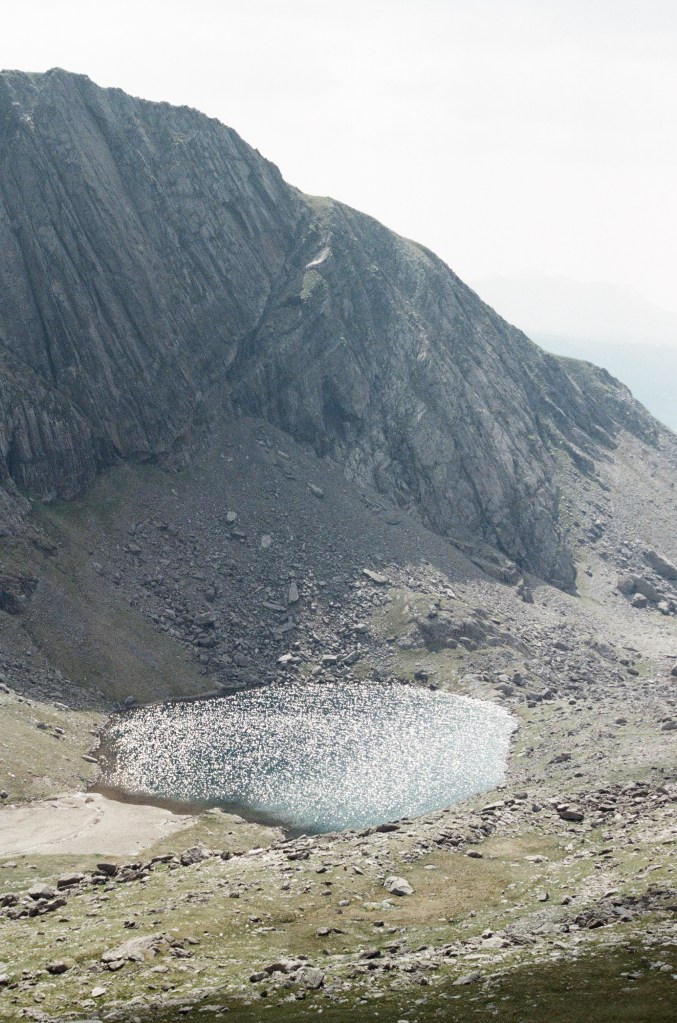
Llyn Du’r Arddu
The path continued up, hugging the slope, with the tarn on permanent display to the west, and then eventually ducked under a small stone bridge supporting the train line. From this point on the main track was to the east of the line, and the view of the tarn now restricted. Slogging on south, and up, I was beginning to get a sense of height. Surrounding peaks were now to be looked down on, rather than up to. Continuing for another mile or so, the well-worn path presented little in the form of interest, although a particular feature of this zone was the extraordinary number of discarded banana skins (some of which may well become fossils in due course and in millions of years will create great confusion to geologists).
At 1000 metres I suddenly broke cover from the bland slope, at a point where several paths met. Directly to the south was the craggy summit, with a line of human ants picking their way up to, and down from, the peak.

You have to imagine the hoards queuing at the top
To the east the land fell away hundreds of feet, worryingly, but spectacularly down to a beautiful tarn. A hazardous looking path zigzagged dramatically down the steep slopes and cliffs, and I thanked myself for not taking this route at the start of the day (it had crossed my mind as I had passed the busy car park at Pen Y Pass but had instead continued to Llanberis). Looking down the plunging cliff face below the peak, I momentarily thought of Dom, and shuddered.

I can see for miles
This was the point which had made the whole experience worth it. Whilst not quite at the top the views in every direction were dreamlike, and I wondered briefly whether there was much point in carrying on. Of course I did, and with the path following the railway line for the rest of the walk I eventually reached the summit station, and the very modern cafe and visitors centre (the old pre-war café now long demolished).
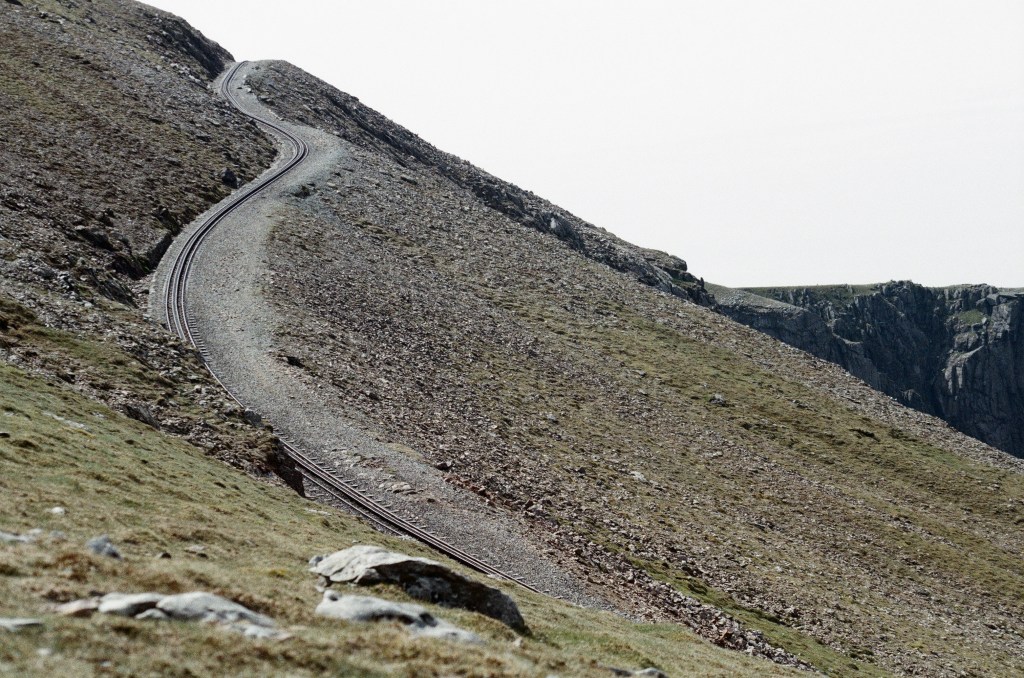
Not far to the café now
Purchasing a coffee and sandwich in a space not dissimilar to your average motorway service station, but with a better view, I went out and sat on some steps, just taking in the vistas. It was a warm afternoon, but despite the altitude the number of flies and wasps was deeply dispiriting. As far as I could tell, such a gathering could only have been exceeded by Clive James’s outdoor dunny at his childhood home at Kogarah in suburban Sydney. A smell, similar to what you get if you have the bad luck of getting a face full of extractor outside a KFC or McDonald’s (and for the sake of any potential litigation, other big fast food brand frying smells are available) hung over the establishment and had clearly attracted every diptera in the Eryri National Park (sorry, I mean Snowdonia – see footnote). And not just flies. Hundreds of gulls swooped, in the hope of a quick snatch and grab, or just wandered around the perimeter picking off discarded rubbish but studiously ignoring the hundreds of discarded banana skins.
Depressed by the scale of the human footprint just below the peak I took a quick look up. So many people were formed into a line winding up the hundred or so extra feet to the top, I rationalised that I’d done it before at some point and instead started my descent. Not long after, and with nothing particular on my mind, an almighty “whooshing” (old Welsh word) noise to my left, and in almost touching distance, the belly of a glider hurtled from below the ridge and then up sharply before disappearing out of sight. The whole thing lasted just a few seconds but I, and a few other witnesses, stood aghast wondering what on earth had just happened, and grateful that any underlying heart conditions hadn’t been accidentally triggered.
Despite my earlier concern about the durability of my right leg, it thankfully held up to the relentless impact stress on the largely stone stepped path. Relieved that I wasn’t going to have to resort to a dying swan act next to the railway track, I dug in and got on with the retreat. Back the way I’d come, and incident free.
For six or seven hours of the walk I’d put any worries about domestic issue to one side, but back at the car the first thing I did was check my emails. Nada!
The following day, the last of my short stay in north Wales, I drove up the northwest coast and circumnavigated the previously unexplored, and delightful Llyn Peninsula. I stopped at Aberdaron, a small village near the peninsula’s end and walked along the beach. There was no Wi-Fi signal of any sort, which was a curse and blessing in equal measure. Back at the village I grabbed a sandwich and cup of tea in a small cafe. The man serving asked what I’d been up to. I mentioned Snowdon. He knew it well, he said, and then explained he’d been up it numerous times, including three or four times on a bike (one time in snow). I should have been impressed I suppose, but I still had a lot on my mind. I asked him if they had Wi-Fi (the great equaliser). They did, and I took my drink and sandwich to a table outside and logged on.
I had been out of signal range for some hours, but I immediately registered a series of text messages from my neighbour pleading for me to read the emails. By now, and racked with anxiety, I opened Outlook, and the inbox was alight with emails. Judging from the jubilation being expressed in my neighbour’s emails, at long last (the whole process we had reached the end of a painful legal process (which had taken 18 long months – don’t do it unless you really must).
The good news was that we had finally gained the freehold. The bad news was that I was now broke. But the good news was that I could now get on and sell the flat, to address the now being broke situation. The bad news was that I would have to sell the flat. Oh well, as I looked out to sea, I realised that there could have been worse places to celebrate and commiserate at the same time. How many times did the lad say he’d cycled up Snowdon? Well, that was the last time I’d be attempting it either on foot, or by train.
The phone pinged again. An email from our solicitor. “Congratulations, please transfer £X%@&ing1000’s of pounds by close of play!” Wails from Wales!
*
And so, it came as a bit of a shock when, in March 2022, and after two long years of lockdowns, I ended up staying with my daughter and her partner in a small cottage in a valley in the middle of a very rural north Wales, somewhere near Cerrigydrudion. It was so remote that at night, if a car entered the valley two miles away its headlights lit the roads and hedgerows like a 1940’s black and white film noir. I expected a knock on the door and two men in beige gabardine coats demanding to see my identity papers at any moment. The shock was that as part of the deal (it being in part a birthday treat), there was an expectation that a climb up Snowdon was required. “But,” I explained, “I vowed I would never go up Snowdon again.” Of course, and quite rightly, my feeble excuse fell quite literally on stony ground, and so on the morning of the 6th March 2022, I was back at the visitors centre in Llanberis. At least, I rationalised as I looked up to the snow covered peak, if my leg gives in this time, I had two young Sherpas to get me back down.
We set off, and of course I’d forgotten again how gut bustingly steep the first half mile was. The route, of course, was the same as before, and before that and that, and despite the gloriously sunny day it was cold. Maybe it was the time of year, or maybe it was a consequence of Covid, but there was no sign of life at the halfway snack shack. Lynn Du’r Arddu was a challenging slate blue. No signs were necessary, but if there had been they would have said “Swim here – If you think you’re hard enough!” I assumed that the guy from the cafe at Aberdaron had already done it, before climbing up the rest of the mountain on his hands.
The snowfield started at around 900 metres. A light dusting at first but gradually increasing in depth where the ground wasn’t fully exposed to the wind. By 1000 metres, and where the path emerged onto the col at Bwlch Glas, for the first time in my life I was high on a mountain in polar conditions. It was cold but the exhilaration of being at that location, there and then, and with my daughter and her partner blocked out any discomfort. I guess that if there had been the slightest of breezes it would have been a different matter, but we were lucky.
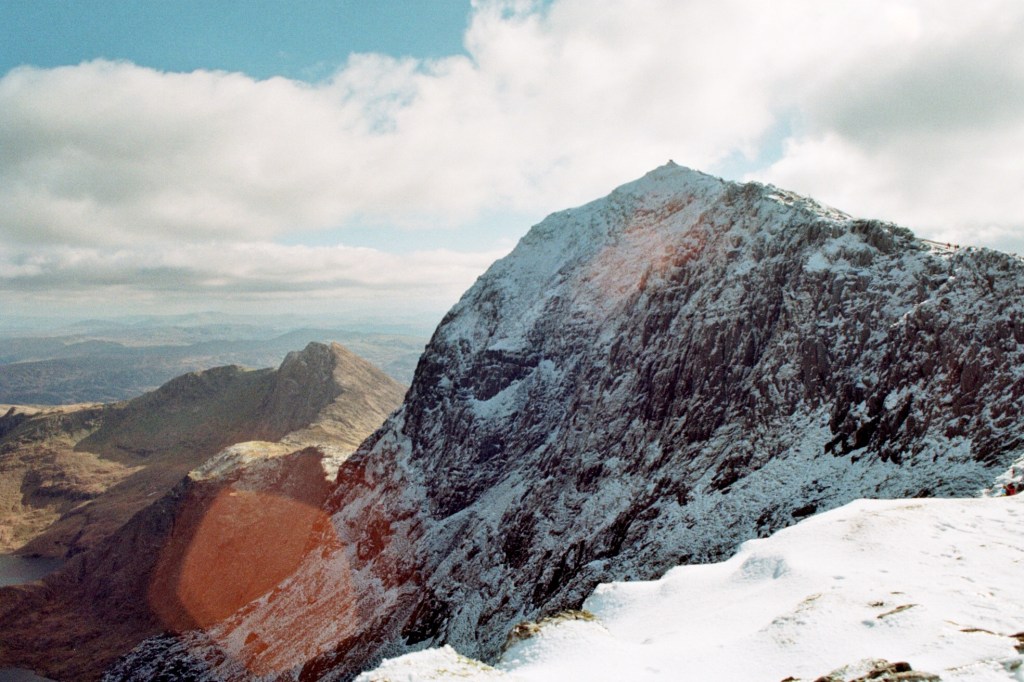
Compare and contrast (Spring 2019 above)
As we took photos and gawped at the magnificent views, I noticed my daughter and partner had started up a conversation with a couple standing nearby. It transpired that they were work colleagues from some time back. About the only time I have ever randomly bumped into an old friend was coming out of the tube at Tufnell Park station, so it seemed almost incredible that this was happening at 3000 feet on a mountain in north Wales; in winter. I was introduced to the couple, who were on their way back down after reaching the summit. I rather pathetically mentioned that at 64, and from what I had seen on the trek, I was almost certainly the oldest person on the mountain. But apparently not. They’d come up with one of their dad’s. He was 70. “Right. Where is he now?” I asked, embarrassed and somewhat deflated. “Oh, we left him at the top.” There was no hint of irony or further explanation. I looked towards the frozen summit. Perhaps, I wondered, it was a discrete form of assisted dying? I am sure I’m not alone in having an older relative say something to the effect that “if I ever end up like that just throw me off a cliff.” When it happened to me a couple of years ago, I had to explain that whilst I understood the sentiment, the consequences for me would be life in prison. However, being left at the top of a freezing mountain without walking aids? Hmmmm…. I haven’t had that conversation with my children…yet!
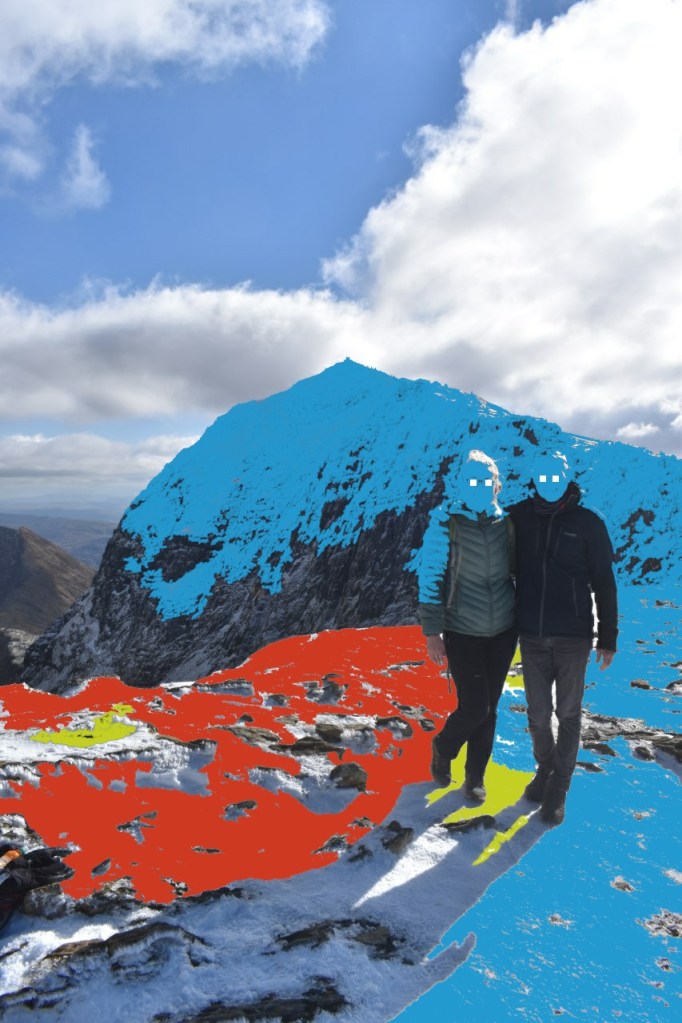
My daughter is waiting for me to say something. It can wait.
After parting company with the couple we carried on, following the line of the railway track, covered in snow and under maintenance. We reached the cafe, which was also closed. Fortunately, we had some bananas. We sat on the same steps I had sat on three years earlier, admiring the surrounding landscape and untroubled by any flies or the smell of hot fat.
After a short break we joined the queue to the peak (resistance was futile), and not long after we attained the summit, took the obligatory photos and headed back down.

Near summit view towards the sea
I’d kept a careful eye on all the other climbers throughout, and at no stage did I see any man who looked remotely 70 years old. Curious?

Don’t leave me…just yet! We need to talk about it.
Despite my initial misgivings, climbing back up Snowdon in such invigorating conditions, and in good company, was wholly worthwhile. But I’ll never do it again! The kids left the next day, and I spent a couple of extra days staying in Barmouth. Someone had recommended taking a look at Cadair Idris, and despite still sore legs I made my way to Minffordd, a short drive from Barmouth.
I could write another thousand words on my day on Cadair Idris, but that’s not the point of this exercise. At 2930 feet, it’s a long way from even being the second highest peak in Gwynedd, but from a purely aesthetic point of view it is a little gem of a mountain. A challenging walk with glorious examples of every glacial feature that physical geographers dream about (think roche moutonnee’s, but not for too long), and because of its solitary location, breath taking views in all directions, Cadair Idris is far more than worthwhile. A big thank you to the person who recommended it, and don’t tell anyone on Instagram.
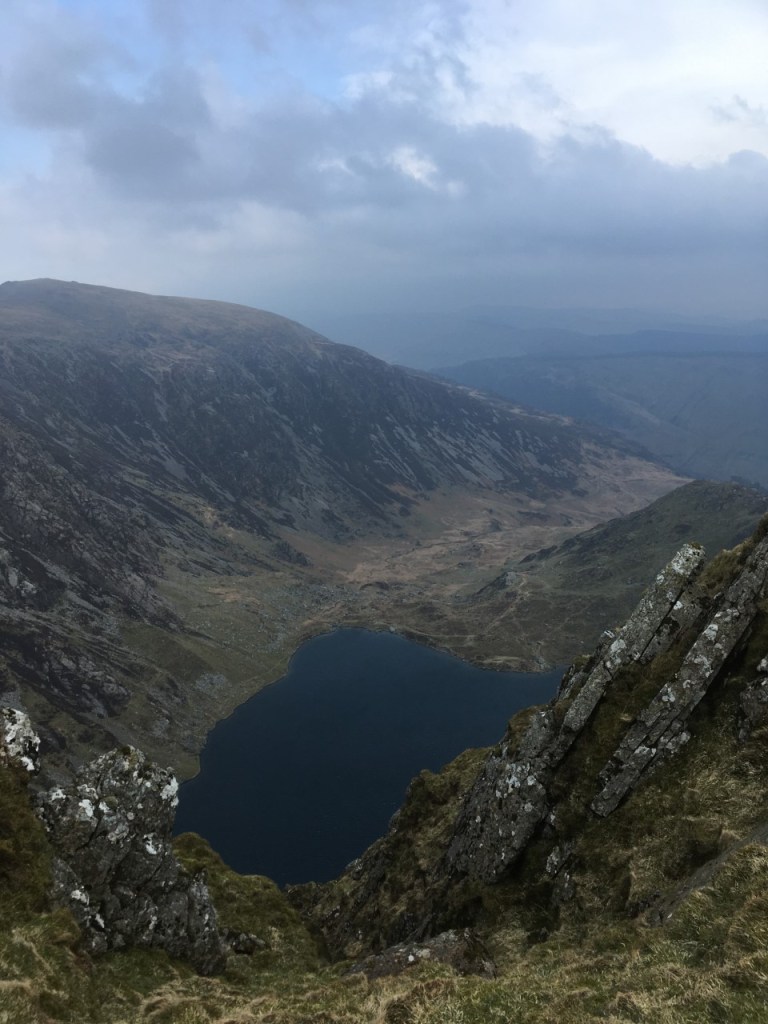
Cadair Idris. This view is for free
* Anyone who has had the endurance to read this far will almost certainly be concerned, positively or negatively, that I have stuck with the traditional English name, Snowdon, and not the traditional Welsh name Yr Wyddfa (Snowdon). There is an interesting (if you’re into etymology) discussion to be had as to what came first, and indeed what both these words mean. The English Snowdon is pretty straight forward. Don is “hill” and snow is – well pretty obvious. The first documented use of the Old English Snowdon was recorded in the 11th century – so, pretty old. Yr Wyddfa is a bit more ambiguous, and without walking into a linguistic minefield I have no understanding of, it either means a cairn or burial mound, or a high place. The use of Yr Wyddfa as a name for this place is recorded, but some centuries or two after the English version. Regardless, I have stuck with Snowdon on this occasion for the simple reason that the official name change took place late in 2022, some months after my last ascent.
I am 99% certain I will not be climbing it again, but if I do, and need to update this account, Yr Wyddfa it shall be.
** As I was writing up this account a BBC news story popped up about wanton damage being caused by a large rise in people visiting, and recklessly exploring the Dinorwig Slate quarry. Unfortunately, in the process vandalism and damage was being caused to the historically important industrial heritage site, including buildings being set on fire. Arson aside, I’m not entirely sure where I stand on this. Given the centuries of industrial scale brutalisation on the landscape, trying to preserve its legacy in aspic feels somewhat ironic. No culprits were named, but the main driver had been identified. Instagram!
 El Colmado 57