Hanging Hill
236 Metres
781 Feet
30th March 2025
A Battle to the High Ground
A beautiful Spring morning in Bristol, and a few hours to spare with my daughter and her partner J, before heading south after a short but very enjoyable weekend visit. They were both aware of my growing interest in seeking out county high points and indeed had previously enabled me to the tops of Ben Nevis and Snowdon. Was there somewhere locally where a short walk could take us to another county top? Well, up until a few weeks earlier I would have said no, and time was too short to hop over to south Wales. But that was before I had discovered a new county (or so I thought).
In October 2024, when I had climbed Cleeve Hill, I thought I had ticked off Gloucestershire. As winter came and held me in the grip of my local area, I found a map of British Counties online and ordered it. When it arrived it was exactly what I had in mind. Very simple, with the key information, and massive. I bought a large piece of plywood and carefully mounted the map using double sided tape. Now, all I had to do was work out a methodology of categorising the high points (by height obviously, but also by geology, for no other reason than to complicate the process), and then begin to annotate it as and when a new cresting occurred. I should say at this stage that it’s become quite a complex beast, and I’m a while away from any annotation, but something happened a few weeks ago that radically altered the dynamic.
One of the joys of having a huge, mounted map is that it’s easy to look at and take in geographical relationships and direction. When it comes to looking at maps on my phone, or on a PC, my spatial/visual awareness seems to go out of the window. I guess I was just born too late but give me a map in the hand and by and large I feel like I am in control. Of course, I couldn’t fit this map into my hand, but when I was planning the weekend in Bristol I had sat down and looked at the big one to see what counties might provide opportunity, either on the way there, or on the way back. It all seemed straight forward, until err… until, just past Wiltshire (yet to do), appeared a county called South Gloucestershire. What the what the?
South Gloucestershire wasn’t on my original list of counties, but sure enough it exists, as a Unitary Authority since 1996, and after the abolition of the previous authority of Avon. Whether or not including it in the itinerary is open to debate, but it was on my map and delivers all the services provided by Gloucestershire council to the north. It couldn’t be ignored and given that its high point was just a few miles to the east of Bristol, I offered up Hanging Hill as a short walk option before parting company.
We drove out of Bristol on the A431 (Bath Road), and just before the Swan Inn at Swineford turned left and along a track through a farm, pulling up at a small, very serviceable and free, car park set in a thicket of trees. You don’t get many of these for the pound these days, but without the need to have a ten minute confrontation with a pay by phone pay and display machine, I wasn’t complaining. J had done the research, and we set off east, past an old mill stream, and then into a large field with what appeared to be free range ostriches in the one adjacent.
Passing through a line of trees we entered another field, with the path then rising steeply until reaching another tree grouping flanking an ancient drover’s lane. The track, with steep banks on either side, continued up, but without being obvious, started taking us southeast, and away from our objective.

Steeply hollow
After plodding on up for nearly half a mile a path leading away from the track appeared to our left. Following a straight path we entered the seemingly exclusive hamlet of North Stoke. A road continued taking us east. A small red-letter box set into an impressive stone wall forming part of one of the more impressive buildings gave rustic charm. Continuing on and then left again past the modest but aesthetically pleasing St Martin’s church, we started to ascend another steep track that formed part of the Cotswold Way.
I should just say that, having stripped off various layers, and now down to my T-shirt, I hadn’t expected to still be climbing UP at this stage! I hadn’t really been paying much attention to the route and had assumed that we had parked quite close to Hanging Hill. I made my first inquiry whilst panting at each weary step. “Are we nearly there yet J….?”
Reassuring noises came back. Suitably reassured, I found a new lease and before too long (at least another half mile!) we reached a bench next to a gate leading onto a golf course. We were now on the Cotswold Way and that meant more walkers. A shame for me as out of nowhere an enthusiastic group appeared and colonised the very bench that, as we had approached, I had coveted over the previous two minutes.
We stopped, standing, to get our breath back (well, that’s what I was doing at any rate) and took in the impressive panorama looking west and towards Bristol, the Severn, and the Welsh mountains beyond. From the lie of the land, I assumed that we weren’t too far. “Are we nearly there yet J….?”
J consulted his phone. “Yup,” he replied. “That’s it just over there.”
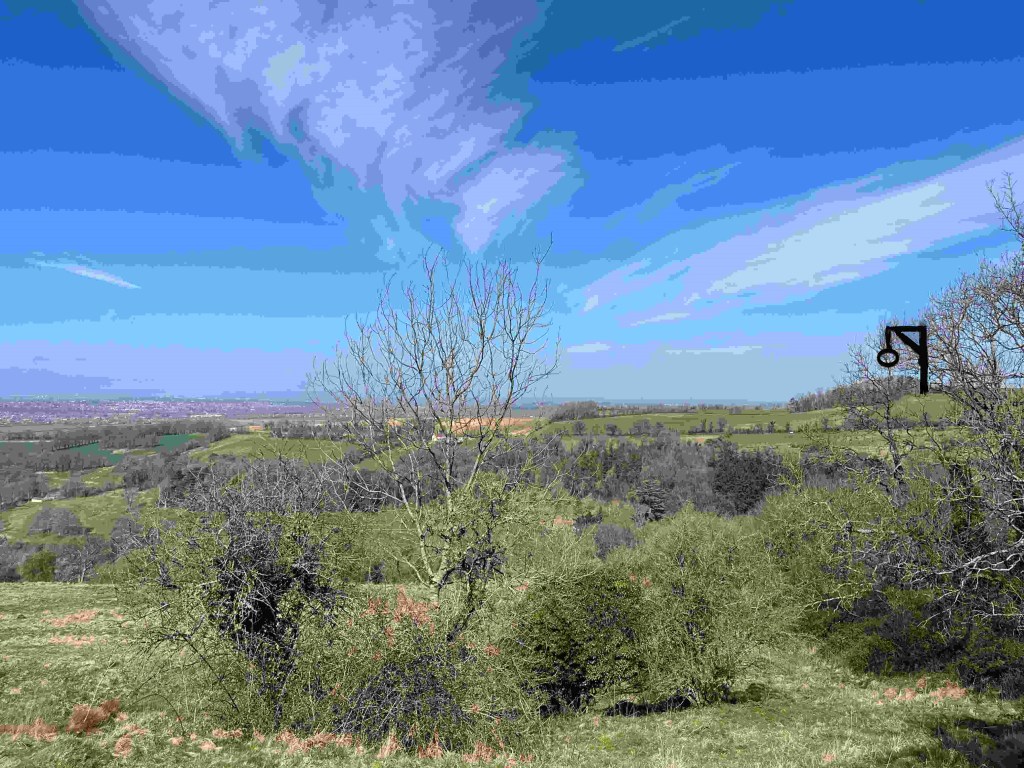
Of course it was…
I looked north. The land fell away steeply into a valley and then rose again towards a clump of trees at the end of a ridge. Just over there, yup, about a mile just over there (as the crow flies). Now, I had all day, but it was a Sunday, and I hadn’t wanted to eat into too much of my hosts remaining hours before their new working week. If, at that moment someone had said that getting to Hanging Hill was going to take too long, I would have surrendered the task there and then, to return another day. But nothing was said and so we continued on, flanking a pleasant looking golf course to the right and woods to the left. At least now we were on the flat.
Just past an old farm building, in a fallow field, a collection of metal fantasy sculptures had been let out to rust slowly in the elements. I’m not necessarily a fan of “industrial” art, which I find somewhat contrived (I can’t find an emoji of Morrissey, but if one exists, insert here), but on this occasion I was suitably impressed. Something about the location perhaps, but also the aesthetic and the way the Grim Reaper with dog, and other Tolkienesque characters had been positioned pulled me in. I considered taking a closer look, but time was pressing, and the need was to move on.

Sculptures by David Michael Morse – Deceased
The track continued up to a crest, with the golf greens now on our left. We headed northwest, still on the Cotswold Way. A delightful wood, covered in a carpet of thousands of wood anemones stretched out to our right. A suggestion to wander through these woods was vetoed. We appeared to be at the limit of our time window. The greens we passed seemed to stretch forever, and judging by the disastrous tee-shot swing (and hope) by a possibly hungover weekend golfer at the nearby tee, his game was going to be a stretch too, far.
Here the course ended and just ahead a gate beckoned us into a large field that vanished to the horizon, which was dispiritingly far away. By now there was a palpable tension. I’ll leave out the details, but entertaining the old man’s cranky new hobby had clearly run its course, and I had run out of credits. We had come too far to turn back. My own assessment of the land and the area suggested that we could make a dash back to the cars an alternative way, but for the moment it was important that I focused solely on apologising with conviction for my selfishness and trust for the best!
We crossed over the large field, a path clearly pointing us towards our destination. Minutes later, and to my overwhelming relief, we reached the trig point that marked the top of Hanging Hill. I was tempted to say we didn’t hang around, but sensibly we stopped and took a five-minute break. Hanging Hill? No idea. The next one to the north was called Freezing Hill. You get the medieval idea here.

Just hanging around. Trig points are handy things to rest on.
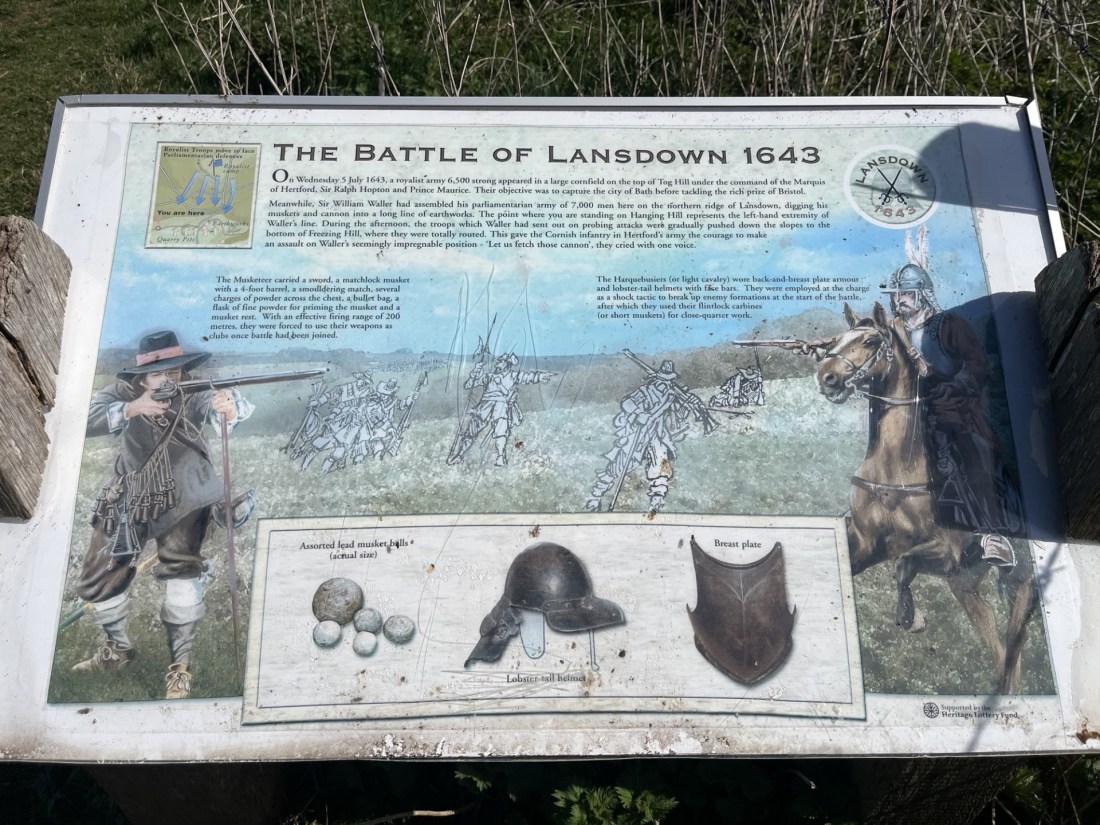
Just past the trig point, an information panel told us a bit about the Civil War battle of Lansdown, fought on this spot in 1643. With time pressing I chose to take a photo and read it later.

Limited information
This is not a history lesson, and in truth, as I found out later, neither was the information panel. * If we had had more time, it might have been possible to survey the scene and appreciate more the scale of the carnage that had occurred here four hundred years earlier. But the research would have to wait.
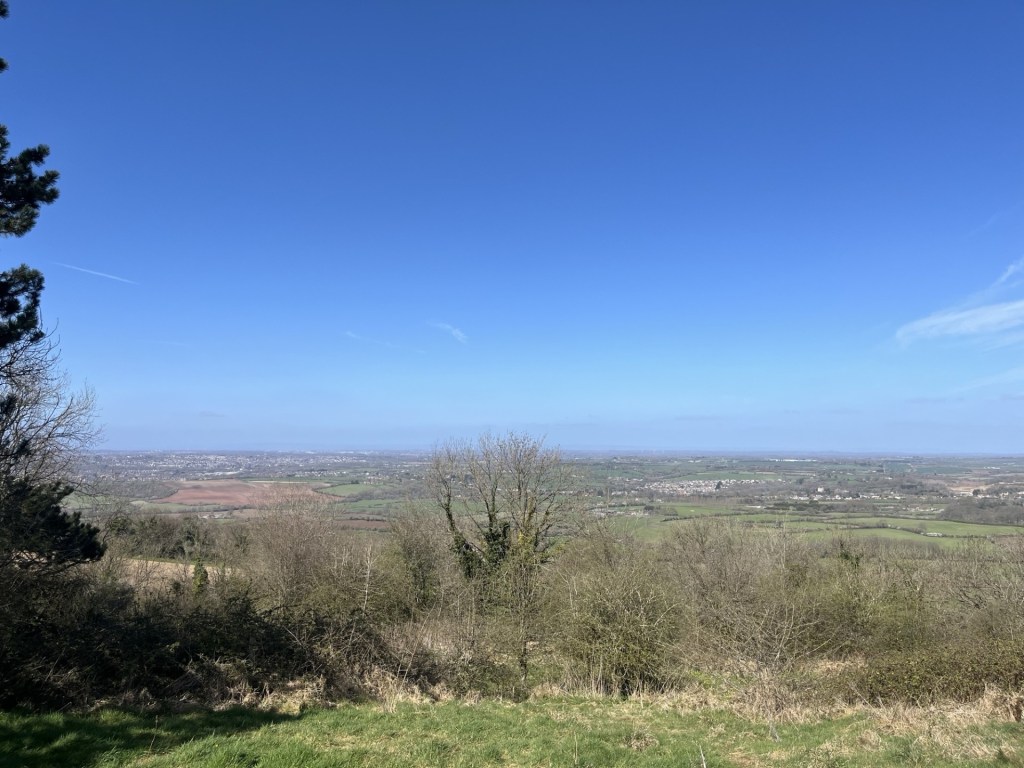
The killing field
The prerogative now was to get back to the cars as sharp and as shipshape as possible. We’d been out too long. The good news was that it looked like it was going to be all downhill from now on. Except we chose to set off northwest, heading away from where the escape vehicles were parked up. We trod carefully down a steep track through dense woodland, with the first signs of new growth all around. With continuing murmurings of discontent amongst some of the team, I quietly hoped the correct decision had been made. The track continued for, in my mind, too long, but eventually we spilled out onto a narrow road, and despite some hesitation decided to bear left and head west.
Marshfield Lane proved to be the win bonus of the day. Hardly a vehicle passed us, and progress was swift. A bank to one side of the road stretched for some distance, covered by hundreds of yellow primroses. Soon after we were passing the rather appealing looking Upton Arms in Upton Cheyney. No time though to contemplate the achievement over a coffee or cold drink. Onwards and downwards on Brewery Hill and then, at a sharp bend in the road, we followed the footpath directly down through a farm, then through a gate, and within minutes we were sitting in the garden of the Swan Inn at Swineford, the sun beating down and all was right with the world.

Mothers Day at The Swan Inn Swineford
It had been a longer hike than anticipated, with an unexpected, almost continuous 700 feet of elevation from the start to Hanging Hill, and much tougher than expected. Just under five miles, but thoroughly worth it, and in the end we were all still friends.
* The battle of Lansdown hill makes for an interesting read. Not that you would necessarily have known it from the information board, which gave the impression that the Royalist forces inflicted a crushing defeat on the Parliamentarians (under the leadership of Sir William Waller). The forces appear to have been pretty evenly matched, with Waller’s troops dug in at the top of the ridge, his left flank at the trig point. A fuller account is provided in the link below, but in a nutshell, it was a long and hard-fought battle over many hours and into the night. With ammunition low, Waller chose to retreat to Bath in the dark of night. With ammunition low but having sustained severe casualties (not least to many of the commanding officers), the Royalist forces gave up the chase and set off to Oxford in disarray. It had been but a pyrrhic victory for the Royalists. The two sides met again for a rematch a week or so later at Devizes, where the Parliamentary forces were soundly beaten after Royalist reinforcements arrived in the nick of time. The losses at Lansdown Hill are speculation but the estimate is that on the Parliamentarian side, 20 troops died, and 60 were wounded. Multiply both those figures by ten to get an idea of the scale of the losses on the Royalist side, not to mention the high casualty rate amongst its senior officers (Wikipedia). It must have been a brutal and bloody affair, with deadly skirmishes taking place between infantry and cavalry in the woods that we had walked down through. Sobering indeed.
After I read the fuller account of the battle, I was able to picture vividly what the calvary and infantry clashes in the woods above Marshfield Lane must have been like. Loud, close and very bloody. This very rarely happens to me at any historic battlefields, where it is impossible to imagine mass slaughter in a vast corn field. I also realised that, other than a superficial understanding of the English Civil War, I really knew nothing about it at all. Given not just the struggle, but also the fundamental principles involved and how it changed the world, within the week I had bought The British Civil War – Trevor Royle. With 900 pages I may come to regret the purchase, but without seeking out the highest point of this unitary authority, my ignorance would remain complete.
Just Hanging Around
 El Colmado 57