5 Etchingham to Stonegate
2nd September 2026
5 miles
OS Explorer 136 (no Google maps were used in the production)
Carry on Up the Rother
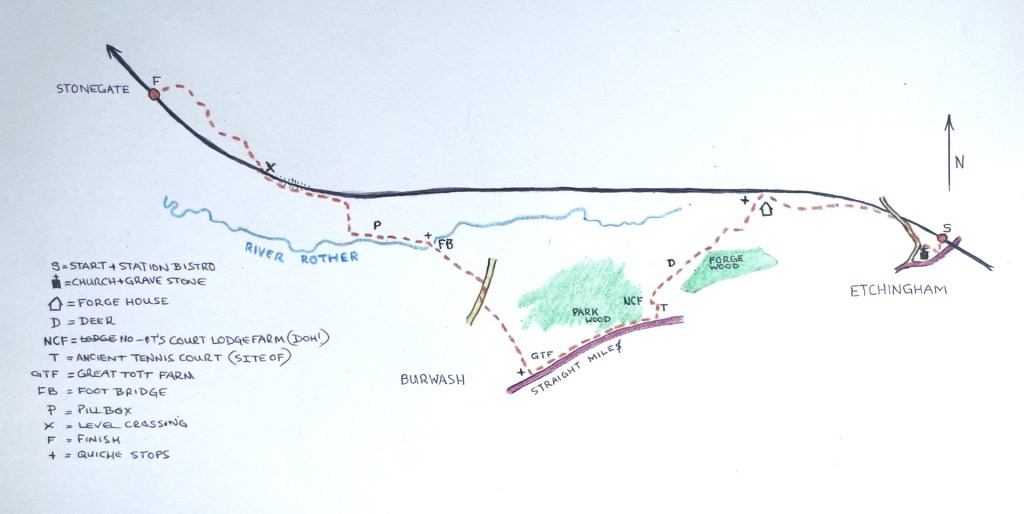
Crap route map!!! Apologies
I stepped onto platform 1 at St Leonard’s Warrior Square station at just the moment when a triple headed posse of Class 73 electro-diesel locomotives pushed on through, heading west and with unknown purpose.
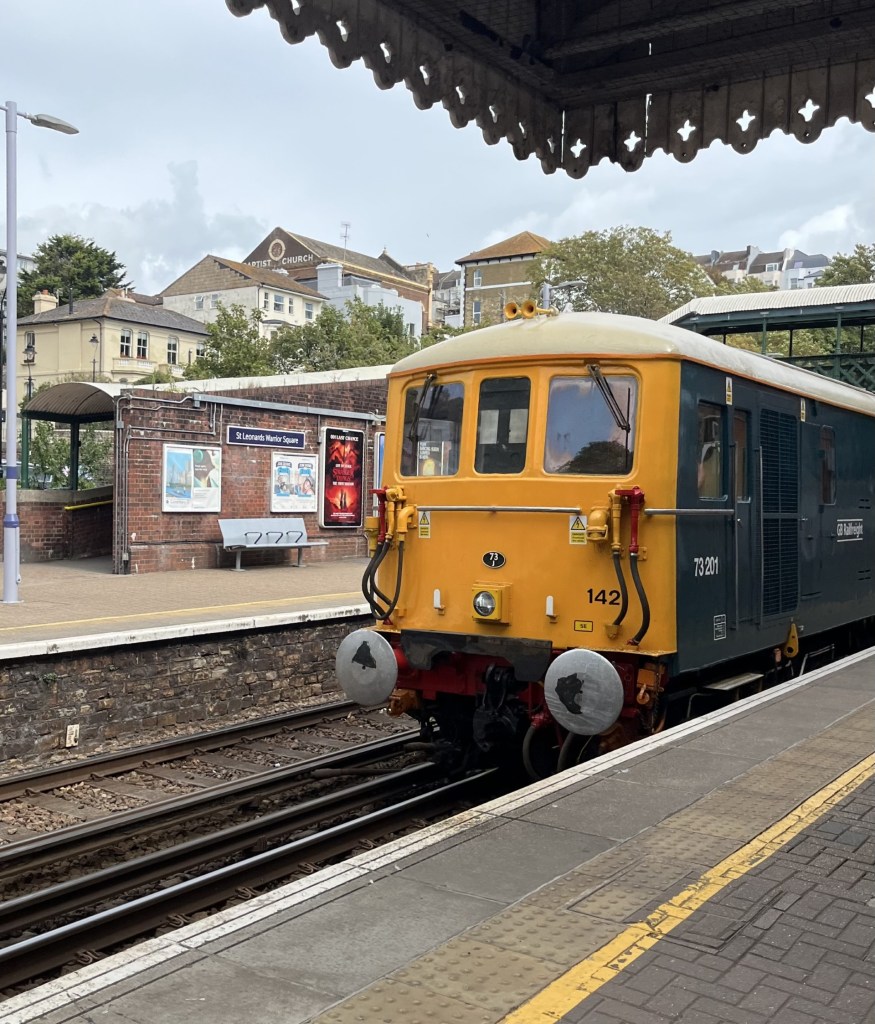
Leading the way – 73201 – Class 73 (built 1960) and sporting classic British Rail blue livery
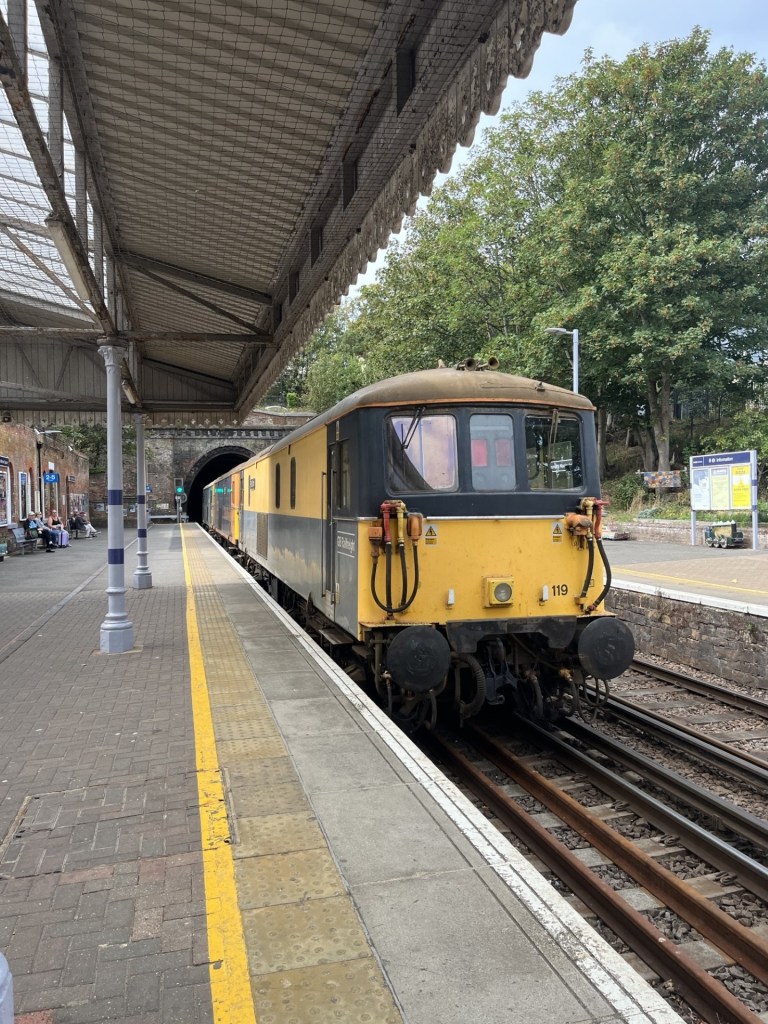
Bringing up the tail class 73 sporting err… Wasp livery?
I’ve gone off piste already. Apologies. My destination was Etchingham and then connecting by foot to the next link in the chain at Stonegate. Two days earlier I could barely walk to the recycling bins, having spent more than a week significantly weakened by the sort of pains one normally associates with the advice that seeking urgent medical attention is an imperative. I had reasons not to do that, having just become a grandfather for the third time and not wanting to spoil the occasion by worrying the rest of the world. Foolish really, but out of nowhere, and against all expectation I was suddenly feeling a lot better. Not 100%, but enough to risk the purchase of an off-peak day return to Stonegate.
I alighted at Etchingham where just a month before, and in another climatic latitude, I had reached after walking up from Robertsbridge. The old waiting room had been converted into a small Bistro (I’m not sure what that means, but I was prepared to find out). And very nice it was too. I took a large slice of quiche (spinach and caramelised onion), had it wrapped in foil, and set off back towards the church I had poked my head in to on the last outing.
The weather was humid and overcast but with a chance of rain. I wanted to crack on to test the legs and try and make the return train from Stonegate, due to arrive at 15.58. The first footpath led through the graveyard at the eastern end of the church. I wasn’t really paying any attention but glancing at a passing gravestone I decided to stop and see who was there. I was completely unable to comprehend the name without closer scrutiny.
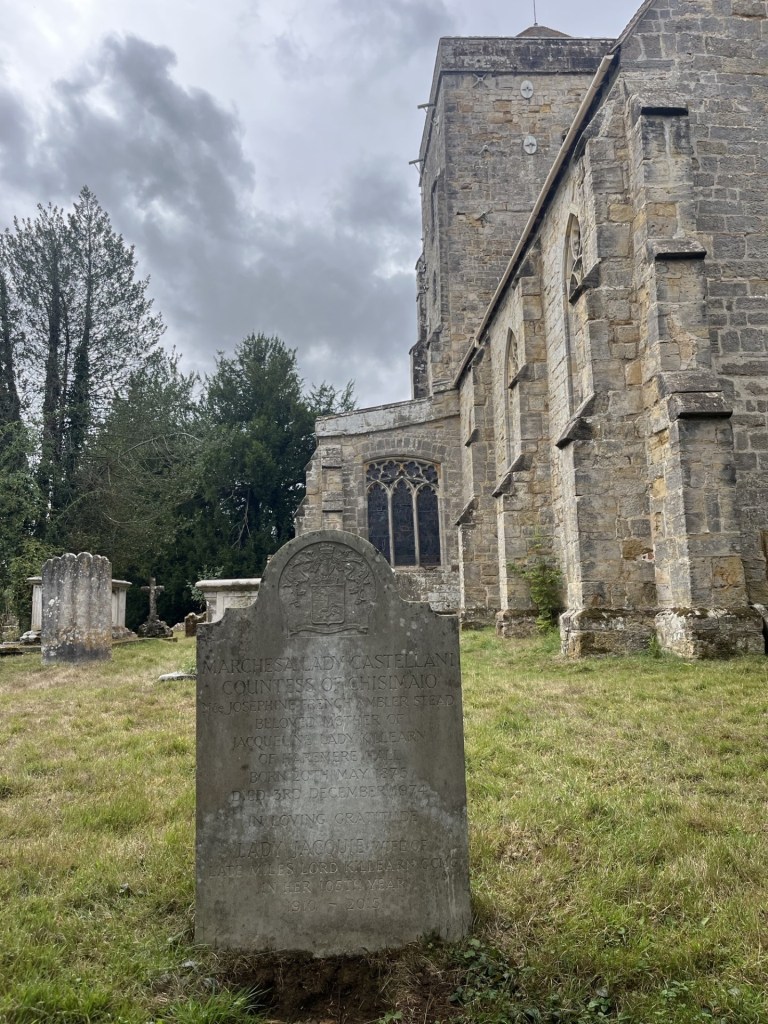
The random gravestone – Nee Josphine French Ambler Stead (formerly of Leeds)
It read, Marchesa Lady Castellani Countess of Chisimaio, and that’s not the sort of name you normally expect to find in a Sussex village graveyard. Later, back at the ranch, I decided to look her up. The initial search located her, but only through the annoying AI overview. Fortunately, without having to click on the link, I could see a reference to Sir Aldo Castellani, who, now working through Wikipedia, turned out to be an Italian of some significance, a pathologist, who amongst other worthy achievements, at the turn of the 20th century, was a pioneer of combined vaccines (and wherever he’s buried, I have no doubt he is turning in his grave as American politicians scramble up the greasy pole, desperate to impress on the ignorant why vaccines, especially the combined sort, are the work of the devil).
With only a smidgen of information available from the gravestone, which also honoured her daughter, Jacqueline, who died at the age of 105 in 2015, and who had married the aristocratic Miles Lord Killearn GCMG (I don’t know what these initials stand for, but he was a high ranking diplomat with very old school views on other races and the Empire, and who, whilst never actually the Viceroy of India, apparently acted as if he was), and lived in the nearby stately pile of Haremere Hall.* Given the evidence on the stone, it seems that at some point, presumably after Sir Aldo died, mum had moved in with her daughter till the end of her days. Haremere Hall no longer houses the aristocracy. If I wanted to, I could spend three nights there at the start of an early November week for a mere £4013.00, and that doesn’t include breakfast! I won’t be mentioning this to my daughter if she decides to get married!
Passing on through the back of the graveyard I took a last look at the imposing church.
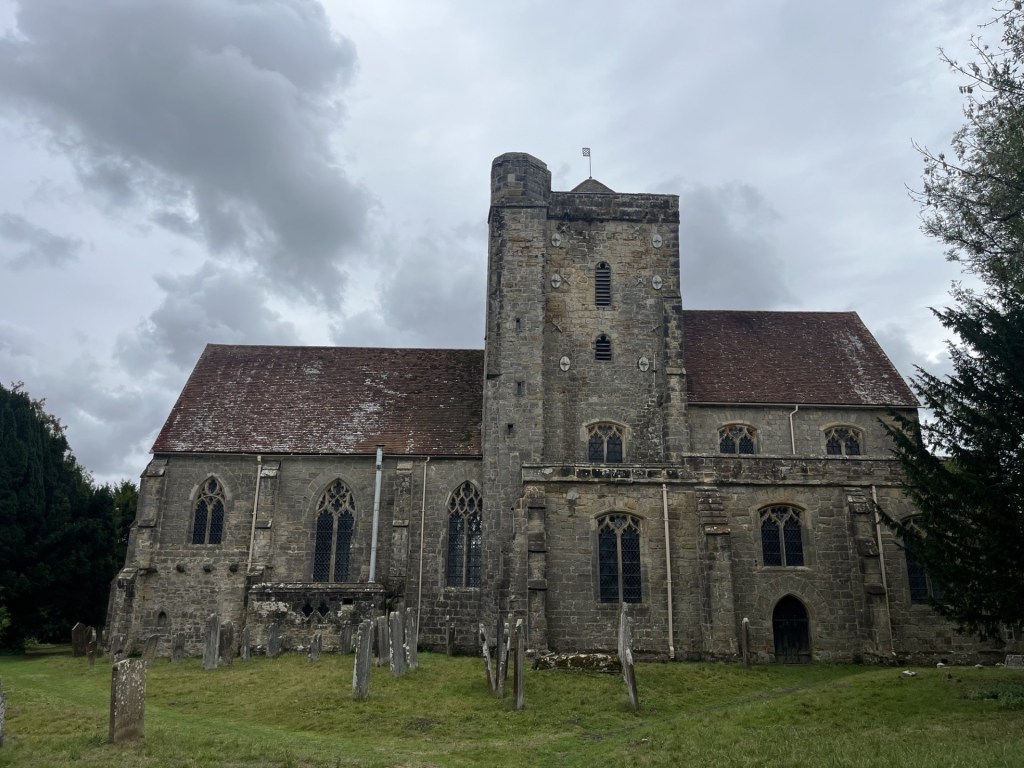
Suitably gothic vibes
The path led out through a gate to the north and into a wooded area, which after a couple of hundred metres met with Church Lane. Turning right I passed a short terrace of old cottages, with the railway just behind. The road bore to the right and over the tracks, but the country footpath that I needed was to the left through a gate.
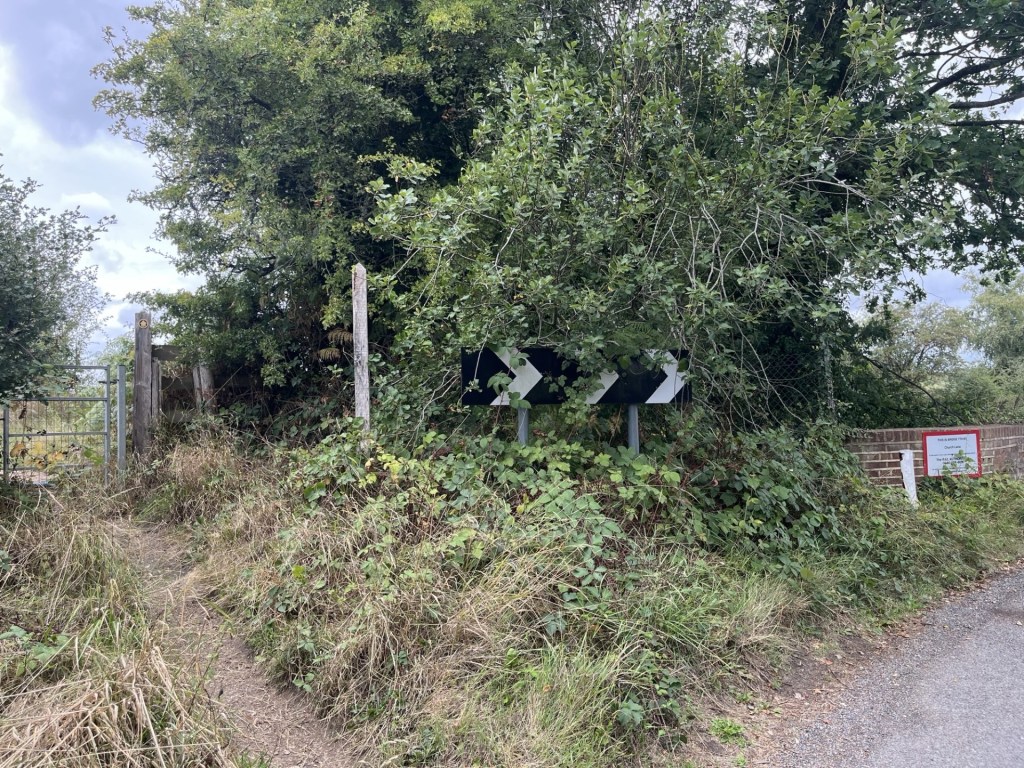
Ignore the chevrons – bear left
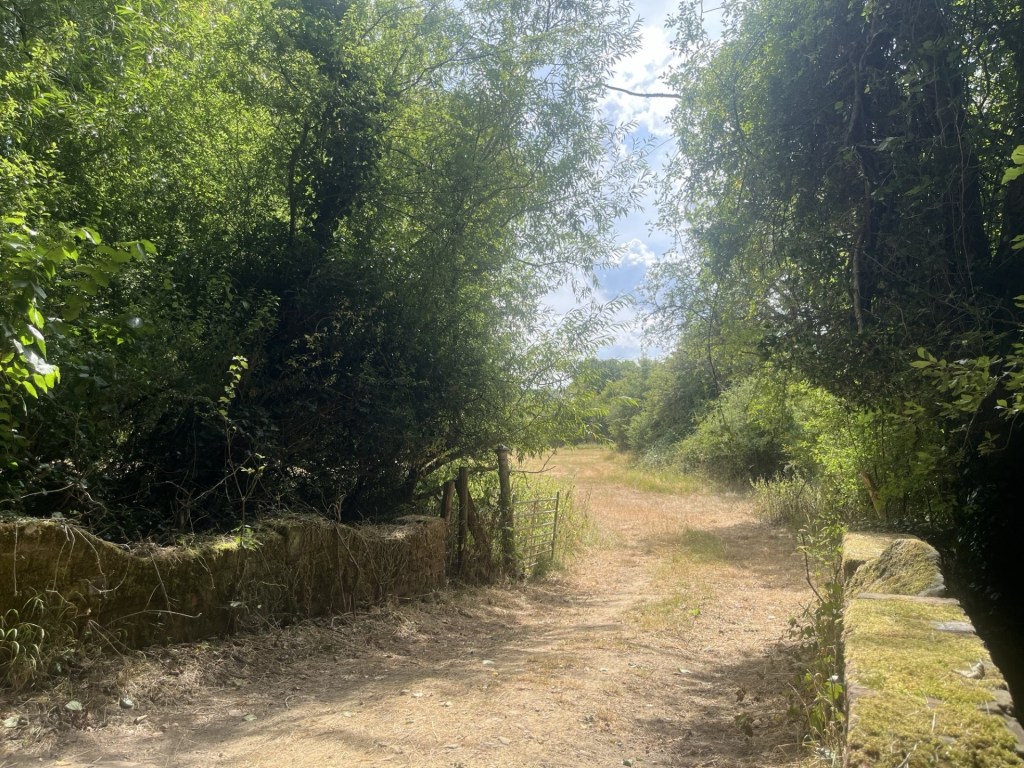
From here the path broke into open country, with gentle slopes rising away to the left.
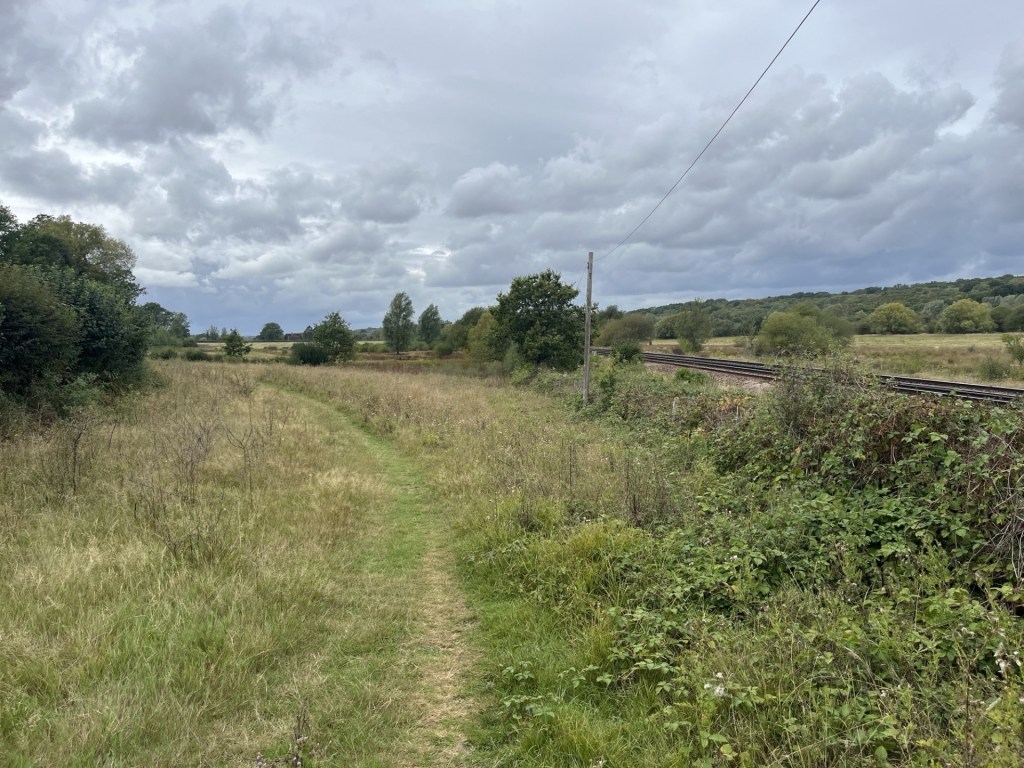
Open country for the next 500 metres
The OS map shows the path heading almost directly west for about a mile, and hugging the railway line immediately to the north, but the reality on the ground was that much of the land near the line was heavily overgrown, and most of this section of path ran through a large field away from the tracks.
When it eventually met back up with the line it intersected with another path heading north and over the tracks.
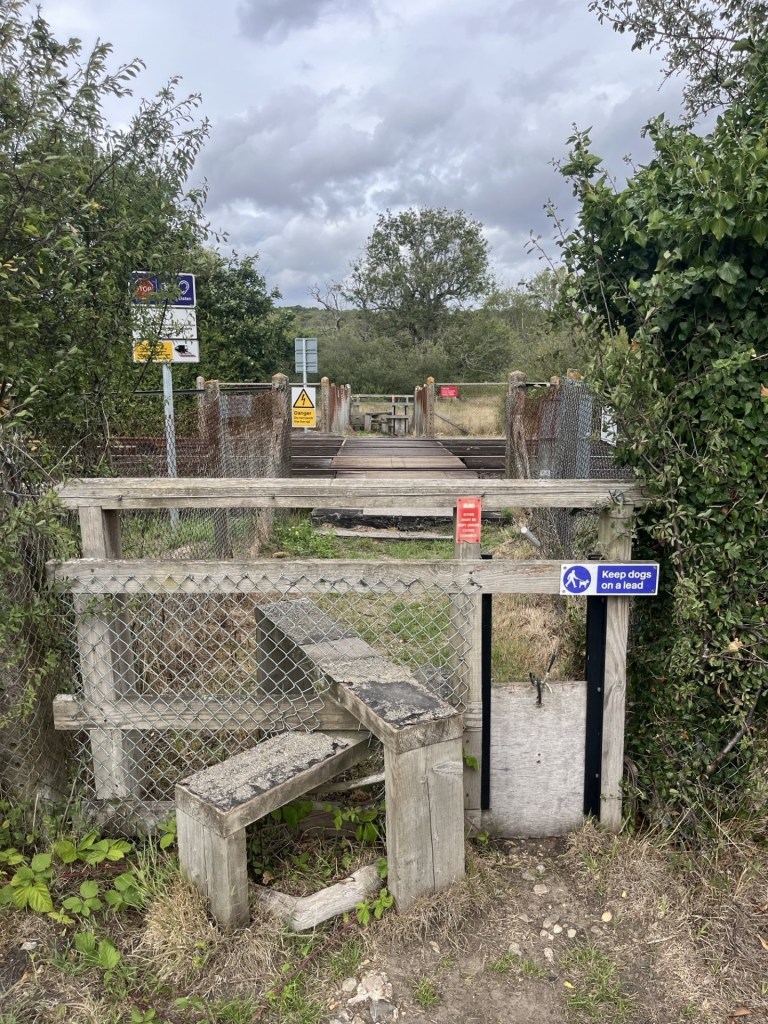
The only seat for miles – don’t cross here
I chose this spot to have a rest and take some bites out of the quiche. It was very nice, but so fresh that within seconds juices were tracking down my left hand. Mopping up with a tissue (which now meant the fluid was running down my right hand) and badly rewrapping what was left, which was still quite a lot, I noticed a large building a hundred metres to the south; surrounded by trees. This was Forge House. ** The “forge” element was a bit of a give-away. I was aware from the map that somewhere in the field beyond the house was what was marked on the map as an Ironworks (site of) so it seemed perfectly rational to assume that the building had at some point held a connection. After shoving the badly wrapped, and no doubt leaking quiche back in the bag I set off past the house and across the field with a small winding stream to my right, and keen to find any evidence of the old ironworks.
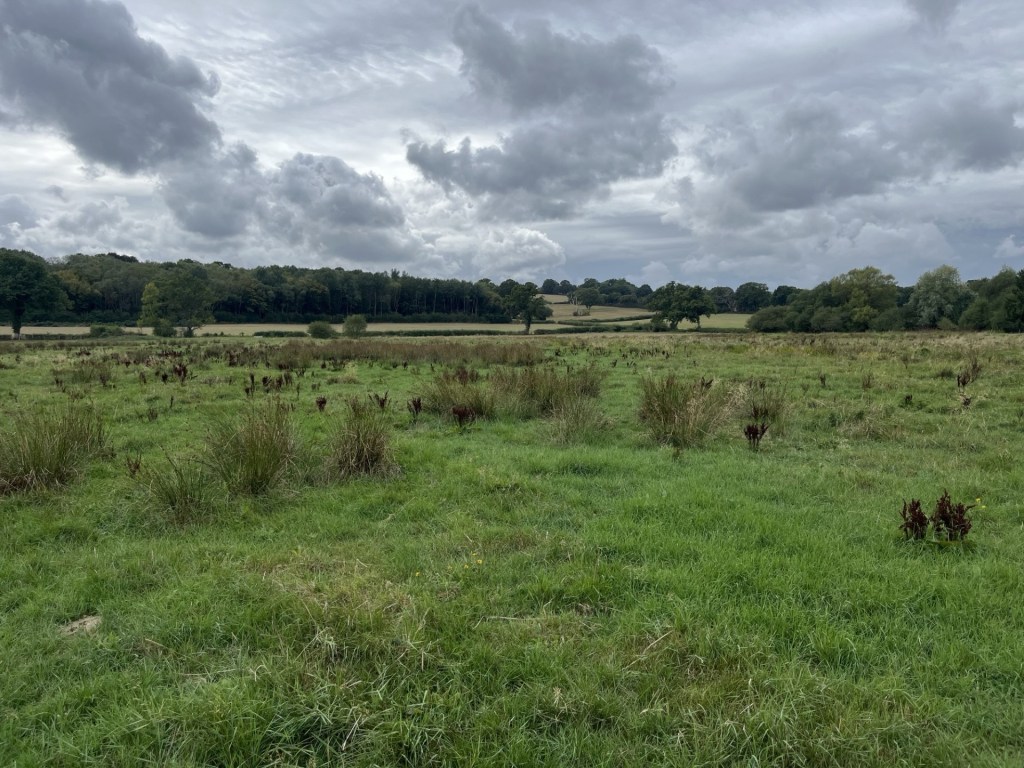
Site of Ironworks – somewhere here. Forge Woods to the left
By the time I had reached the top of the field I realised I had failed.
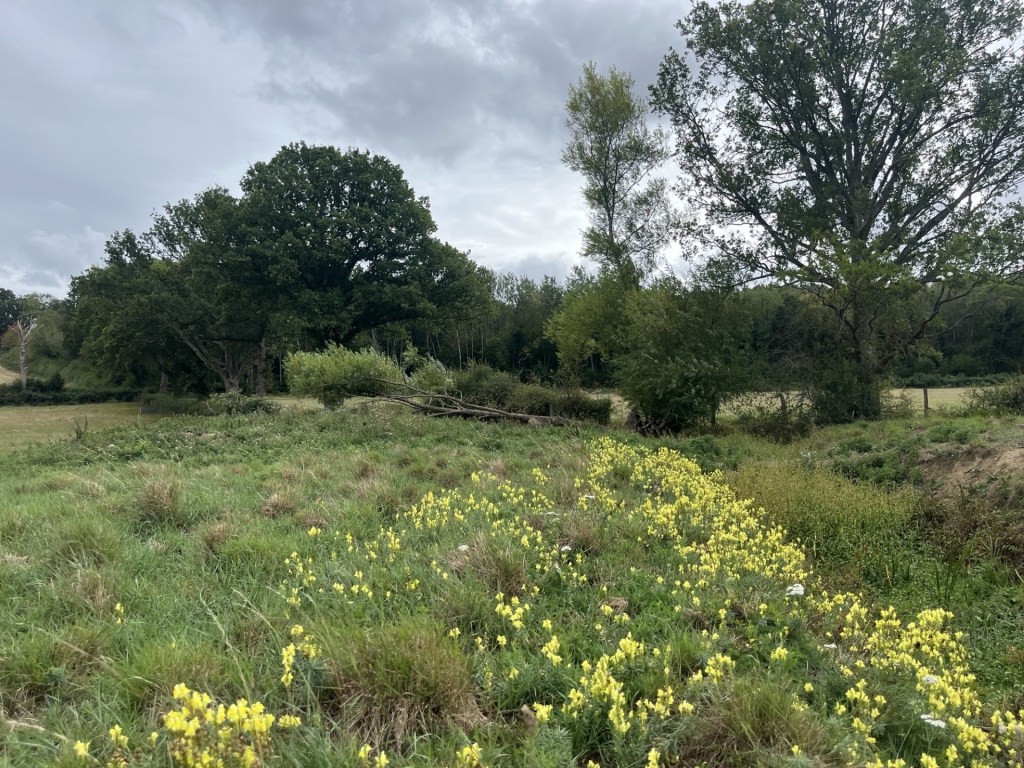
Top of the field and no obvious evidence of an Iron works to be seen, but nice wildflowers
Fortunately, the stream was made fordable by a raised mound of earth, and I continued to the western corner of the field where a gate led into another field rising away to the south-west and with dominant woodland to the left. The map claimed this was Forge Wood, another clue, but meaningless now.
I began the steady climb up the hill. After a couple of minutes and looking up and ahead three deer (roe I think), at two hundred metres. I saw them, they looked up and saw me, and without hesitation the largest (mother of the smaller two I suspected), turned on her heels, and in a flash all three were dashing and leaping away and towards Forge Wood.
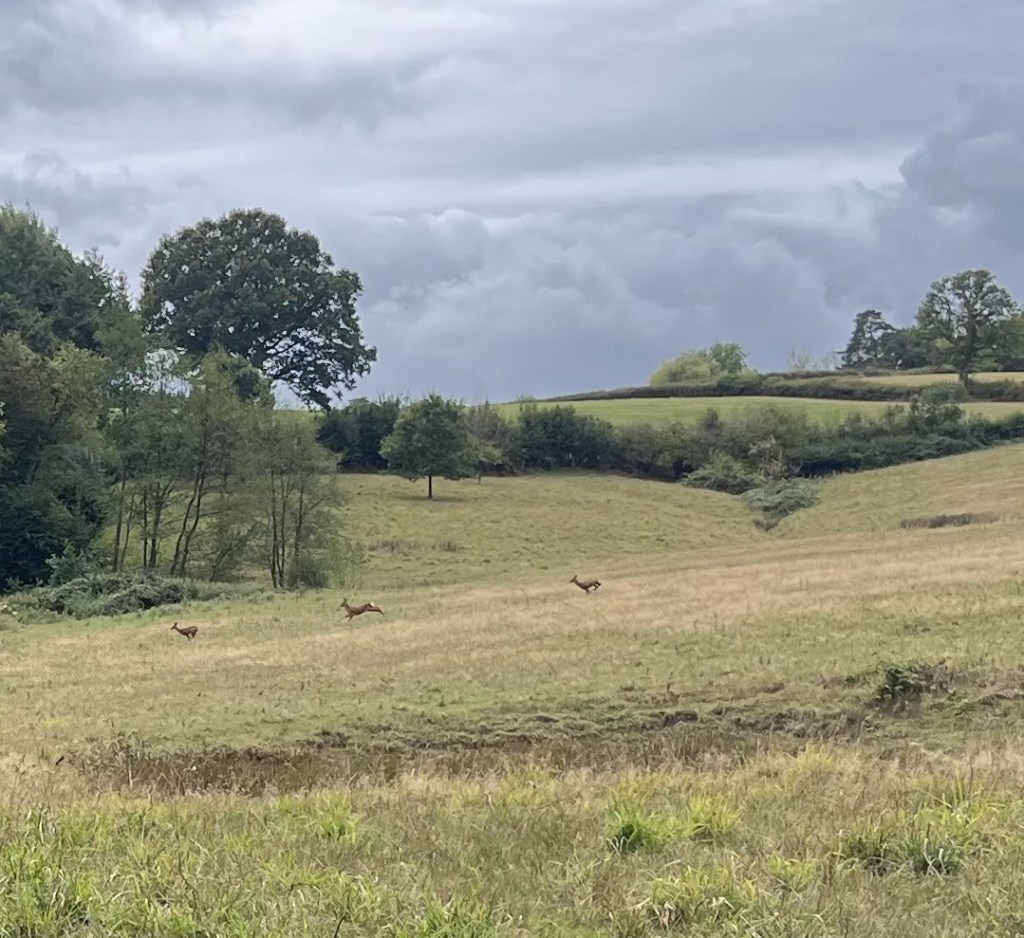
And… their off
These are the moments. The moments when, out of the blue, and on an idle walk, nature catches you unawares and you drop your jaw. Elegant, powerful and disconnected from the human condition (unless hit by a speeding car, or the nearby venison farm), I watched them approach the woods, then leap one by one the high fence that separated the trees from the field. It was over in a flash. Remarkable. I walked a few metres. Looking back over to the woods I noticed that one of the kids had failed the hurdle and was entangled with the top wire. Not a pleasant sight, but within seconds it was free, though suddenly alone and on the wrong side. It ran one way along the fence, and then the other. Clearly distress, as, I have to say, was I. It was my fault after all! Eventually it started a long run down the field and then into the woods on a track that disappeared into darkness. And that was that. Who knows?
Excitement over I carried on up the long and pleasingly undulating field. Nearing the top a couple with a dog emerged from a gate set into a high hedgerow. We said “hellos” as we passed, and unthinkingly I headed towards the gate, went through and carried on up a clearly defined footpath towards another long hedgerow, and another gate.
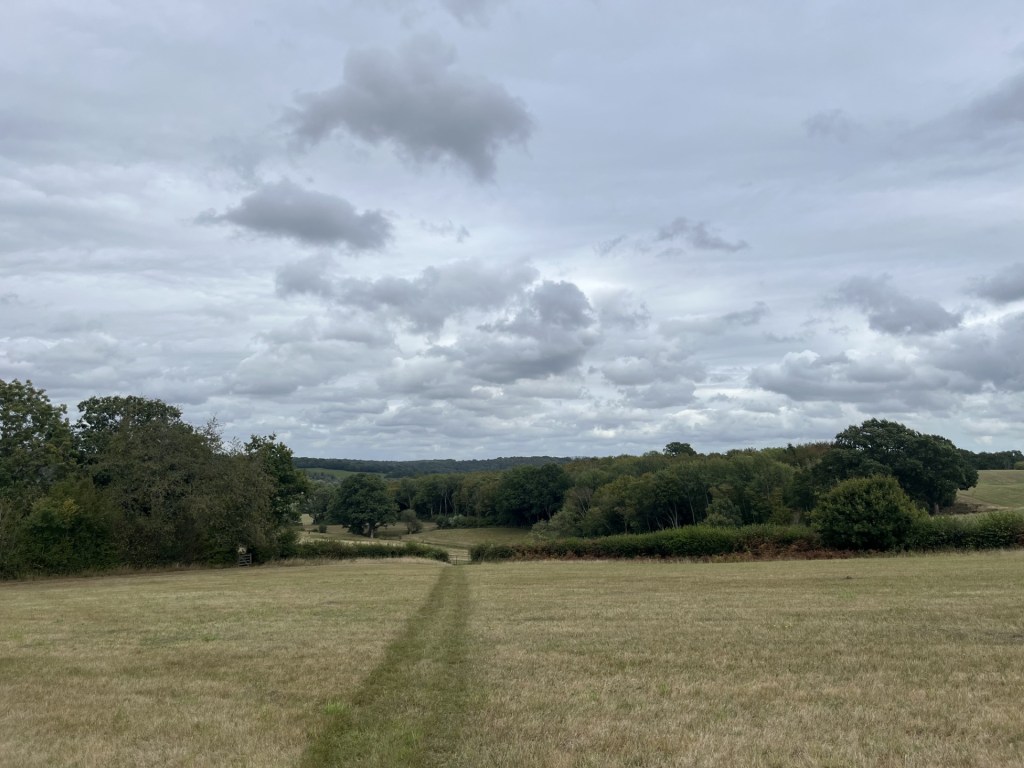
In hindsight I shouldn’t have gone through that gate.
Here I found myself in what appeared to be a large, wooded garden area, with a plain stucco but attractively grand old slightly Tudoresque mansion a hundred metres in. At this moment nothing screamed at me that I was off course, but of course that that was precisely what I was. It’s not unusual for public footpaths to run through people’s gardens, particularly in rural spots, so I carried on up through the glade and to a gravel road a short distance from the house (part of a group of buildings under the name of Court Lodge Farm).
I had noticed a man get out of a car just outside the house as I had passed through the gate, but no one came out or over to challenge me. A main gate providing vehicle access lay ahead, and I assumed this was the exit that otherwise eluded me. It wasn’t; fitted as it was with a robust magnetic lock. There was nothing more to do but go back through the wooded area and out the way I had come.
Beyond the gate and back in the field I tracked up along the side of the garden to another gate which opened out into another field, with extensive views south and east, and bizarrely the remains of a lawn tennis court, the only evidence of which was the flat rectangle area of overgrown grass and the two metal net posts, rusting away into history. In a few hundred years’ time, what archaeologists will make of this site is anyone’s guess, but, (as I later discovered through a quick online search of Court Lodge Farm – and finding that it was still operating as a farm of sorts – it’s main function being breeding a quarter of a million pheasants every year for target practice across the land and beyond), being located near to a recently installed animal incinerator, speculation could run riot, this of course being the era of new cults.
I hopped over a solid gate, Wimbledon winner style (not) and walked confidently away from the farm and to the main A265 road, called at this point Straight Mile.
I had to head west along the road for what looked like a mile or so, and needless to say it lacked any pavement or any alternative footpaths. It couldn’t be avoided so I got on with it. The countryside rolled away to the south towards another hill range, but I didn’t look too often as I was regularly squeezed up against the verge hedge as the traffic passed. To be fair, no one tried to spook me or run me down, which was pleasing as it’s not always like that. To my right most of the route was flanked by a large wood. Park Wood to be precise. Except it wasn’t a park at all, and there was no way of entering it to seek an alternative route away from the potentially murderous road. Shucks – private property rules.
Past the woods and on the other side of the road signs of an enormous, seemingly old house, peeking through the hedges. A care home of some sort. Lovely setting (if you omit the road) but in the middle of nowhere. Escape would be difficult. A red kite lazily flew overhead and moments later the sound of an alarmed cluster of geese, located somewhere within the institution’s grounds filled the air.
I reached the footpath sign I had expected to come across just past the entrance to Great Tott farm. I stopped for a minute to confirm my bearings and watched three sheep walk towards me but then veer away to a water trough at the top of the long and descending field. I had another bash at the quiche, still dripping and again proving difficult to rewrap once another two mouthfuls had been consumed.
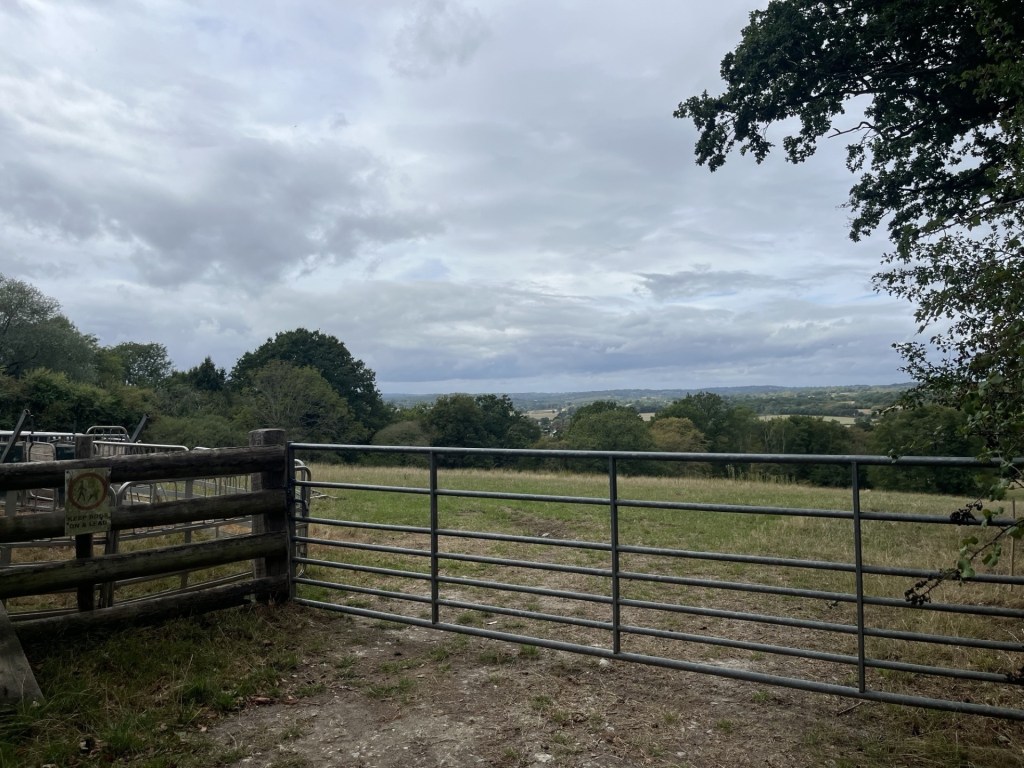
The second quiche stop – Great Tott Farm
It brought back a memory from decades before, when reaching the top of Mam Tor in the Peak District on a wild but sunny day with an old friend, who, on sitting down, promptly and in true Bob Mortimer style, produced an unwrapped scotch egg (curried I should add) from his pocket. This small act instantly attracted the curiosity of a nearby sheep, which trotted over and made a lunging grab for the disgusting egg, pork and curry snack. The resulting tussle nearly sent them both over the edge but in the end my friend surrendered the small object of desire and we left the scene, speculating later in a Castleton pub (The George to be precise, which had served us up the most insanely hot chilli con carne), what the consequences might be to a sheep that had just consumed a curried scotch egg? A diminished sale price at auction was inevitable.
Through the gate and onwards, the path led directly north and slightly descending, through a field full of sheep. The edge of Park Wood (see above) met the eastern flank of the narrow field and in a clearing hundreds of sheep sheltered in shade under isolated oak trees. The end of the field was out of sight, hidden by a brow of land that then fell away sharply. As I passed the glade a solitary cough from one of the sheep. Unfortunately, the poor creature continued to cough every ten seconds or so for the whole time I remained in the field, and whilst I’m no expert (definitely not), my gut told me that it wasn’t a good thing.
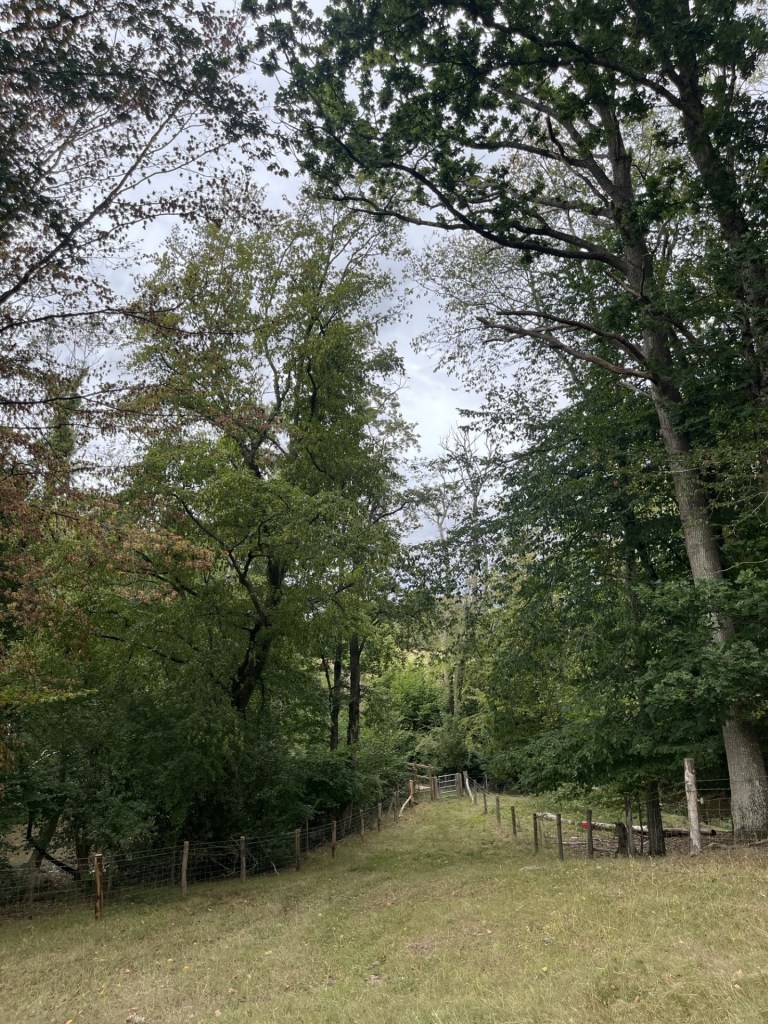
The brow at the top of the hill masks the end of the field. Don’t be put off, the exit is here.
A gate at the bottom end of the field, which had now narrowed to an arrow point, opened into a wooded area. A stream, a tributary of the Rother, snaked through the woods. Crossing the bridge the path then climbed for a short distance and then between two fields coming out onto Shrub Lane, a minor road that led north.
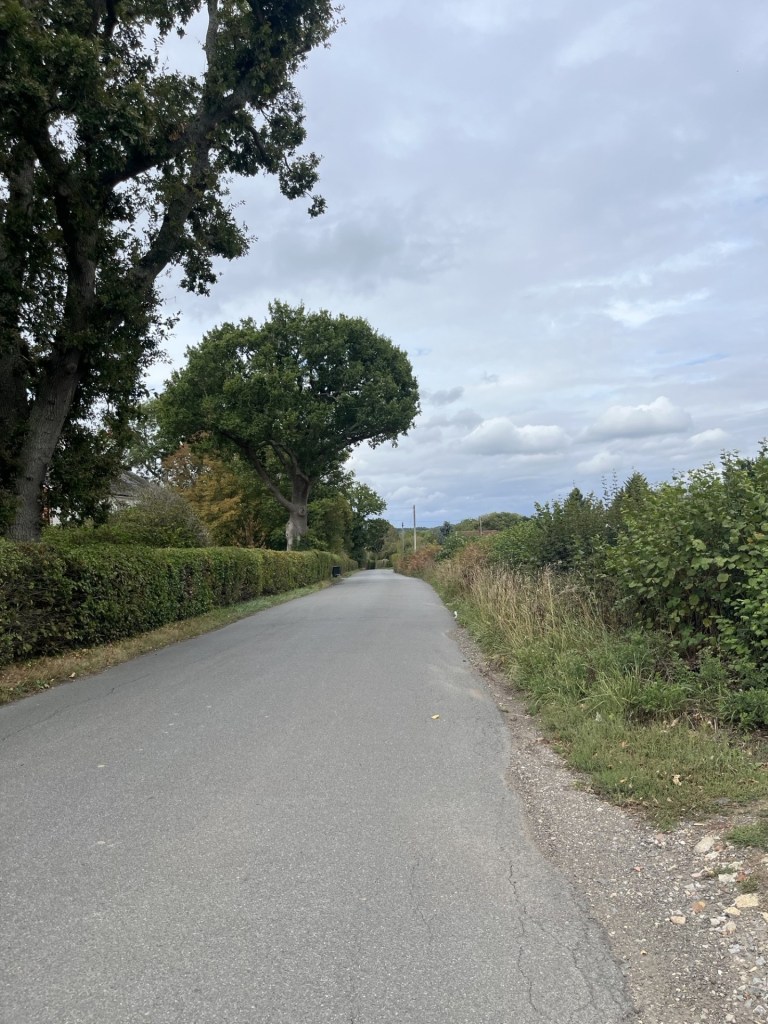
Onto Shrub Lane
I headed along the road, busier than I had expected with various delivery vehicles out on the range. I almost missed the sign indicating the footpath. I think I had been taking evasive action from a pincer movement that involved a supermarket delivery vehicle and a van belonging to a company named after the world’s greatest river, and who don’t pay tax.
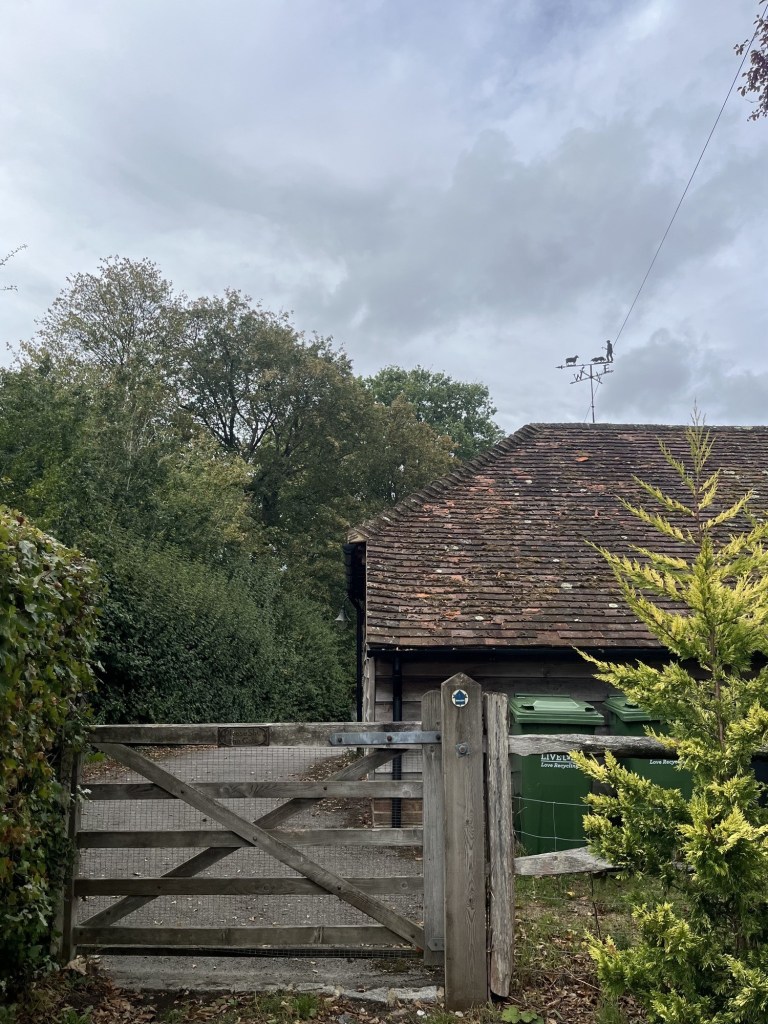
The sign points northwest
The footpath (a bridleway) was through a gate behind which a low building with a weathervane indicated an historic past. On closing the gate behind me, I noticed a very important message.
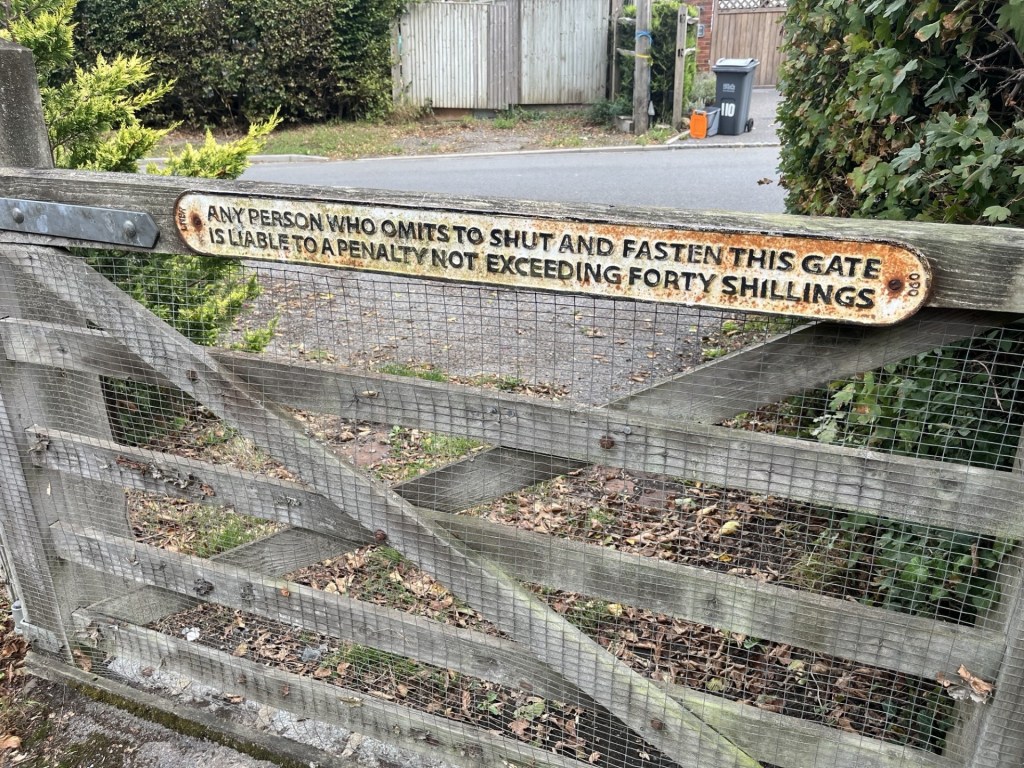
I didn’t omit
I wasn’t sure what the exchange rate was from old money (LSD) and today’s new pence, or whether or not the sign was genuine or had been installed as a novelty ruse, but I wasn’t prepared to pay forty shillings so left the gate firmly closed. There are cameras everywhere these days!
The bridleway led through a large modern farm, the only noise a solitary dog, fortunately behind a door, but letting me know it knew!
Beyond the buildings, fields swept away in all directions. A shallow valley with the River Rother, or what was left of it, meandering down the middle. I crossed one field, then through a gate and then bearing northwest across another (full of cattle that were suitably far away) and then reaching the bridge over the Rother, evidence of which was scant. I stopped for a minute, relieved to have navigated through the field without any cow conflict, but also to grab another bite or two from what was turning out to be a substantial quiche.
I wrapped up what remained (I don’t have a huge appetite) and moved west through a long and narrow flat field, rammed full of sheep, many of which expressed their dissatisfaction with my presence by demonstrating some quite assertive acts of urination within feet of my feet. But they weren’t intimidating me. I’d just crossed a field of cows after all.
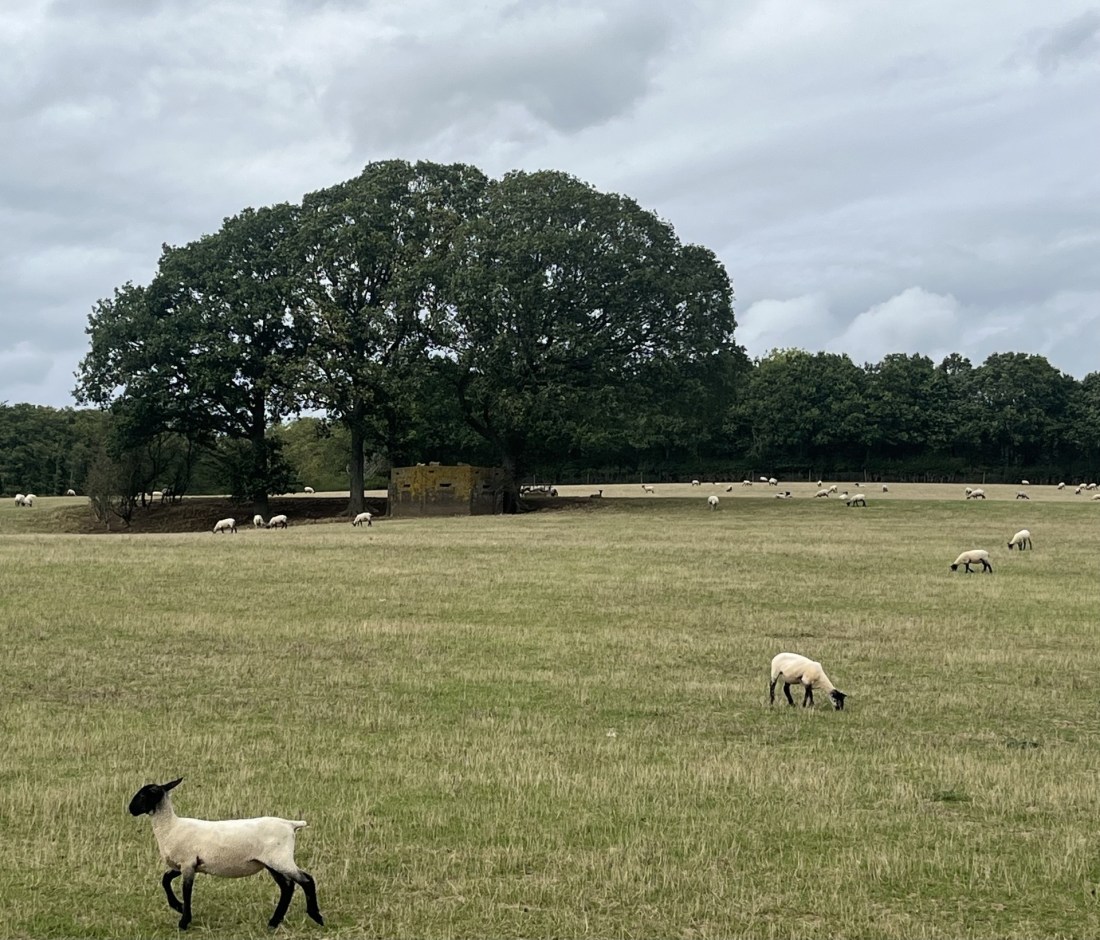
Beyond a fence to the right, and which ran the entire length of the field, the land rose away and up towards woods beyond which the mainline was hidden from sight. A solitary oak tree stood in the field, and beneath its boughs rested the unmolested remains of World War Two anti-tank pillbox.
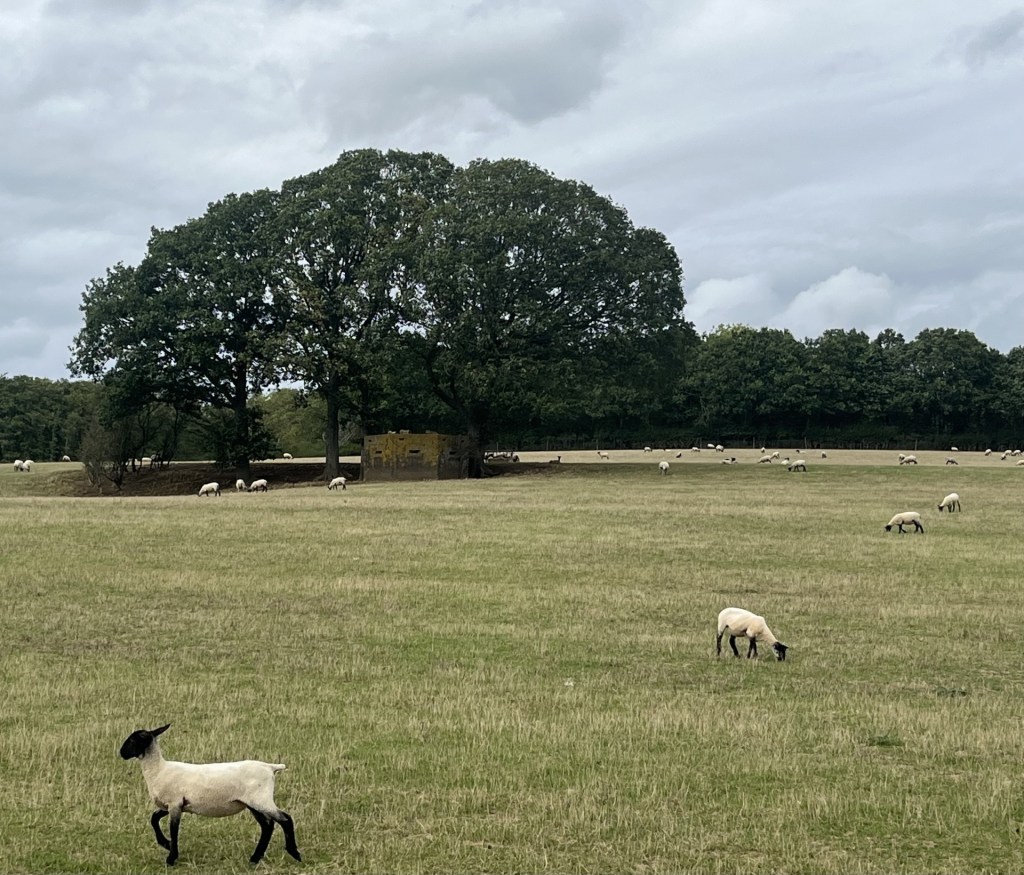
Historic building – missing from all maps
I hadn’t seen any others so far but assumed that it was part of a network of similar defences that would have lined the river during the war. It would have been quite a trek for the soldiers, presumably Home Guard, who would have been stationed there, and its location appeared to be quite exposed. Maybe it had been surrounded by bushes or trees back in 1940, but as it stood aloft and alone, apart from the tree that would have added many metres to its height and girth since then, it now looked small, vulnerable, and from another time, almost beyond reach. I’m pretty certain that if I had been there in 1940 and three Tiger tanks appeared down the valley, I’d have up sticks and scarpered to the nearest pub for last orders. And it’s not on any maps. Actually, that’s not entirely true. I have found an online website (The Pill Box Study Groups) dedicated to mapping pillboxes @
https://edob.mattaldred.com/map/S0008244
Good work!
Through another gate at the end of the field and now the land began to rise over a folded landscape. The official footpath headed at a slight angle across the large field, but I turned immediately right and followed its edge, with a wooded area to my right that partly hid a stream that came down the slope from the railway at the top. I say stream, but in truth it was as dry as a bone, despite some recent rain. Reaching the top of the field I turned left and continued west with the track to my right and hidden by more substantial woods. This continued for more than half a kilometre, with views opening along the valley.
Eventually, with a last view over the Rother, the trees ended and an enormous, recently improved embankment curved ahead and away to the right.
The walk took me down to the foot of the embankment, across another dried-up stream at just the moment an up train from Hastings powered through and above.
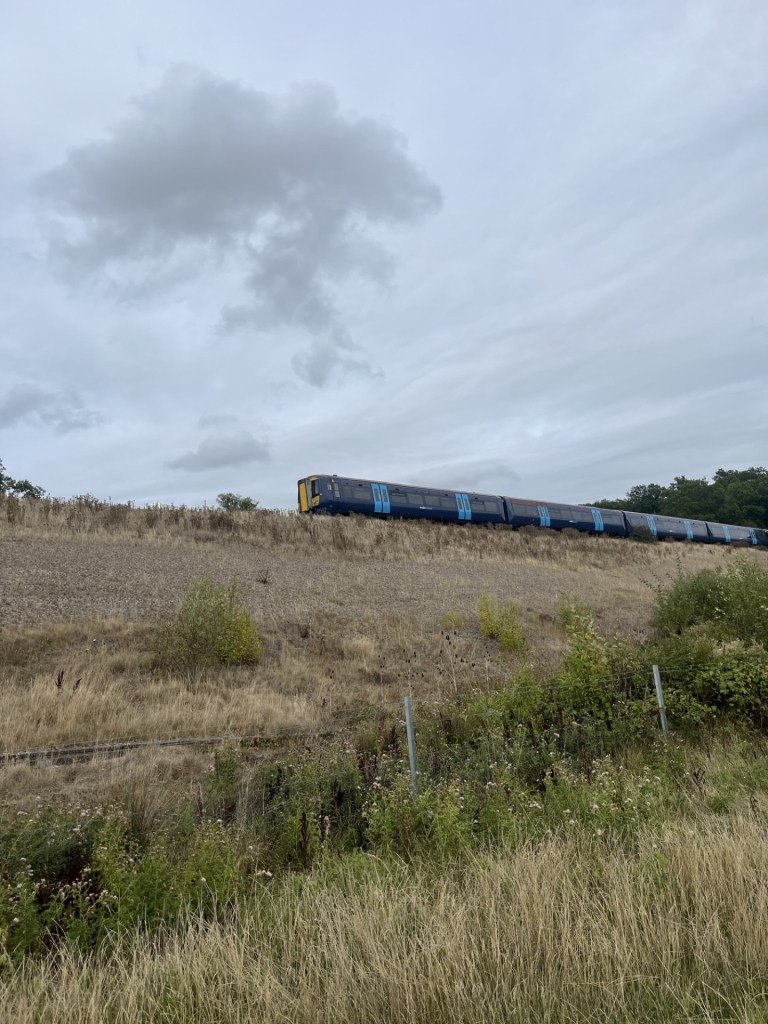
One view
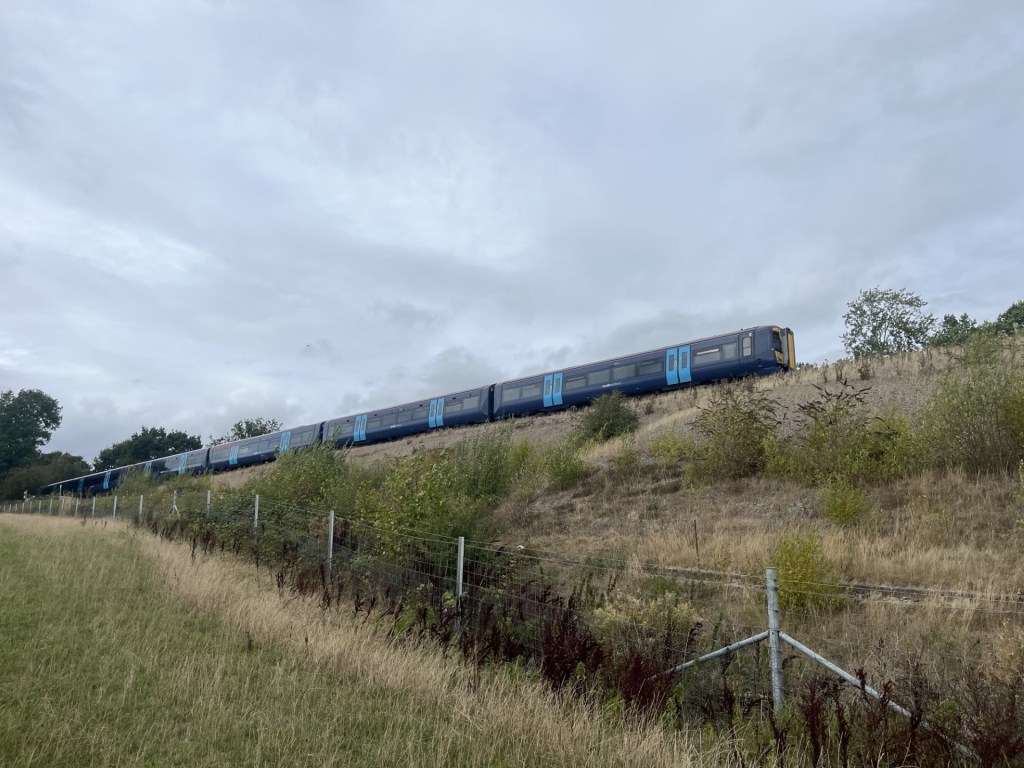
And another
As it disappeared into more woods I climbed back up and to a level crossing where I crossed the tracks as quickly as possible.
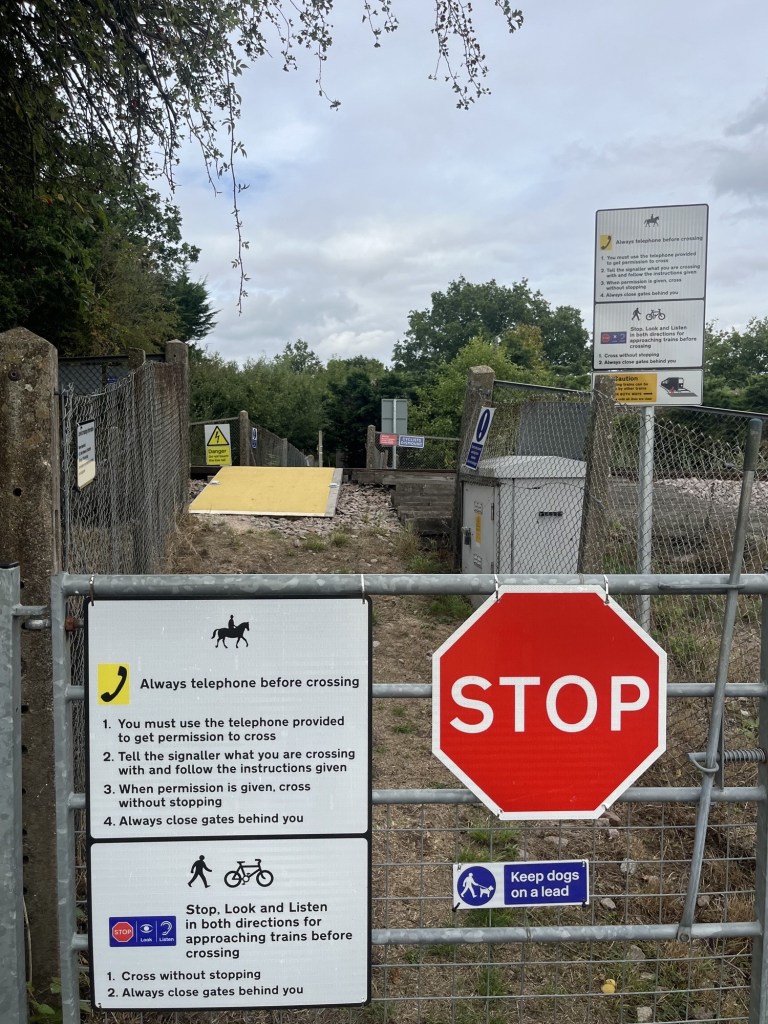
If you have the time it’s worth reading all the signs
Beyond the crossing the path veered left through more woodland, eventually crossing a small ravine, naturally devoid of water, and where the trees had been thinned out.
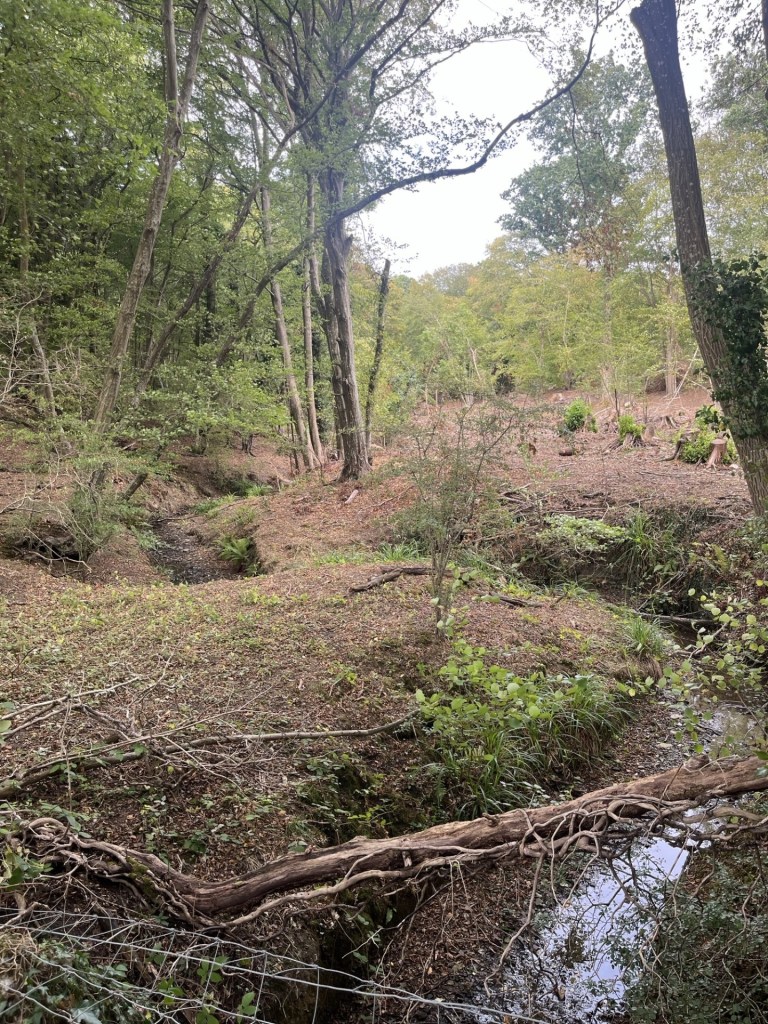
I say ravine…. Perhaps an exaggeration
The path began to rise again into a field, now with the railway a couple of hundred meters to the left. Something caught my eye. Could it be real????? A triple header of class 73’s cresting the horizon and heading towards the marshalling yards at Tonbridge (I presumed).
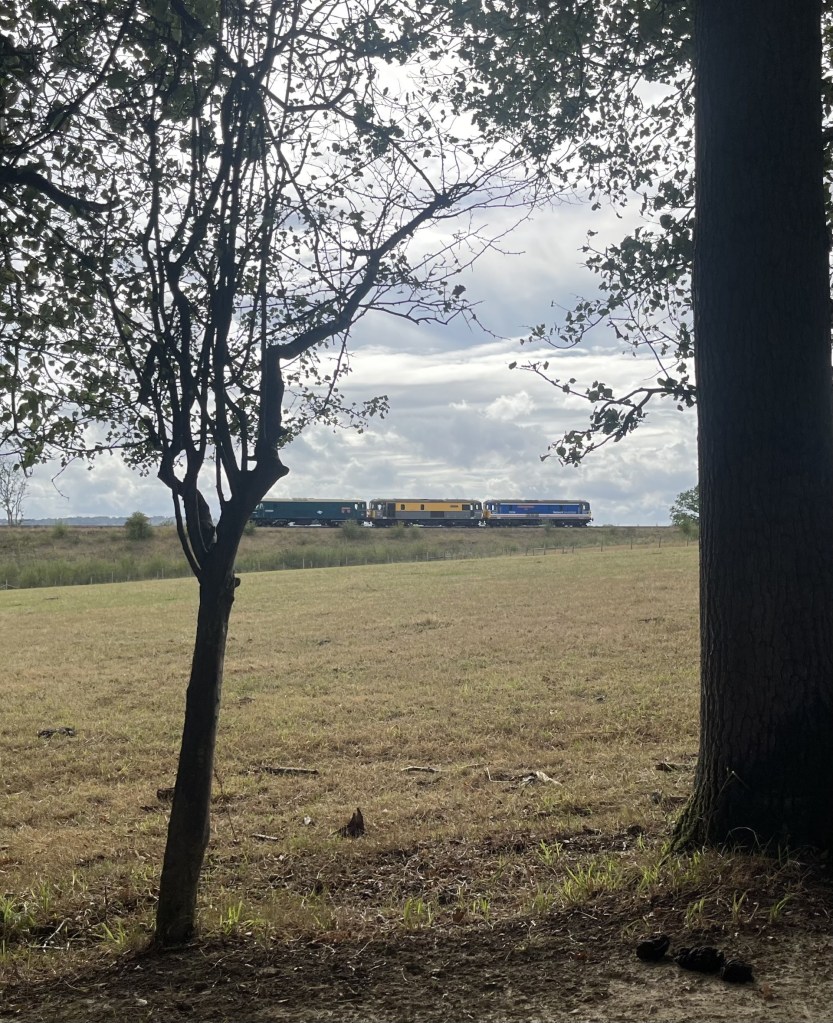
Too much excitement for one day – three more Class 73’s
I assumed it was the same grouping I’d seen earlier at Warrior Square, but there was something wrong with the order of liveries (this is quite niche, so don’t get too excited). Later, with time to examine the photo in more detail, it was clear they were not the same grouping of locos from the morning. That meant there were two, three class 73 loco combinations working the same area. Who knew why, and I imagine, who cared. Oddly, I did. It’s an affliction.
I was now nearing Stonegate (thank goodness, you cry) and after navigating another field round some farmhouses (the wrong way) I reached an asphalt track that I recognised, and with a large, good-looking pond to the left.
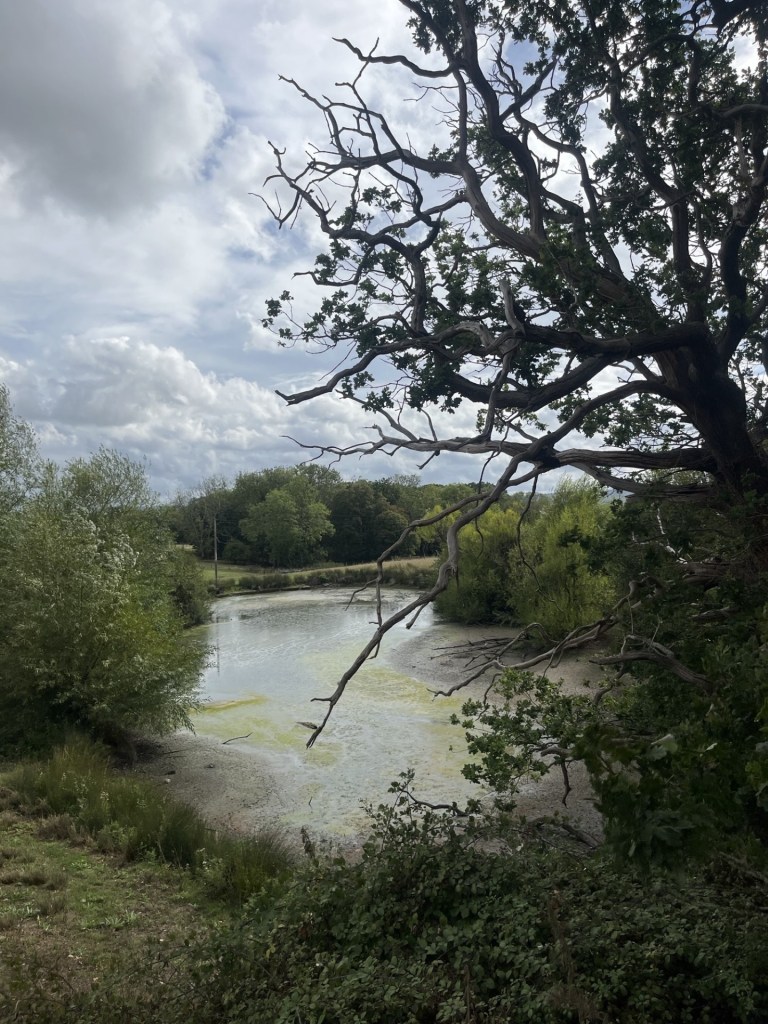
Is this pond is on the tilt, or have I just been less than diligent in the production
As I began the short descent to the station it all started to come back. I’d been here before and a mystery was being resolved. A long time ago, at least fifteen years or more, I had arrived by train from London with some friends, met up with another old friend who had driven to the station, and then set off east. The destination was Bodiam. We made it to Bodiam and enjoyed a meal and a couple of pints at the Castle Inn, whilst watching the steam trains trundle up and down the Rother valley. All good. Except, now equipped with a far more detailed and personal understanding of the local geography, I had been trying to work out where we had started and ended the walk. It had been troubling me for a few weeks since starting this exercise. Now, heading towards the station I fully recalled the moment when we had made it back here so many moons ago.
That being the case, that walk, which included a couple of pints of Sussex best, must have been the best part of 20 miles. If I’d known at the time that that was the challenge, I might well have found an excuse to dodge the occasion. As it was, we had done it, and here I was now, having puffed and panted a mere five miles. Mystery solved, nonetheless.
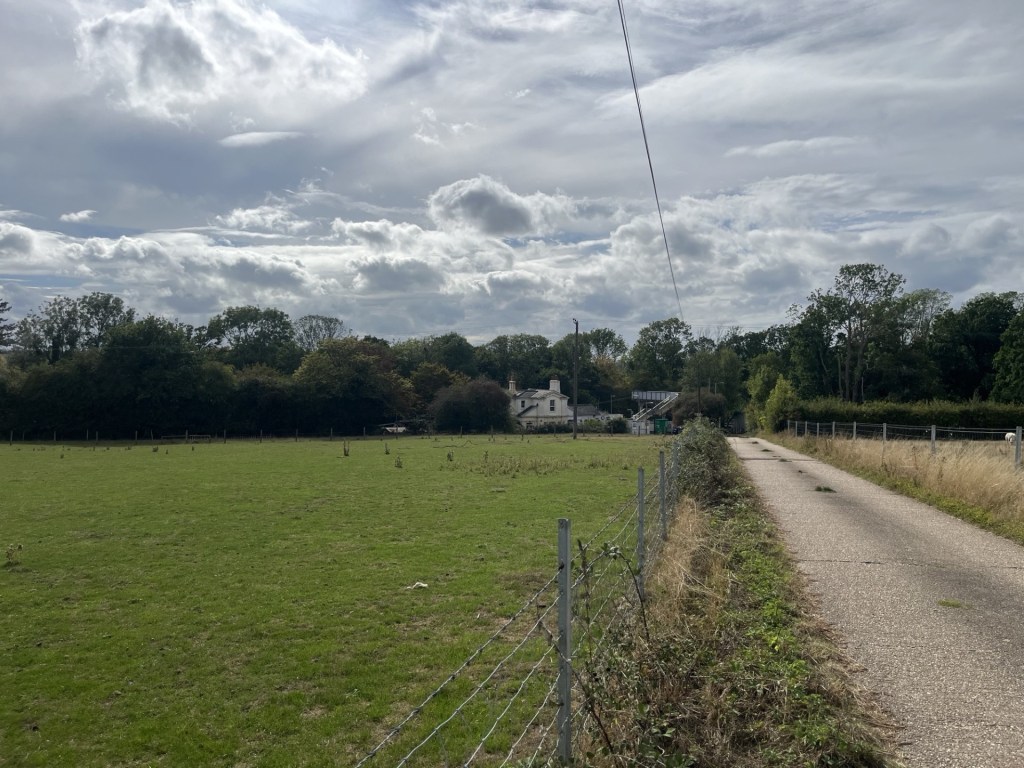
Familiar territory – approaching Stonegate Station
I had some minutes to kill before the train arrived. Time enough to dispose of the remains of the quiche (I’d eaten enough). To my delight there was a mini recycling nirvana directly outside the station. A general waste bin but also a bin for metal and one for food waste. These people were eco warriors for sure, and I had the products to match. I pulled the remains of the quiche from the remains of the foil and prepared to flick it into the food waste bin. I went to open the lid. It failed to open. I tried again, but it was definitely locked. I then tried the lid of the metal waste. Locked too!!! The general waste was the only option. The disappointment was complete.
I was still musing on the bitter experience when the train arrived.
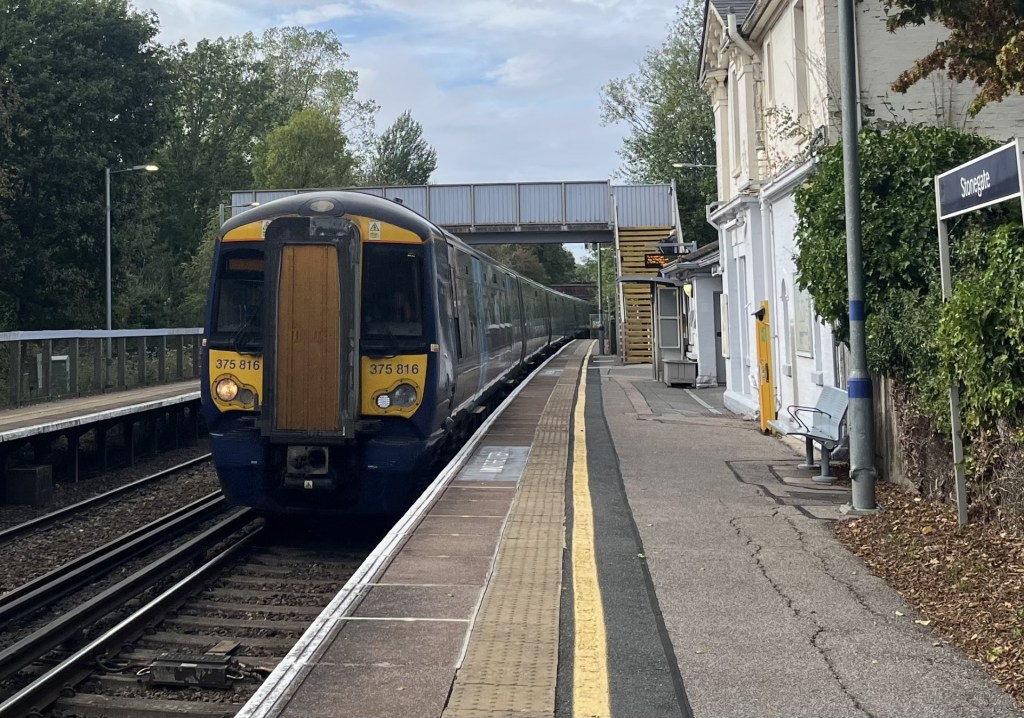
Time to go
I was pleased to have resolved the Bodiam walk mystery and thinking back on the group of old friends who had made the journey, there was only one tune that could match the occasion. Just going for a walk in the trees. Probably the best cover track of all time. I found another version of this on YouTube from 1978, a surreal black and white film that begins with a lot of excellent southern region train action but then goes off into the ridiculous with George Melly and a woman wandering through trees across Hampstead Heath, I think, being followed by a youth playing a harmonica, and that the end, Melly, or the woman, kicking over cardboard cut outs of band. If it hadn’t been for the fact that the sound quality was so poor, I’d have posted it, but instead, enjoy.
* A week after coming across the gravestone, I casually mentioned it to my mum, now in her 90’s but with an astonishing memory for anything in her youth. I mentioned Lord Killearn being listed on the gravestone, and she immediately recognised the name. She had been brought up in Glasgow and then evacuated to Lennoxtown, a small town north of Glasgow, and not a million miles away from Killearn House. They were very “in” with the monarchy and it seems that everyone in Lennoxtown knew what they used to get up to when certain members used to visit the Killearn’s. It would certainly have included a lot of shooting, but I can’t possibly mention what else, unless I was prepared to face the full force of the Royals legal team.
** Forge House is now described on the website as a holiday cottage! £3400 for seven nights in mid-September. Which sounds a lot, but it has six rooms and sleeps 16. A full complement works out at £30 per head per night. And it has Wi-Fi! I need to work on that sixteen friends’ goal.