Blackdown Hill
280 metres
917 feet
13th August 2024
Roads to nowhere, and two short walks
When I decided to start visiting the highest points in each county, one of the reasons was to find places I had never been to before, and unless otherwise motivated, was extremely unlikely ever to do so and, with some luck, come across the unexpected.
I live in East Sussex but spent most of my life in and around central and outer London. I often used to travel out, and know many towns, cities and the wilder areas of the north, Wales, Scotland and East Anglia, but despite its proximity, with the exception of the coastal zone, West Sussex has remained largely unexplored.
Early August and the weather had been improving. I texted a couple of friends to see if they were up for a night or two’s camping the following week. Unexpectedly, almost immediately after sending the text the weather looked like it was going downhill again. Along with commitments, and cold feet (literally by all accounts), they couldn’t make it, and I put the idea out of my mind.
Friday came, and I looked again at the weather ahead. Hmmm…. seemed to be suggesting that out of nowhere something of a heatwave was in the air. Within an hour I’d booked a campsite near Midhurst and within striking distance of Blackdown Hill, for the Sunday and Monday night.
I arrived at the campsite mid-afternoon on the Sunday. The site was very basic, but the day was hot, and the situation pitch perfect. I planned on doing Blackdown Hill the following day, so in the meantime, with the South Downs just a mile or so to the south, there was, I hoped, enough time to get Beacon Hill (242 metres) at Harting Down then getting back for supper in the nearby pub.
I drove the three or four miles to the National Trust owned car park, located at the top of an interesting winding road that came up from the valley below. I had already driven through two or three good looking villages and was beginning to get a feel for the area. It was going to be a satisfactory evening.
I parked up and could see the chalk path leading away to the northeast. Before I took it on, I checked the parking restrictions. The charge of £3 applied at all times. I didn’t have a problem with that and had even had the presence of mind of bringing some petty cash to use in just such circumstances. There was no machine, just a sign with a phone number to ring to pay the charge. Some years earlier I had through necessity, mastered pay by phone, when with no options available, and an absolute need to park in a rain drenched street in north London, I spent twenty minutes negotiating the endless auto requests for numbers, letters and hash-tags.
After dropping the credit card three times, entering the wrong numbers and being cut off twice, and by now soaked through to the skin, I had eventually logged my car to the system and paid. We’ve all been through this, so you know what I’m saying. Once is quite enough!
I rang the phone number, which looked familiar, but sadly it wasn’t the more widely known pay by phone service provider which I was familiar with (think famous drummer). A monotone automated voice that tried to sound like a human female proceeded to offer up a range of options based on whether, or not, I already had an account. As I had no idea if I already had an account, and because now I had forgotten all the presented opinions, I had to hang up and start again. Eventually I decided that I didn’t have an account and pressed the relevant key. Silence. “An account has been identified with this phone. Enter your PIN number to proceed.”
This was the moment when the first indication of the life force leaving my body expressed itself with a resigned sigh. “PIN number? FF’s,” I mumbled, aware that other humans were occasionally returning to their vehicles. I forgot what to press if I had forgotten my PIN number, so I terminated the call for a second time and rang back. The day was still hot, there was very little cover, and I was beginning to think I’d made a bad decision.
Ringing back, I went through the same routine and eventually got to the key moment and pressed a button to say I needed a new PIN number. Instantaneously I was informed that a new number had been sent to me by text. I know that most people under the age of sixty can multitask on their mobile phones, and once upon a time I figured I was quite good at using new technology, but those days are long gone, and just the thought of trying to access text messages without accidentally terminating the call had me in a mild frenzy. Somehow, I managed the first step, found the text and the six digit temporary code, whilst at the same time listening to the automaton reminding me several times to enter the number. “Give us a chance,” I exclaimed, as if it was paying attention. I got back to the phone call and entered the first three digits but having forgotten the rest I had to navigate back to the text. Finally, having entered the full six digits, the monotone told me that I now had to enter a new personal number. I entered a number with a fifty percent forgettability factor. Once I had done this, I then had to start the entire process again from the point where I was now going to use my existing account. Somehow, I managed to remember the six digits I had just created and was in.
“Now enter your vehicle registration.” I suspected this was coming but had thought perhaps, given I had an existing account, it might have remembered this detail. A long, convoluted and instantly forgettable message followed which referenced the hash key several times. “Enter the first character of your registration number using the keypad.” Oh Lord, don’t ask me these questions!
I found the key for the letter C. “You have entered 2. 4 2 confirm with the hash key. 4 A press 1. 4 B press 2. 4 C press 3. 4 2 press 4.” What the f..k? I had no idea what these instructions meant and was now walking impatiently in circles. OK. So, it wants me to press a number. By process of elimination, I worked out that I needed to press 3. “You have entered the letter C. Press the has key to confirm.” Done. “So far your registration is C.”
“Yes,” I said, “It’s sodding C.” “If this is correct press the hash key.” I pressed the hash key.
“Now enter the second character of your registration from the keypad.” Having just about got my head around what I needed to do I did as I was told. Thankfully it was another letter, so I managed to move on swiftly (or as swiftly as the system allowed me to) to the next character, which was a number. But no, I had forgotten the essential update. “So far, your registration is C F. If that is correct press the hash key.” #lorks!
“Now enter the third character of your registration from the keypad.” The next character was of course number four. I pressed 4. “4 G press 1, 4 H press 2, 4 I press 3, 4 4 press 4.” My jaw dropped, I kicked some dirt, and issued forth an oath. 4 4F’sakes, what?
After some minutes had passed, during which the sun had dipped a few degrees further to the west, I had completed my task. “You have entered C..F..1..5..R..T..D. If this is correct, press the hash key.”
And of course, it wasn’t correct. Somehow the 4 had gone west, being replaced by a random 5. I was sorely tempted to just press the hash key and bugger off to Beacon Hill. But a nagging doubt. I figured it was probably around that time of day when the parking wardens pounced on late afternoon visitors who, like me, thought they could get away with it. But where was the option if it was wrong? Not there by all accounts. With a deep intake of breath and another kick of the dirt, I terminated the call and rang again, confident that despite the fact it was going to take another ten minutes, I now knew what I needed to do. At least I could still remember the PIN.
Time continued to ebb away, but eventually I got there and pressed the hash key to confirm the registration number. “You have entered C..F..1..4..R..T..D. Using the keypad, enter the location of the vehicle and then press the hash key.” I knew this bit, and very quickly entered the six-digit location printed on the sign. “Now, enter the 16-digit number on the back of your payment card etc etc.” Yup, I knew this bit too, and because I wasn’t standing in a gale force wind, soaked through to the sink, I managed this bit effortlessly.
“Enter the number of minutes you wish this session to last.” I’d forgotten this bit. It was a fixed tariff of £3 so randomly I entered 90. “Your session will cost three pounds. If you wish to proceed, press the hash key.” By now my wish to proceed was in serious doubt. I was aware that I needed to get back to the pub at some point before they stopped selling food. Given that it was a Sunday evening I rather doubted that it would be much past 7.30, and it was already half past five. I pressed the hash key.
“The session for your truck, registration C..F..1..4..R..T..D, parked at location 6..0..1..5..0..3 has started.”
“My truck?” I said it out loud several times, along with words that rhymed, and in front of a couple who, perhaps understandably, jumped into their car and made a hasty getaway. I’d had enough. The idea of going through the whole procedure again in the hope that I might be lucky enough to press the correct key establishing that my little Ford was a car and not a truck, was just too much to contemplate. I needed a bloody good walk.
I set off along the track that led to my known destination. This was intended to be a scouting expedition. I would get to the top of Beacon Hill, and beyond, somewhere to the north, I would be able to see Blackdown Hill. Like the mountaineer who sits for several hours drinking cold beer in a Schloss studying the route they intend to use the next day as they scamper up the north face of the Eiger, I would quietly contemplate the contours and ridges that would need to be traversed if I was to make a safe and successful ascent of the sandstone massive.
The walk along the chalk ridge was straightforward, and the views increasingly impressive as the land rose. Until, that is, it stopped being straightforward. Having strolled over a low summit I could make out Beacon Hill ahead. It wasn’t far, except to get there, the path dropped steeply down into a massive dry valley. It wasn’t too clear how far the path dropped as the route was surrounded by low hawthorn and brambles. No problemo! I started down. A couple of young women dressed in sporting gear approached slowly in the opposite direction. They were doing well but breathing heavily and covered in sweat. Despite the omen I continued, eventually reaching the bottom after a few minutes. The path had dropped the entire slope of the valley and now depressingly continued straight back up to Beacon Hill.
There was no point in dithering, so I engaged the lowest gear and started the long trudge up. There are times when I genuinely hate walking chalk ridges, because too often, and without any obvious explanation other than the topography, the paths make you do this rollercoaster thing. On a hot day it is no fun. And by the time I eventually staggered to the top I was pretty vacant too. The short push up to the top had registered 250ft on my app, and there was no shade.
But! What a view.

Our English Coast 2024
To the south, and maybe some twenty miles away, the sea. Portsmouth and the Isle of Wight clearly visible to the southwest, and large ships at anchor in the Solent. No sign though of either of the arguably (by me and others more in the know) wholly pointless aircraft carriers that will achieve nothing of any value, but whose cost eliminates any chance of us having a half decent defence force.
Views extended east and west for miles along the chalk ridge, but much to my disappointment, any view of Blackdown Hill was obscured by the only copse of trees in the entire area. I sat down by the trig point (nearly 800ft) and a short while later a couple joined me. We exchanged pleasantries and agreed on the excellence of the location. Before they carried on, the woman said she had heard there had been a big decline in butterflies this year, and clearly identifying me as an expert, demanded to know if I knew why. Without missing a beat, I explained that it had been a very wet Spring and early summer and that had put everything back. I said that I had noticed the huge decline in butterflies in my garden this year. I think she was happy with my answer, and they bade me farewell. I don’t know if it was true, but it was along the right lines. I had been momentarily tempted to add that, of course, the underlying issue was global warming, but the truth was it was a lovely hot and sunny Sunday evening, so why bring down the mood.
Half an hour later, and after another steep climb, this time up the west slope of the dry valley, I was back at the car park, and by seven back at the campsite and then at the pub. They served food till 8.30pm, on a Sunday night. The garden was full of customers, and with an exceptional view back towards the Downs, the low sun blushing the slopes, it was no surprise.
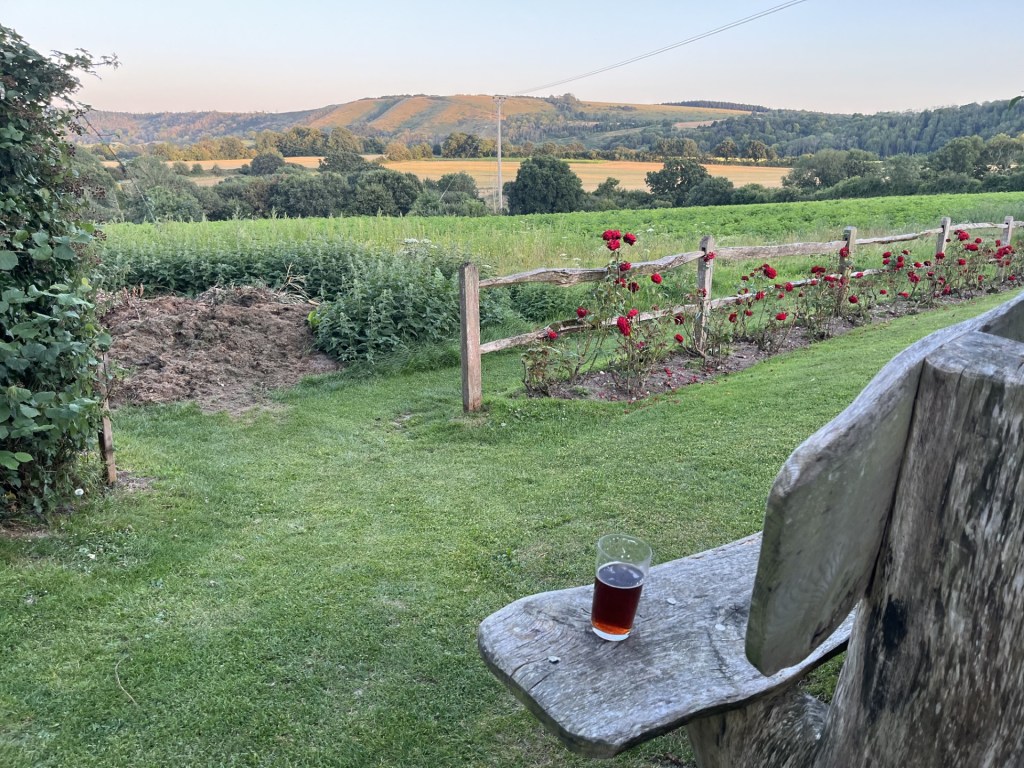
Beer Garden/Garden Beer
I chose to eat in. It was cooler and there was no-one else there. Customers came and went from the bar. A group came in and one of the older men seemed to have spent the day monitoring radio communications to and from the harbour master in Portsmouth. At some point in the afternoon the Prince of Wales aircraft carrier (see above) had entered the harbour to dock, no doubt after having had some essential repairs carried out, again. This had required the closure of the harbour at short notice and had come as a surprise to the Captain of a Brittany Ferries ferry, who demanded to know why he and his 133 passengers were being denied access to the harbour. The story did have some amusing elements to it, but it seemed that after two hours, and whilst other boats and ships had been allowed to enter the harbour, the Captain of the Brittany Ferries ferry was apoplectic that he and his 133 passengers (I’m guessing mostly Brits) were the last allowed in. This produced a few guffaws from the man’s group of friends, but somehow the jingoistic undertow to the story left me a bit flat. At least, in my view, the ferry had some sort of purpose. Other than being anything other than a massive inconvenience, I fundamentally fail to understand what purpose either of the “royal” carriers serve.
*
Day two. Baking by 10am. Whilst Beacon Hill was a fair height it wasn’t the highest point in West Sussex. I had looked at the map and figured that the drive to a marked car park at Blackdown Hill would take about twenty minutes. I set off and decided to grab a coffee and a bite in Midhurst. A genuinely ancient town sadly overwhelmed by endless traffic moving slowly up and down the high street. I was of course part of the problem.
I headed off on the road north towards Fernhurst, where I had factored in a right turn into deep country and onto the car park. At Fernhurst I made the turn and drove along luxurious lanes. At the junction with Highstead Lane the road south was closed for works. No worries, I was heading left, and north. All I had to do was keep going in this direction and I would soon be at my destination.
At a Y junction, with a small green, I pulled up behind a couple of stationary cars. It took a minute to work out that the road I needed to be on was closed due to “shifting” road works. Several large resurfacing vehicles were parked haphazardly and men in high viz jackets wandered around, seemingly aimlessly. A guy on a vintage motorbike at the front of the queue seemed to be trying to elicit information from two of the operatives. They didn’t give any indication that they had any intention to engage with him. Another car pulled up behind me. I wasn’t up for an argument, which seemed to be all that the motorcyclist was achieving, but the older woman who got out of the car behind was able to establish that the road would be closed for a while and that we needed to drive across the green and towards Lurgashall where, she was assured, there were diversion signs.
After driving over the green I soon arrived at Lurgashall, a very pleasant looking village with a pub on a large green. There was no diversion sign. I parked up and checked directions on the phone. All it showed me was to go back the way I had come. Obviously, Google maps hadn’t been informed of the shifting road closure. I went into the pub and asked if anyone knew how to get to Blackdown Hill. The people who knew only knew the route I had already come. I got back to the car and determined that I would turn left onto Blind Lane. Perhaps that should have been a bit of a giveaway. Just before I left, the older woman who had spoken with the guys back at the roadworks pulled up next to me. She had got to Lurgashall before me and had turned right, been taken around the lanes again and was now giving up. She had been trying to get to Blackdown Hill to meet her daughter but hadn’t a clue either, so her daughter was going to come to her. I wished her good luck and considered that her daughter would probably need it.
I don’t want to talk about the next hour because, two weeks on, I’m still experiencing PTSD. Suffice to say it was a distinctly miserable experience in which the occasional diversion signs may or may not have had any relevance but certainly misled, and Google maps was as useful as the Mappa Mundi. Quite how I managed it, and it can only have been on instinct rather than navigational aids, I eventually found myself driving south through verdant forest along Tennyson’s Lane. Suddenly to my left a small car park appeared. I knew it wasn’t the place I wanted to be, which was a mile or so further south, but I’d had more than enough of the pantomime drive and pulled in.
It was over thirty degrees Celsius but under the high canopy it felt cooler. A wide path headed south away from the car park, and without giving it any further thought, concluded that it was the way to go. I was immediately enchanted and after a couple of minutes on the hoof I had forgotten the anxiety of the previous 90 minutes.
A fine white sandy path led me gently up through woods of oak and mixed conifers. After a short while occasional views opened to the southeast and the High Weald. Breaking out of the woods the landscape changed to sumptuous heathland, criss-crossed by footpaths. There was no need to check on directions. I continued to head south, past a large pond with dark peaty black water. Beyond, the path edged down a bit and then along an escarpment which dipped away steeply, and I guessed down to the car park I had originally intended to get to. I was just slightly relieved that on such a hot day I hadn’t had to climb up to this point from there.

Close to the Edge
A few minutes later I was back on heathland, and then a thin line of tall conifers suggested I was now close to the highest point.

It was just a short distance before the path started to go down again and towards the Temple of the Winds, which I had assumed was the highest point (it wasn’t). I could hear children laughing and a dog barking just below. At the foot of the path an area opened out and I had reached my destination, clearly marked by a concrete plinth. I gravitated towards it and stopped. A small terrier type dog scampered up to me, barking furiously and just a foot away from my exposed right ankle. Having been bitten just under the eye by a similar creature when I was around eight years old, I was naturally cautious. The owner, clearly the mother of the two children enjoying their freedom, sat indifferently on the nearby bench. I was resigned to the fact that the anticipated quiet contemplative moment at the top was now illusory, but other than standing stock still had no response to the ankle menace.
“What should I do?” I pleaded, not wishing to offend, nor do the obvious, which would have involved my right foot and a high flying canine. The woman rose and started approaching, calling ineffectually to the dog to back off.
“Sorry, he’s a terribly yappy little dog,” she quipped. I was tempted to agree but you can never quite tell how dog owners will react to understated sarcasm.
After the dog was eventually under some sort of control I meandered over to the edge of the clearing and took in the impressive views towards the South Downs and beyond. It was a glorious day.

South towards the Downs
It was time to move on. Whilst the spot implied that it was the highest point, I noticed that the land rose up through some trees to the west. I picked my way through the woods and eventually concluded that if I wasn’t actually at the highest point, there was nothing nearby to indicate anything higher. I carried on through trees and then back onto open heathland where a bench presented itself and I sat for a bit and took in the enticing views west. If I was to carry on with the project, to climb to the highest points in each county, I was now going to have to take on some longer journeys, and at least ten of them were somewhere in the general direction of my line of sight.
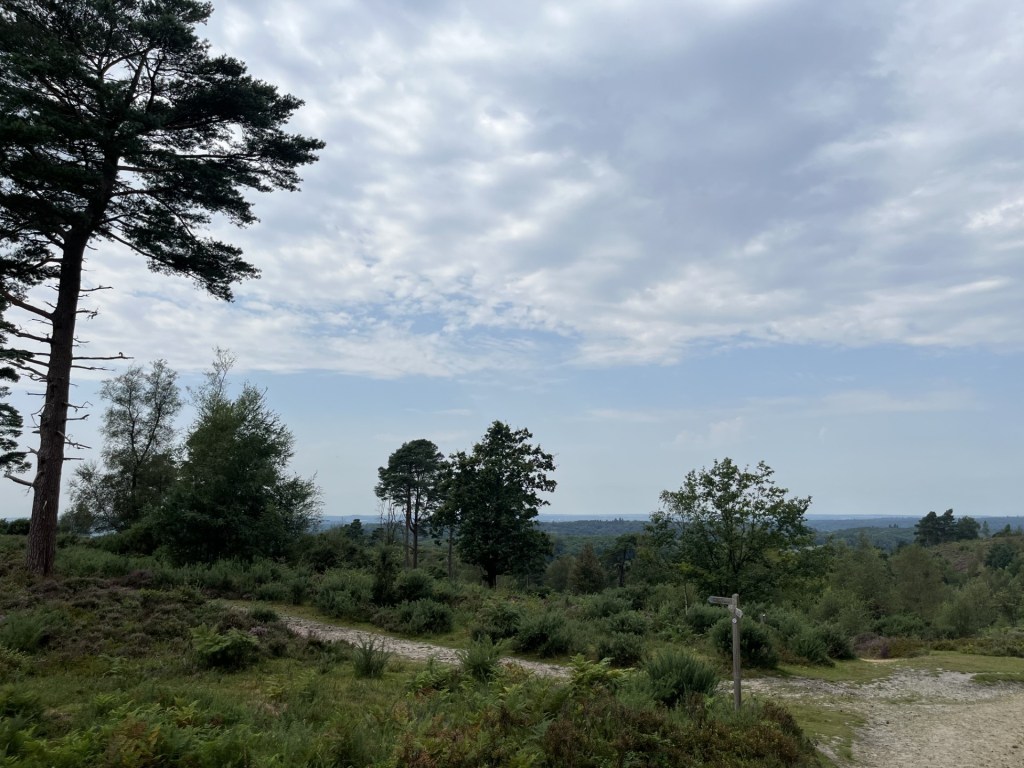
West and towards other peaks
It was time to head back. I noticed a small track leading through the gorse and heather heading north. Walking slowly, I picked my way along the path. I felt like a child, in a mysterious environment where everything I looked at was new. Would I find anything of interest? A snake or a lizard perhaps? I didn’t but did come across a small pond where a red dragonfly zigzagged around close to the surface.
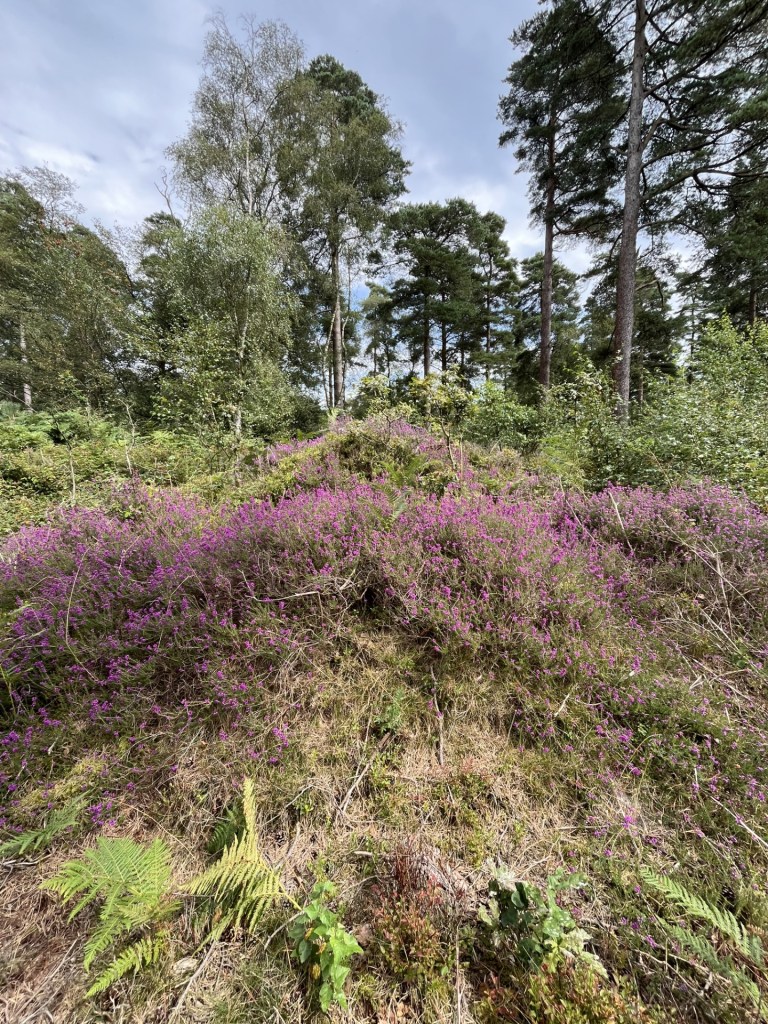
Eventually I reached a wider path that led east and back to a place I recognised from the walk up and a larger pool I had seen earlier. Just at the same moment the woman with the two children and the “yappy little dog” (not my words you’ll recall) passed by and because I was keen to avoid any further confrontation, I decided to sit by the pool for a while to allow a bit of distance.
The sun shone through the tree canopy and gently dappled the dark pool. Every so often something or other broke the surface and after a while my eyes were adjusted enough to work out that the pond was teeming with newts, some venturing just below where I sat. It was time to test the capabilities of the phone camera. Every time I pointed in a particular direction, the water would break just out of shot. I could see that they rose almost vertically and when their mouth hit the surface, they turned on their backs, revealing their golden bellies before quickly disappearing again. I once walked along a tiny stream next to a field by a housing estate just to the south of Manchester on a sunny evening, when suddenly, in a small pool at a bend in the stream, a huge rainbow trout flipped over and revealed its effervescent golden majesty. The mere fact that a trout of any size could even exist in such a small pool was stunning enough, but that it was so big was nothing short of a miracle. I have never seen anything like it since, but something in the way the newts presented themselves in a similar, albeit a significantly diminished way, was still a thrill. I wasted about ten minutes, slightly mesmerised, trying to capture one of these moments but in the end had to settle for a couple of shots that if anything at all proved their existence.

The evidence
I got up. I’d had enough excitement for one day, surely? I headed back along the path I had come up. ** Another much smaller pond appeared on my left, with an emerald-coloured dragonfly on patrol. Maybe the camera could do better here. I crouched, and each time the dragonfly approached after doing its round I took a snap, having no idea if I was getting anything useful. On at least the tenth approach I noticed a reflected movement on the surface of the pond. The shape of a huge bird that, at first, I thought was a heron. I looked up, and very slowly, disappearing towards the west and the distant tree line, was what I could only conclude to be an eagle. It could have been a buzzard, but it was far too big and slow, and it certainly wasn’t a heron or a kite. Some white-tailed eagles have been established in the south, but the idea that this was one of them seemed unrealistic. But, hey! I should have just taken a shot at the surface of the pond at the moment I noticed the movement in the sky. It might have caught the reflection. Never mind.

I carried on back across the heath, still enchanted by the terrain and the views. It felt like an environment where highwaymen may once have earned their living, but aware too that most of the area had been a private estate since the dark ages, which probably ruled that scenario out. Just before I reached the car park, I noticed a concrete structure, with a metal plaque and a coin slot. The plaque read “Please put car park charge and other donations in this collection box – Emptied Daily.” How quaint I thought, before slipping a couple of quid through the slot. Paid in a second.
It took thirty minutes to get back to the campsite. The countryside in this area is grade A plus. I passed through small villages and then back through Midhurst, where a Chinook helicopter rocked over the steeple. Back at the campsite I shivered through a much-needed bucket shower. The Chinook reappeared and impersonated a dragonfly, making several sweeps to the north, back over the campsite and then over to the Downs. It was hard to ignore the fact that a lot of dosh circulates in these parts, and if you needed any evidence of that, as far as I could tell almost every pub in every town and the smallest of villages, had survived austerity, Covid and recessions, and fortunately for me on those two amazing days were not only open Sunday’s and Monday’s but also sold food till late, both nights. At the pub that evening I watched as the Chinook either picked up or deposited troops on the ridge of the Downs. Perhaps the exercise involved transporting our entire army from one part of West Sussex to another. No worries though. We’ve got two massive vanity projects back in the harbour and the captain of the Brittany Ferries ferry is probably still waiting to get in.
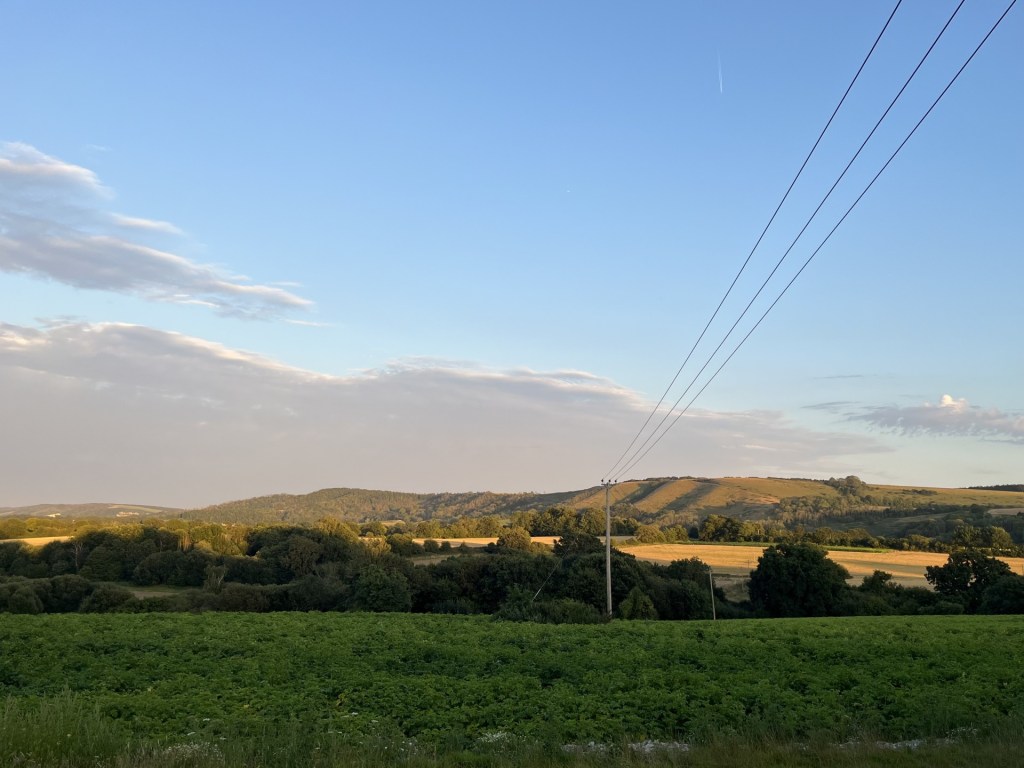
Painting by numbers
With the exotic countryside and proximity to the boating coast, it seemed obvious why this was such a desirable area to live, and also why the small number of other walkers I had come across left me with the impression that for people living locally there is no great desire to advertise it. Realistically I may not get many other opportunities to spend a bit of time here, but if I do, I’m pretty sure I won’t regret it.
* I later checked out Beacon Hill in a Wild Guide to London and the South East. A very short mention, which referenced an Iron Age fort that I had completely missed. It was the same walk I had taken and merely stated “This is a tough walk with a number of steep climbs.” Stating the obvious perhaps but maybe I should have read it before I left home. It failed to mention factoring in an additional 30 minutes to pay for your stay.
** After returning home, and on the tenth attempt to establish the exact location of the summit, I concluded that it would have been deep in the woods, about 50 metres to the west of the path between the two ponds. So, I seem to have missed it by a small margin of error but given that most of the area is something of a plateau and roughly the same height, I’m not going back just to prove a point.

 El Colmado 57