Milk Hill
Metres 294
Feet 965
30th July 2025
Two Walks and a Migraine
It was Wednesday. I’d spent two nights in Bristol with my daughter at short notice and was now due to head home. However, something was in the air. Something that suggested I was about to have an unpredictable, intense and taxing experience over the coming weeks (accidents will happen). For the moment at least my brother was on the case. To break the journey back and buy myself a bit of me time before the storm broke, I decided to book a night in a room in Marlborough.
We were in the kitchen (my daughter and I), chatting away and about to go for a therapeutic walk when, for no reason I could fathom (it’s often that way), I spotted the first nondescript but telling sign of an oncoming migraine. Well, that instantaneously knocked the edge off the day! “Ready for our walk Dad?”
As the insidious black and white geometric pattern started to flesh itself out, I closed my eyes. My daughter had enough on her plate and here I was slipping into instant fug. Ten minutes later, against my better judgement and experience, I decided to throw the migraine into the metaphorical bin and put my boots on. “Let’s go.”
Without overdoing it we managed an interesting three mile walk through the Coombe Brook nature reserve and along the Bristol and Bath Railway Path, a fascinating combination of dells, glens, playing fields, open heath and industrial heritage. It will have to be done again when I’m not having to half close my eyes to keep out the light.
This new strategy seemed to have worked, for the moment at least, and I was feeling good enough to set off to Marlborough. We said our goodbyes and soon I was driving east towards Chippenham. Past Chippenham, which just seven weeks on I can’t remember a thing about, I carried on through Calne and continued directly east on the A4. I was heading for Milk Hill, the highest point in Wiltshire. I had done some basic research and noted that somewhere near to the site was a white horse carved into the chalk. And so, as I passed out of the small town of Cherhill and noticing what appeared to be something that looked like a white horse on the north-west facing slope of a range of hills, I assumed I was getting close. I stopped in a layby just past the town and got out to survey the scene.
The first thing I should say is that as white horses carved into chalk go, it was a bit of a disappointment. It looked more like a cross between a stunted giraffe and a starving hyena. It certainly lacked the surrealist brilliance of the truly ancient Uffington white horse I’d seen the previous September, or the starkly beautiful and anatomically accurate Bratton White Horse near Westbury (visited in 2023 but not in the county tops list).
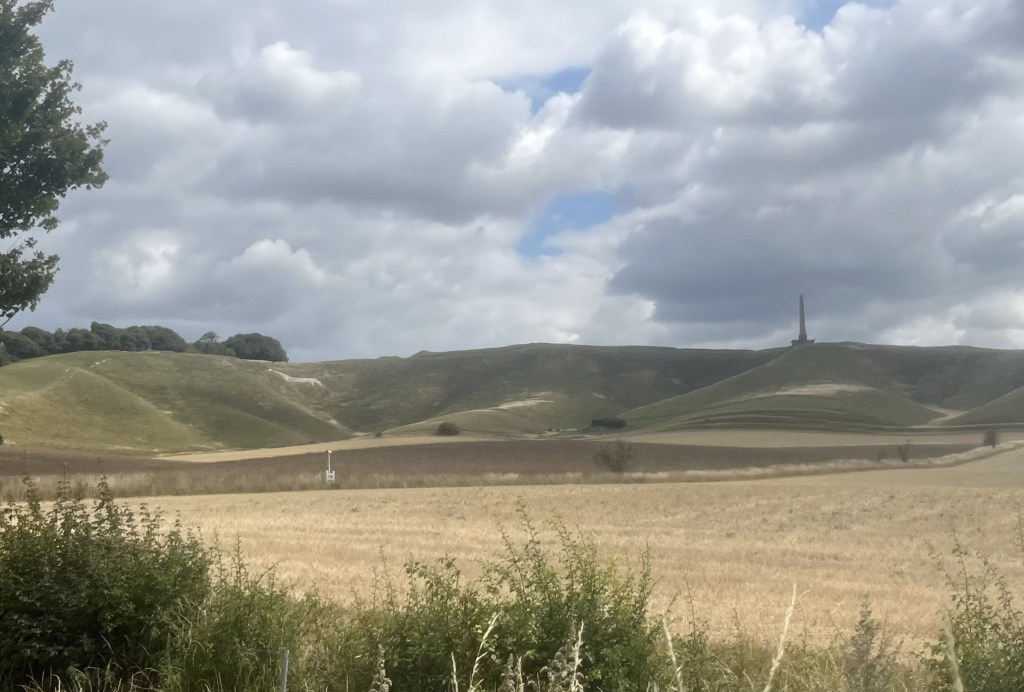
The Cherhill white creature and, at the time, an unidentified interstellar communication device.
Scanning to the right, along the ridge and unavoidable to the eye, a massive stone pointy thing thrust upwards. A commemorative structure of some sort, no doubt, but not necessarily what I had expected, unless it marked the top of Milk Hill. *
I figured that all I had to do was drive on a bit and eventually I would come to a turning to the right that would get me closer to the top (I had previously done a journey planner on Google where a small road ran a good way up towards the top of Milk Hill). I drove on but nothing materialised. I reached a roundabout at a place called Beckhampton. Things weren’t making any sense. I pulled over again and tried to re-orientate. I had another go at entering a route on the phone, and I was told to carry on east and then turn right onto a small road at West Kennett.
There always seems to be a complication when I’m trying to find these spots. I’ve concluded that the complication is me, and my increasing lack of engagement with new tech. I think this is in part because I don’t want to know everything. Knowing everything means there are no surprises. So, when five minutes on and a bit further down the road I noticed a familiar conical shaped hill just to the left of the A4 I was genuinely surprised and delighted. It had been many decades since I had last gazed at Silbury Hill, and there was time for another quick stop.
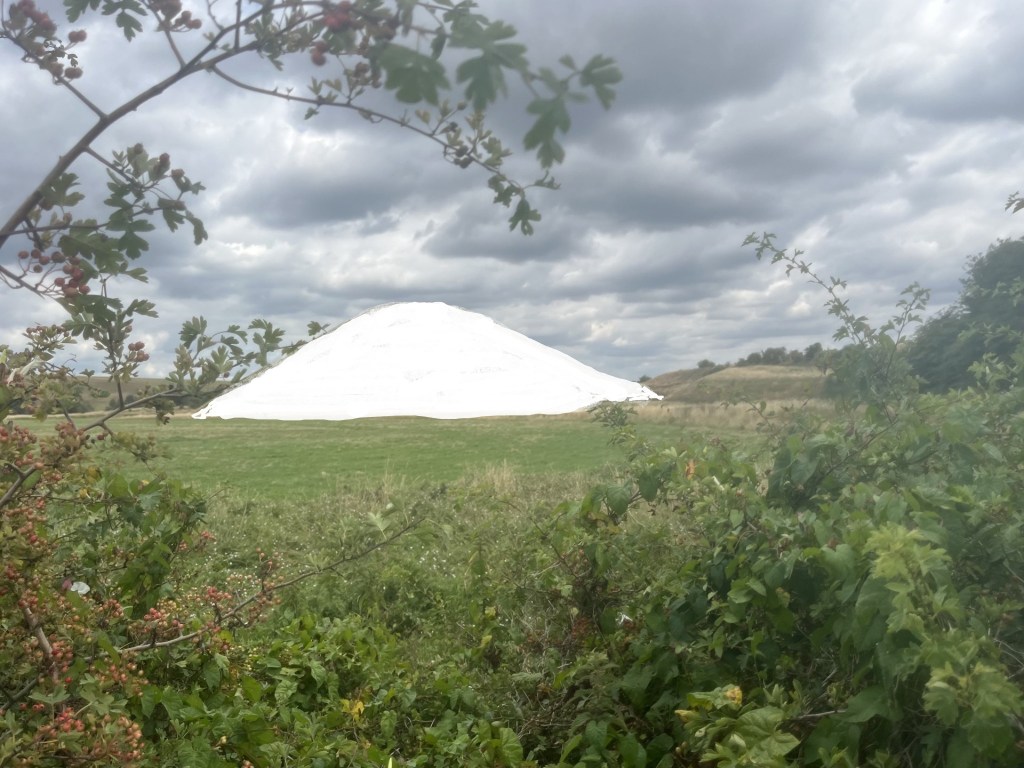
Silbury Hill in its original un-grassed state – as re-imagined
After a few minutes of contemplation (Why? Well, because when you see Silbury Hill you do have to wonder) I carried on to West Kennett and located Gunsite Road on the right which, according to Google, was going to take me to within touching distance of Milk Hill (check it out, the blue line takes you to within 300 metres). **
The narrow road headed south and slowly up. A large farm building emerged to my left, and then, just around a corner, a heavy metal gate blocking further progress. This hadn’t been in the script. I stopped and inspected the obstacle. Locked, along with a second metal gate just to the right where another road led away to the west! This was an unexpected blow, but it was obvious that I wasn’t going to be getting near the top on four wheels. Conscious of my delicate condition (I have occasionally had more than one migraine in a day), I turned the car around and headed back towards the A4. Just before reaching the end of Gunsite Road, I noticed a car parked up on a small patch of dry ground just off the road. I pulled in behind and spent a few moments considering my position. My body was weak, that was for sure, but I’d come a long way and doubted that I’d be back this way anytime soon. It was mid-afternoon. A bright sunny day, and not too hot. Sod it.
With my walking boots on I headed back to the locked gate and then onwards along a concrete road that continued south and gradually up. I had by now lost any concept of where the top of Milk Hill was, or even if I was on the right track. It was just a question of keeping on walking, and so long as I was going up, I stood something of a chance. Looking back, I noticed a small number of people dotted around an unusual hump in the landscape on an adjacent rise.

An old barrow. See **** for extra extraordinary information.
I had seen a sign earlier to West Kennett Long Barrow. Judging by the small gathering of people clambering over the mound I figured I was now looking at it and wondered if I had ever been to it. I’d certainly been to Silbury hill many decades before, but nothing came back to me to suggest I had been to the barrow. It was too far away now to divert me just so I could tick a box. I carried on along the concrete road, slightly out of breath, until it levelled off for a while and I reached an isolated barn structure where the road bore to the left. By now the landscape was opening out and I could see what appeared to be the higher ridge stretching east to west a mile or so further to the south. I had more than once toyed with the idea of calling it a day and retreating, but now the objective seemed to be tantalisingly close. I chose to go on.
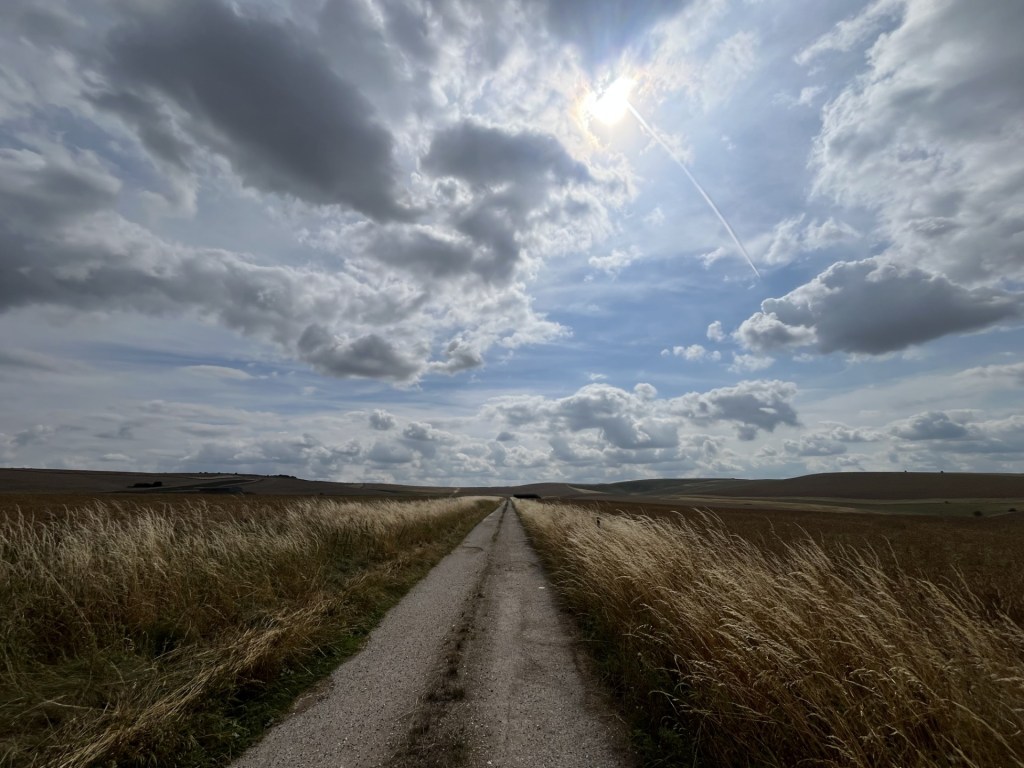
The first sight of the higher ridge
I expected at some point to find a path that would take me on a direct course but nothing materialised and at the next collection of farm buildings a sign proclaimed the land to be private property, whilst another claimed that CCTV was in operation to prevent rural crime. Whilst sympathetic to the farmers’ need to protect assets and knowing that rural crime is a blight, I hadn’t come this far (still with the threat of a migraine in the back of my mind) to be deterred by these notifications. Rightly or wrongly, I carried on, conscious that my progress/trespass might be being monitored. The road veered back southeast and continued up past huge fields to either side. Stopping to catch my breath I took a 360 look around. Far to the west, at least three miles away, and rising dominantly above the ridge, it was impossible to miss the enormous obelisk I had seen back at Cherhill. Well, that at least told me I had been entirely misguided in my assumption that it might have marked the top of Milk Hill. Despite all the gadgets I had become seriously disoriented and regretted not having an Ordinance Survey map to provide a degree of certainty.
I ploughed on up. Towards what I hoped was near the top, the road intersected with another that led up a steep slope from a valley below. Using this road I soon reached a gate and an information board that hinted that at last I might be close to the top. A path headed directly south across a grassed field and towards some trees, with another cultivated field to the left. Precisely what was being cultivated was unclear to me, but I had little doubt I was looking at Milk Hill, with the highest point a hundred or so metres beyond the barbed wire.
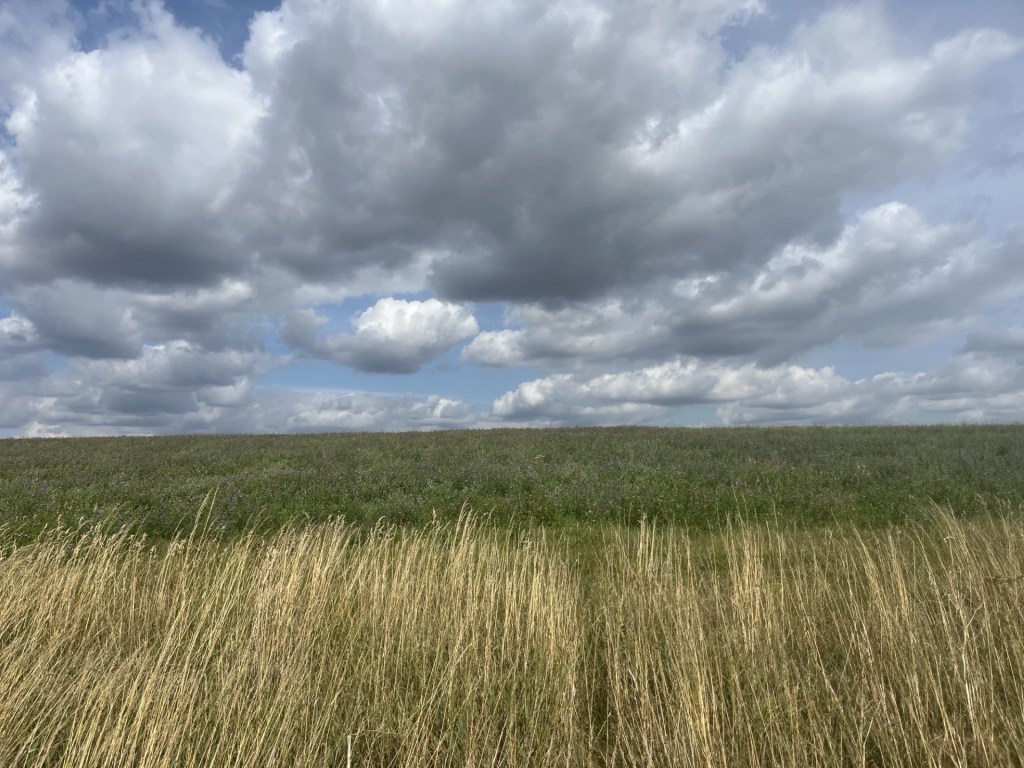
Here’s looking at the top – Milk Hill
Maybe somewhere a path led to the top, but from what I could see it seemed unlikely. I had done as much as I could, and frankly, by now I was more impressed with the magnificent and commanding views of the Vale of Pewsey opening to the south. I still had some reserves in me so carried on along the edge of the field until, with no white horse to be seen, I decided to stop. The reason for stopping was simple. Scattered randomly across the grass were a number of limestone boulders that made perfect seats. They looked entirely comfortable in these surroundings, but as I sat and took in the views, I was left wondering. Wasn’t this chalkland? ***

Unaccountable erratic’s
The landscape looked familiar, yet unfamiliar at the same time. I’d seen a view not dissimilar to this before and it slowly began to occur to me that about twenty years before, along with my son, we had been on these hills, having camped for a couple of days at nearby Pewsey.
I’d pushed my luck getting to this point and decided to abandon the idea of seeking out the white horse. I started back the way I had come. Back on the concrete track and looking west the outline of a huge ditch snaked along the top of the ridge and towards the horizon. Hoping to get a dramatic picture of what was clearly a man-made structure dappled in light and shade, I waited a while for the right combination of sun and shadow. As neither presented themselves and I was getting bored, I took a shot anyway, just at the moment a red kite swung into view. Despite this interesting moment, it remained a disappointing photo.

A disappointing photo of the Wansdyke and a rhyming red kite.
Down I went, now with three or four red kites circling the adjacent fields, and then passing the group of buildings with the CCTV. Happily, there was no one there with a pitchfork to challenge me. A movement to my left and a hare dashed out of some crops, stopped for a moment and then darted at immense speed into more crops. Hare coursing remains a significant rural activity. Those who do it would call it a “sport”. Because it’s illegal it’s not a sport, thankfully. How anyone might get a kick out of setting dogs on one of these stunning creatures is beyond me, but then again, I’m just a townie, so what do I know about the country ways, but it might have explained the CCTV.
As I approached the second solitary barn there was an odd but slightly disturbing thumping noise coming from its general direction. So far, apart from one large harvester in a distant field, I hadn’t seen anyone and whatever was going on inside the structure didn’t sound like it was being generated by a human. Being in Wiltshire, a county steeped in ancient mysticism and crop circles, I moved towards the structure, which was nothing more than a corrugated roof, some metal supports and a few bundles of hay. The knocking noises continued. Suddenly there it was, the source. A deer, quite large but type unsure and clearly startled, skipping around at the back, and trying to escape…. from me!
The poor thing was in a terrible panic. I stood still trying not to make the situation worse. Its problem was that it was trying to get under a corrugated panel and into the field beyond by throwing itself at the light, but its small downy horns kept hitting the metal sheeting and knocking it back. On the third or fourth attempt it eventually managed to hunch low enough and with a final, slightly sickening thud, it scraped under and vanished. For no logical reason I felt slightly guilty for the animal’s discomfort but rationalised that they were hardy creatures and probably found themselves in similar pickles daily.

Silbury Hill and West Kennett Long Barrow from Gunsite Road
I carried on down the road where, to my surprise, a car suddenly appeared coming up what must have been a subsidiary road. This was the moment I thought I would be challenged. But it wasn’t. The car carried on down Gunsite Road. **** Moments later two further vehicles were behind me. I moved over. This was all getting a bit too Southern Comfort for me, but whoever they were (farm workers knocking off for the day I guessed), they passed on by before pulling up a couple of hundred metres ahead at the locked gate, which they opened with ease and disappeared.
I reached the gate a couple of minutes later. It had been locked again, and I noticed that the bridleway sign, which had been upright earlier, was now on its side and lying in a ditch. Sometimes there’s no point in trying to rationalise things. The good news was that I hadn’t experienced another migraine, and the car was still where I had left it. I remembered to stop the walker App. Six miles!!! What had I been thinking? I collapsed into the driver’s seat. I had one night in Marlborough before what I knew were going to be exhausting and challenging weeks ahead. Despite the sudden onset of knackerdom I knew I had made the right call. I’d breathed in the heady Wiltshire air and seen its ups and grassy Downs, I was ready.
* The enormous monument was erected by the 3rd Marquess of Landsdowne (who he?), in honour of one of his ancestors. The Petty-FitzMaurice’s have been around a very long time, and one of them was even Prime Minister around the time the French were despatching with their own aristos. From what I can tell the 9th Marquess still sits, unelected but inherited, in the House of Lords.
** As at the end of 2025, if you look on Google Street view you can see that the gate is unlocked and just inside the field several cars are parked up. Daytripper’s/hare coursers? Nearby a sign states, “private property”. One way or the other the landowner has since decided to secure the premises and this may be legitimate, but by locking the gate she/he has also blocked a signed byway (thus preventing onward horse travel).
*** It took a while and a lot of searching but I’ve since concluded that the erratic’s at the top of the chalk weren’t limestone but in fact sarsen stones. How they came to be there is unclear (see infinite theories on Stonehenge). The logical answer is by glaciation, but maybe human action too.
**** Well blow me down!!! I decided to see why Gunsite Road was called what it was called and came across this little article (which suggests it once led to a firing range). Just up the hill from the locked gate, going towards the long barrow, was the setting for the moment in Saving Private Ryan when the army officer and priest visit Mrs Ryan at her home on the plains of Utah to tell her three of her sons had died in action. A very moving scene.
https://www.sarsen.org/2019/08/gunsite-road-archaeology.html

 El Colmado 57