Great Wood
129 Metres
423 feet
30th June 2025
Hot Footing
The drought and high temperatures of early 2025 had been on-going for weeks, and the weather forecast for the coming days was something along the lines of “another heatwave”, “end of humanity”, “hotter than Athens”, “keep hydrated – unless you live in any of the regions that have run out of water”. You get the idea. I’m generally ok with high temperatures, but there’s something about heatwaves in England that can be stultifying.
Ten days earlier I had managed to spend a couple of sweltering weeks in Greece, where the cicadas sang and the sea breeze stole the heat. Those delights were not going to be available in the UK over the next few days so, with the great outdoors in mind, and a few basic necessities in the backseat of the car, on Sunday 29th June I drove to the village of Gosfield and pitched up under some trees next to Gosfield Lake. At that moment, under the shade, and with a wind from the lake, it was the coolest spot in Britain.

Water, water everywhere, but not a drop to spare
In the evening, I walked into town to seek food and drink from the local hostelry – The Kings Head. Naturally, being a Sunday they didn’t serve food (a tactical mistake on my behalf that required the purchase of three bags of peanuts to stave off disaster), and whilst I had thought when booking the site that I would be spending the night in Suffolk, judging by the accents in the bar (the lack of a soft rural burr was evident), a quick check revealed I had only managed to make it to north Essex.
My overnight stay in Gosfield was just a stepping stone on my journey towards Suffolk and Norfolk, where I hoped to capture the tops of both counties. Returning to the campsite from the Kings Head I noticed a huge old country house (Gosfield Hall) that displayed a variety of historical architectural styles. Once the home to several generations of Courtauld’s (textiles and central London gallery), many of whom now lay in the graveyard of the nearby St Catherine’s church, the rowdy shouting and screaming drifting across the fields betrayed its current status as a wedding venue. A big expensive wedding, in Essex, on a hot summer evening? The stuff of reality TV surely, but what would I know about such things?

Show me the way to go home
Back at the tent and the day-trippers had gone. When I had arrived the extensive site was occupied by large family groups enjoying the weather and surroundings. One family in particular, the one next to where I had pitched my tent, seemed to be very keen to advertise their presence by playing music, which could have been K-Pop for all I knew, at maximum volume through the car speakers and with all the doors open. I should state that these events took place nearly two months ago, but whilst I have been writing this account an email has just arrived from the campsite booking website saying that I haven’t yet reviewed Gosfield Park. I was certain that I had but never mind. What’s important is that had my noisy neighbours still been there on my return that evening, my review of the site would have been very different to what I probably wrote at the time – which was along the lines of it being a very pleasant location for a Sunday night and out of season, but that perhaps during school holidays it might be a different kettle of fish.
That night, as I slowly drifted off into a sleepless night, the souped up internal combustion engines of the local boy racers (presumably on their way home from the nearby wedding) filled the sweet summer air as they greased it up the small country road to the south of the lake; reminding me that the next day I would be in a different, and perhaps slightly quieter, county.
*
It was another scorching morning, and I was grateful for the shade under the old trees and the breeze from the lake as I took down the tent and decanted the site. I drove north along insanely quiet country roads, and at one point on a road I recognised from years before on a cycle ride out of north London, eventually arriving at the town of Clare (just over the border and into Suffolk). Thirsty, but also in need of a substantial calorific infusion after the disappointment of the King’s Head I stopped at the market square, grabbed some scram from the Co-op and took a short stroll around Clare’s blanched centre. I’d never heard of this place before, but it was an architectural gem, stuffed with houses and building going back centuries, with hardly any modern clutter.
After the regenerative input I carried on north, and again along tiny lanes that were almost traffic free. Arriving in the small hamlet of Rede, I parked up near All Saint’s church. The moment I stopped the air became suffocatingly hot. It didn’t seem like a lot but from the OS map (Landranger 155) that I unaccountably possessed, I had a three mile walk ahead of me. I was beginning to have second thoughts, but on the basis that it was extremely unlikely I’d be anywhere near here ever again I dragged myself out of the car with half a bottle of tepid water as my crutch.

All Saints Church – Rede. A handy sign proved invaluable
The church looked kind of interesting, so I ambled over to the grounds, aware that every eye behind the nearby cottage windows was probably on me. It being a church and yard, it was a peaceful spot. I walked along its northern flank, determined to remain in shadow, and became aware of frantic sounds from above. Looking up I could see several bird boxes tucked under the eaves, and every few seconds swallows would fly in and out. The noise of the hungry chicks inside was being amplified through small speakers set next to one or two of boxes. There are so many wrong things going on in the world at the moment, to see that someone had spent a bit of time providing nesting sites for these beautiful birds, and bringing their sounds to the ears of the occasional visitor restored a little bit of faith in humanity.
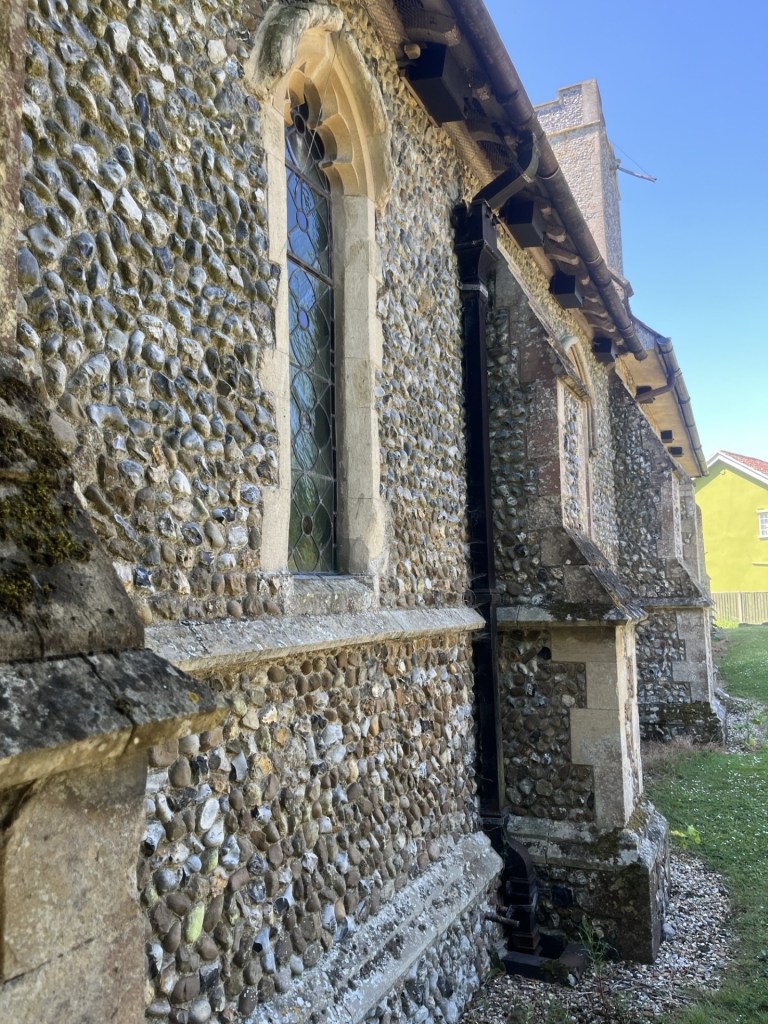
Bird songs of praise
I walked back to the road, turned right, and then almost immediately left onto a small road that quickly led into a large field. I flanked the northern edge of the field before hopping over a ditch into an adjacent uncultivated field where trees provided some cover. A large military aeroplane with one of those big radar attachments, circled above. A gate at the end of the field took me through a pasture where a sign suggested lurking horses. None were visible.
Another large field opened beyond the small coppice I had emerged from.
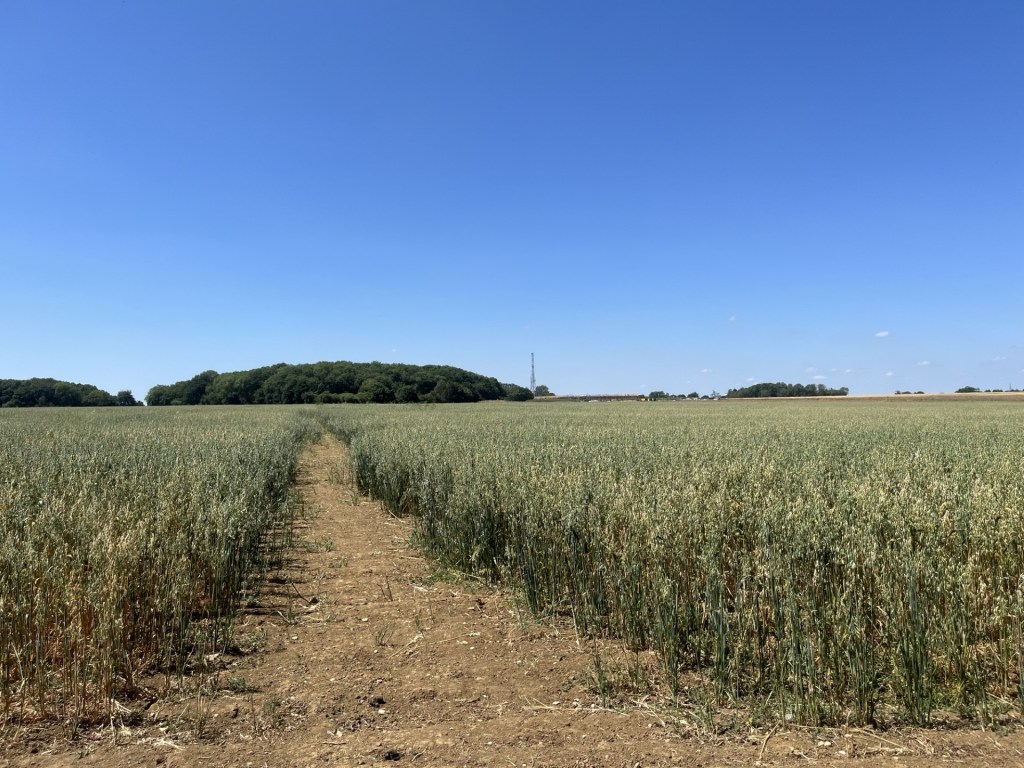
Target obtained – The Great Wood!
The path headed straight as an arrow towards what was perhaps the inappropriately named Great Wood. It was obvious where I needed to go, and the baking midday sun made it an imperative I got there as quickly as possible. Under normal circumstances the path should have been a doddle, but with the ground rain free for weeks, the numerous inch wide cracks in the earth required some careful navigation. On reaching the woods, the path continued around its flank to the north. Another field, protected by a wire fence, lay to my right. A sign indicated that it was being left to nature to encourage wildlife. It looked tatty but was clearly performing its designated function. Hundreds, if not thousands, of small white butterflies danced around in the air above the vegetation. These sorts of interventions in the countryside are controversial, particularly as we continue to import more and more food from the other side of the world, and, as evidenced this year, global warming is knocking the shit out of our crops. But, when you can see with your own eyes the astonishing fecundity of nature when we provide the necessary rebalancing habitat, you must be hopeful.

A thousand small white butterflies – but you’ll have to take my word for it

A common brimstone butterfly, one of many gracing the Peloponnese two weeks earlier.
At the top of the field a huge construction site was generating some activity. An Anglian Water, pipeline and water storage facility the size of a football stadium. It’s infrastructure at least but whether it is too little too late, we’ll have to see.
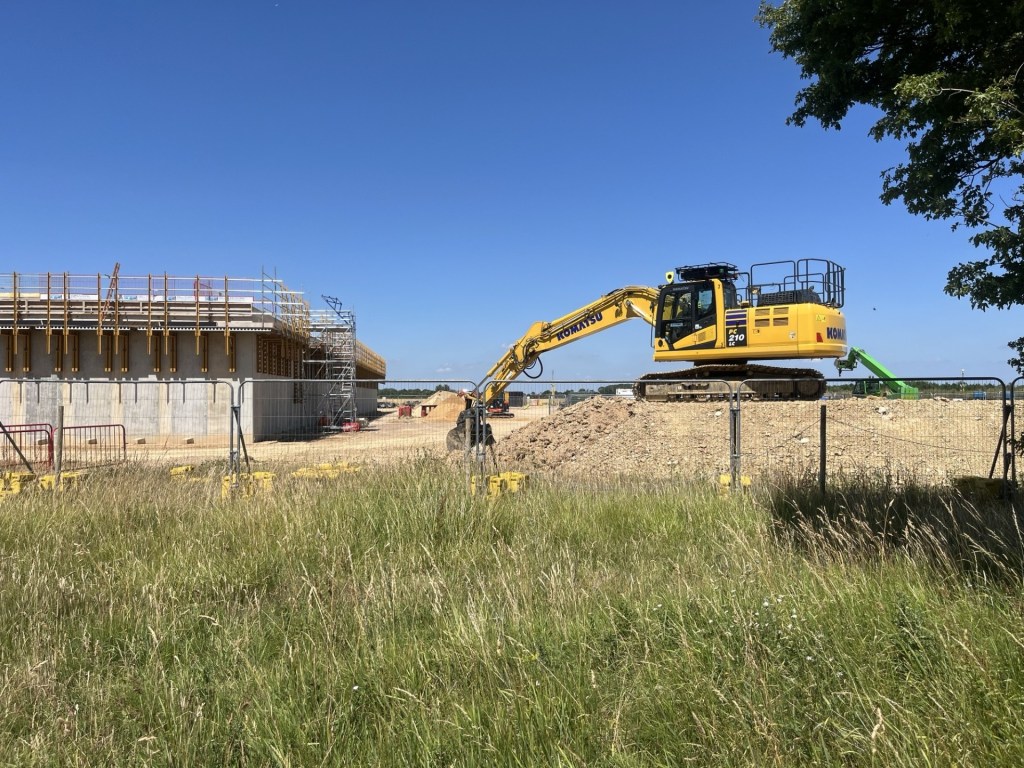
Top Digger action at the water works
Flanking the works and along a path through shrubland I emerged onto a dusty road network, primarily servicing the construction traffic. From what I had researched the highest point wasn’t in the Great Wood, but directly opposite in a small thicket that sported a communication tower. Lots of warning signs warned of crossing the roads, and to be fair, I was duly warned. There was no point trying to explore further so I sat down on a plastic road barrier (which was bizarrely full of stagnant water that hinted at a mosquito breeding ground) and took a moment out of the sun.

Catching the rays at Suffolks highest point.
Looking at the map I could tell that there was an alternative route back to Rede and that at the end of this route the sign for a public house. It being a Monday, and it also being in the middle of nowhere, I had to accept that a cold soft drink at the end of the walk was unlikely, but it was incentive enough.
I wound back through the shrubby path and after a couple of false starts found the alternative path that took me through woodland to the south of the Great Wood. Despite the relative coolness of the glades, I was conscious of being slightly dehydrated. Emerging from the woods a track headed south-east along the edge of a vast field. Again, the heavily cracked earth made progress mildly treacherous, but eventually the track gave way to a metalled road, Pickard’s Lane. The lane continued into a complex of buildings that looked like a farm, but which seemed to be slightly more industrial. To the right a small field had been contoured and landscaped in an imaginative style, which included what looked like a miniature Glastonbury Tor.
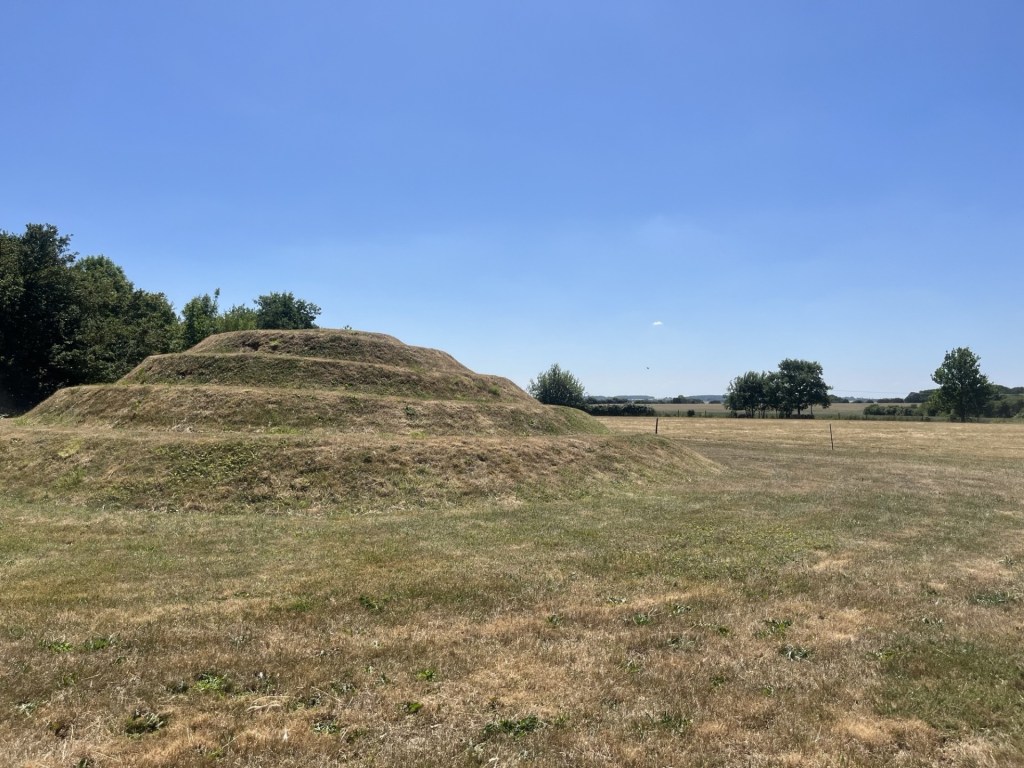
East Anglia’s Avalon. If you’ve reached this point, you’ve gone too far.
A man was delivering some goods to the industrial building just beyond. If I continued along the lane, would I get back to Rede, I asked. No, it was private property (Pykards Hall to be precise), and I had to go back a bit where I would find a path heading north. The thought of any retreat by this stage was slightly depressing but it had to be done. Finding the path, I walked through more woods and eventually emerged at The Plough, which immediately spoke of bygone times and warm beer after a hard day in the fields.
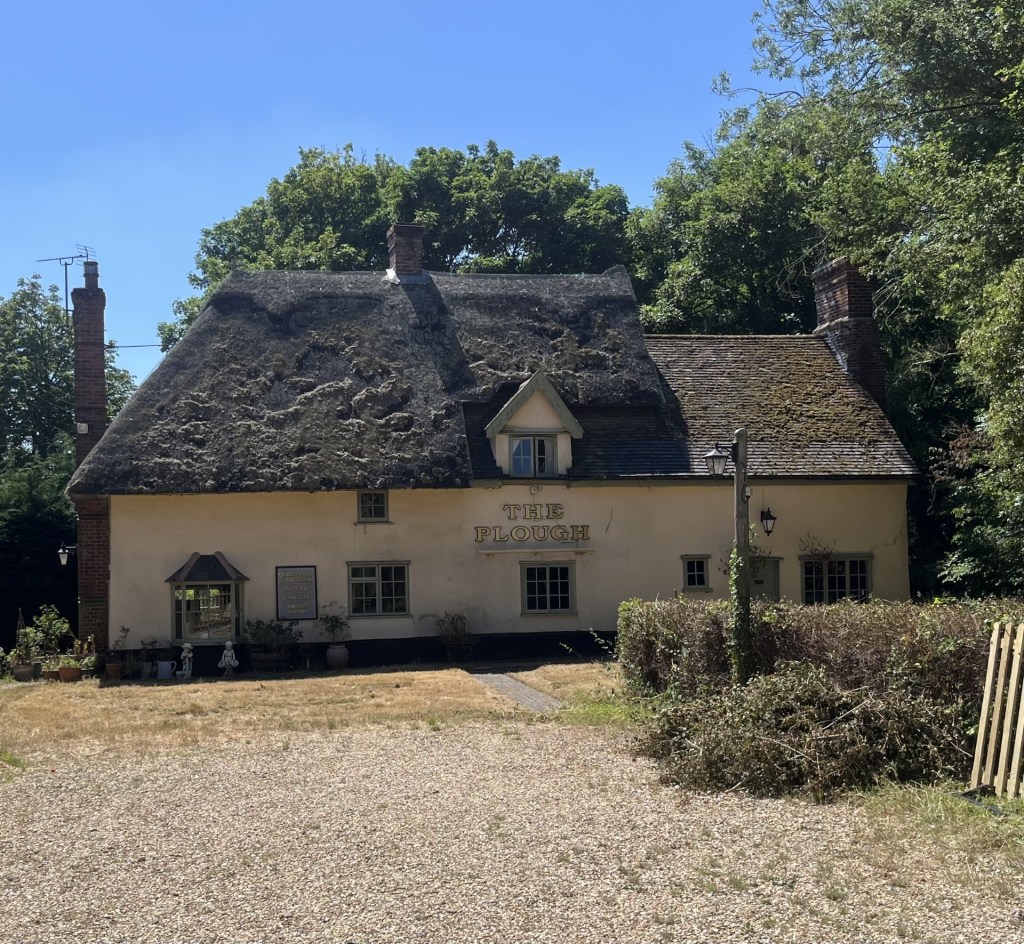
The scene of the crime – The ex-Plough
Initial observations weren’t hopeful. As I suspected, being a Monday it appeared to be very much closed. And I wasn’t wrong. Indeed, it was so closed and devoid of any indication that a good beer, or other sustenance, could be procured that I had to conclude that the old Plough Inn was now very much a private home. I guess it didn’t surprise me too much, but it still felt like a rural murder had been committed. Why hadn’t this made national news?
Opposite the gutted remains of the pub stood a small and neat village hall. A woman with a small dog was sheltering under a nearby tree. As I passed, I said hello and asked her what had happened to the pub. She confirmed it had been closed for some years and was now a private home. Shucks! I thanked her and made for the car. As I passed the side of the hall, I noticed a flyer in one of the windows. A local character called Charlie Haylock was going to be doing a talk about the history of spoken English, at the hall on the 2nd of August, with proceeds going to the church. It might have been interesting, but I wasn’t going to be there, and I also wondered if I would have been able to sit through it without being reminded of Bob Fleming’s, Country Matters from the Fast Show, and not coughing out loud.
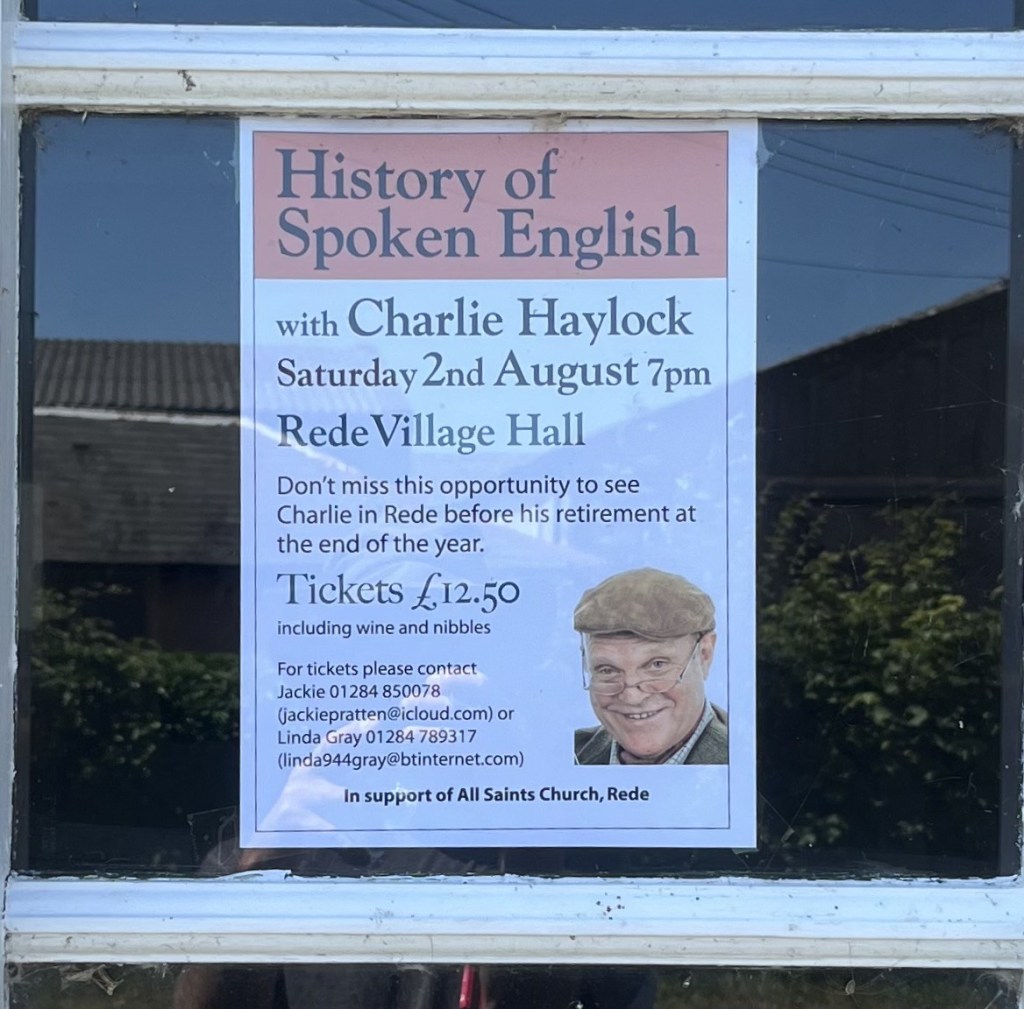
Charlie Haylock’s last gig
Walking the short distance back to the car, if Lee Van Cleef had stepped out from behind a post further down the road and spat a mouthful of tobacco into the curb, I wouldn’t have batted an eyelid. I opened the driver’s door to be met by an urgent escape of searingly hot air bursting out into the open, reminding me of the time I’d visited Ravenscraig steel foundry in the 1970’s.
I waited a few minutes before risking getting into the car. I guess I had enjoyed the walk, but it definitely hadn’t been the day to do it. I liked Rede too, though the murder of the pub had probably killed off the hamlet’s beating heart. Still, there was always the village hall and the occasional event, but you’d have had to be there, and it was time for me to vamoose. An ice-cold drink was calling from a faraway town

 El Colmado 57