The last heatwave of the summer had come and gone. I seemed to have missed most of the August one, driving between home, hospitals, care homes and petrol stations but the personal hiatus had calmed down. Before winter set in I decided to head off somewhere new and seek out some more county tops if the opportunity arose. Hmm… but where?
Sunday the 7th of September and I’m to the south of London, heading west on the M25. The day before I had booked a room for the night in Chepstow, just over the big river and just inside Wales. I had plumped for three nights in the extreme south-west of Wales, but the idea of taking that journey on in one day felt a bit too ambitious.
I had only been on the motorway for ten minutes before the almost inevitable slow down. It was still early on a Sunday morning but the M25 has a knack of buggering up your day at any time it wants to. As the stream of traffic plodded along under the scarp slope of the North Downs, at around twenty miles an hour, ahead I could make out the figure of one of our new breed of “patriots” standing on a footbridge, with a balaclava over his head and waving a St George’s flag at the passing motorists. It was a warm day. The window was down, my right arm shooting the breeze and with Cerys on the radio playing sweet Sunday morning melodies. And this “proud” boy had just gone and crushed my karma. In that moment, and just seconds before I passed under the bridge, my right arm made an entirely involuntary movement of the Churchillian variety. I doubt he saw it, waving as he was to someone who had honked, I assumed in support. Sigh…
Four hours later, and what felt like an over exposure to footbridges sporting St George’s flags (I should say, for balance, that the Women’s Rugby World Cup was on and England were the favourites), I drove over the River Severn at close to low tide, entered the Principality and fifteen minutes later was checking in at the Beaufort Hotel in Chepstow, a town I had passed several times before, but had never peeked.
With the sun beginning to sink I took a walk down to the River Wye. The Chepstow side (Wales) was flat and nestled in a large curve in the river. On the opposite side of the river (England) an impressive limestone cliff reared up. A hole in the cliff was explained away on a noticeboard as being used for different purposes over the centuries, including storing dynamite. Nothing explained away the huge Union Jake chalked onto the surface of the rock just to the right of the hole, but refreshingly it had nothing to do with recent “disturbances”. The tide was still going out, the dirty brown river thundering along and generating a mass of swirling eddies. Not too far downriver the Wye meets the Severn. It crossed my mind that if an opportunity arose in the future, I’d want to see the Severn bore. Looking around, the Castle took me by surprise and as castles go, it was the business. The rest of the town was an interesting mix of Georgian, Victorian and the occasional 1950s concrete misfire. Back in the Beaufort and a quick pint before bed Motorcycle Emptiness by the Manic Street Preachers issued from the speakers at a satisfactorily loud level. I was being welcomed to Wales, and I wasn’t complaining.
Monday morning and a coffee outside the Ugly Mug Cafe whilst planning my routes for the day. Until the construction of the first Severn Road bridge in 1966, the high street in Chepstow was the main road between England and South Wales. The road through the town is a bog standard small town road, but half way up it narrows to one lane as it passes through the medieval town gate, set into the defensive wall. Trying to imagine what it must have been like here before the construction of the bridge and M4 was enough to make the brain hurt. The ultimate destination was to be St David’s in Pembrokeshire. Still a long way to go but I had all day, the sun was still smiling, and so far, I hadn’t seen a St George’s flag. I wove out of town on the B4293 and then the B4235. (I had an uncle, no longer with us, who had the remarkable ability of being able to describe almost any journey to any destination – particularly if it ended in Scotland – by naming each and every A/B and M road on the route, and the exact locations where one became another. If you’d driven to his house from Cape Wrath, it would be time to go home by the time he’d explained to you in detail the way you had come in the first place – Scotch Corner often featured).
I was heading west to Wentwood Forest and the location of the highest point in the Unitary Authority – also referred to as a County Borough – of Newport (which would explain why its football team is called Newport County AFC). Wentwood Forest lies at the authorities’ north-eastern limit and on the boundary with Monmouthshire. The drive up from Chepstow was pleasant and almost traffic free. I wasn’t entirely sure where I was going to end up but as I drove in the general direction of the forest, I met the Usk Road, and a sign pointing back east to the Cadeira Beeches car park. Parking up I checked the phone and was satisfied that it would do. An information board explained that the forest was unique and one of the oldest ancient woodlands in Wales.
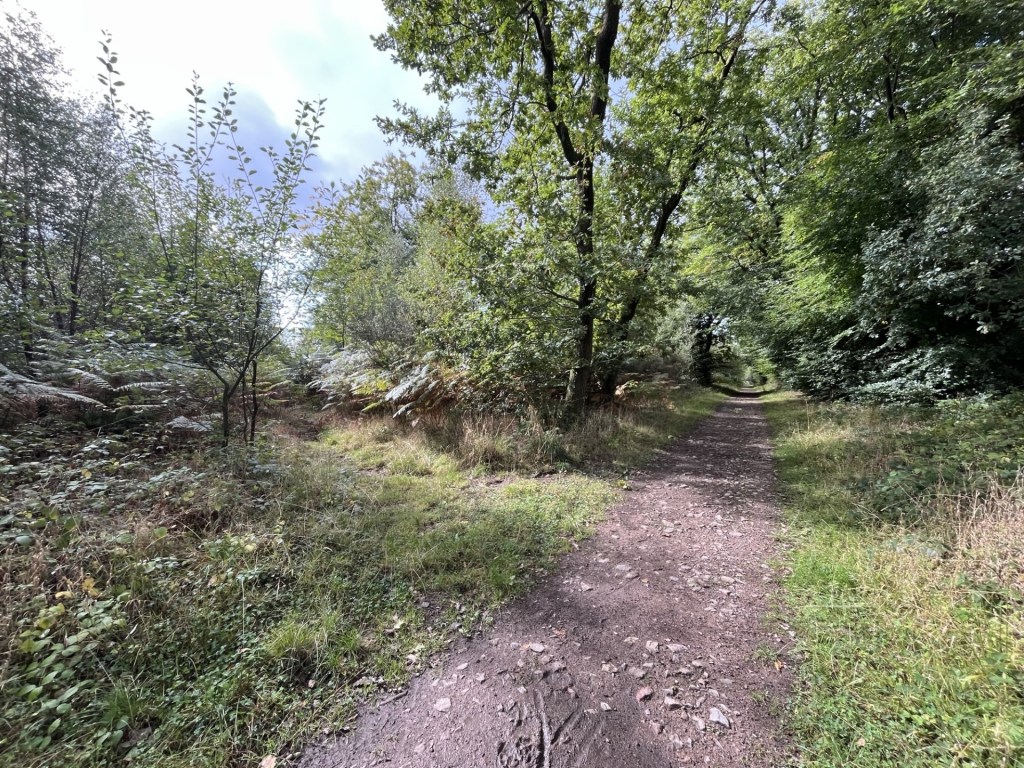
Setting off on a wide track to the west of the car park, all I needed to do was keep on going. The track rose gently. A car approached from the opposite direction, which suggested I could have driven closer to the top, but I needed the stretch.
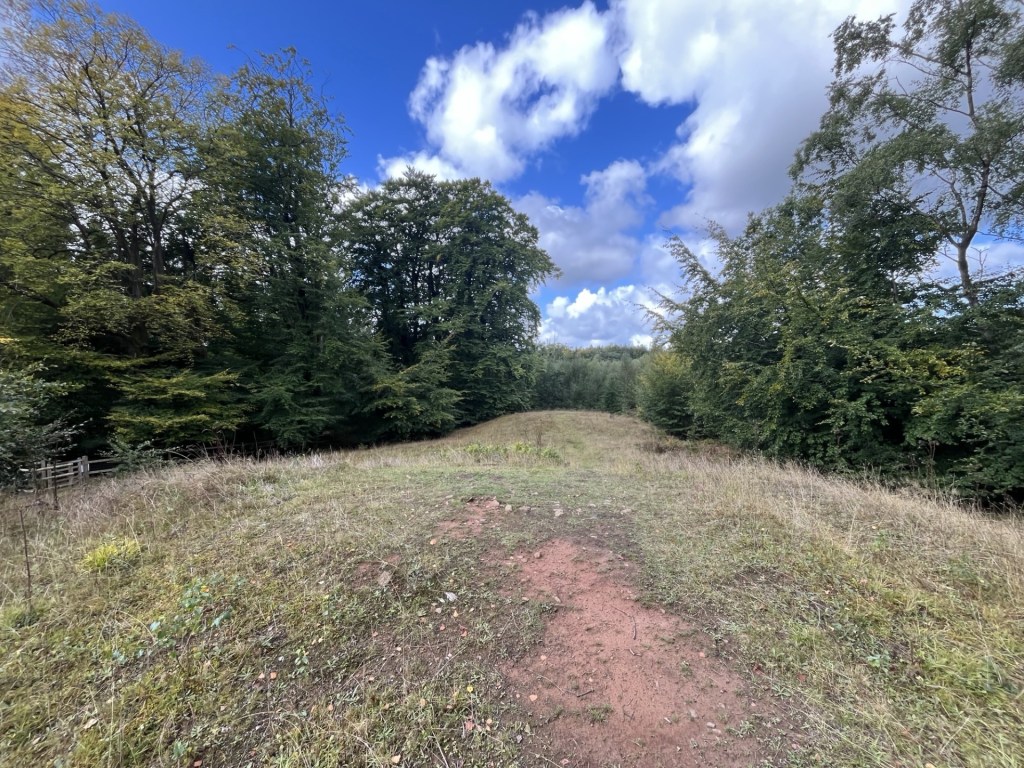
After about a kilometre the track bore to the right. A few metres on a sign pointed into the woods and to Wentworth’s Ancestors? These were two low Bronze Age burial mounds lying in a small clearing in the woods.
The view from one Ancient (me) to another
I climbed to the top of the larger mound. It took three seconds. A moment to ponder what it all meant, but no answers came. Back on the track and what was indeed a road quickly deteriorated into a muddy puddled quagmire that would have certainly swallowed up my little Ford. I’d made a sensible decision.
The track met an unnamed road which I crossed and then into a large carpark with just one vehicle, looking slightly vulnerable. A wide track led on west, but I chose to take a smaller path just to the south, on the basis that it, rather than the track, appeared to continue heading gently upwards.
On the drive up there had been a point near where I had joined the Usk Road where a dramatic view had opened to the north towards the Brecon Beacons and most obviously Sugar Loaf, the distinctive peak that was responsible for all this endeavour in the first place (requires reading the introductory premise). Whilst the walk in the woods was nice, given that I was near the top of the hill, it was a slight disappointment to realise that there wasn’t going to be a similar view at some point. I guess that every tree is sacred, but still!
Another 100 metres on and a communication tower to the left, a good sign at any location that the top is nearby. The path was wooded on both sides and after another 200 metres I sensed that I must have been near, or at the top. I knew that a trig point was somewhere in the neighbourhood, but it wasn’t obvious. Scanning the surrounding thickets I eventually picked out what looked like something of a track leading into the woods just off the main path.
Left turn to the top
It wasn’t immediately obvious but having discovered the indistinct path I took the bait and then, stooping below the brambles, took careful steps through the undergrowth. Every so often flattened vegetation indicated others had recently passed through. Other Crest hunters, it seemed, had been here too.
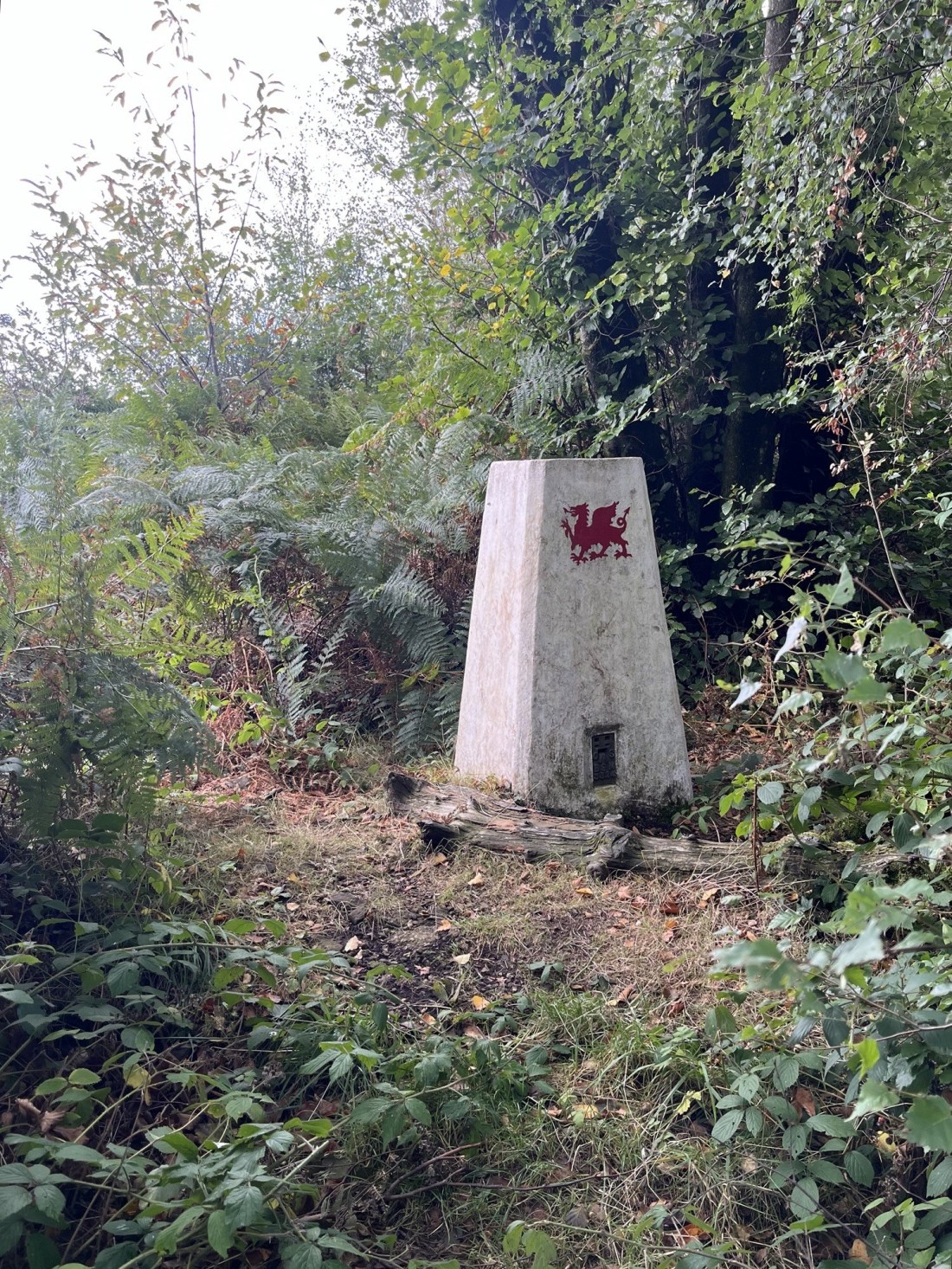
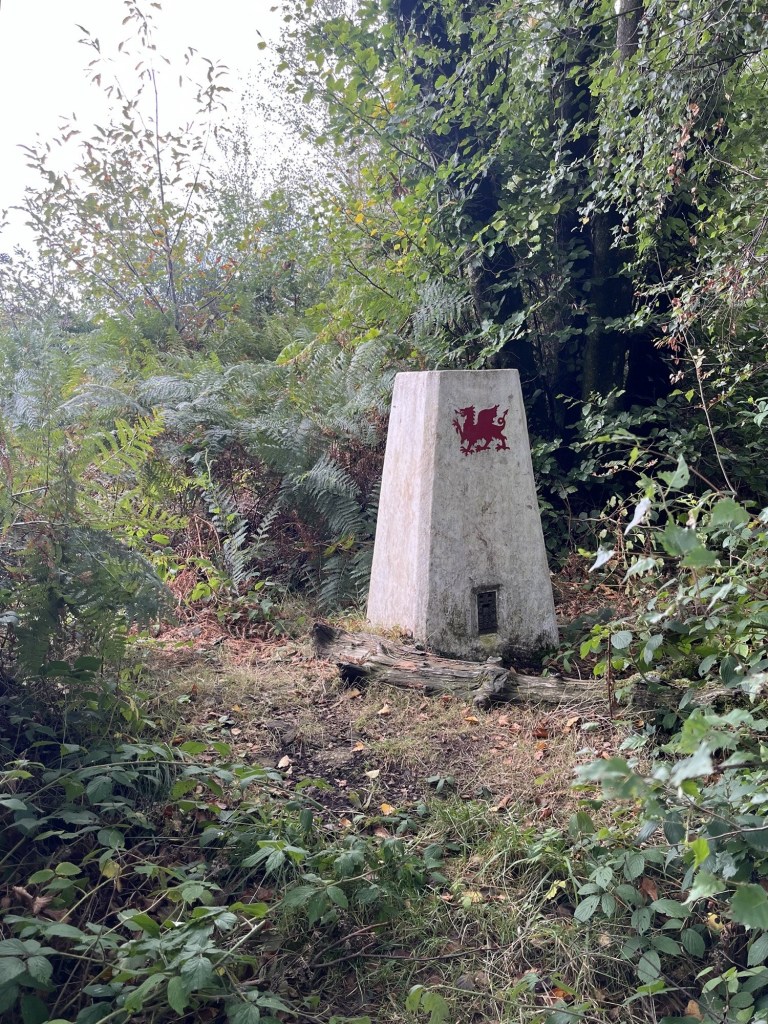
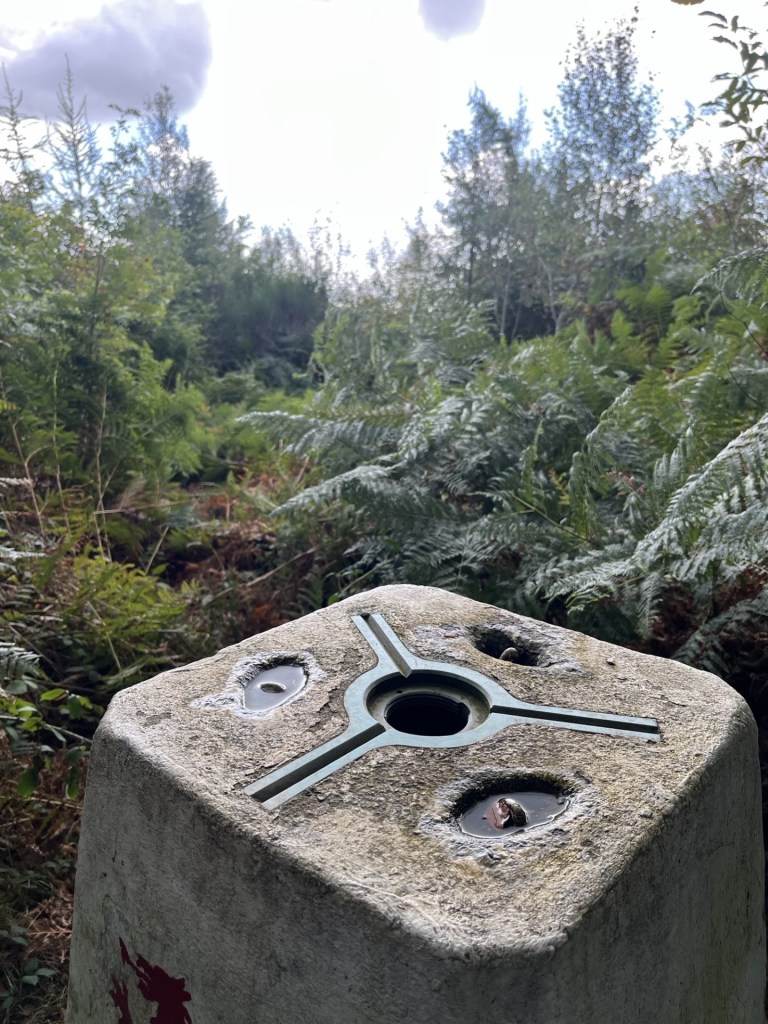
Within a minute or two I emerged into something of a clearing and there it was. The concrete trig point, painted white and with a red dragon to boot.
The trig in the woods
Any hope of a view here was dashed. The thickets and low trees continued into the distance.
A restricted view
That said it was a serene spot, and the painted trig point an interesting feature. I have an old friend who spent much of his youth growing up in Newport. I sent a photo of the trig, asking him if he could guess where I was.
There was nothing more to do but return the way I had come. I was slightly relieved to emerge onto the path unseen by anyone else. It might have looked a bit odd. The big car park had gained another three or four vehicles in the time I had been to the top, and dog walkers were heading off in various directions.
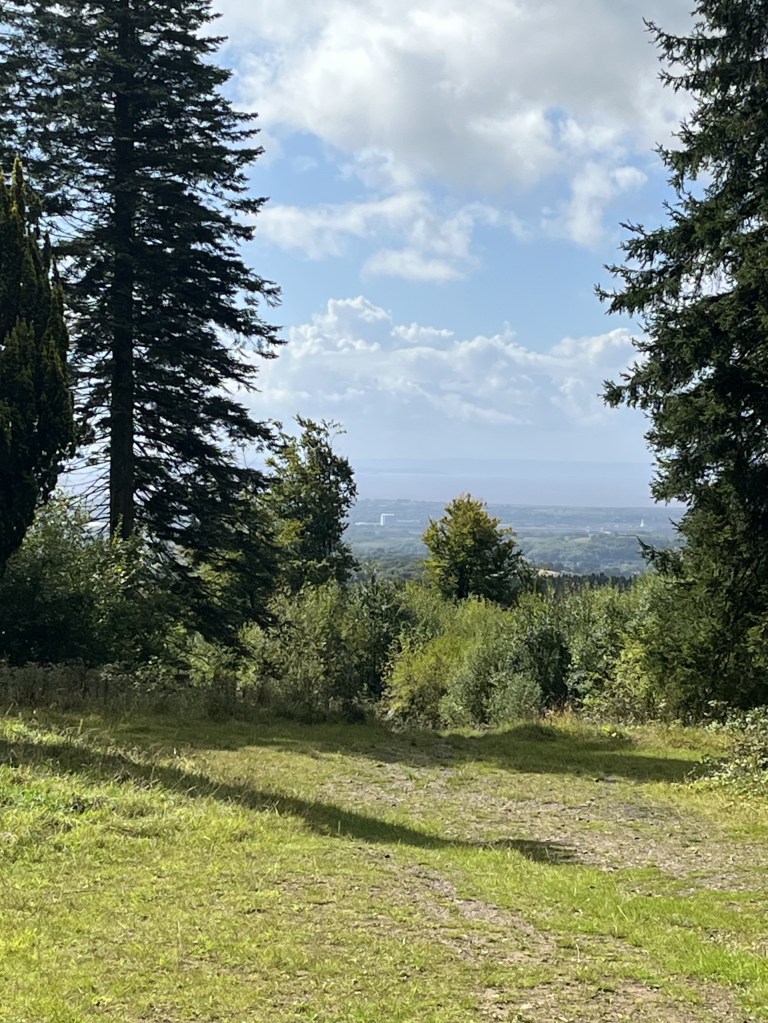
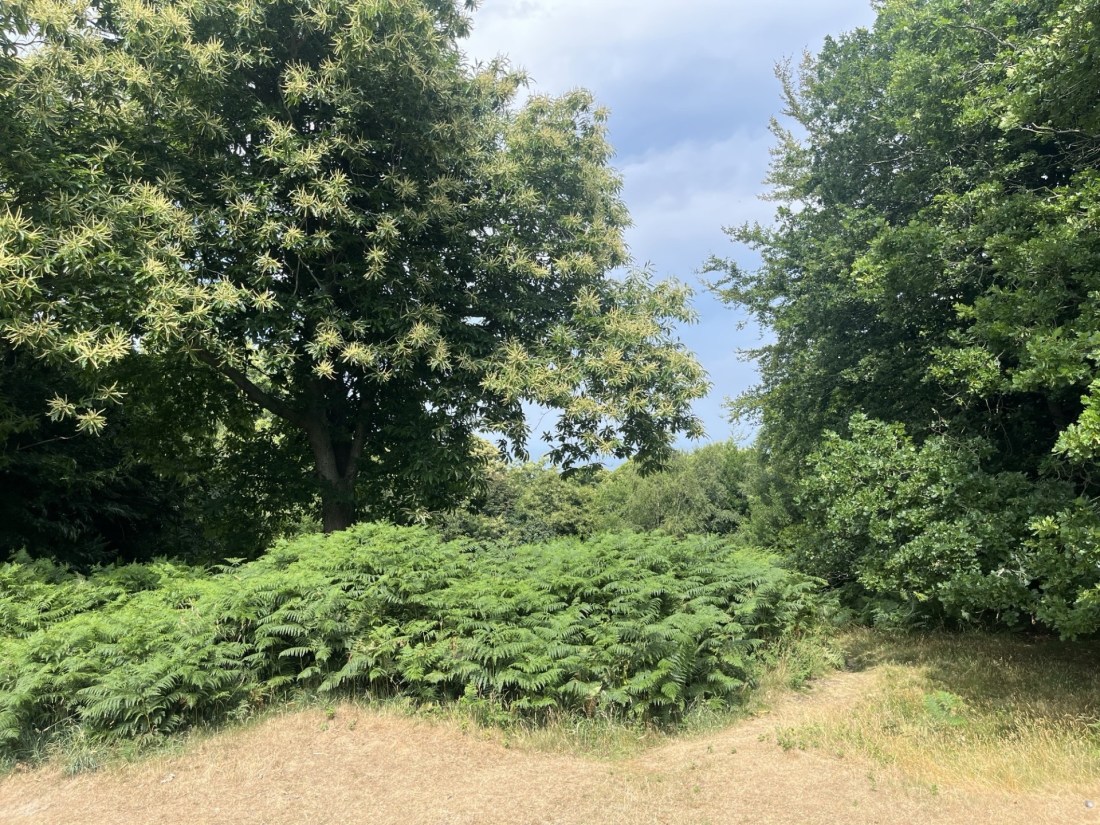
Just past the Ancient’s I noticed a break in the tree line and the entrance into what turned out to be a much bigger clearing than anything so far. Sun was occasionally breaking through the clouds. Walking down into the clearing a view of Newport, the Bristol Channel, and far beyond the north Somerset coast, shimmered between isolated tall pines. I stopped for a while to take it all in.
Glimpsing the county
I set off back to the car park, scanning between the trees for just one inch of a view to the north, but it never came.
Back in the car and taking off my boot, a ping announced an incoming text. It just said “Wales?”
I texted back. “If I said no? Well… yes. One-point smart arse.”
Perhaps unsurprisingly, a month on and he’s not replied.
The walk was just two miles, but this was a nice spot, and deeper into Autumn the trees will radiate here. Just a few miles to the west lies Blackwood, the home of the Manic’s. Sorry, any tenuous excuse!
It was a Saturday, and I had woken up with no particular objective in mind. That said I’d spent nearly a month running around like a headless chicken on caring duties and was truly exhausted. Once upon a time, on a day like this (warm and a soft sun) I often found myself on an empty Saturday slipping onto a train or tube and spending a couple of hours watching football in one part of London or another. Those days are long gone, not least because you can’t just turn up at a ground and expect to get in, but more significantly because I no longer live in London. No footie, no worries. Take a walk instead and hope to avoid all results until Match of the Day.
This one had been on my mind for a while. The old county of Sussex is now (at the time of writing *) split east and west, and at its heart is the Unitary Authority of Brighton and Hove. I had done East and West Sussex in 2024, but Brighton and Hove had eluded me. Today was the day to get on the boots, a train, and then up the chalk.
I missed the first direct train. It was at the platform as I crossed the footbridge but knowing that there was no time to buy tickets and board, I was resigned to wait for the next. That was fine. There was no rush. I wandered down the nearby street, full of second-hand shops, small galleries and one stop dog manicuring facilities. It was busy, and the usual coffee outlets were bursting. Walking back towards the station on the other side of the road, music was seeping, quite loudly, from an unfamiliar shopfront. A vinyl record store that sold coffee. Hmmm… well why not?
With my coffee secured and sitting outside watching the world go by, all was well. And then it got ten times better. Those unmistakable opening brass blasts of Move on Up by Curtis Mayfield get me every time, and it was no different now. If I hadn’t already been motivated, I certainly was now. Sometimes, depending on whether something has inspired me on the day, I embed a music video from YouTube at the end of these accounts, and I’m just telling you now – it’s going to be there. The extended version of course.
The Brighton train pulled into Eastbourne, which is a terminus and where all trains stop for fifteen minutes or so to allow the driver to swap ends before onward progress. It’s a tad frustrating to be honest and is entirely the fault of Mr Beeching, who, along with his committee, decided to remove a mile long section of track to the north of the town. This had provided direct services along the coast, but now it has gone it means that everyone travelling east to west (and back), is sucked into Eastbourne for the mandatory pitstop, thus rendering speedy transit to Brighton or London an impossibility. Well, no worries. I wasn’t in a rush.
The train failed to leave the station at the designated time, but it was only when the guard walked down the carriage apologising to the passengers and explaining that someone had locked themselves in the toilet, that the atmosphere on the train changed. Almost immediately some of my fellow travellers were very loudly offering up a menu of opinions they had in mind if the situation wasn’t dealt with quickly. This included a man near me volunteering to kick the f’ing door down. I’m not sure the guard handled the situation very well to be honest. He chuckled at the offer of assisted violence but also hinted that the person was a teenager trying to avoid paying the fare. By now there were people, male and female, on their feet and baying for blood. A chant went up “get him out, get him out, get him out.” I felt like I was at a footie match in the 1980’s. I sat schtum. It’s felt a bit like the leash has been slipped in recent months, with some unpleasant sentiments and reactions bubbling to the surface of society that would have previously been unacceptable. The situation finally resolved itself when the toilet door opened and moments later three (yup, three) fifteen-year-old lads in trackies appeared on the platform looking cocky and unfazed. There was a muted round of applause for the guard. I looked at the three boys, heads turning this way and that like a group of nervous meerkats. They’d chanced it, had had a moment of fun and annoyed a few people. No one was hurt. Thank God they had been white.
The train left a few minutes late of course. I alighted at Falmer station. Falmer sits just to the northeast of Brighton. It’s the site of the University of Sussex and the relatively new Brighton and Hove Albion football stadium. Earlier I had had a moment of panic when it dawned on me that there might have been a Premier League game at the ground that afternoon. That would have been a drag, but there wasn’t, so I was the only person to get off the train. I was heading to Bullock Hill, the highest point in Brighton and Hove and a mile or so to the south of Falmer.
Walking out of the station I made my way up a series of concrete steps that led towards student residential buildings. It was summer and there was no one in sight. It felt strange wandering through an empty campus, next to an empty football stadium. I’ve supported Tottenham Hotspur since 1967, when they won the FA cup. As a teenager I was brought up in Croydon and so spent a lot of time going to watch Crystal Palace (ironically the current FA Cup holders). Along with Arsenal (see Spurs above), Brighton is the theoretical enemy. When Palace play Brighton, it’s called the M23 derby. As far as I can recall there’s never been any violence, and I hope it stays that way.
Past the university buildings and at a higher level now, I passed along the side of the stadium. On a game free early Saturday afternoon, a soulless place to be. The road led on to the east. I turned and took another look at the ground, nestling into the chalk.
The offside rule explained.
Before we start to go up, here’s a tenuous Brighton joke to break the tedium (I’m afraid it’ a longish read).
A year or two ago I was with family in the garden of a pub in Nottingham, expecting to watch Nottingham Forest on the outdoor TV. Due to a colossal misunderstanding the match (which was taking place a quarter of a mile from where we were sitting) wasn’t televised, so the entertainment had gone missing in action. Except, at just around 3pm, and as we sat disappointed by the development, a middle-aged man wandered over to our bench, sat down and proceeded to tell a joke. Over the next two hours, and without interruption, he told joke after joke, only pausing occasionally to accept the offer of another pint. None were offensive, rude or controversial, but most were funny. This was one of them:
“You’ve heard of the footballer, Danny Welbeck?” Yup, we all answer.
“Played for United, now at Brighton.” Yes, we all answer.
“You’ll have heard of his dad then?” No, we all answer.
“What? Everyone knows Danny’s dad.” Well, we don’t, we reply.
“Yeah, he was in the army. Everyone knew him.” We are all ears.
“A Bomb disposal expert.” Wow! We didn’t know that.
“Yeah, everyone in the army knew him. Great guy.” Hmmm… (where’s this one going?)
“Danny’s Welbeck’s dad,” he paused. “Yeah, we all knew Stan.”
Boom boom. How we laughed – eventually!
Walking east and away from the Amex Stadium and the university complex I crossed over Falmer Road then started the ascent on a well-maintained cycle/path path. The route was set back from road and tracked it up the chalk slope. Steep at times but then easing off views began to open out to the east and towards Lewis.
Waves of chalk heading towards Lewes
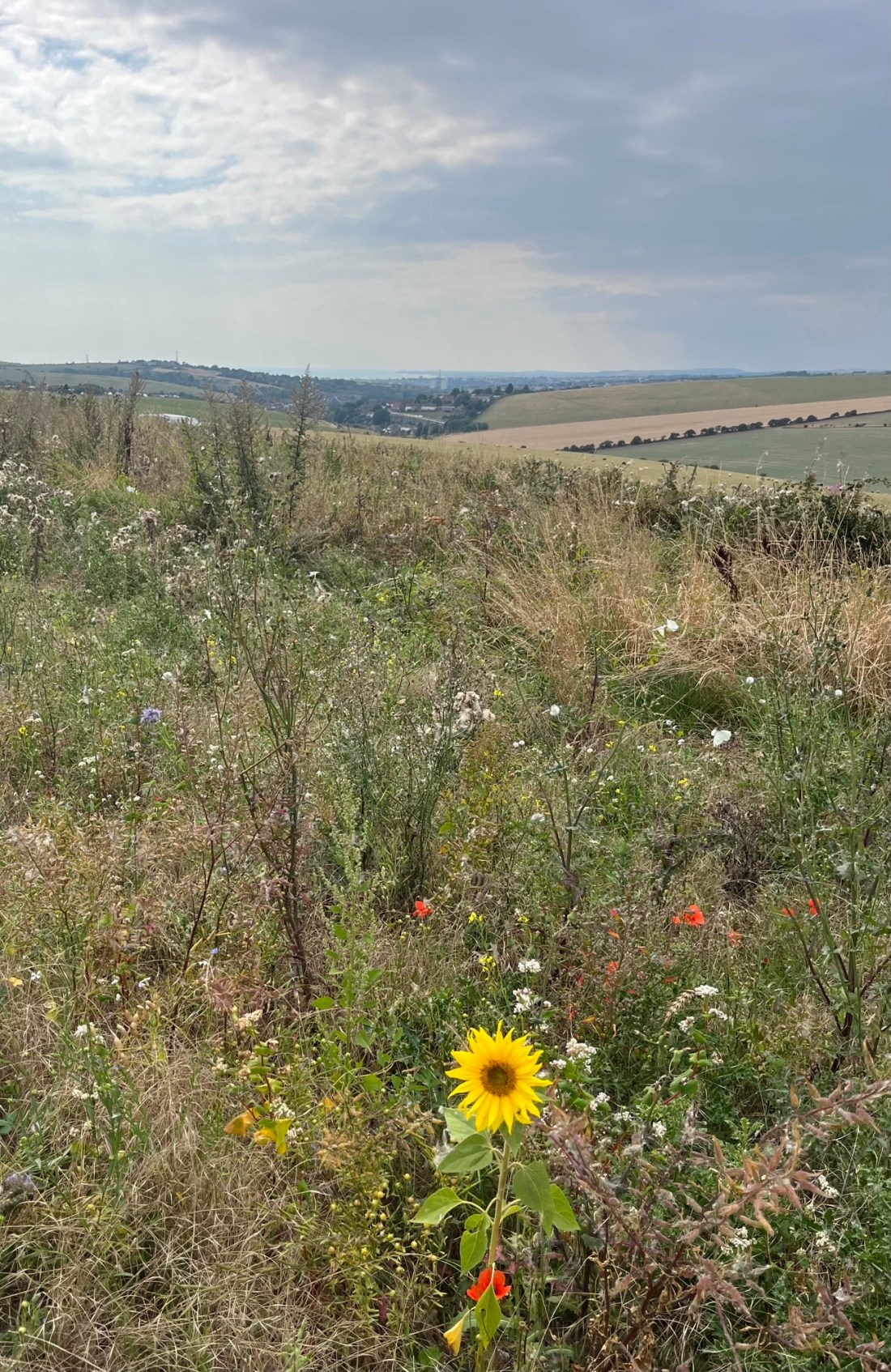
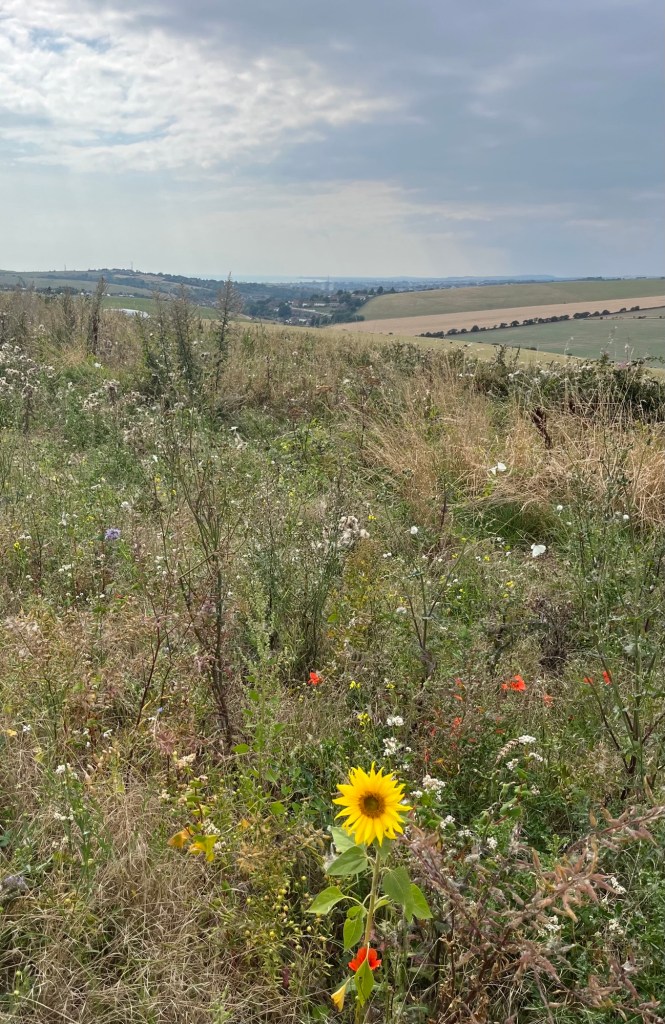
After a mile or so a slight bend in the road and some land set aside for wild planting offered an opportunity to inspect some colourful flora. Looking towards the southwest the view towards Shoreham was unexpectedly spectacular.
Spot the butterfly
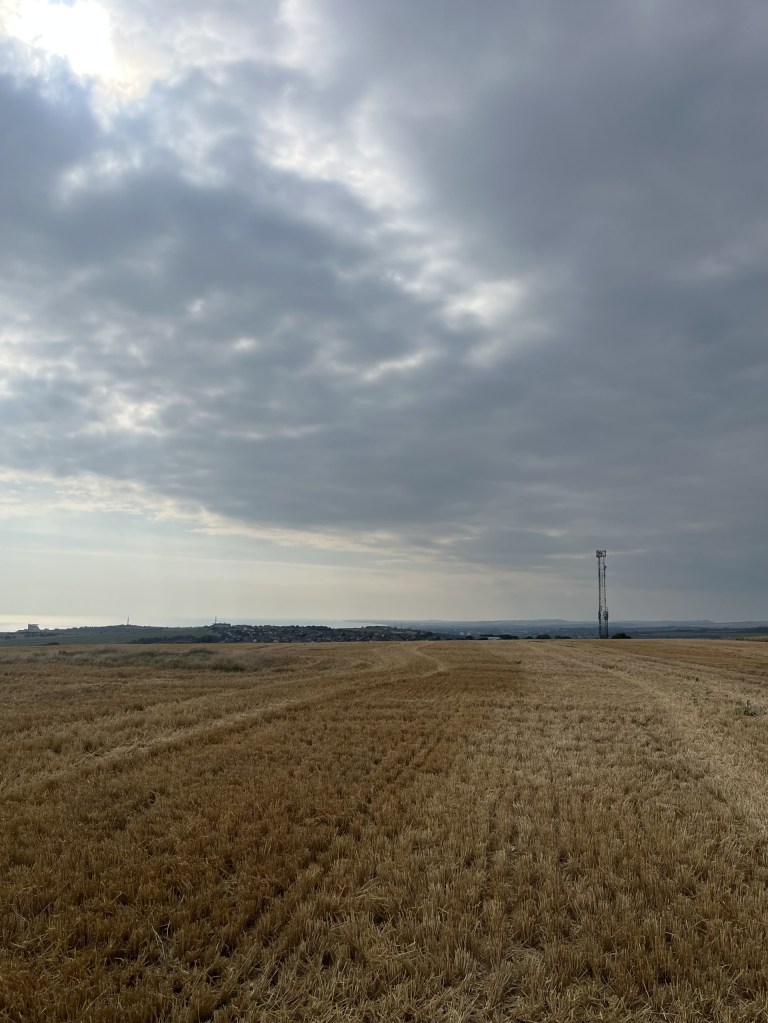
This was a whole new part of the world for me, and I was impressed. Five minutes on and I was at the top of the ridge, with tracks heading directly east and towards my objective. Following the track that flanked the edge of the Woodingdean housing estate (a desolate dormitory in winter I imagined) I soon arrived at a point which presented options. The main one was a signposted path that had all the hallmarks of being official. Tempted, but not convinced, I decided to follow the unmarked track that headed straight into a field and with a telecommunication tower just to the right.
Bullock Hill rising just to the left of the aerial.
Passing the small collection of buildings and rising metal structures I was able to get a sense of where the highest point was located. This required a slightly tricky clomp over bone hard uneven ground until, after a couple of minutes, I could see a trig point in the middle of a recently harvested field.
The other thing I saw was four people gathered around the trig point. I was slightly surprised by this because it was clearly off the beaten track (which officially was running about 200 hundred metres to the north). Slightly self-consciously I cracked on across the cracked land and stubble. As I approached it became clear that the small group were in the middle of something which appeared to involve a camera and badly applied makeup. Despite the absurdity of it all I felt like a brazen intruder. At about ten paces one or two of the group became aware of my presence, which they acknowledged. “Hi,” one of the young men said (it was three young men and a woman). “Can we help?” he added. Feeling like a complete nerk, and not really knowing what to say, I managed to splutter out something about having come a long way and wanting to get to the trig point. “Ok, no problem,” he replied, “we’re nearly finished.”
By now I had noticed that the woman and one of the men were wearing white sheets with randomly applied muddy smears, and the other two men between them carried expensive looking camera and recording equipment. I guessed that they were probably students making the obligatory short zombie movie that they hoped would soon propel them to Hollywood. I stood and looked away towards the communication towers. Self-consciousness doesn’t get close.
Looking away from the action
Within a minute or two they had finished and I wandered towards them. “So, what’s the importance of this place then?” one of them asked.
“Oh, not much,” I replied. “It’s just the highest point in Brighton.” All four faces turned towards me, jaws beginning to drop.
“No way man.” “For real?” “Who knew?” The woman yawned. They looked around and behold, it was true. Moments earlier they had just been sitting in a field on a mound surrounded by loads of other fields on similar sized mounds. Now it was obvious to them that they were on the summit of a mighty hill, staring down imperiously over everything in sight, including the i360 in Brighton.
Conversation flowed. Did I know what the large crater was just a few paces to the east of the trig point. Well, I sort of did but wasn’t 100% sure. “It could be a sink or swallow hole, possibly post-glacial,” I ventured. “Actually, I reckon it’s more likely to be a dew pond. Dug out by a farmer a couple of hundred years ago, perhaps.”
Bullock Hill Trig. Today’s lecture will be from Prof Bull S. Hitter
The crater – subject of various bs theories.
Incredibly, within a minute, I had gone from an awkward stranger to a veteran sage of the mountain. Their collective astonishment at my imparted (and I should add – free) wisdom and knowledge was almost overwhelming, and for almost the first time in my life I had justified my choice of doing a Geography degree in the 1970s. It was time to go before they asked me a question I couldn’t answer, though to be fair I seem to have slipped into bullshit mode effortlessly.
We parted company and I wandered over to the crater for a closer inspection. Yup, artillery – Second World War. Time to move on down.
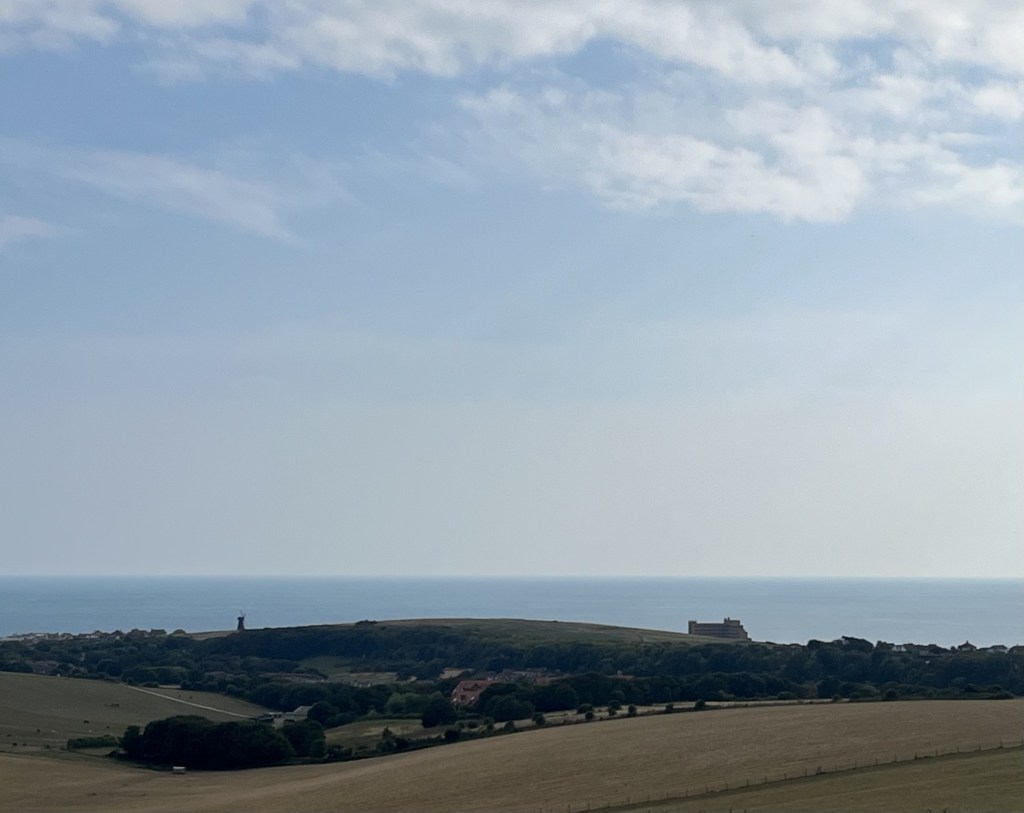
I followed the edge of the field to an open gate and at a point that met up with a bridleway heading east. I looked at my ancient Ordinance Survey map (Landranger 198). Immediately to the south, at a distance, I was able to make out the black and white form of the Beacon Hill windmill at Rottingdean. Which was exactly where I wanted to be. A path in the field adjacent to the bridleway headed straight towards it. After a quick rest I got on it and strode forth.
Tilting towards a windmill
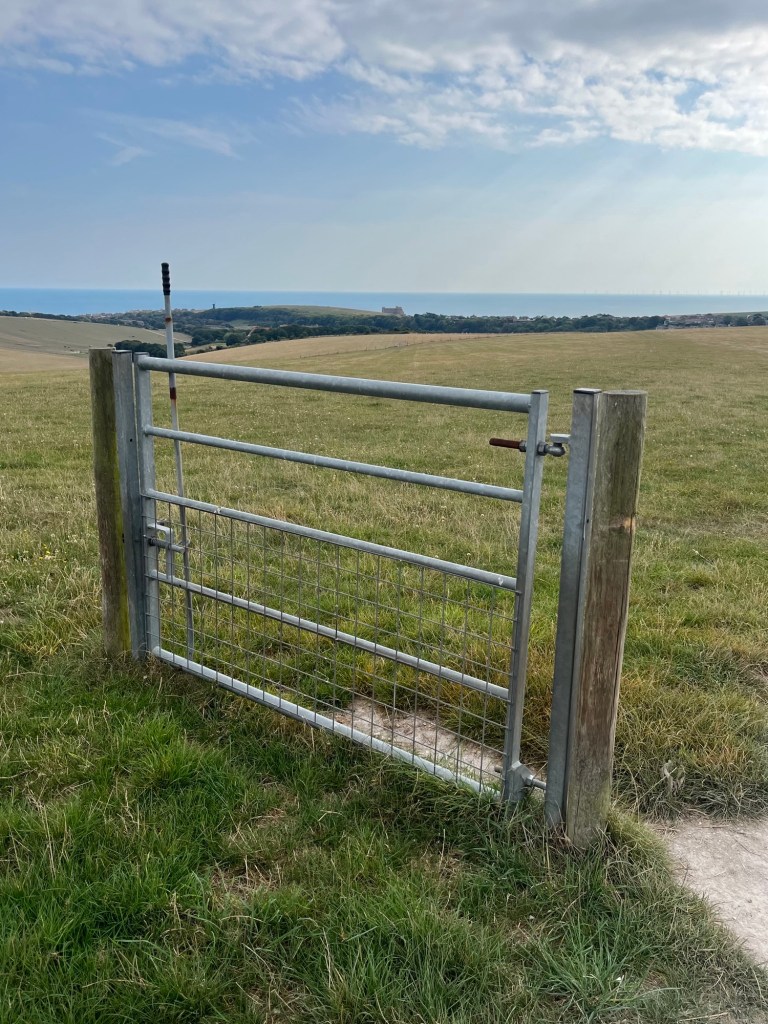
It all looked pretty straightforward. Follow the path and head on down. At the end of the first field a walker friendly gate gave access into a much bigger field which rolled away on all sides. The only slight concern was a sign to the side of the gate proclaiming private property. That’s as maybe, I thought, before setting off on what felt like a path. After about five minutes I came to another of what appeared to be a recently installed gate. It sat at the end of a few low hawthorn trees and quite literally on its own.
The Riddle of the Gate
Another sign re-stated the private ownership of the land. Was this some sort of fantasy video game in which you had to correctly answer a riddle or question before progressing (Mordon’s Quest on the Spectrum from 1985 came to mind – I never did understand what the saltpetre was for). Obviously, I decided to go around the gate, but had this been the right decision? Well, I didn’t blow up, so I guessed it was and carried on down towards two more of these standalone installation gates, one of which I decided to go through just to make sure it was in working order. Carrying on I headed towards another fence and gate around 400 metres to the south. The land here was shaped into a wide folded dry valley with the crop recently harvested. It was a barren sight, made more dramatic by the endless hot and dry weather. It felt lifeless, except at that moment a green woodpecker flew past, settled on a nearby tree and then let out its distinctive high-pitched call.
Classic chalk dry valley, with the emphasis on “dry”
As I reached the end of the field and the escape gate (here at least there was the more traditional fence either side) a middle-aged woman accompanying a girl on a horse approached in the other direction. I gave way and they came through into the field. I said hello and asked the woman if she knew what the lonely gates in the fields was all about. She didn’t know, but then told me it was private land, and “they” could…… She hesitated, as if realising that what she was about to say next might sound absurd. “Hmm… Shoot me?” I joked. She didn’t look very amused but at least it broke the ice. “No, no,” was all she could muster. I smiled and passed on, thinking that what she probably meant to say was “they could prosecute me for trespass.” Yup, that really would have been absurd, but in England (not Scotland) there are many landowners who will go out of their way to keep the hoi polloi off their domains, either through neglect of the infrastructure, or in some cases, the deliberate blocking of legitimate rights of way. That didn’t explain why here, very new and quite obviously expensive walker friendly gates had been installed right next to signage which aimed to make it clear that walkers weren’t welcome. I did have a look on-line later, and whilst I couldn’t find anything to explain the existence of the gates, quite a vicious outbreak of words had recently appeared on a Woodingdean Facebook site about the allegedly deliberate ploughing of footpaths in the area. I didn’t look too hard because it was quite a brutal read, and perhaps reflective of our species newfound ability to miscommunicate with every touch of the keypad. Oh well, I guess I’ll never know the reason, and that’s probably for the best.
Past the gate I joined a more significant track that led towards a large farm complex. On either side areas of land had been set aside for horses and with people were milling around, mucking out and generally minding their own business. I wondered if they were looking at me through one eye and thinking “trespasser”. Too much paranoia I think (Ossie had only recently died after all). Through the farm and, with a slight sigh of relief, at last I was back on public land.
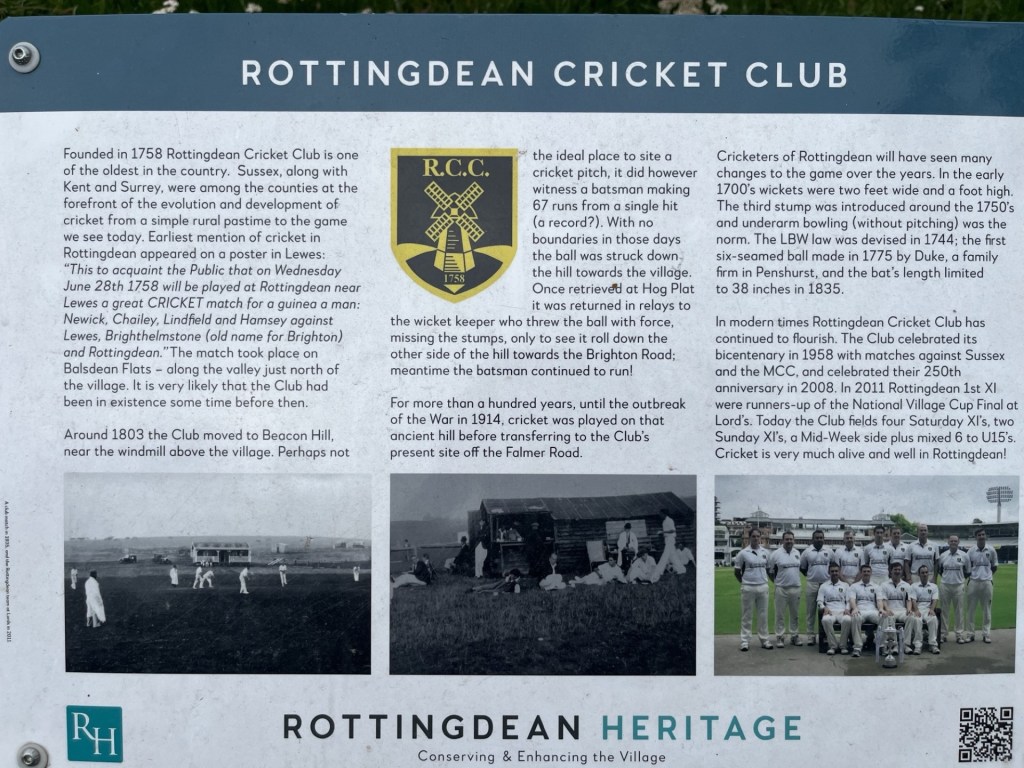
Continuing south and back on the Falmer Road, I started into Rottingdean. On the left cricket was being played on a pitch that made the slope at Lords look like a salt flat. A sign at the side of the road explained the history of the Rottingdean Cricket club and a little-known fact that the highest score ever run off a single delivery was made on a nearby older ground. For the record it was 67; after the ball had ended up rolling down the high street and before the introduction of boundaries. When the ball eventually arrived back at the wicketkeeper, he missed the stumps and the ball then set off down another street. There’s a metaphor here for something or other.
Howzat?
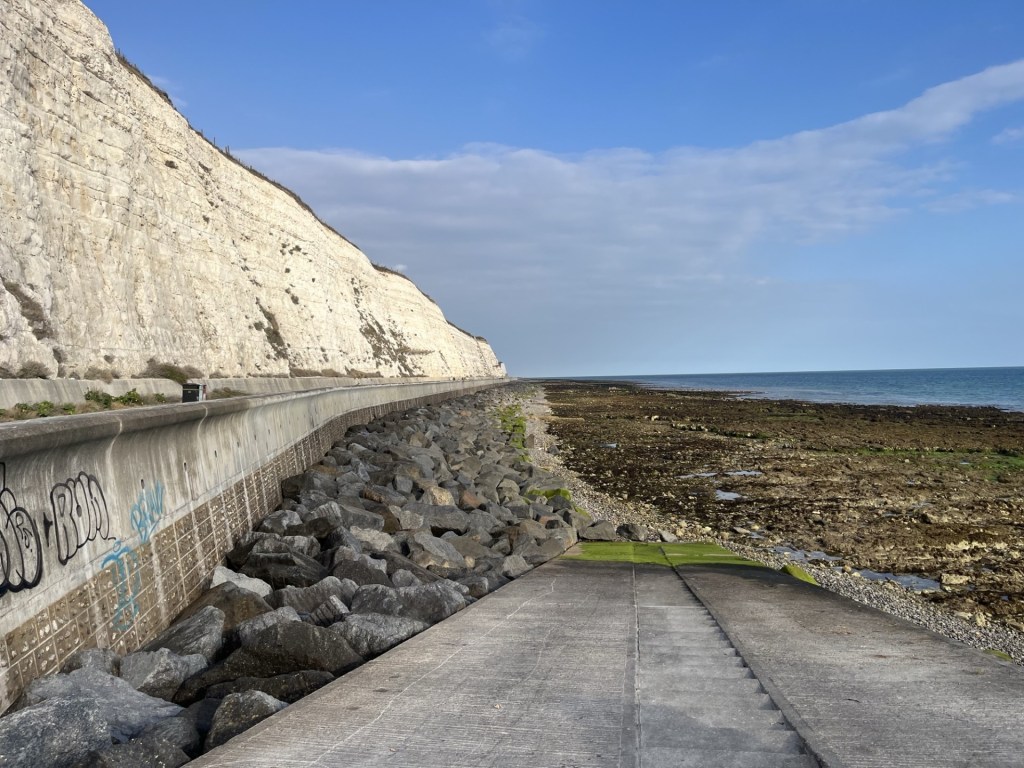
The buildings entering the town were, to say the least, eclectic, and in the main very well to do. Soon afterwards I was at the busy sea front heading west along the wide Undercliff path and under the chalk cliffs and towards Brighton. The last time I had been here had been some years back, on a cycle ride from Brighton to Eastbourne. Not a particularly long ride but trying to hoik the bike over the Seven Sisters had nearly finished me off. That was something that wasn’t going to happen again. ** Up until this point there had been a fine haze that had kept the temperature at a reasonable level, but that was now lifting, and the sun was occasionally breaking through, illuminating seaweed on the rocks below and bringing life back into the chalk cliffs.
Undercliff path looking back to the east
As added interest a low flying seaplane (type unknown) glided silently past, going west to east.
Flying with the birds
I was beginning to flag a bit and regretted not having stopped for a tea or coffee at Rottingdean. Keeping to the Undercliff path I trudged past the Marina, which seemed to go on far too long. Beyond the Marina I stopped for a few minutes to watch and listen to a rock band entertaining a large crowd gathered at a mini festival. The tune they were blasting out almost sounded familiar, but I couldn’t place it, and it wasn’t quite my cup of tea; speaking of which I was now in desperate need.
Rock the Marina
Madeira Drive looked longer than I remembered it, but it had to be tackled.
I’m not entirely sure if it could be classed as music, but at the halfway point between the Marina and the Pier a brain numbing sound was blasting out from the Concorde 2 music venue. Two or three years earlier, with a friend, I had had the privilege of seeing Steel Pulse there. Whatever the genre was that was crucifying the eardrums of the punters there now, it certainly wasn’t anything like Handsworth Revolution. As I say, I was now desperate for a large tea, and I certainly wasn’t going to get that at the Concorde 2.
Now desperate, and against my better judgement, I finally succumbed to a tea option at one of the tacky seafront fish and chip/kebab/candy floss and ice cream outlets near the Sea World aquarium. Despite emphasising that I just needed a very small drop of milk, the man who served me couldn’t resist pouring a quarter of a pint of the stuff into the cup. I was tempted to protest but didn’t have the energy to follow up any potential conflict with added venom, so grabbed the miserable warm concoction and went and sat on an uncomfortable bench.
At least here there was more entertainment to be had. A small group of mods were posing on their classic scooters on the other side of the road. It was quite hard to establish which one of them was the “Face”. In part this was because all the men were bald and their facial structures, a bit like mine, had slowly collapsed over the fifty odd years since they had first arrived here on the back of watching Quadrophenia. Despite their average age of an estimated 65 plus, most were dressed in state-of-the-art 1960’s mod clothing. Revving up (well that’s not quite the right description – the sound more that of defective lawn mowers hitting hidden twigs), they began to assemble on the opposite pavement with an indication that they were about to ride off in unison. They were waiting for something. And then he was there and being saluted by a collective throttle tonk. The Face! At full speed and his ride decked in at least thirty rear view mirrors, a man drove by at maximum speed…. on his mobility scooter. From my side of the road, a young man and woman dressed in immaculately retro “Rocker” gear jogged across to their motorcycle. They were acknowledged by the mods, and a few friendly words were exchanged. I couldn’t help chuckling. Was it nostalgia, cosplay or a genuine commitment to the cause? Either way it had kept my mind off the task of digesting the disgusting warm milk that I’d paid £3 for.
At least here there was more entertainment to be had. A small group of mods were posing on their classic scooters on the other side of the road. It was quite hard to establish which one of them was the “Face”. In part this was because all the men were bald and their facial structures, a bit like mine, had slowly collapsed over the fifty odd years since they had first arrived here on the back of watching Quadrophenia. Despite their average age of an estimated 65 plus, most were dressed in state-of-the-art 1960’s mod clothing. Revving up (well that’s not quite the right description – the sound more that of defective lawn mowers hitting hidden twigs), they began to assemble on the opposite pavement with an indication that they were about to ride off in unison. They were waiting for something. And then he was there and being saluted by a collective throttle tonk. The Face! At full speed and his ride decked in at least thirty rear view mirrors, a man drove by at maximum speed…. on his mobility scooter. From my side of the road, a young man and woman dressed in immaculately retro “Rocker” gear jogged across to their motorcycle. They were acknowledged by the mods, and a few friendly words were exchanged. I couldn’t help chuckling. Was it nostalgia, cosplay or a genuine commitment to the cause? Either way it had kept my mind off the task of digesting the disgusting warm milk that I’d paid £3 for.
Not in the least bit refreshed but suitably entertained, I continue past the Pavilion and then up the steep backstreets off the Queens Road. A familiar noise began creeping up behind me. I turned around and there they were again. The mods on their sewing machines. As they passed me by, and now closer, I was able to re-assess the average age. It was at least 75 and they were clinging onto the handles for grim death, which of course was waiting just around the corner. Three or four of the riders, who came with their partners on the back, almost had to get off and walk their bikes around the turning into Foundry Street.
By the time I reached Brighton station my ankles were crying out in revolt. I recognised the sensation. The last time I’d experienced similar hadn’t been during the climb of Ben Nevis a year earlier, but instead it had been at this exact spot in May 2024, after walking from Falmer station to Ditchling Beacon (the highest point in East Sussex) and then back into Brighton. History was repeating itself. Eleven miles in total, and whilst to date I have avoided ranking any of these expeditions, I have to say that this one had been a top five contender.
I reached the station just before my ankles reached their limits. It was time to move on up and move on out. Great day.
Meanwhile, in a funky bar somewhere in the Lane’s, four media studies students were huddled around and earnestly reviewing the title for their arthouse short movie. “What about The Zombie’s on Bullock Mountain?”
“Hmm… not catchy enough. How about Zombie Sinkhole Apocolypse?”
“That’s it. Your round Stan.”
The following day Brighton and Hove Albion played Everton away and lost 2 – 1. Danny missed a sitter, and then a penalty. Shucks!
* At the beginning of 2025 a consultation began on whether to reshape local government in Sussex. For what it was worth I put in my thru’ pence worth. We’ll find out soon what the final decision will be, but it looks like it could end up as five unitary authorities with shared services. That may or may not be a good idea, and it may or may not save money, or it may or may not cost everyone more. It may or may not lead to greater local democracy and representation, although I’m not convinced. Either way it will render my efforts to get to county tops somewhat meaningless. Creating two more here in Sussex would be no big deal (by topping Brighton and Hove I’d completed the Sussex set). Another two excursions close to home – okay. The problem is that these changes are likely to be taking place in many locations across the country and the implications of that are – well, to say the least – daunting!
I knew I had landed in Norfolk when I drove past a large sign saying so, but which added that I was also entering Nelson country. It was, apparently, the hottest day of the year so far (so far there had been too many already), and had just reached the top of Suffolk at Great Wood. I was heading for Norfolk’s north coast and a campsite just outside the village of Blakeney, a place I knew nothing about.
Almost as soon as I entered Norfolk the scenery changed. Mile upon mile of heathland and conifers marked out the impressive Breckland landscape, which, prior to undertaking the high points challenge, I had assumed would be where Norfolk’s high point would be found. Apparently not.
I reached the campsite late in the afternoon and was offered the choice of two remaining pitches. One was next to the cleaning facility, the other by a hedge next to the nearby road. The appeal of being close to the toilets was enticing, but something told me to take the other option. After pitching the tent, I needed to take the opportunity of using the facilities, and as I approached in the baking heat, realised that I had made the right call. The septic tank might have been doing its best but there was no mistake – this was another type of county “high”.
In need of food, and having blown my options the previous evening, I walked into town. All I knew about Blakeney was that it was a great spot to see seals, but I had also just read that it had the highest number of exclusive homes in the UK that had been subject to charity lotteries through Omaze, a phenomenon that I simply can’t get my head around. In a town near me a huge modern oligarch type bunker was recently built on the site of an older family house. On completion it suddenly appeared on numerous feeds in one of these lotteries, going for £4m. Who would have thought we were in the middle of a housing crisis?
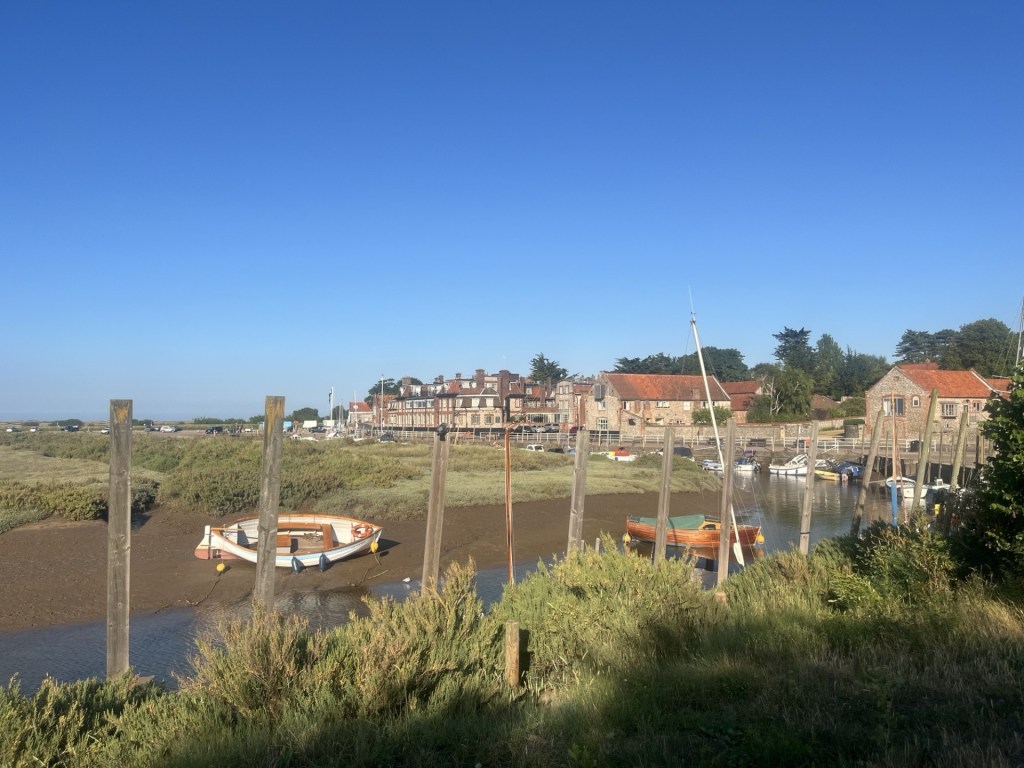
With the heat still pounding, I spent a while taking in the views around the creeks and then dived into the Kings Arms.
Up a creek
I had hoped to have sat outside, but understandably every seat was taken. It was like a sauna inside the bar. I ordered a meal and a pint and found a snug. The meal arrived within minutes and was as hot as the core of the sun. I had noticed a sign outside claiming that it was a Michelin star establishment. Based on the searing pile of mashed potato and molten gravy offered up, it wasn’t anymore. As I ate, more plates of food of mammoth proportions were being served up around the pub. Each delivery was met with a gasp of incredulity, or perhaps despair, by the customers, many of whom had already placed orders for desserts and were now regretting their enthusiasm. I managed to quell the burnt embers of what was left of my palate with another beer before heading on back to the campsite and promising to myself that I would make do with something from the nearby chippy the following evening.
The weather forecast for the following day was for a scorchio repeat. The night before my tent had been sited under trees and by a cool lake. There was none of that here on the exposed Norfolk field. So, when I woke up after a good night’s slumber, and hadn’t felt the immediate need to escape from an oven, it occurred to me that the weather had changed. And, on crawling out of the tent, it had. The sun was hidden behind low and intermittent clouds. A breeze was pulling in from the north-east and it felt that the sweltering heat had passed. After a couple of brews, it was time to head off to the day’s objective: Beacon Hill at West Runton.
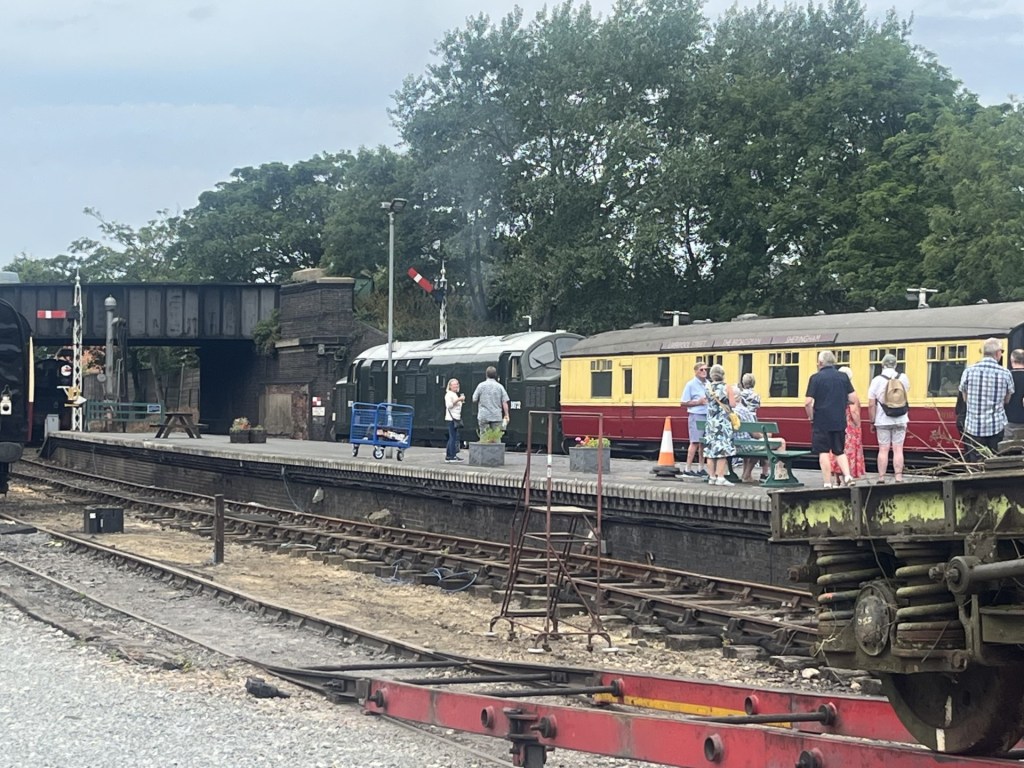
I drove along the north Norfolk coast road, a satisfying journey through interesting looking towns, Cley next the Sea being the pearl. I stopped in Sheringham, ostensibly to grab a pie and a coffee. The best thing about parking up in Sheringham was that the car park serviced the North Norfolk Railway. As I was locking the car I heard the familiar rumble of a class 37 gunning up its distinctive diesel engine. I had my SLR camera on me and was desperate to get onto the platform to get some shots, but with all the flaffing around with bags and mobile phones there was no time to get there so I had to content myself with a quick snap on the phone from the other side of the tracks.
The Class 37 leaving Sheringham – missing audio enhancement
The town was heaving and at the seafront the sun came and went behind scudding clouds whilst seahorses danced on excitable waves. It was a lovely day, but I was here to secure an interesting breakfast pastry. Walking back up the hectic high street, it became apparent that despite the huge number of food outlets, there was a homogeny common to most of our towns these days. It might just be me, but when the only options are fish and chips, and sausage rolls, we seem to have lost our culinary diversity. The problem was I couldn’t put my finger on it. Was I imagining some previous time that didn’t exist when it was possible to get pastries and tarts that consisted of more than just cheddar cheese and pork? * Either way in the end I had to settle for an average sausage roll from a local bakery. I retreated back to the station, grabbed a coffee nearby and watched the occasional engine moving up and down the line.
Classic diesel multiple unit action
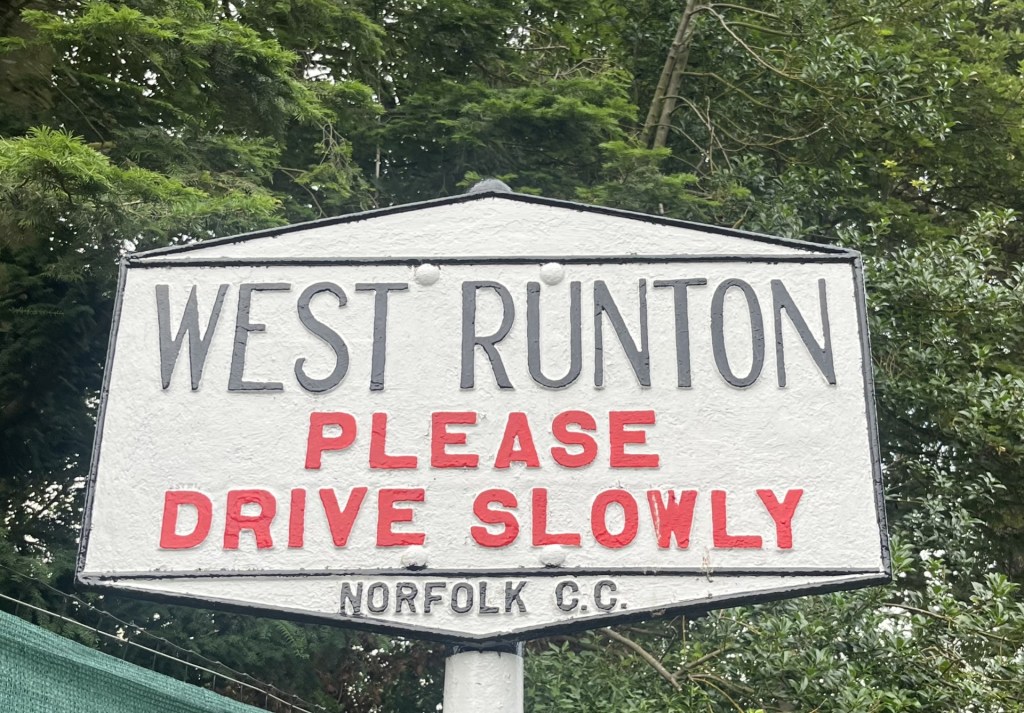
Twenty minutes on and I was parking up on Sandy Lane, West Runton, and just above sea level. Beacon Hill is one of the few county tops that can be reasonably reached after starting any walk from sea-level. One of the few others is Ben Nevis, and here the comparison ends.
Confirmation I was in Norfolk
Some paths led away to the west and into woodland, but I knew that my objective lay almost directly up Sandy Lane and decided to go route one, rather than taking the risk of getting lost in the woods. It was a narrow road, and I had to keep my wits about me whenever a vehicle approached. Large Edwardian homes were set back off the road in dells and with extensive luxuriant grounds. Beyond the houses the beech and birch woodlands spread away on either side. After a kilometre or so I reached the brow of the hill and turned right on a track leading to a caravan site, opposite which was a sign for Roman Camp, the top of Beacon Hill. I read the information board which suggested that there is no evidence for any Roman activity at the site, and that whilst the location had seen some beacon like activity at various points in history, it all seemed a bit vague. A warning sign also warned of the risk of ticks. I was wearing shorts and now was now regretting I hadn’t brought my tweezers.
The top of Beacon Hill – and associated risk warnings
I walked across the flattened ground with its raised grass banking, and looked out to the north, past the trees and towards the North Sea. But there was nothing to see on the small segment of sea that I could see, so I carried on along the track that serviced the caravan site and gradually lost elevation.
No boats or ships to see through the trees and towards the distant sea.
A couple of weeks ago (as I write), mass hysteria broke out on the beaches of Norfolk when a boat, whose crew were merrily rowing around the UK coast to raise money for charity, was wrongly identified as a vessel full of asylum seekers. Urgent Twitters were sent out by all and sundry, urging a Border Force intervention, and people gathered and marched along the beaches near Great Yarmouth to deter any landing. The local MP Rupert Lowe (ex-Reform, now Independent Witch-finder General) led the on-line charge (sorry – frenzy) and later had to apologise. Of course, this incident is no reflection on the people of Norfolk, the vast majority of whom would find this behaviour a tad indecent and recognise that the chance of a small rowing boat making it from mainland Europe to this coastline would be nothing short of miraculous. Horatio would have been impressed. I only mention this here because since I started this exercise, the xenophobic atmosphere has been escalating, and incidents like the one described here are becoming commonplace. Perhaps I should turn a blind eye, in the Nelson style, but…. Nah!
After a quarter of a mile, I picked a footpath down through the woods and heartland. A nice spot that you could spend some hours just chilling.
A better view
At the foot of the hill a lane headed back towards Sandy Lane with a field to the right. In that field I noticed several large horses. One, a bandy-legged large grey, was gazing at me from a distance. As I walked along the lane this particular individual followed my progress, either with menace, or simple curiosity. Getting closer it struck me that these horses, in particular the bandy-legged big white, were massive. I had realised that they were probably shire horses, but having only ever seen one or two in all my life, I was struck by their size.
Who you lookin’ at?
Outstared I moved on and was back at the car five minutes later.
Returning to the campsite and a quick brew, I legged it back into Blakeney. It was still relatively early, but I wanted to make sure I got to the chip shop before it closed (you never know these days). Guess what? It was closed. A sign indicated that it only opened early afternoons. WTF!!!! How bourgeois!
And so, it was back to the King’s Arms. The heat of the day before had gone so I was happier back in the bar but hesitant to order any more food. On a chalk board a parsnip, coriander and curry soup was being offered, with some bread, for just £7. After it had arrived and I had finished it off, I went to the bar. The woman behind the bar asked what I would like. “I just wanted to say that that was the best soup I have ever had.” And it was.
*A couple of days ago, while watching a TV drama, the main character was walking along a station platform. It must have been filmed a couple of years back because he passed by a closed up Delice de France. And it all came back to me. Once upon a time there had been a Delice de France in most towns, providing just a little bit more than the traditional bland. Now, from what I can see there are no more than a handful across the entire country.
The drought and high temperatures of early 2025 had been on-going for weeks, and the weather forecast for the coming days was something along the lines of “another heatwave”, “end of humanity”, “hotter than Athens”, “keep hydrated – unless you live in any of the regions that have run out of water”. You get the idea. I’m generally ok with high temperatures, but there’s something about heatwaves in England that can be stultifying.
Ten days earlier I had managed to spend a couple of sweltering weeks in Greece, where the cicadas sang and the sea breeze stole the heat. Those delights were not going to be available in the UK over the next few days so, with the great outdoors in mind, and a few basic necessities in the backseat of the car, on Sunday 29th June I drove to the village of Gosfield and pitched up under some trees next to Gosfield Lake. At that moment, under the shade, and with a wind from the lake, it was the coolest spot in Britain.
Water, water everywhere, but not a drop to spare
In the evening, I walked into town to seek food and drink from the local hostelry – The Kings Head. Naturally, being a Sunday they didn’t serve food (a tactical mistake on my behalf that required the purchase of three bags of peanuts to stave off disaster), and whilst I had thought when booking the site that I would be spending the night in Suffolk, judging by the accents in the bar (the lack of a soft rural burr was evident), a quick check revealed I had only managed to make it to north Essex.
My overnight stay in Gosfield was just a stepping stone on my journey towards Suffolk and Norfolk, where I hoped to capture the tops of both counties. Returning to the campsite from the Kings Head I noticed a huge old country house (Gosfield Hall) that displayed a variety of historical architectural styles. Once the home to several generations of Courtauld’s (textiles and central London gallery), many of whom now lay in the graveyard of the nearby St Catherine’s church, the rowdy shouting and screaming drifting across the fields betrayed its current status as a wedding venue. A big expensive wedding, in Essex, on a hot summer evening? The stuff of reality TV surely, but what would I know about such things?
Show me the way to go home
Back at the tent and the day-trippers had gone. When I had arrived the extensive site was occupied by large family groups enjoying the weather and surroundings. One family in particular, the one next to where I had pitched my tent, seemed to be very keen to advertise their presence by playing music, which could have been K-Pop for all I knew, at maximum volume through the car speakers and with all the doors open. I should state that these events took place nearly two months ago, but whilst I have been writing this account an email has just arrived from the campsite booking website saying that I haven’t yet reviewed Gosfield Park. I was certain that I had but never mind. What’s important is that had my noisy neighbours still been there on my return that evening, my review of the site would have been very different to what I probably wrote at the time – which was along the lines of it being a very pleasant location for a Sunday night and out of season, but that perhaps during school holidays it might be a different kettle of fish.
That night, as I slowly drifted off into a sleepless night, the souped up internal combustion engines of the local boy racers (presumably on their way home from the nearby wedding) filled the sweet summer air as they greased it up the small country road to the south of the lake; reminding me that the next day I would be in a different, and perhaps slightly quieter, county.
*
It was another scorching morning, and I was grateful for the shade under the old trees and the breeze from the lake as I took down the tent and decanted the site. I drove north along insanely quiet country roads, and at one point on a road I recognised from years before on a cycle ride out of north London, eventually arriving at the town of Clare (just over the border and into Suffolk). Thirsty, but also in need of a substantial calorific infusion after the disappointment of the King’s Head I stopped at the market square, grabbed some scram from the Co-op and took a short stroll around Clare’s blanched centre. I’d never heard of this place before, but it was an architectural gem, stuffed with houses and building going back centuries, with hardly any modern clutter.
After the regenerative input I carried on north, and again along tiny lanes that were almost traffic free. Arriving in the small hamlet of Rede, I parked up near All Saint’s church. The moment I stopped the air became suffocatingly hot. It didn’t seem like a lot but from the OS map (Landranger 155) that I unaccountably possessed, I had a three mile walk ahead of me. I was beginning to have second thoughts, but on the basis that it was extremely unlikely I’d be anywhere near here ever again I dragged myself out of the car with half a bottle of tepid water as my crutch.
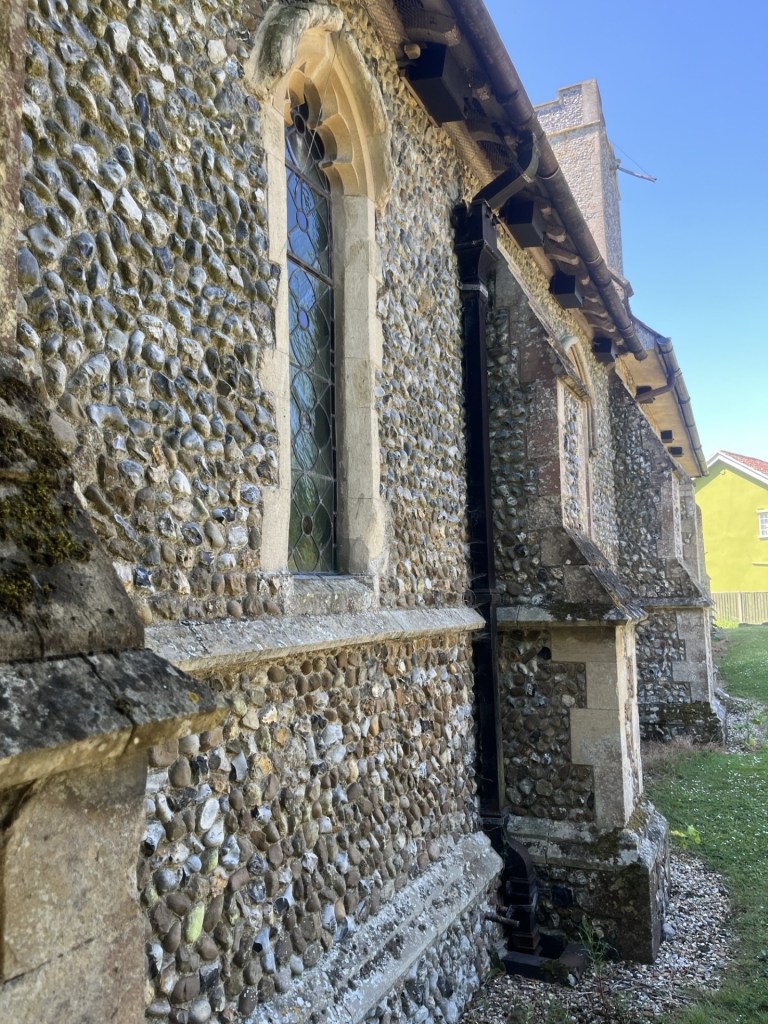
All Saints Church – Rede. A handy sign proved invaluable
The church looked kind of interesting, so I ambled over to the grounds, aware that every eye behind the nearby cottage windows was probably on me. It being a church and yard, it was a peaceful spot. I walked along its northern flank, determined to remain in shadow, and became aware of frantic sounds from above. Looking up I could see several bird boxes tucked under the eaves, and every few seconds swallows would fly in and out. The noise of the hungry chicks inside was being amplified through small speakers set next to one or two of boxes. There are so many wrong things going on in the world at the moment, to see that someone had spent a bit of time providing nesting sites for these beautiful birds, and bringing their sounds to the ears of the occasional visitor restored a little bit of faith in humanity.
Bird songs of praise
I walked back to the road, turned right, and then almost immediately left onto a small road that quickly led into a large field. I flanked the northern edge of the field before hopping over a ditch into an adjacent uncultivated field where trees provided some cover. A large military aeroplane with one of those big radar attachments, circled above. A gate at the end of the field took me through a pasture where a sign suggested lurking horses. None were visible.
Another large field opened beyond the small coppice I had emerged from.
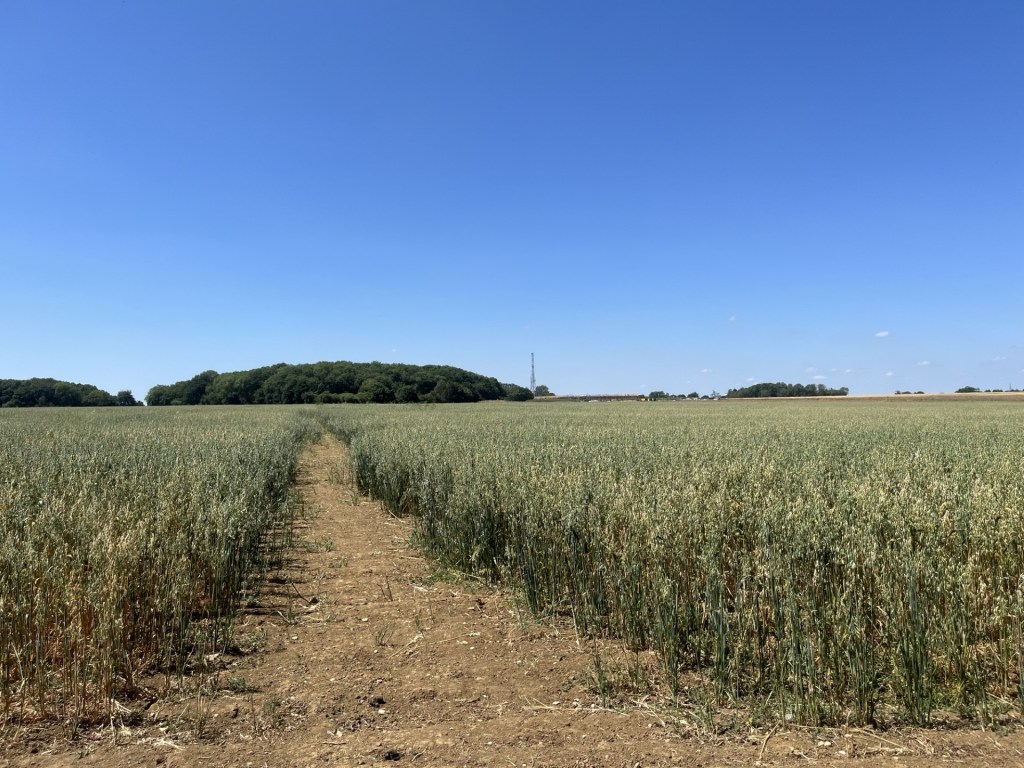
Target obtained – The Great Wood!
The path headed straight as an arrow towards what was perhaps the inappropriately named Great Wood. It was obvious where I needed to go, and the baking midday sun made it an imperative I got there as quickly as possible. Under normal circumstances the path should have been a doddle, but with the ground rain free for weeks, the numerous inch wide cracks in the earth required some careful navigation. On reaching the woods, the path continued around its flank to the north. Another field, protected by a wire fence, lay to my right. A sign indicated that it was being left to nature to encourage wildlife. It looked tatty but was clearly performing its designated function. Hundreds, if not thousands, of small white butterflies danced around in the air above the vegetation. These sorts of interventions in the countryside are controversial, particularly as we continue to import more and more food from the other side of the world, and, as evidenced this year, global warming is knocking the shit out of our crops. But, when you can see with your own eyes the astonishing fecundity of nature when we provide the necessary rebalancing habitat, you must be hopeful.
A thousand small white butterflies – but you’ll have to take my word for it
A common brimstone butterfly, one of many gracing the Peloponnese two weeks earlier.
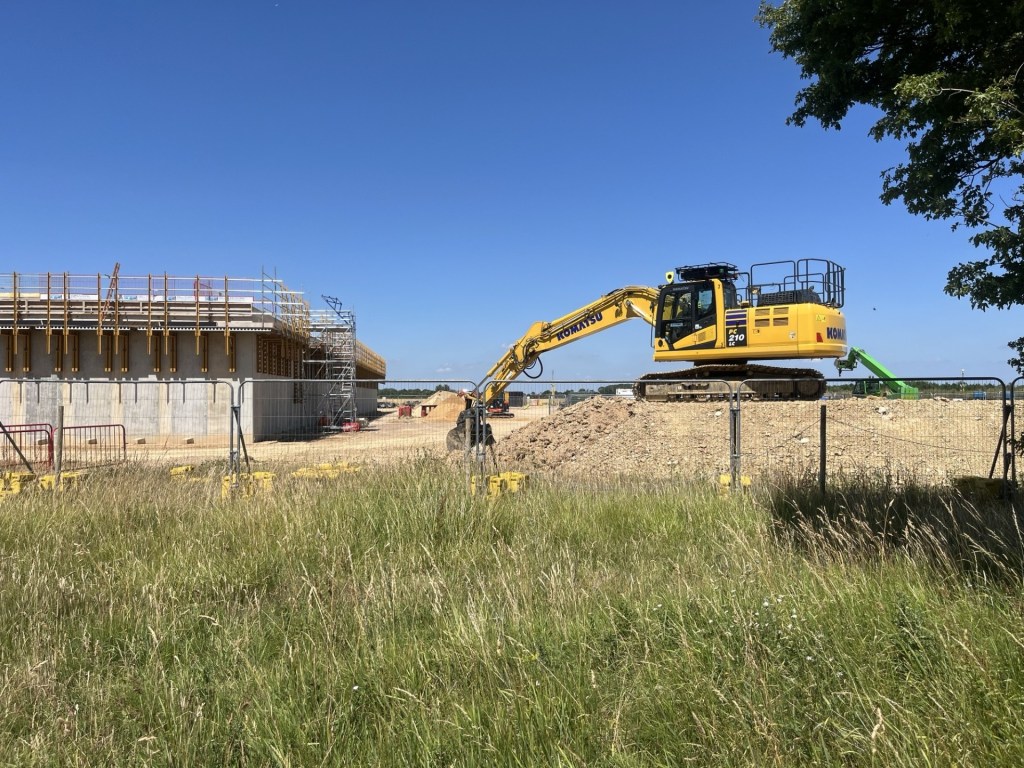
At the top of the field a huge construction site was generating some activity. An Anglian Water, pipeline and water storage facility the size of a football stadium. It’s infrastructure at least but whether it is too little too late, we’ll have to see.
Top Digger action at the water works
Flanking the works and along a path through shrubland I emerged onto a dusty road network, primarily servicing the construction traffic. From what I had researched the highest point wasn’t in the Great Wood, but directly opposite in a small thicket that sported a communication tower. Lots of warning signs warned of crossing the roads, and to be fair, I was duly warned. There was no point trying to explore further so I sat down on a plastic road barrier (which was bizarrely full of stagnant water that hinted at a mosquito breeding ground) and took a moment out of the sun.
Catching the rays at Suffolks highest point.
Looking at the map I could tell that there was an alternative route back to Rede and that at the end of this route the sign for a public house. It being a Monday, and it also being in the middle of nowhere, I had to accept that a cold soft drink at the end of the walk was unlikely, but it was incentive enough.
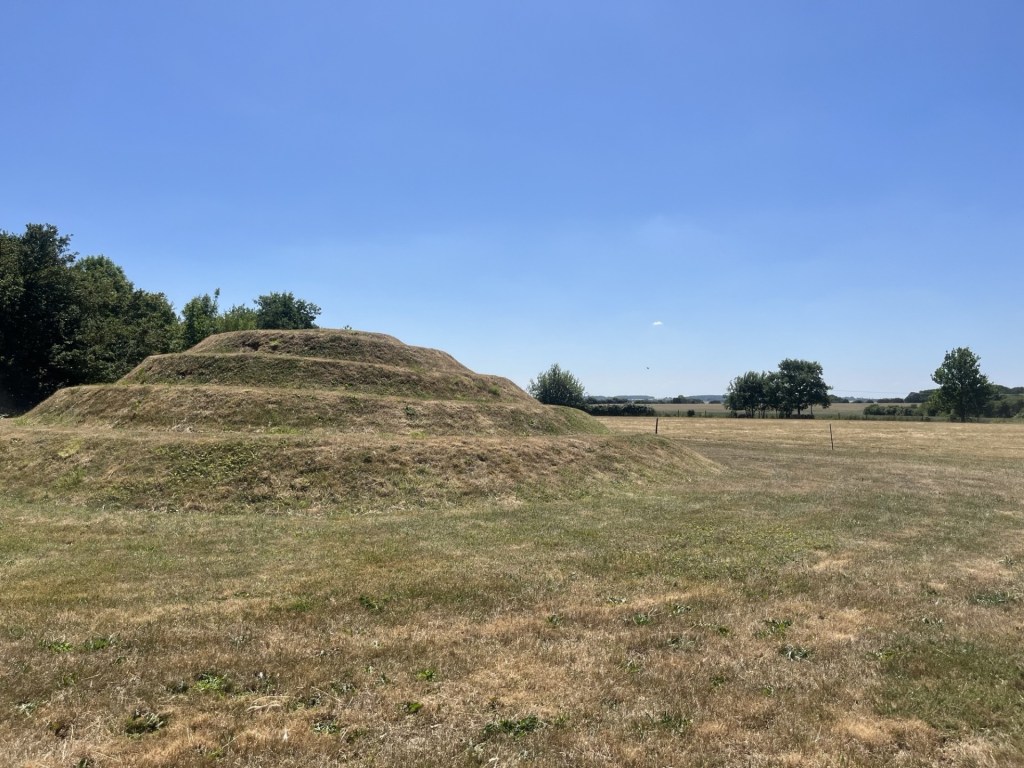
I wound back through the shrubby path and after a couple of false starts found the alternative path that took me through woodland to the south of the Great Wood. Despite the relative coolness of the glades, I was conscious of being slightly dehydrated. Emerging from the woods a track headed south-east along the edge of a vast field. Again, the heavily cracked earth made progress mildly treacherous, but eventually the track gave way to a metalled road, Pickard’s Lane. The lane continued into a complex of buildings that looked like a farm, but which seemed to be slightly more industrial. To the right a small field had been contoured and landscaped in an imaginative style, which included what looked like a miniature Glastonbury Tor.
East Anglia’s Avalon. If you’ve reached this point, you’ve gone too far.
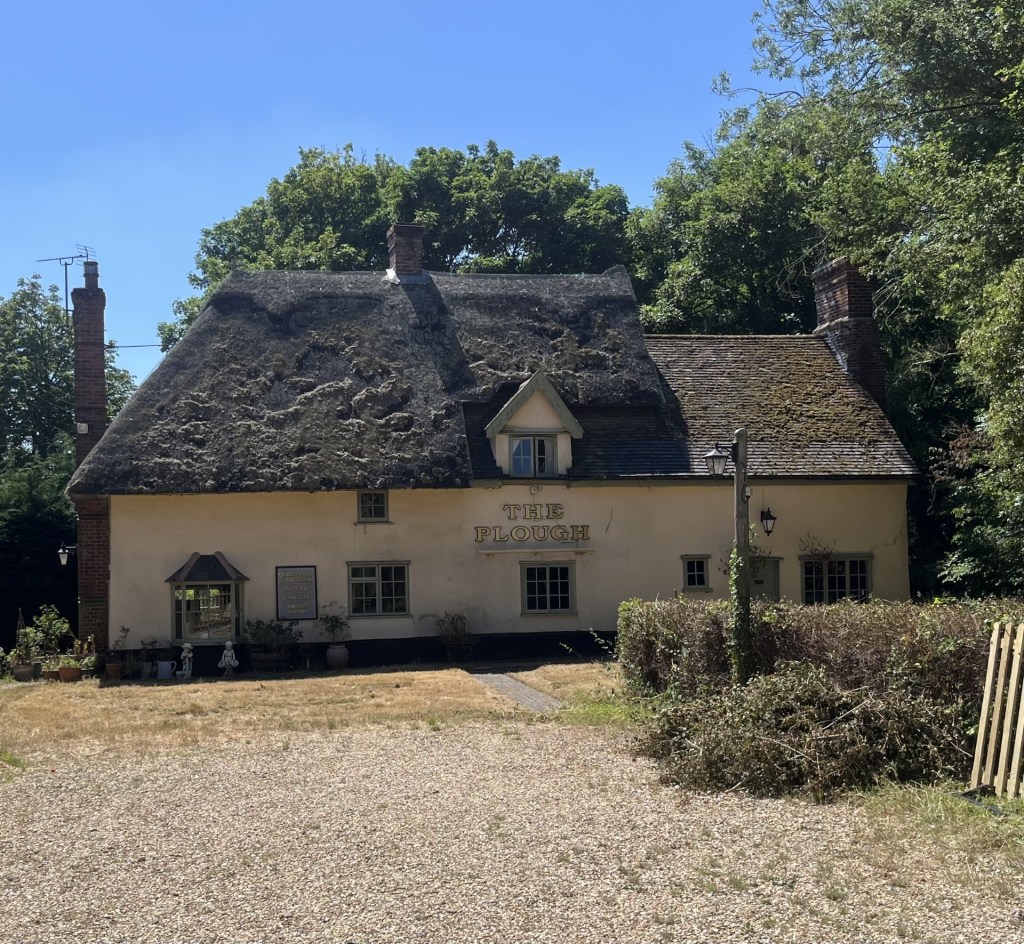
A man was delivering some goods to the industrial building just beyond. If I continued along the lane, would I get back to Rede, I asked. No, it was private property (Pykards Hall to be precise), and I had to go back a bit where I would find a path heading north. The thought of any retreat by this stage was slightly depressing but it had to be done. Finding the path, I walked through more woods and eventually emerged at The Plough, which immediately spoke of bygone times and warm beer after a hard day in the fields.
The scene of the crime – The ex-Plough
Initial observations weren’t hopeful. As I suspected, being a Monday it appeared to be very much closed. And I wasn’t wrong. Indeed, it was so closed and devoid of any indication that a good beer, or other sustenance, could be procured that I had to conclude that the old Plough Inn was now very much a private home. I guess it didn’t surprise me too much, but it still felt like a rural murder had been committed. Why hadn’t this made national news?
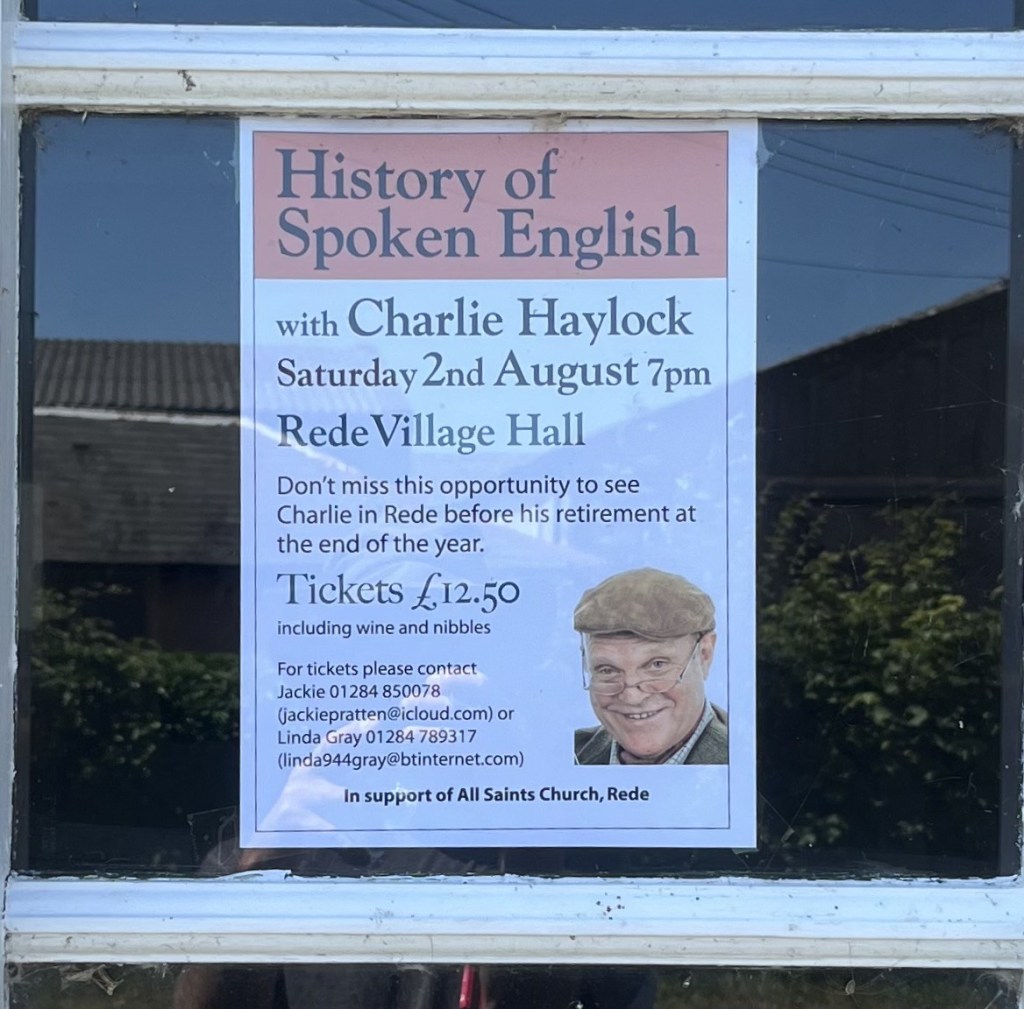
Opposite the gutted remains of the pub stood a small and neat village hall. A woman with a small dog was sheltering under a nearby tree. As I passed, I said hello and asked her what had happened to the pub. She confirmed it had been closed for some years and was now a private home. Shucks! I thanked her and made for the car. As I passed the side of the hall, I noticed a flyer in one of the windows. A local character called Charlie Haylock was going to be doing a talk about the history of spoken English, at the hall on the 2nd of August, with proceeds going to the church. It might have been interesting, but I wasn’t going to be there, and I also wondered if I would have been able to sit through it without being reminded of Bob Fleming’s, Country Matters from the Fast Show, and not coughing out loud.
Charlie Haylock’s last gig
Walking the short distance back to the car, if Lee Van Cleef had stepped out from behind a post further down the road and spat a mouthful of tobacco into the curb, I wouldn’t have batted an eyelid. I opened the driver’s door to be met by an urgent escape of searingly hot air bursting out into the open, reminding me of the time I’d visited Ravenscraig steel foundry in the 1970’s.
I waited a few minutes before risking getting into the car. I guess I had enjoyed the walk, but it definitely hadn’t been the day to do it. I liked Rede too, though the murder of the pub had probably killed off the hamlet’s beating heart. Still, there was always the village hall and the occasional event, but you’d have had to be there, and it was time for me to vamoose. An ice-cold drink was calling from a faraway town
I was travelling from the Rosedale Valley in North Yorkshire, with the intention of spending the night in Cambridge. Five days earlier, on my journey north, and aiming for Nottingham, I had hoped to make an attempt on Bardon Hill in Leicestershire, but time was against me, so it had to be postponed. Earlier in the day, after eventually finding Stock Hill (the highest point in the City of York Unitary Authority area) I crawled south on the A1(M) and then the M1. It was a Bank Holiday Monday, and it was depressingly obvious.
When, over a year ago now, I started out on my quest to reach the tops of our counties, I was fairly confident that having climbed up to Old John in Bradgate Park (on at least two or three occasions over the years), Leicestershire was already in the bag. Bradgate Park lies to the north of Leicester and has a feel of a slice of lowland Scotland. I had first visited and climbed to the highest point (where the Old John folly adds a few more metres) in 1978, with my girlfriend. It had been a warm and sunny day when we caught a bus out of Leicester. Aww… a perfect picture, except, as we approached the summit, clouds rapidly began to gather. Within minutes the rain started to hammer down and all we had for cover was the small lintel of a door set into the tower facing away from the wind. The fun of the day quickly evaporated as the precipitation enveloped every nook and cranny, and as we slowly drowned in our light clothing, I was overcome by regret in my choice of activity in what was quickly becoming a seriously misguided attempt to impress (I was studying for a Geography degree – what can I say!). How did I feel? Inadequate. No worse. I could now empathise with King Lear:
Blow, winds, and crack your cheeks! rage! blow!
You cataracts and hurricanoes, spout
Till you have drench’d our steeples, drown’d the cocks!
You sulphurous and thought-executing fires,
Vaunt-couriers to oak-cleaving thunderbolts,
Singe my white head! And thou, all-shaking thunder,
Smite flat the thick rotundity o’ the world!
Crack nature’s moulds, an germens spill at once,
That make ingrateful man!
After the rain had passed so had the laughs. We traipsed off down the open slopes and back to the park entrance, where, to compound my juvenile insecurity, the last bus to Leicester had departed. There was nothing else to do but walk. On a road that may or may not have been heading back into Leicester a van pulled over, the occupants clearly having taken pity on us. My memory of exactly what happened next is hazy, but I do recall that by the time we got out we were nothing but relieved. Whilst the two men in the van may well have been acting out of charity; there had been an unsettling sub-text to their conversation that perhaps suggested another agenda. We eventually made it back into town and still wet through found sanctuary in a small pub where we dried out over a couple of wet ones.
But of course, for this account that story would have to be abandoned, because on double checking on the highest point in Leicestershire I discovered that Old John, whilst a significant and delightful high point, was overshadowed by the nearby Bardon Hill, just to the south of Coalville.
Leaving the M1 at junction 23, I navigated south and eventually parked up on Romans Crescent, a road passing through a pleasant newish estate on the edge of Coalville. I had previously researched the location on Google Maps and had taken a screen shot for reference. Despite the recent heatwaves, from what I could tell Coalville came with a rather troubling weather pattern of its own, where permafrost meets the temperate zone.
Fortunately, on the day I visited only warm drizzle filled the air. A short walk south and to an opening into a wooded area. The path extended further south with trees on the left and a wide field to the right extending slowly upwards. I had no idea what to expect on this walk. Despite having lived in Leicester for some years it had never registered that there was significant high ground to the north-west. I had read that from the top of Brandon Hill it was possible on a clear day to see the Malvern Hills, all the way to the south-west in Worcestershire. This seemed to me to be inconceivable, not just because Bardon Hill wasn’t exactly a mountain but because of the distance (around 70 miles at a guess). The other thing I knew was that at some point there was a quarry of some sort, but its extent remained unknown.
Just beyond the field – the boulders may have been a sign
With the field ending the path led into mature woodland, and just a short distance in a sign made it clear that something of interest probably lay ahead.
Oh! No, this is a sign. Well, you get the gist
The track continued and then an obvious upward path to the right indicated a steeper ascent. Continuing up through the woodland the gradient increased significantly, and after four or five minutes I was beginning to pant. The occasional dog walker passed by, going down. I was envious.
After maybe ten minutes the woodland began to retreat from the edge of the path, and slowly the land eased in its gravitas. The surroundings were now more heathland than woodland, with minor tracks leading away towards the quarry. I wasn’t too curious. There would be a view at the top I was certain. A large wooden bench and some smooth rocks presented a rest opportunity. For some reason I chose the rocks.
Resting point
After a few minutes I carried on up a short way to the top of the rise. A concrete structure sat to the right in some woods and the land beyond fell away. I had clearly reached the top.
The top?Obs…
Mission accomplished, I retreated to the bench and stone combo. A short distance to the left provided a partial view of the quarry looking north-west. I had expected to see something quite significant, but the size of the hole in the ground was far bigger than I had expected. Largely overgrown on its higher slopes I wondered if there were any items of a policeman’s uniform hidden in the undergrowth. If you are wondering why I was thinking this you’d be right to ask.
The view from near the bench
At the time of my visit there had been a national news story about a Leicestershire policeman whose helmet had been lost some twenty years earlier but had recently been found and recovered from a local quarry. He was delighted with the discovery but had no memory of how it was lost, or how it had ended up in the quarry. Quite why this was a national news story was bewildering. Perhaps Trump had lost his phone, or the Russian army was on a day off. Well, I reckon if you had lost your helmet on duty, you’d know about it and remember the moment. And if you couldn’t remember it, your colleagues would and would never let you forget. My best guess was that after a long shift on a Friday night, the squad had some down time where alcohol may have been consumed, and in a moment of abandon the helmet was disconnected from its appointed owner and hurled randomly in an unfortunate direction. Was I now looking down into the quarry in question, and at the scene of the crime? We will probably never know.
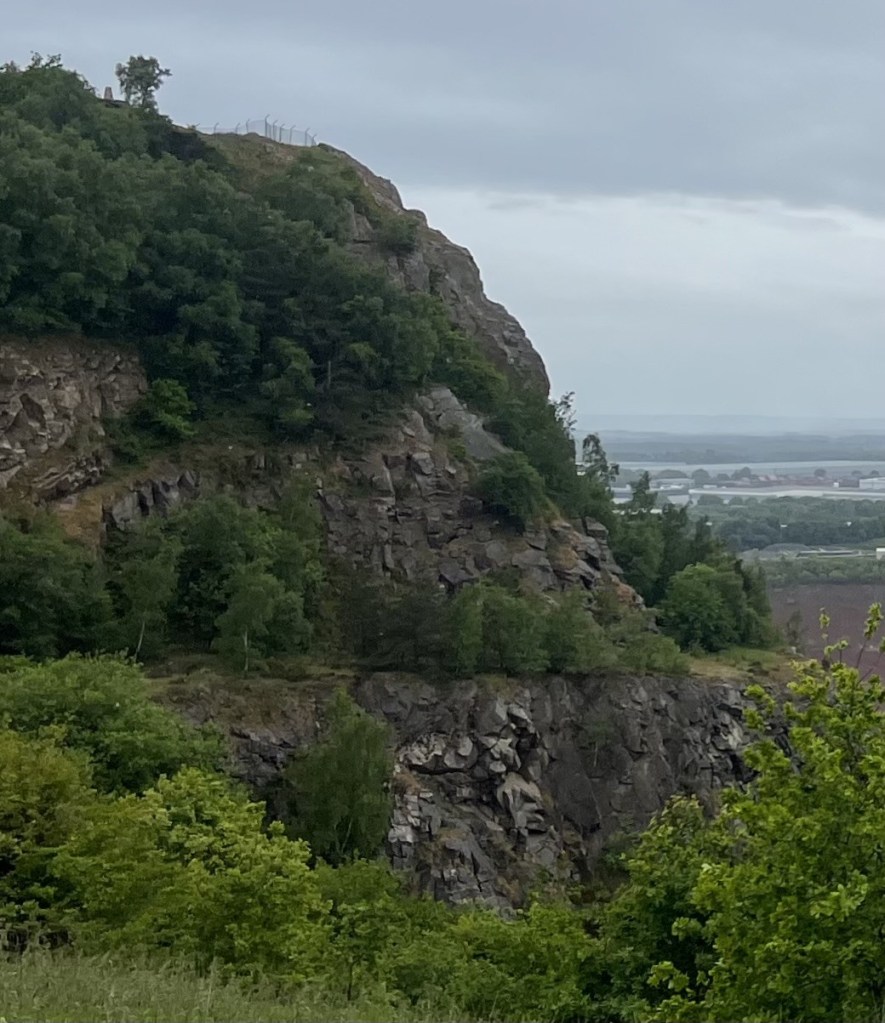
Back at the bench I concluded that I had fulfilled my obligation and so started my descent. About one hundred metres on, and another small path appeared to the left. Well, one more look wouldn’t harm. I reached the fence where the view to the west and south was more expansive than before. I looked up to the highest point. Hmmm…. It looked much higher than I had expected, and what was that feature near the edge? Ah! A trig point, and with that realisation an instantaneous sense of mission failure. The journey from York south had been painfully slow and I was keen to press on to Cambridge and some time to rest. But… and it was an important but, whilst I have contented myself with the notion that for various reasons I wasn’t always going to get to the very top of each county, falling a long way short, without adequate excuse, was inherently lame. Reluctantly, I was going to have to address the situation.
Trig warning – top left ☹
Back at the main path I trudged up to the bench and stone location, and then on to the point which I had previously considered the top of the hill. *
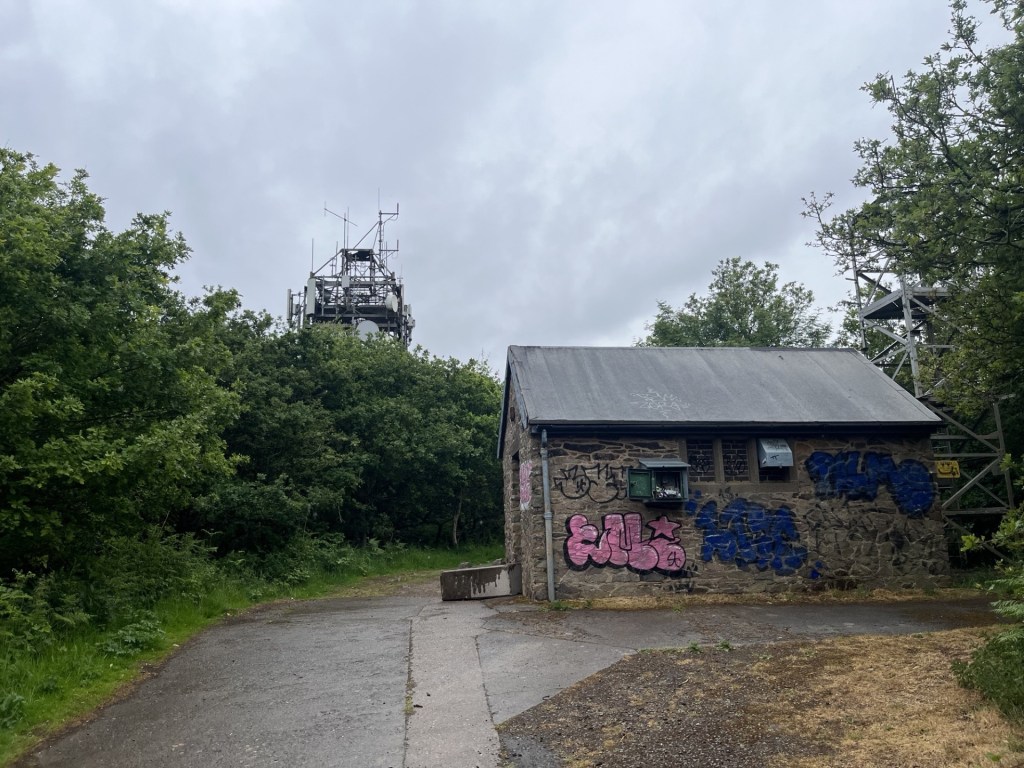
I noted that the path carried on, descending away to the right. I dutifully followed and after a short distance it began to rise again. About 100 metres on a large abandoned, graffiti covered building brightened up the overcast day.
The art of installation
The track meandered onwards, up and down, over rocks and through thickets. Not the easiest terrain. Emerging out of some woods, at last, I had reached the end of the journey. The trig point stood proudly ahead.
That’ll do
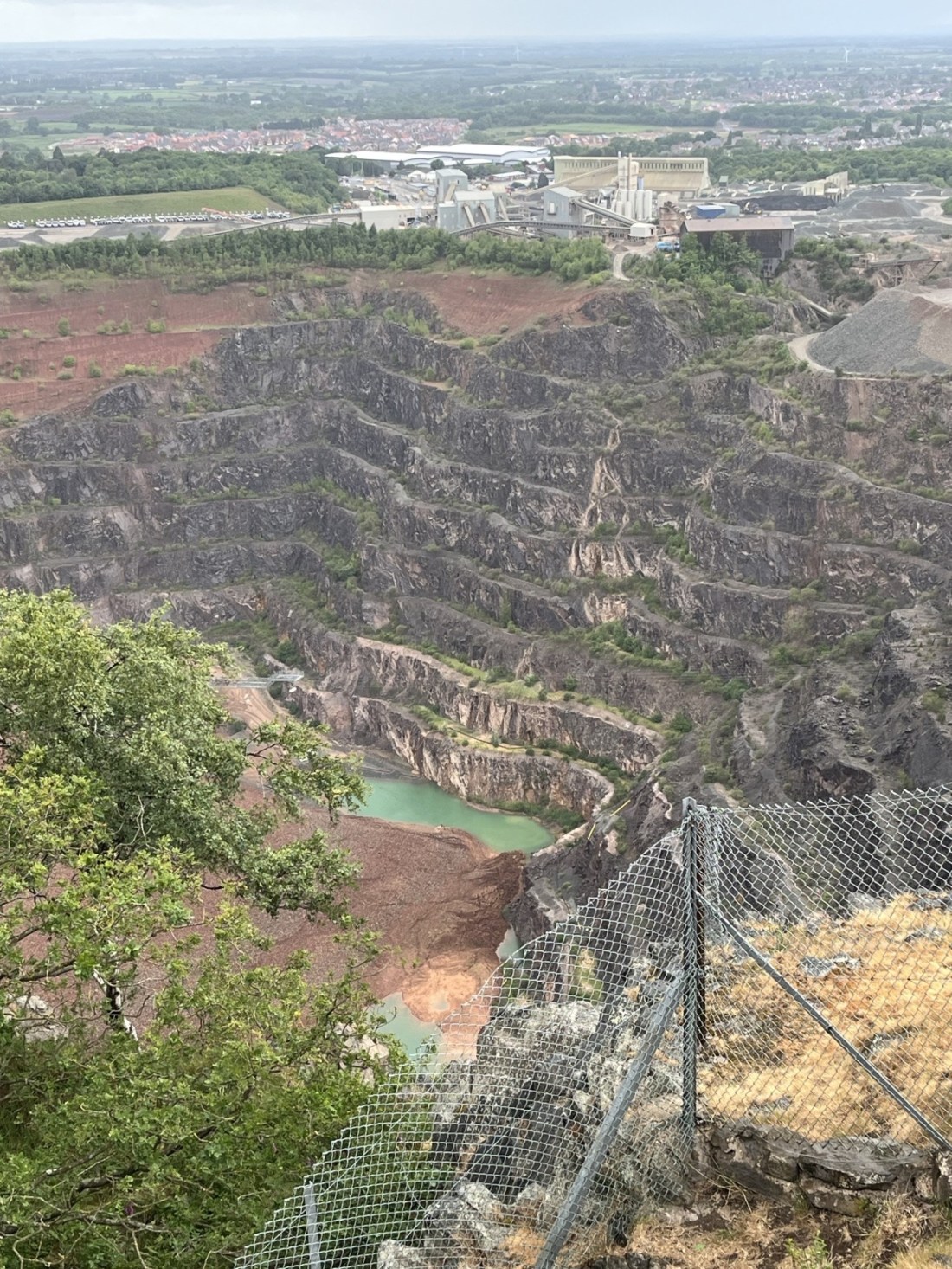
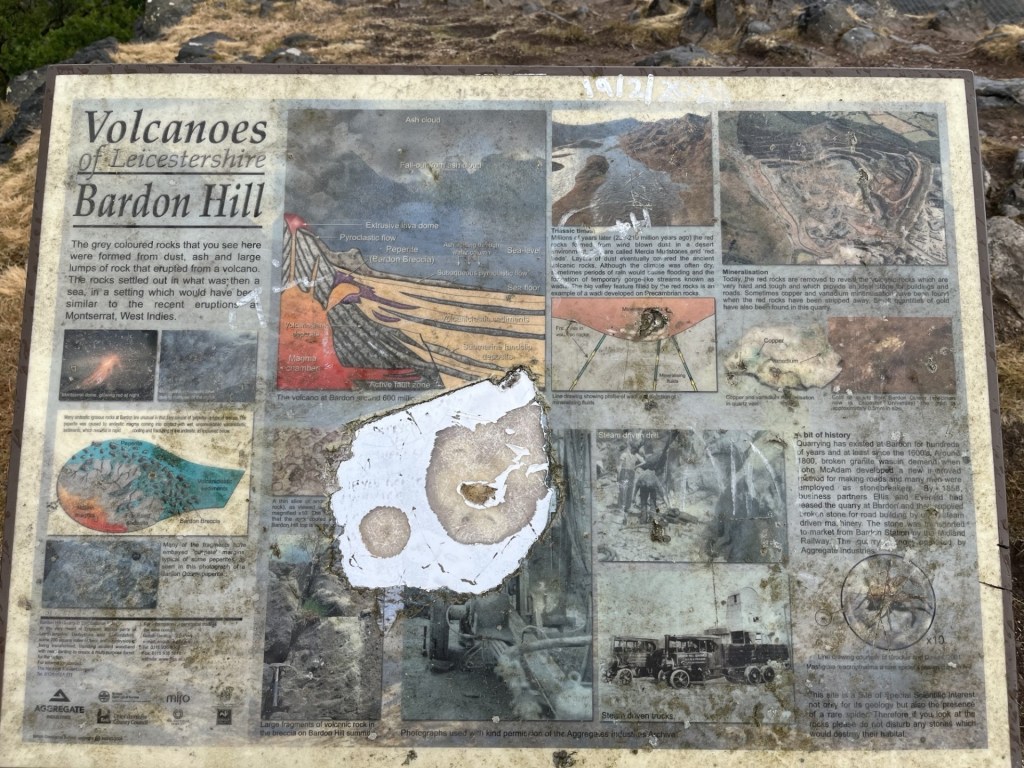
Clambering to the very top the view of the quarry was fully exposed, and despite its devastating impact on the hill, bleakly impressive. There was no sign of the Malvern Hills seventy miles to the south-west, but there was a battered information board, that by deduction must have been installed around thirty years earlier, given a reference (top left) to the “recent eruption at Montserrat, West Indies”. 1995 for the record.
An information board struggling to survive.
I moved over to the railings at the edge of the quarry. Looking down it was very obvious that it was still an on-going operation. The rock was volcanic, and the excavated material aggregate, something, when you think about it, we can’t do without. Once upon a time (570 million years ago by what I have read), a volcano had erupted and created the conditions which, an incomprehensible number of years later, allow us to extract the rock to build roads, support railway lines, and in more inhospitable parts of the country form the basis of paths and tracks that allow walkers and ramblers the opportunity to reach wild summits. No doubt soon after the eruptions stopped it would have been possible to stand on a lip of ground, much higher than today, and look down into the volcano’s caldera. Now I stood slightly aghast and looked down on a man-made caldera. It was overcast and grey, but on a sunny day, with its azure, blue lagoon, I suspected it would be of some strange beauty.
A large chunk of Leicestershire, now missing
I knew from an earlier check that this was not the only large quarry in the area. There were at least another two nearby. The Bardon Hill quarry produces 15% of the county’s aggregates. Whilst larger country’s boast much larger holes in the ground, by the UK’s standards, this is a big one and had been bolstering the nations infrastructure for around 400 years. Well, I’d found out a bit more about my land. I’d enjoyed the climb and what I’d found. If I lived locally I would be clambering up as often as possible (in the hope that on one very clear day I might just see the top of the Malvern Hills). Thirty minutes on and I was back at the car and soon after back on the M1.
An hour or two later, I was driving slowly into Cambridge from the north-west. No dreaming spires on show, but as I approached on Castle Street and looking directly ahead into the heart of the city, I conjured up images of Burgess and MacLean, Philby and Blunt (in no particular order). I turned left into Chesterton Lane, running along the north bank of the river Cam, arriving at the Arundel Hotel shortly afterwards. Parking up at the back and trying to fathom how I had managed to wangle a room here for £70 I soon found my way through to reception, passing a tall, lean fellow wearing a tweed jacket and carrying The Times, which carelessly enfolded a copy of the Morning Star. A woman was working in the office at the back, no doubt sending encrypted messages to Russia, Romania or the USA. She noticed my presence, smiled and approached the counter.
“Good evening,” she said. I smiled and thanked her. “Are you with the party sir?”
Momentarily taken aback I considered the question carefully. “No,” I replied, “just on my own.”
She handed me the keys, but as no further contact was made during my stay it can’t have been the correct response.
* “Top of the Hill” from the superlative album “Bandstand” by Leicestershire’s finest Family.
After the City of London, Rutland is the smallest county in England and sits pretty much in the middle. Which was handy for me, as it was just a slight diversion on my route to spend a night with my brother and sister-in-law in Nottingham.
It was mid-afternoon as I turned left off the A1 and started heading west across the county on the A606. The last time I had done this journey would have been decades ago, but other than a few sympathetically designed newbuild properties in the small town of Empingham, nothing much had changed.
Between Empingham and the county town of Oakham, the mass of Rutland Water flanked the road to the left. Until its creation in the 1970’s, by flooding a large part of the county, it’s probably fair to say that nothing much had changed in Rutland since the Roman occupation.
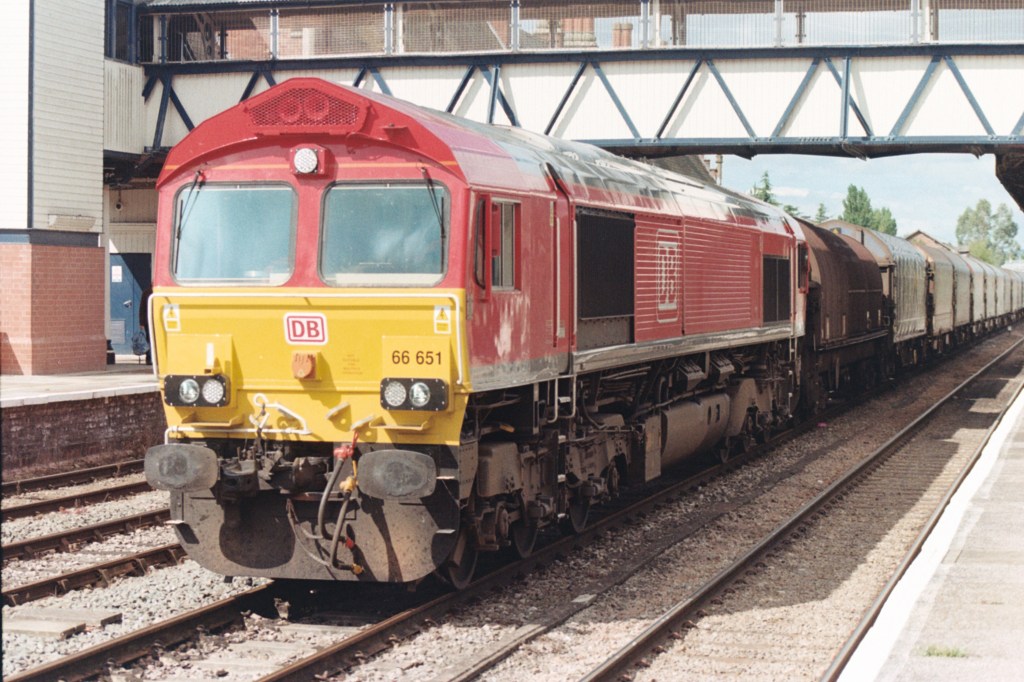
The objective was beyond Oakham to the west. I drove straight into the town and then came to a halt just short of the station. The level crossing gates had come down, and for the second time in a couple of weeks, in a completely different part of the country (Snodland), a red Class 66 diesel locomotive powered north with empty freight wagons dragging gracefully behind. *
After the excitement of the train moment (I already suspected that the rest of the day would now be a disappointment), I crossed over the tracks and carried west on Cold Overton Road. Leaving Oakham, the road continued up a shallow gradient for over a mile and until I turned left at Glebe Farm. Whilst it felt a little bit like a private road there didn’t appear to be anyone around, so I continued past a telecommunication aerial (always a good sign) to the end. I knew it was the end because there was a big farm gate dead ahead, and to the left another bigger gate preventing access to a concrete water storage facility. I parked up, looked around and went through the farm gate. A footpath sign gave hope.
Past the First Gate (I had hidden the car behind the fence)
The road continued onwards for a short distance beyond the gate, before opening out into fields on all sides. The first field, to the right, was unfortified, and I knew that if I just walked southwest across it, I would at get close to the top, but no further. For reasons I can’t quite pin down now, something about the field suggested private property, which it probably was, but in a rare moment of self-doubt I decided to reject the opportunity.
Looking south-west towards the top (my right to roam instincts let me down)
Instead, I tracked back along the line of the field to the south to where a footpath sign confirmed I was entitled to carry on, and at least to the point in the field just to the east of the trig point at the top. It was only going to be a three-minute walk but as I passed into the field, and on looking ahead, a rash of cows suddenly appeared (brown if I recall). Up until about twenty years ago I had never given a second thought to cows in fields. Around that time, and perhaps due to the deluge of news through new technology, stories were beginning to crop up about people being injured and killed by cows (whilst the numbers are relatively small, on average four people a year are killed). At around that time, and whilst on a short stroll through a field somewhere in the south, a herd of cows started moving towards me. At first, I gave it no thought, but their pace picked up and without trying to show panic, so did mine. At around 20 paces, the twenty or so brown heifers, or whatever they may have been, seemed to be getting very excitable, and I was beginning to fear the worst. By now I had reached the edge of the field, and whilst still not entirely sure of my fate, I chose the undignified plunge into the bramble thicket and trees that hid a small stream, rather than taking my chance on the open ground. Fording the stream didn’t appear to be an option, so I waited it out until the herd, no doubt disgruntled by their failure, slowly retreated back across the field, giving me enough distance to trot back to the entrance to the field and a liberating sense of relief.
And, with this historical encounter in mind, with just a hundred or so metres to the top of Cold Overton, I bottled it and slipped back to the car.
Cattle deterrent on the horizon.
So, I didn’t quite get to Rutland’s summit, but it was as much as I could do under the circumstances. Cowardice, or perhaps just sensible pragmatism, had got the better of me.
Apart from getting to Nottingham for six, I had one more objective for the day. Reaching the top of Leicester Unitary Authority. I turned left onto Cold Overton Road and continued west through what was left of Rutland (a small matter of about 200 metres), and then over the border into Leicestershire.
*A red Class 66. Hereford Station – Oct 2024 – Other colours are available
I arrived at Ashford International station on a small train. On leaving the carriage, the intention being to catch an onward train to Paddock Wood, the early warmth of the day had dissipated. As I waited on the desolate platform, a cold wind from the north knocked the stuffing out of me. Poor old Ashford. Battered by Brexit and then Covid, the last of the Eurostar’s left from here some years ago, and they ain’t coming back anytime soon.
After twenty minutes, by which time my fingers had gone an unhealthy yellowy white, and I was pondering on the wisdom of the decision to do this journey, my onward train arrived. As it sped west through Kent, I read that today was the day that Reform UK succeeded the Tories by taking control of Kent County Council. Well, good luck with that, I thought, before reassuring myself that I was, at least, going to spend part of the rest of the day in the Unitary Authority of Medway, a chunk of the world on the south bank of the Thames that had once formed part of the wider Kent (the summit of which – Betsom’s Hill – I had reached on my very first outing nearly a year to the day before, and also before I had decided to include Unitary Authorities within the scope of these investigation). *
At Paddock Wood I changed trains again, and shortly I was heading north, with the river Medway to the right. This route was entirely new to me. Despite having lived in the South-East for much of my life, somehow this area had eluded me. And very pleasant it was too! The short train stopped frequently, and it struck me that at some point in the future a walk along the banks of the river from station to station would make for a productive afternoon.
I was excited at the prospect of passing through Maidstone, a town I knew nothing about other than last year their football team had made impressive progress in the FA Cup. On arrival, the prospect on show was pitifully disappointing. No sign of the town beyond the tatty old warehouses and poorly designed modern flats.
Heading north out of Maidstone and towards Snodland (my destination for the start of my walk), heavy industry flanked the line, although at a distance the ridge of the North Downs stretched away to the east.
Snodland, for reasons I can’t account for, seems to crop up on the news, and on the sort of programmes made by middle aged male “has-beens” professing their love for our railways (I’m just jealous really). I had no idea what to expect as I left the quaint Victorian station and headed up a road leading west and towards the town. I had an Ordnance Survey map (OS Landranger 178) and had an idea of my route to Holly Hill, but I hadn’t expected to be taken over a depressing road bridge that spanned the miserably busy A228 road below.
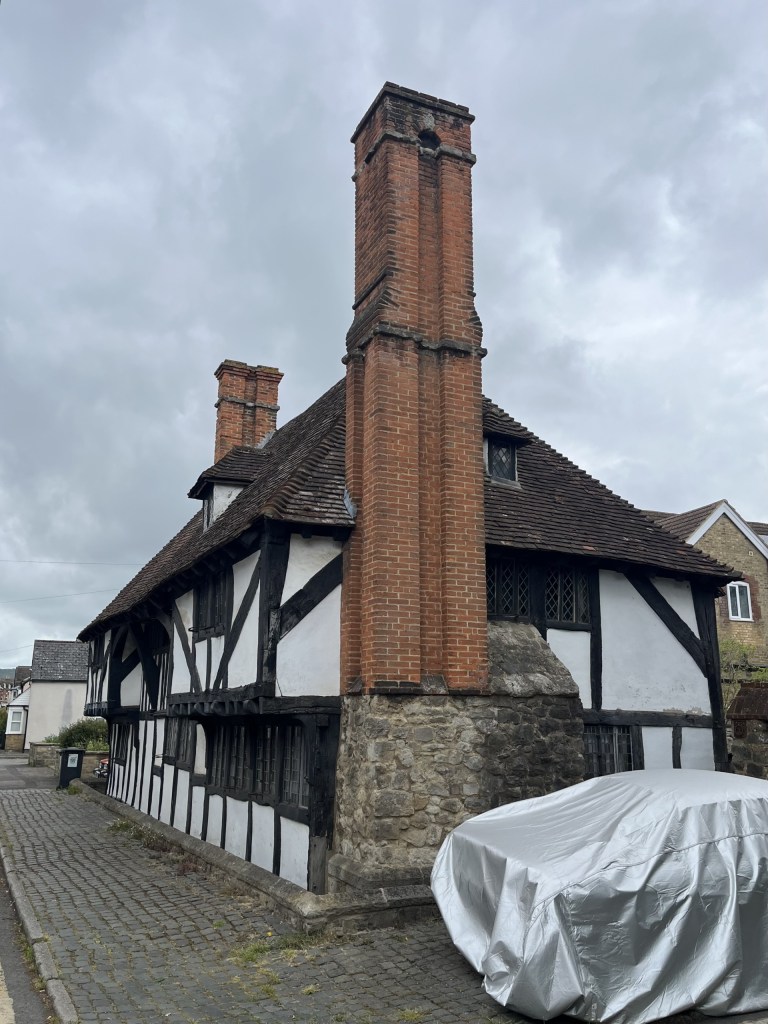
Having made it across the bridge, an even less inviting pedestrian path to the right (not a place you’d want to hang around in the dark) took me down to the start of the town, and a dead end which would, at one time, have continued to the station had it not been for its amputation by the A228. A few Victorian terrace houses, one having been a long-closed pub, lined the road on the left. A very impressive Tudoresque house stood to the right, with a very expensive car, covered to protect its identity, parked outside.
It was all downhill (or was it up) from here
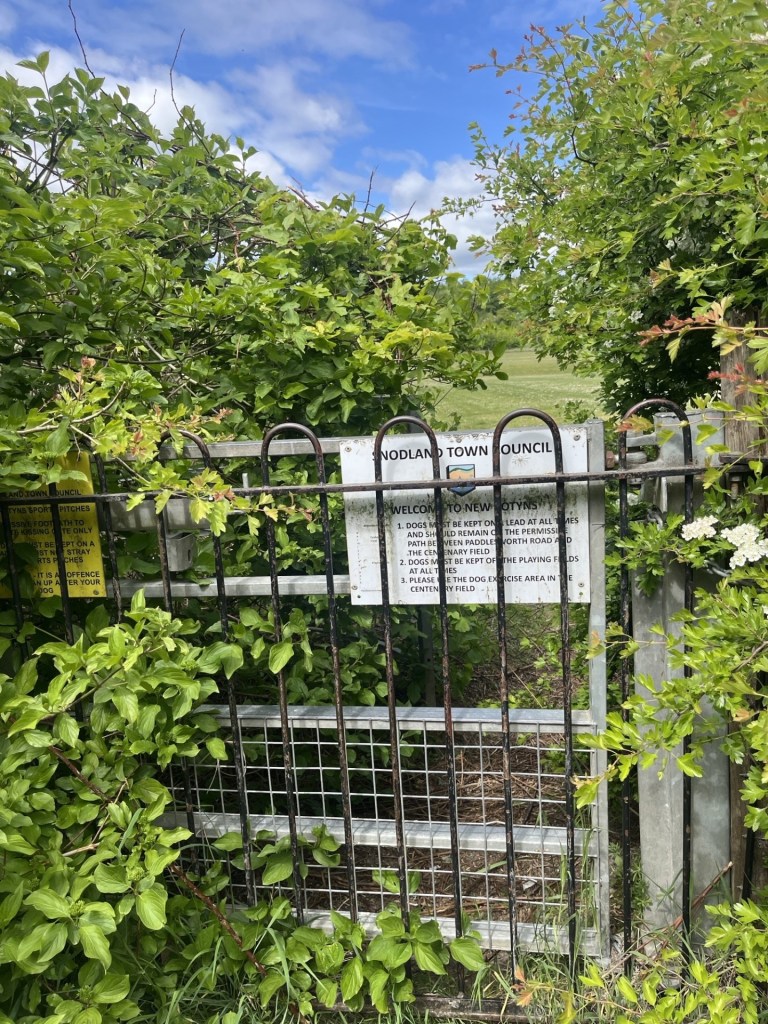
These few buildings aside, I’m afraid to report that the rest of Snodland offered up nothing of interest. I walked up the High Road into the town, crossing another main road, and then after a few minutes had reached the end of Snodland and was onto Paddlesworth Road. Almost immediately this narrow and very rural lane took me out of the urban sprawl. I knew from my map that at some point soon I would find a footpath on the right-hand side and momentarily got excited when I came across a fairly new and robust looking metal kissing gate, obviously intended for public access. Disappointing then to find it strapped up with heavy duty padlocks, and thoroughly overgrown. What had been the intention? I’ll never know.
Best laid plans
Further up the road, which, when a vehicle appeared, required one to back carefully into the hedgerow, a footpath sign to the right, and I was now off the road and following a straight chalk path up through the middle of a large field. Halfway up I noticed increasing evidence of broken pottery and other bits and bobs that indicated that at some time in the fairly distant past this area had been used as an early fly tipping site. Very Kent – now the beating heartland of rural desecration by organised crime.
The old straight tip track
At the top of the field a wide track to the left, flanked on both sides by enormous, recently trimmed hedges, pointed me in the direction of my destination. The land ahead rose towards thick woodland and somewhere beyond that was Holly Hill. The track took a while to navigate, and the recently trimmed branches proved surprisingly awkward to traverse. To my right I could see a very solid green metal fence with pointy bits on top, clearly intended to protect people like me from the unknown danger that lay beyond.
Beware of recently cut hedgerow because it’s sure to get you
Eventually I was free of the hedge track, and now on a more traditional country path with fields to my right. I stopped to take a look over the more traditional barbed wire fence. Beyond, and stretching for hundreds of metres, was evidence of what must have been a huge chalk quarry (or pit). I have a certain thing for chalk pits. My second year Geography degree dissertation in 1978 had been about the chalk quarries of south Croydon. I mean, you know, someone had to do it. And at times, whilst also trying to earn a few bob working in the electrical department of a now long-gone department store, it was quite enjoyable cycling up and down the steep terrain, with a camera and notebook, trying to figure out what was what and trying to formulate a suitable narrative. I even ended up being invited into a Coca Cola bottling factory on an industrial estate which occupied one of the old quarries, and being told about the danger to life and limb of their employees from the kids on the estate above who specialised in throwing rocks down into the quarry after school. This of course was a very long time before the internet and PCs. Academic research was confined to whatever the main Croydon library had to offer, which was probably more than I could have expected. Once I had written up my opus magna it had to be professionally typed up (and blooming well bound), at a cost that left me in debt for some years to come. Once submitted, that was the last I saw of it. It became the property of the University!! Huh! And there was no feedback, or indication on whether it had any merit.
Many years later I came across a small exhibition somewhere in Croydon, which seemed to me to cover some very familiar territory (if not the copyright of the University). It piqued my curiosity. Where had my dissertation ended up? I wrote to the University and asked if I could be sent a copy or at least have access to it. The reply came – they no longer had a copy! Huh – again! Along with all the effort, expenses and the £20 for the typing, I felt slightly robbed. Am I straying a thousand miles from the subject matter here? I’m over it now though. In 1980, and not to be caught out again by the typing scam, I obtained a cheap typewriter and taught myself to type. Never very proficient, and for many years I felt that all the effort had been a complete waste of time – until, well, until the modern world intruded and the keyboard was now the only thing on earth of any value. Bingo! Unintended consequences. **
Towards the Quarries
But none of the quarries on the scarp face of the North Downs in Surrey were on anything like the same scale I now saw before me. As I contemplated this scene I could hear the sound of excited dogs somewhere ahead. A kennel I suspected. A little ominous too. Carrying on up the path, I became aware of movement quite a distance ahead. A young woman was coming in my direction, being, from what I could tell, dragged along by a dog the size of an adult pig, and with the appearance of a Baskerville hound. It had already been the driest Spring on record, but the amount of slobber sloshing from this abomination’s mouth would have been enough to rejuvenate the driest of streams. There certainly wasn’t room for the both of us to pass and so; to give myself a chance, I climbed high up the embankment to my left and uttered a cheery “afternoon” as they passed. I assumed that the dog was a temporary inmate at the nearby kennels which were at the end of the path, but to the person, somewhere, who has created this breed, whatever it was, and to the people who purchase similar, please stop!
At the top of the path (just to confirm I survived the dog moment unscathed), a track led left and right, but I chose the gate directly ahead and a path that started to ascend up through some woods. To the right, an old derelict house sat in amongst the trees. A sign attached to a fence said Keep Out – Property of the Blue Circle Cement Company, which explained a lot. The path continued through beech and birch trees in the first flush of new growth. A teapot, naturally, sat wedged in the cleft of one of these trees. Art, a tiny house that tiny things lived in, or just fly tipping, it was hard to tell, but in truth it looked quite at home in the tree.
Brewing Up
At this point the path began to head downhill. Welcome to a degree, but with the caveat that all height lost meant more pain later. I emerged into a large glade, surrounded by pines and other varieties. A dirt road passed east to west, and a solitary dead tree stood in the middle of the glade sporting a large sign explaining that something was private property. Given that there was no sign of any fencing it was hard to determine what this instruction referred to, other than it might have been the dead tree. I had no plan to climb it.
I didn’t get the message
I chose to follow the track that ran westwards, and a while on did indeed come across a fence to my left, and a large field of scrubland that stretched up to the north. In places the last primroses of Spring clung to the edge of the track. Consulting the map, I could see that somewhere at the top of this open ground there was a footpath that led into some woods that emerged into bigger fields which would lead up to the top of Holly Hill, and so it was onwards and up.
Up the scrub and looking towards the Medway
It was a fair old hike to the top of the scrubland (for an old person anyway). Having reached the top, I worked around the dilapidated fencing and came across a similarly dilapidated stile. Anyone who does a bit of recreational walking in the country will know that slightly deflating feeling when coming across an unmaintained stile or gate. It was patently obvious that this location was rarely ever troubled by the public and had not been interfered with for some weeks, or months. Chest high nettles had grown with vigour on both sides. I considered going back down to find a better route, but that felt slightly defeatist so instead I took some minutes preparing to climb over; grateful that I wasn’t wearing short trousers. With a brave heart and hands held high I progressed purposefully and made it without incident.
Travelling in stile
Now I was in a small glade. The remnants of a path took me so far before evaporating in a jungle of more nettles and enthusiastic young brambles. The land ahead rose sharply up through dense woodland. Somewhere within this tangle of nature there was a legitimate route, but it was no use. I began to pick my way up as carefully as possible, trying not to brush skin on anything that represented a threat, which was everything. This was hard going and I’m not the nimble gazelle I once was. Trying to pick the least worst route took ages, and even the least worse routes involved repeated trouser snagging. This was a very short climb, but it took me about twenty minutes.
Don’t be deceived – These bluebells were lethal
At last, and to my great relief, I was out of the morass and standing at the edge of a large agricultural field. Disorientated, I had no idea where at the edge of the field I was and the map couldn’t help me, but I knew that heading north and keeping to the edge of the field would get me there eventually. A while on and to the right, another less than useless stile indicated where I ought to have emerged.
Somewhere in a field, somewhere still in Kent
Keeping to the edge of the field eventually I headed directly across rough ground and to a hedge line that I hoped was the top. It wasn’t. A settlement a short distance away confirmed I had another large field to go. By now I was certain of the objective. A large old tree stood on its own in the field beyond. I aimed directly at it, despite a minor uncertainty as to whether I was trespassing or not. Near the tree a large area of the field, about the size of two football pitches, had been turned over, for no obvious reason I could think of. I guessed that some sort of greening subsidy was being used to make something of this otherwise neglected field.
A few steps into Medway
To my north the field was lined with dense woodland, where, if I was to believe some of the literature online, the highest point in Medway lay just beyond the hedge line. The thing to note about this endeavour was that whilst almost the entire field area, stretching to the south, was in Kent, for reasons that simply can’t be explained, expect by the officer who plotted the boundary, the county line (not to be confused with County Lines – which is a completely different pursuit), makes a triangular shaped intrusion into the field. This Medway intrusion must be very confusing for the landowner and must lead to inter authority bureaucratic squabbling over incidents of fly tipping.
The Medway Unitary Authority salient (in orange). Kent/Medway boundary marked by dash/dot black line
I sniffed a bit along the hedge line at approximately the location that PeakBagger had indicated was the “top”, to see if there was any sign of higher land within the woods, but it didn’t seem as if there was, and looking back at the field I had crossed, despite being something of a plateau, I was fairly convinced that the land past the tree, and where the field had been turned over, was marginally higher than anywhere else. ***
Somewhere, just to the right of the tree, the top
Having, one way or another, crested Medway UA, I certainly wasn’t going to battle back down the way I had come and already had an alternative route in mind. Back down the field a bit, and to the east, a decent enough gate led the walker into dense woodland, and as I passed into its embrace, I was back in Kent.
A short walk into the woods and the path split in two directions. One carrying on with the contour and the other falling away down a slope. At the junction I beheld a quintessential English country landmark. None other than a plastic litter bin overflowing with plastic bottles and dog shit bags. There was obviously a good reason for it being there i.e. the compulsion of a large minority of people to drop their drinks containers and dog shit bags on the ground, rather than the inconvenience of taking them home. So, cause and effect, some kind heart/s had installed the bin to limit the impact. Bless them, but poor sods too, having to come out here probably every day to empty, rinse and repeat cycle. Depressing really.
Where the path diverges. Dog shit marks the spot.
I opted on the downhill route, on the basis that it was downhill and I rather desired to get down sooner than later. Not as easy as it looked. Quite a lot of branches blocked the way. Not enough to prevent further progress, but I hadn’t done my stretching exercises in the morning. I was now.
And then the trail took a much steeper dive. The ground was bone dry, but I was going to need to take some care. At this point I noticed what appeared to be lumps of iron sticking out of the ground, and they spoke of instant disaster. I also noticed to my left a rope that fell away along the side of the path. What was I getting myself into? It slowly began to make sense. The foot wide lumps of metal, hammered into the ground every couple of feet, were there, along with the rope, to aid the walker, or in this case, climber. In wet conditions I am certain that the metal steps would be extremely useful but covered in dry dirt and a lot of vegetation, they now made for an almost inevitable trip feature. I took the greatest care of going down, and it continued down for some minutes. Eventually, uninjured, the path exited the woods at a small road.
Believe me, every one of those steps hides a trip hazard
Walking up the road it soon bore to the right. It felt logical to follow it, but just to my left a footpath sign and a sturdy kissing gate invited more interesting countryside exploration.
The gate took some negotiating. It clearly hadn’t been used in a very long time, but once in the field, and having looked at my map, a footpath could just be discerned heading across the large, tatty field. Overgrown, largely with thistle type plants, this part of the stroll was particularly unpleasant, and I now regretted not having stuck to the road. Eventually this annoying part of the journey ended, with the path dropping back to the road through a thicket so thick that a machete would have come in handy.
I followed the road for a while and occasionally looked at the views towards the north and east. Across the river Medway to the east and more evidence of vast chalk quarries hacked out of the North Downs.
Into the Medway
The road became more of a dirt track as it entered the top of the large field with dense woodland to the left. The track then turned downhill, heading southeast until reaching Ladd’s farm at the junction with the Pilgrims Way. The farm buildings, apart from long ago extensions here and there, remained remarkably, and you could say charmingly, unaltered since the 19th Century.
Ladd’s Farm
A small road (Ladd’s Lane) ran roughly south, almost directly opposite the farm, but a small sign pinned to a lump of wood at the side of the field opposite caught my attention. Another sad memorial to the dead of previous wars. This time, Denis Page, Pilot Number 127990, killed when his Mustang fighter crashed into the nearby field. He was just twenty!
This poignant story was counterpoised by the huge field opposite, where a yellow swathe of rape flowers lay like a carpet over the chalk, and where beyond a long low chalk cliff formed the base to a small community above.
The artificial chalk cliffs of Halling
With the field to my right the lane started to head east and back towards Snodland. In the late afternoon, and apart from the odd vehicle coming out of Snodland, it made for a pleasant end to the walk. Eventually the fields gave way to the heavy-duty green metal fencing with pointy tips that I had encountered earlier in the walk. Clearly intended to prevent access to the huge old quarries and pits lurking beyond.
The road eventually reached an area called Holborough where, before reaching the A228, a large newish estate with pond features created on land reclaimed from the old quarries. As modern estates go it looked pretty good. A path headed south along the backs of older housing, which at least meant avoiding contact with the dual carriageway, and I was soon back in Snodland and then the station, just as a freight train pulled by a class 66 locomotive thundered northwards (sorry, it’s a niche sideline).
I had twenty minutes to wait for my train back to Paddock Wood, but that was okay. My son rang to touch base. When I explained the day he expressed some interest, which was kind! It had been an unexpectedly excellent seven mile walk in an area I knew absolutely nothing about, but which I now felt I knew a lot more.
Snodland Station – next stop Paddock Wood
* Medway Unitary Authority covers the area of Rochester, Chatham, Gillingham and the Hoo Peninsula. Some years ago, when I was a tad younger and fitter, I wasted some time on my bike sticking as far as I could to the coast, and if you are desperate for more of where this comes from these links will take you to the north.
** In a moment of extraordinary serendipity, as I was coming to the end of writing this account, I was also multitasking, having decided to reorganise my clothes draws. I started on the bottom draw, having completely forgotten what it contained, and having not opened it in some years. No clothes, but instead random “stuff” that included a plastic bag. I felt in the bag and the first thing out was a cardboard envelope, in which, and to my amazement, a draft copy of my dissertation. For the next hour I sat and re-read it. In parts it was naive, and in truth (I had had a very Comprehensive education) at times the spelling and grammar left a lot to be desired. I suppose I was only 20 years old at the time, yet despite these minor self-criticisms, it made for an interesting and informative read. At the end I considered that one day it ought to be possible to rejuvenate one of these old chalk quarries as a leisure water park. And so, when looking on Google maps and at the area to the north of Ladd’s Lane – St Andrew’s Lakes. A deep water “aqua” leisure park, built into an old chalk quarry some years ago. I had missed a trick!
Kenley Chalk Pit 1978 – Car free adolescence
*** This is the point that Peak Bagger claims as the top, and I believe they are correct. On the other hand, Peak Visor, which is another clever looking site, places the top of Medway a bit further to the north at a place called Round Hill, which, according to the BGS App, falls short by 10 metres.
Having spent the weekend with my daughter and her partner in Bristol, and having successfully claimed Hanging Hill in South Gloucestershire, rewarding myself with a strong coffee at the Swan Inn at Swineford, I drove south down almost vehicle free roads through Somerset, then east Devon and eventually into Lyme Regis in Dorset. A couple of nights booked in the Nags Head before heading back east to see friends in Portsmouth, then home.
After booking into my small room in the Nags Head and then having spent a couple of hours near the sea front trying the fish and chips and a couple of pints of the local ale, I set off up what felt like a 45% hill back to the Nags Head. By the time I arrived, panting and crawling over the threshold, with one of the patrons saying to me “have you been out there the whole time?” to which I had no answer, I flopped at the bar, rationalising that I desperately needed a small whiskey before bed. With fortification in hand, I took a seat whilst the last of the punters supped up and left. On gazing around my eyes fell upon a picture on the wall. It spoke of more optimistic times and for a moment I felt privileged to be in this space.
Toasting the man
Lewesdon Hill, Dorsets highest point, was a thirty-minute drive northeast of Lyme Regis. I decided on parking up in the village of Broadwindsor, located just north of the hill. As I neared the village, driving along the B3162, a stationary police car was parked up on the road ahead. I drew up behind but was waved on. Just up the hill, a second police car was pulled over next to what appeared to be an abandoned car, and a couple of officers stood silently by, with arms crossed.
I drove on and within a minute was parked up in a small close to the south of the village. The weather was perfect. Almost too perfect. I had no summer clothing so chose to leave my coat in the boot. The OS Explorer map (116) showed a route out of the village and straight to the top of Lewesdon Hill. It required walking into the village, which was fine because I needed a snack and guessed that the settlement was just big enough to support a shop. Fortunately, there was a profusion of old-fashioned signposts, and on each the words, Village Shop, as if it was the biggest attraction in the area. Maybe it was.
Surprisingly, being a Monday, the small community shop was open, although in truth it was rather lacking in immediately edible stock. Reluctantly, (I had walked in and so walking straight out would have been seen as a tad rude) I settled for a rather unappetising looking vegan sausage roll thing, made by a large food company that rhymes with “balls.” The shopkeeper was almost certainly delighted to see the back of it, but hey, needs must.
After procuring the snack and a cola, I walked back up to the White Lion Inn (closed Mondays) and headed west on err… West Street. A small house on the corner had a stone sign above the door that claimed Charles the Second had stayed there for a night in 1651. What it didn’t say is that he was fleeing from Parliamentarian troops after the battle of Worcester and escaped the village dressed as a woman. Just the previous day I had stood at the top of Hanging Hill in South Gloucestershire where, eight years before, a large force of his father’s military sustained appalling losses against a Parliamentarian army, taking the high ground before retreating.
Perhaps more interestingly, Broadwindsor also had a 17th Century vicar called Thomas Fuller who, apparently, often had his congregation in stitches. Who wouldn’t have wanted to live in a place which, whilst plague, and the warring elite ravaged the land, had a Sunday morning comedy club? I have an image of Paul Merton standing at the pulpit and drifting off into a flight of fancy, although having read a couple of Fuller’s “jokes” I think it’s likely that these days we would struggle to understand the nuance. By the time Charles the Second sought refuge in the village, Fuller was no longer the vicar, so missed the opportunity to crack a line at the King’s expense.
West Street wound down a hill to a bend in the road (which headed on up beyond). A footpath sign pointed south and confirmed the evidence on my map. Passing between a handful of buildings the path crossed a sparkling stream before reaching a large gate, with fields beyond. So far, so good. The gate, of course, was locked. There was no sign to indicate why. I don’t get annoyed in these situations, but it happens too often these days and can be mildly disconcerting. I looked around to see if I was missing something and noticed a small track leading away to my right, following the stream and through some woodland. It felt a bit unlikely, but I was in no rush so decided to follow the path and see where it took me.
Which was about 200 metres. The path petered out as it became overwhelmed by marshy ground. A delightful spot, but for me it was back to the drawing board, which meant a retreat to the gate. I looked beyond the gate and eyed up the path that clearly led to the top. No sign of a bull. I looked at the map, which showed an alternative path, but which required beating back through the village. I looked around. No one was in sight, so without further thought I was up and over and then stepping boldly along the path.
From there on it was reasonably straight forward, although at another locked gate a sign pointed east towards an alternative route, which I duly observed. After twenty minutes or so I arrived at a gate that marked the entrance to the Lewesdon Hill site, managed by the National Trust. Ahead lay dense woodland, with a variety of mature trees climbing up the steep slopes towards the top.
The approach to the enclosure
Proceeding through the gate, a large, mounted sign provided information about the area, the flora, the fauna and that an Iron Age settlement had probably existed on the site. That this seemed to be any doubt felt odd. It seemed to be a perfect setting. The board also stated that Lewesdon Hill was “the highest, quietest and most remote place in the county”. From what I had witnessed so far it felt a little bit like stating the bleedin’ obvious, but I wasn’t complaining.
A few steps on and a second sign. Slate grey, with the image of a Spitfire flying overhead in the top right-hand corner. I anticipated a sombre story.
In summary, on 15th March 1942, Jean Verdun Marie Aime De Cloedt, a Belgian in the RAF, in poor weather and with a faulty engine, crashed into the top of Lewesdon Hill. The commemorative board also mentioned that it was still possible to see the destructive path the plane had taken through the trees at the top. It felt like an unnecessary detail, but regardless it was a poignant tale. An intimate human story at “the highest, quietest and most remote place in the county”. Wars and hilltops. It was becoming a theme.
Chert stones that must have travelled down from above and onto the sandstone bedrock, scattered the path that headed south towards the top. Unusual, but would almost certainly have made this an attractive spot for early flint pioneers.
Within five minutes the path broke from the cover of the trees onto a heathy plateau and continued towards the only point that looked slightly higher than the surrounding topography. There was nothing of note to pinpoint the spot, but a hump of grassy earth seemed to be the place. I looked out to the south and towards the sea some miles away. Rays of sunlight swarmed through the large gaps between the trees. Looking down the steep escarpment the sun on the otherwise stark branches revealed the first, almost indiscernible, green blush of new growth.
From the top – Looking south southwest towards Morecombelake
Despite the delay in making progress at the foot of the climb, (due to the locked gate) I had made good time, and so after taking a few bites from the almost inedible vegan roll (cardboard wasn’t included in the list of ingredients, but I think it should have) I followed another path heading west and above the drop to the south. And a considerably steep and long drop it was too. Despite almost qualifying as a cliff, ancient birch and oak trees rose up from below, climbing and clinging on bravely to the thin earth. At some point it occurred to me that this was likely to have been the area where Jean Verdun Marie Aime De Cloedt’s plane had torn through the trees. I chose not to try and work out where.
Reaching the end of the plateau area another notice board gave more information, which must have made no impact on me at all, given that I can’t remember a word. A view opened out. The land fell away, but then rose again to the top of Pilsdon Pen, about two miles to the west, which even from a distance revealed features consistent with a hill fort.
West towards Pilsdon Pen
Scrambling down the north slope, on land recently cleared of larger trees, I was back on the main track which forms part of the Wessex Ridgeway and banked up to the right. The sound of a helicopter overhead intruded but tailed off as it headed north. Soon I was back at the entrance with the information boards, and after a quick look back set off across the first large field. I had noticed on the map that at the end of the field another path veered to the northeast and past Fir Farm. This was a more direct route back to the car and avoided having to negotiate the closed gate.
Objective Broadwindsor
By a large farm building I found what appeared to be the route, heading into some woodland. The noise of the helicopter should have long gone by now, but it was still audible, somewhere just to the north. Entering the woods, it was evident that the trail was little used. A sign had been attached to a tree, informing people like me that due to storms the previous year some of the trees were unsafe and walkers proceeded at their own risk. The sign itself was a year old, and I figured that the landowners would, by now, have taken the necessary action to make the area safe.
This was a lovely spot, a proper dingle dell. A low wall appeared ahead, with a nook cut out to allow the traveller to cross with ease. As I stepped over, something about its appearance had me confused. What kind of stone was this? I looked more closely. What I had thought was a stone wall was in fact a massive fallen tree, so embalmed in moss and lichen that it mimicked a human structure.
Not exactly sycamore gap, but art in nature nevertheless.
Carrying on down through the winding path the noise from the helicopter began to increase, annoyingly. Perhaps it was the military on manoeuvres, or a crop being sprayed with agent orange. Either way it was taking the edge off the afternoon. A bit further on and the path began to flank a track leading back to the farm. Looking ahead something stopped me in my own tracks. Through the trees and hedges, and about 200 metres further on, I could clearly make out the intermittent red and blue lights of a police vehicle.
In the 1935 film, The 39 Steps, Richard Hannah (Robert Donat), is on the run on a Scottish hillside when out of the blue (and out of all context given that Buchan’s novel was set before the Great War) a helicopter appears, hunting him down. Now, I should say at this point, nothing remotely interesting has happened to me for a very long time, although two evenings earlier in Bristol I had witnessed what might well have been a stolen motorbike being crashed at 5mph, and completely bizarrely, into a wall, before a car pulled up and swished the fallen rider away. Surreal. Nevertheless, and just for a moment, with the sound of the helicopter above, and knowing the cops were hovering somewhere just down the lane, my thoughts were suddenly hinting at the prospect of a manhunt! But who, and why? Was it fight or flight time?
Momentarily I engaged in mental research. Who was I? Robert Donat, Kenneth Moore, or, controversially, Robert Powell. I settled on Robert Powell, largely on the grounds that I had liked him a lot alongside Jasper Carrot in the TV show The Detectives. Now all I had to do was to get past the police checkpoint. Did I have my papers? It’s essential to have papers on you in these situations. I patted the inside pocket of my jacket. Hmm… would the Nectar loyalty card suffice? I was about to find out and started to walk purposefully towards the blues and twos.
I noticed that the police car lay beyond another vehicle and realised that I had reached the point I had passed in the car on my way into Broadwindsor. Whatever was going on seemed most particular. I reached the end of the drive and volunteered a “hello” to the two officers idly guarding the mysterious car. I think they may have said something back, but either way I wasn’t subjected to any stop and search, or interrogation, for which I was most grateful, although as I carried on along the road back into town, with the helicopter still bothering around above, I wondered whether the officers might have been a tad neglectful in their duties.
Back at the car I checked the app which had been recording the walk. 2.79 miles. 411 ft elevation gain. 670 calories. 8k steps. No more, no less. Oh, for 39 more! But never mind, for an hour or two, in a remote part of Dorset, which had once been the home of “Have I Got Sunday Morning News for You”, I had been away from the numbers.
A beautiful Spring morning in Bristol, and a few hours to spare with my daughter and her partner J, before heading south after a short but very enjoyable weekend visit. They were both aware of my growing interest in seeking out county high points and indeed had previously enabled me to the tops of Ben Nevis and Snowdon. Was there somewhere locally where a short walk could take us to another county top? Well, up until a few weeks earlier I would have said no, and time was too short to hop over to south Wales. But that was before I had discovered a new county (or so I thought).
In October 2024, when I had climbed Cleeve Hill, I thought I had ticked off Gloucestershire. As winter came and held me in the grip of my local area, I found a map of British Counties online and ordered it. When it arrived it was exactly what I had in mind. Very simple, with the key information, and massive. I bought a large piece of plywood and carefully mounted the map using double sided tape. Now, all I had to do was work out a methodology of categorising the high points (by height obviously, but also by geology, for no other reason than to complicate the process), and then begin to annotate it as and when a new cresting occurred. I should say at this stage that it’s become quite a complex beast, and I’m a while away from any annotation, but something happened a few weeks ago that radically altered the dynamic.
One of the joys of having a huge, mounted map is that it’s easy to look at and take in geographical relationships and direction. When it comes to looking at maps on my phone, or on a PC, my spatial/visual awareness seems to go out of the window. I guess I was just born too late but give me a map in the hand and by and large I feel like I am in control. Of course, I couldn’t fit this map into my hand, but when I was planning the weekend in Bristol I had sat down and looked at the big one to see what counties might provide opportunity, either on the way there, or on the way back. It all seemed straight forward, until err… until, just past Wiltshire (yet to do), appeared a county called South Gloucestershire. What the what the?
South Gloucestershire wasn’t on my original list of counties, but sure enough it exists, as a Unitary Authority since 1996, and after the abolition of the previous authority of Avon. Whether or not including it in the itinerary is open to debate, but it was on my map and delivers all the services provided by Gloucestershire council to the north. It couldn’t be ignored and given that its high point was just a few miles to the east of Bristol, I offered up Hanging Hill as a short walk option before parting company.
We drove out of Bristol on the A431 (Bath Road), and just before the Swan Inn at Swineford turned left and along a track through a farm, pulling up at a small, very serviceable and free, car park set in a thicket of trees. You don’t get many of these for the pound these days, but without the need to have a ten minute confrontation with a pay by phone pay and display machine, I wasn’t complaining. J had done the research, and we set off east, past an old mill stream, and then into a large field with what appeared to be free range ostriches in the one adjacent.
Passing through a line of trees we entered another field, with the path then rising steeply until reaching another tree grouping flanking an ancient drover’s lane. The track, with steep banks on either side, continued up, but without being obvious, started taking us southeast, and away from our objective.
Steeply hollow
After plodding on up for nearly half a mile a path leading away from the track appeared to our left. Following a straight path we entered the seemingly exclusive hamlet of North Stoke. A road continued taking us east. A small red-letter box set into an impressive stone wall forming part of one of the more impressive buildings gave rustic charm. Continuing on and then left again past the modest but aesthetically pleasing St Martin’s church, we started to ascend another steep track that formed part of the Cotswold Way.
I should just say that, having stripped off various layers, and now down to my T-shirt, I hadn’t expected to still be climbing UP at this stage! I hadn’t really been paying much attention to the route and had assumed that we had parked quite close to Hanging Hill. I made my first inquiry whilst panting at each weary step. “Are we nearly there yet J….?”
Reassuring noises came back. Suitably reassured, I found a new lease and before too long (at least another half mile!) we reached a bench next to a gate leading onto a golf course. We were now on the Cotswold Way and that meant more walkers. A shame for me as out of nowhere an enthusiastic group appeared and colonised the very bench that, as we had approached, I had coveted over the previous two minutes.
We stopped, standing, to get our breath back (well, that’s what I was doing at any rate) and took in the impressive panorama looking west and towards Bristol, the Severn, and the Welsh mountains beyond. From the lie of the land, I assumed that we weren’t too far. “Are we nearly there yet J….?”
J consulted his phone. “Yup,” he replied. “That’s it just over there.”
Of course it was…
I looked north. The land fell away steeply into a valley and then rose again towards a clump of trees at the end of a ridge. Just over there, yup, about a mile just over there (as the crow flies). Now, I had all day, but it was a Sunday, and I hadn’t wanted to eat into too much of my hosts remaining hours before their new working week. If, at that moment someone had said that getting to Hanging Hill was going to take too long, I would have surrendered the task there and then, to return another day. But nothing was said and so we continued on, flanking a pleasant looking golf course to the right and woods to the left. At least now we were on the flat.
Just past an old farm building, in a fallow field, a collection of metal fantasy sculptures had been let out to rust slowly in the elements. I’m not necessarily a fan of “industrial” art, which I find somewhat contrived (I can’t find an emoji of Morrissey, but if one exists, insert here), but on this occasion I was suitably impressed. Something about the location perhaps, but also the aesthetic and the way the Grim Reaper with dog, and other Tolkienesque characters had been positioned pulled me in. I considered taking a closer look, but time was pressing, and the need was to move on.
Sculptures by David Michael Morse – Deceased
The track continued up to a crest, with the golf greens now on our left. We headed northwest, still on the Cotswold Way. A delightful wood, covered in a carpet of thousands of wood anemones stretched out to our right. A suggestion to wander through these woods was vetoed. We appeared to be at the limit of our time window. The greens we passed seemed to stretch forever, and judging by the disastrous tee-shot swing (and hope) by a possibly hungover weekend golfer at the nearby tee, his game was going to be a stretch too, far.
Here the course ended and just ahead a gate beckoned us into a large field that vanished to the horizon, which was dispiritingly far away. By now there was a palpable tension. I’ll leave out the details, but entertaining the old man’s cranky new hobby had clearly run its course, and I had run out of credits. We had come too far to turn back. My own assessment of the land and the area suggested that we could make a dash back to the cars an alternative way, but for the moment it was important that I focused solely on apologising with conviction for my selfishness and trust for the best!
We crossed over the large field, a path clearly pointing us towards our destination. Minutes later, and to my overwhelming relief, we reached the trig point that marked the top of Hanging Hill. I was tempted to say we didn’t hang around, but sensibly we stopped and took a five-minute break. Hanging Hill? No idea. The next one to the north was called Freezing Hill. You get the medieval idea here.
Just hanging around. Trig points are handy things to rest on.
Just past the trig point, an information panel told us a bit about the Civil War battle of Lansdown, fought on this spot in 1643. With time pressing I chose to take a photo and read it later.
Limited information
This is not a history lesson, and in truth, as I found out later, neither was the information panel. * If we had had more time, it might have been possible to survey the scene and appreciate more the scale of the carnage that had occurred here four hundred years earlier. But the research would have to wait.
The killing field
The prerogative now was to get back to the cars as sharp and as shipshape as possible. We’d been out too long. The good news was that it looked like it was going to be all downhill from now on. Except we chose to set off northwest, heading away from where the escape vehicles were parked up. We trod carefully down a steep track through dense woodland, with the first signs of new growth all around. With continuing murmurings of discontent amongst some of the team, I quietly hoped the correct decision had been made. The track continued for, in my mind, too long, but eventually we spilled out onto a narrow road, and despite some hesitation decided to bear left and head west.
Marshfield Lane proved to be the win bonus of the day. Hardly a vehicle passed us, and progress was swift. A bank to one side of the road stretched for some distance, covered by hundreds of yellow primroses. Soon after we were passing the rather appealing looking Upton Arms in Upton Cheyney. No time though to contemplate the achievement over a coffee or cold drink. Onwards and downwards on Brewery Hill and then, at a sharp bend in the road, we followed the footpath directly down through a farm, then through a gate, and within minutes we were sitting in the garden of the Swan Inn at Swineford, the sun beating down and all was right with the world.
Mothers Day at The Swan Inn Swineford
It had been a longer hike than anticipated, with an unexpected, almost continuous 700 feet of elevation from the start to Hanging Hill, and much tougher than expected. Just under five miles, but thoroughly worth it, and in the end we were all still friends.
* The battle of Lansdown hill makes for an interesting read. Not that you would necessarily have known it from the information board, which gave the impression that the Royalist forces inflicted a crushing defeat on the Parliamentarians (under the leadership of Sir William Waller). The forces appear to have been pretty evenly matched, with Waller’s troops dug in at the top of the ridge, his left flank at the trig point. A fuller account is provided in the link below, but in a nutshell, it was a long and hard-fought battle over many hours and into the night. With ammunition low, Waller chose to retreat to Bath in the dark of night. With ammunition low but having sustained severe casualties (not least to many of the commanding officers), the Royalist forces gave up the chase and set off to Oxford in disarray. It had been but a pyrrhic victory for the Royalists. The two sides met again for a rematch a week or so later at Devizes, where the Parliamentary forces were soundly beaten after Royalist reinforcements arrived in the nick of time. The losses at Lansdown Hill are speculation but the estimate is that on the Parliamentarian side, 20 troops died, and 60 were wounded. Multiply both those figures by ten to get an idea of the scale of the losses on the Royalist side, not to mention the high casualty rate amongst its senior officers (Wikipedia). It must have been a brutal and bloody affair, with deadly skirmishes taking place between infantry and cavalry in the woods that we had walked down through. Sobering indeed.
After I read the fuller account of the battle, I was able to picture vividly what the calvary and infantry clashes in the woods above Marshfield Lane must have been like. Loud, close and very bloody. This very rarely happens to me at any historic battlefields, where it is impossible to imagine mass slaughter in a vast corn field. I also realised that, other than a superficial understanding of the English Civil War, I really knew nothing about it at all. Given not just the struggle, but also the fundamental principles involved and how it changed the world, within the week I had bought The British Civil War – Trevor Royle. With 900 pages I may come to regret the purchase, but without seeking out the highest point of this unitary authority, my ignorance would remain complete.
The last weekend of March and the start of a new season. A trip to Bristol to stay a couple of nights with my daughter after a long, dour winter, during which the sun refused to remind us of its existence.
ETA in Bristol was 6pm, so I figured I would have enough time to chalk off Hampshire’s highest point on the way. When I think of Hampshire it’s the New Forest, south coast ports, and heathland environs stretching southwest of Surrey. I was surprised to discover then that its highest point, Pilot Hill, is far to the northwest, and not far short of Newbury and the M4.
I seem to have a knack these days of underestimating journey times, and so, after nearly three hours of picking my way up through the roads of the southeast of England I arrived at my chosen destination, the village of Ashmansworth, around two miles from the top of Pilot Hill, located to the northwest. Well, you need to start somewhere! As the morning had progressed, the main breaking news was of a terrible earthquake in Myanmar (aka Burma). A few people were thought to have died, but as the reports came in that was never going to be the final toll.
On the roads near Basingstoke, and then heading north towards Ashmansworth, I became increasingly aware of a high preponderance of Tesla cars. I may have just been more alert to their existence given the turmoil in the US in the previous weeks, but it did seem to be almost every fourth or fifth car.
As I drove into the village, and along the main road, something became clear. Every house was old, large and came with a lot of ground. There were very few vehicles parked on the road, but those that were appeared to be larger than the average. I guessed that the Tesla’s were parked indoors for their personal safety. Exclusive. I reached the end of the village and looped around the small green with its war memorial and then noticed, and balked at, a large, sculptured bush outside one of the houses. What looked like a cross between a bullfrog, Humpty Dumpty and the Witch Finder General, it had been shaped by someone with a vivid imagination, and a seriously sharp pair of clippers.
I drove back along the way I had come, and found a spot to park up. As soon as I did, an unsettling feeling caught me. It may have been imposter syndrome, but at that moment it felt more like intruder syndrome. I had every right to be there, but, given the environment, the many Neighbourhood Watch signs, the peculiar and slightly sinister, shaped bush, and having recently rewatched the Wicker Man (1973), I made an instant decision and drove out of the village, turning left onto a lane leading towards East Woodhay.
The road clung to the top of the chalk ridge and then, as it merged into woodland, started to head downhill. I figured going any further would be a mistake so stopped the car and reversed back a few metres, managing to park up on a patch of muddy kerb and as close to the adjacent bushes as I could, in the knowledge that one small clip from a passing tractor would be catastrophic. Opposite, a lane tracked west, marked by a sign that simply read “Charldown”. I consulted the recently procured OS map (Landranger 174) which confirmed a footpath heading more or less directly west towards Pilot Hill. Assuming I was at the correct spot I took the plunge.
The track, a bridleway, led gently upwards. Pockets of wild daffodils at their best flanked the verge to the right, and a mournful buzzard screeched through the boughs.
The Yellow Flanked Road
I passed Charldown, a large modern eco looking building, presumably built on the site of an older substantial house. Everything was very pleasant, quiet and, the new house aside, as tranquil as could be. Past the house the lane veered left, then dog legged to the right again and became more of a path, with woods to the right and a large field beyond a fence to the left. Breaking out of the woods the views north over open countryside stretched for miles. It was an unseasonal, brisk, bright afternoon, and not a pylon in sight (a testament perhaps to effective lobbying or the price of land). Red kites and buzzards swooped above, and then out across the north facing scarp slope.
A woman with a dog emerged from a path to the right. We said our hellos and I asked if I was on the right track for Pilot Hill (I was fairly certain that I was, but don’t ever miss an opportunity to double check with the locals). There was a slight hesitation in her reply, but yes, yes, I was and should keep going. Validation enough I decided, although in truth I was thinking that I must be close.
Into some woods and then the path wound out and once again open ground fell away to the north. I continued for a couple of hundred metres. A jogger was approaching so I stopped to let him pass. More hellos as he passed. “Great view,” he spluttered. “Yes,” I agreed. And then, for the same reason as before, “I’m looking for Pilot HIll.” He smiled and carried on. I turned and looked down into the plain below. The fields fell away like a green carpet and seemed to converge outside a large red brick stately home. I looked at the map. Hmmm….
“I’ve looked on my phone.” I looked back up the path. The jogger had stopped at the entrance to the woods. “Pilot Hill is back up here and then through the trees to the south.” Needless to say, I was taken by the man’s generosity. He had stopped an activity that was clearly a passion to assist a complete stranger, and I shouted back my profound appreciation. “It was really nothing,” he said, before disappearing and leaving me wondering if he was called William. I was already beginning to work out that I may have gone too far and would have decided to turn back within a few minutes, but under the circumstances the man’s generosity of spirit meant a lot. I’ll tell you now, that in these overtly selfish times, and with a certain self-proclaiming king narcissist telling his worshippers that there has never been a better time to get rich (whilst global markets plunge into oblivion), these small acts of thoughtfulness need protecting, by regulation if necessary (oh no, woke talk).
If you’ve reached here from the east, you’ve gone too far
Doubling back, I found a short track through the woods and then a field stretching to the south. By now I knew that the top of Pilot Hill was somewhere in the large field to my left but chose to track along the top of the southern hill, which had sweeping views and was bathed in sunshine. At a point that felt about right I dipped back into the hawthorn thickets exploding with blossom, that divided the fields, and found myself looking over towards the trig point that I presumed marked the spot. Unfortunately, due to an annoying electrified fence the prospect of reaching it seemed unlikely. The fence, protecting a scrappy, uncultivated field, extended away to the southeast and eventually to a large metal gate. There seemed to be no hope, and I considered calling it a day, but decided that there was nothing to lose by heading for the gate and finding out, one way or the other.
Beyond the fence. So near, so far!
I ducked back through the thicket into the other field and continued the trek. The retort of shotgun fire somewhere down the valley, and fifteen to twenty pheasants of all creeds, faiths, genders and none, broke cover in front of me. School child error surely? Will they never evolve and learn?
I reached the gate, and to my surprise and relief found it open. There was no footpath sign, but a quick look round suggested that no one was going to notice and so set off in a northerly direction towards the trig point. A small act of trespass perhaps, but somehow necessary.
On approaching the trig point, two objects laying in my path made me wonder whether I had made the right choice.
Empty boots. Message or metaphor.
Had I missed a sign warning me that trespassers would be persecuted, or even shot? Mindful of the sinister topiary back at Ashmansworth, and now confronted with possible evidence of human sacrifice, I scanned the horizon to double check that there were no signs of a wicker man being erected.
Whatever had led to the abandonment of a pair of walking shoes, at the very spot you might think you would have needed them most, something else was bothering me. Whilst the trig point logically indicated the highest point, the land appeared to continue to rise towards the west. It could well have been an illusion, and the OS map wasn’t detailed enough to clarify, but my instinct was to keep going. Another fifty metres to the west and I considered that I was now higher than the top of the trig point and, I figured I was at the top of Hampshire. *
True Top?
Well done me then, but an image of the empty boots popped into my head. It was time to skedaddle. I wondered if I could find a way back to the main path by heading straight across the field to the top of the ridge but was it worth the likelihood of almost inevitable entrapment by electric fence or mantrap. Nope.
I went back the way I came. Heading back on the main path, and with the Pilot Hill field now to my right, protected by the electric fence. I looked up to the ridge at exactly the moment a roe deer stepped into the view and taking the high ground. It stared directly at me but didn’t move, which gave me enough time to slip the phone from my pocket and take a couple of snaps before it got bored with me and skipped off towards nearby woods and the electric fence.
Monarch of the Chalk
I was back at the car (it was still there and unscathed), within fifteen minutes. The walk had not been much more than three miles, but the peace, and diversity of wildlife, had been unexpected. I headed back to Ashmansworth, before setting off towards the M4. Whatever had happened to the bootless walker, someone in this community held the answer, and I’ll say no more about that. **
* Trig points are generally located at the highest point of land, but not always. The line of sight to adjacent trig points being the determinate.
** For the record, and because I have seen stuff about the online crime investigator community (web sleuths), who have nothing better to do than poke their noses into the despair of others, I wish to make it perfectly clear that any suggestion of a mystery attached to the empty boots is simply an act of creative writing, and bears no relationship to anyone living etc. Just saying!
For no other reason than seconds after typing up the joggers comment this popped up randomly on the 7000 plus tune iPod!